
If you want an annuity whose payments keep up with rising prices in Canada, you can get part of that protection, not all of it. Insurers let you add a fixed yearly increase or a capped indexing feature, and in exchange your first payment is smaller. The rest of your inflation defence usually comes from outside the annuity: CPP, OAS, and the investments you keep growing.
This guide explains what “inflation protection” really means inside a Canadian annuity contract, what it costs you up front, how Assuris protection treats it, and how to decide how much you need.
TL;DR
- A standard life annuity pays a flat amount for life. Inflation slowly shrinks what that amount buys.
- Canadian insurers generally offer a fixed yearly increase or a capped index feature, not a promise to match 100% of inflation. Either choice lowers your starting payment.
- Whatever inflation feature you want must be written into the contract. Assuris, the consumer protection body for life insurers, cannot add one afterward.
- CPP and OAS are already indexed to the Consumer Price Index (CPI), so an annuity often works best as the stable layer next to them.
- Compare the starting payment, the increase rate and the break-even year before you sign.
Table of Contents
- Why a flat annuity loses ground
- What “inflation protection” means in a Canadian annuity
- The real cost: a smaller first payment
- Read the contract, because Assuris follows the contract
- Pension plan annuities: conditional is not guaranteed
- Let CPP and OAS do part of the work
- Tax and structure points that affect indexing
- Alternatives and complements to an indexed annuity
- Our perspective
- How we can help
- FAQ
- Sources
Why a flat annuity loses ground
An annuity trades a lump sum for a regular income. A level payment is predictable, which is its appeal. The trade-off is that it is a “fixed” income, and fixed incomes erode. Research from York University on valuing pensions draws exactly this line between fixed income and income that adjusts for inflation, and it notes that private-sector annuities seldom offer full protection.
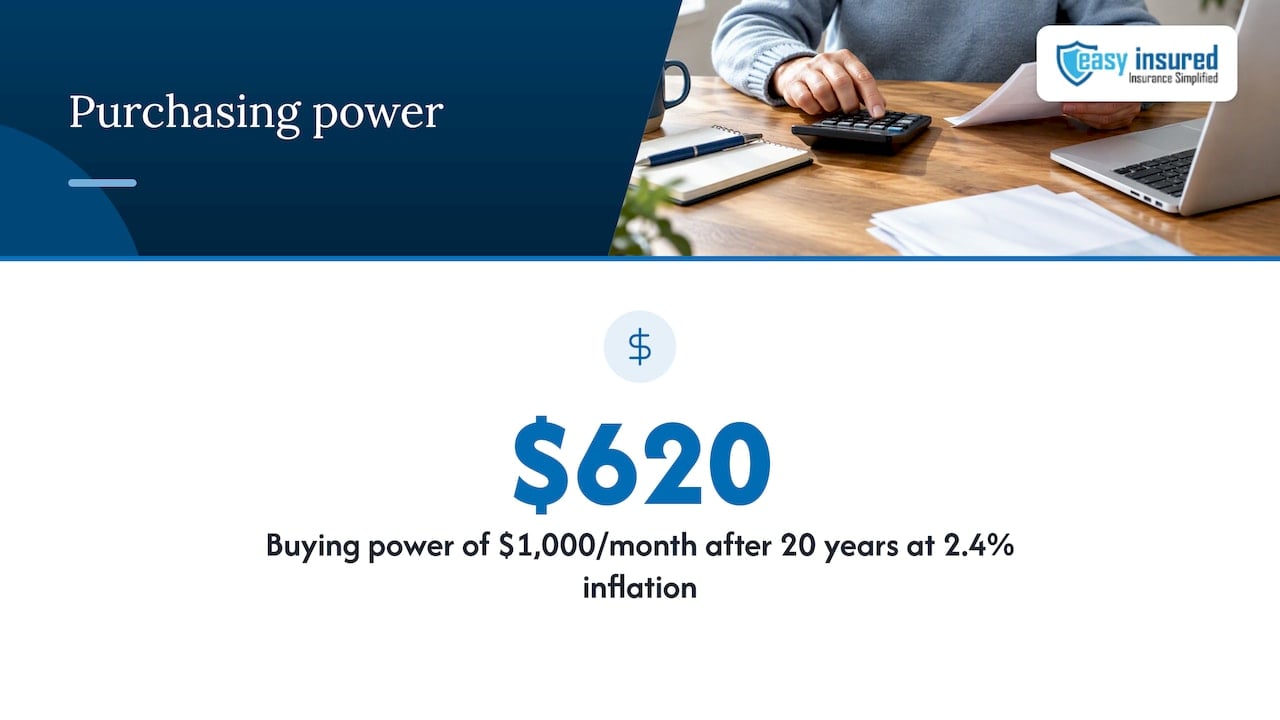
Here is what that looks like. The figures below are an illustration, not a quote. Assume you receive $1,000 a month for 20 years and prices rise 2.4% a year. That rate matches the September 2025 year-over-year CPI increase reported by Statistics Canada, though future inflation will differ. After 20 years, that $1,000 buys about what $620 buys today.
A retiree at 65 could plausibly collect for 25 years or more. The longer the payout, the more the flat-payment problem matters.
What “inflation protection” means in a Canadian annuity
Fully indexed annuities are common in public-sector pensions. In the private Canadian market they are effectively absent, and insurers rarely offer a product that tracks 100% of CPI. What you will usually see falls into three groups.
Fixed annual increase
You choose a percentage, for example 1%, 2% or 3%, and your payment rises by that amount every year, whatever inflation does. It is simple and guaranteed. The risk is that inflation runs above your chosen rate for years.
The tax rules for registered contracts set a ceiling here. For annuities held in a RRIF context, the CRA describes permitted adjustments as CPI-based increases, whole or partial, fixed-rate increases of up to 4% a year, or interest-rate adjustments that approximate market rates.
Capped or partial CPI indexing
The payment follows CPI, but only up to a cap, or only a share of it. In a year when CPI jumps above the cap, you absorb the difference. Over time this can still leave your real purchasing power lower, even though the feature looks like full protection.
No indexing, with a bigger starting payment
Some buyers deliberately skip indexing and take the higher level payment. They plan to spend more early in retirement and cover later inflation from other sources. This is a legitimate strategy when other income is indexed and the annuity is only one layer.
| Feature | Starting payment | Protection against inflation | Main risk |
|---|---|---|---|
| Level payment | Highest | None | Purchasing power erodes every year |
| Fixed yearly increase | Lower | Predictable, not tied to CPI | Inflation can outrun the fixed rate |
| Capped or partial CPI | Lower | Follows CPI up to a limit | Gaps in high-inflation years |
The real cost: a smaller first payment
Indexing is not free. It is paid for by taking less income at the start. The insurer is spreading the same lump sum over a rising stream, so the early payments must be lower.
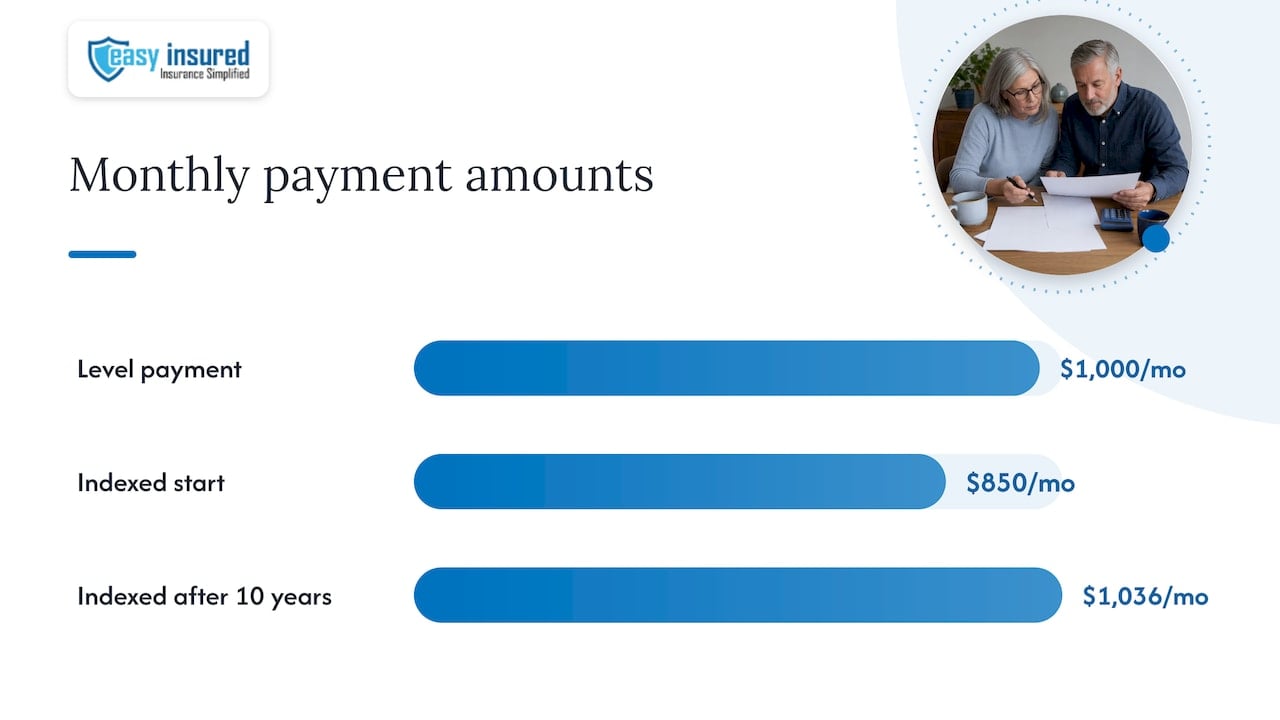
That creates a break-even question. Suppose a level annuity pays $1,000 a month and an indexed one with a 2% yearly increase starts lower, say at $850 (a made-up figure to show the mechanics; real quotes vary by age, sex, insurer, and rates). At 2% growth, the indexed payment would be about $1,036 after ten years. You would have received less in the early years and more in the later ones, and the indexed contract only comes out ahead if you live long enough.
This is why we suggest asking every insurer for two quotes side by side: level, and the indexing option you are considering. Then compare:
- The starting monthly payment for each.
- The year when the indexed payment passes the level one.
- The total received by ages 80, 85 and 90.
- What happens to payments if you die early, including any guarantee period or joint-and-survivor option.
If you are planning for a couple, a joint-life contract with indexing matters more, because the surviving spouse may rely on that income for decades.
Read the contract, because Assuris follows the contract
Canadian life insurers must be members of Assuris, which protects policyholders if an insurer fails. For annuities, the guarantee covers the higher of $5,000 a month or 90% of the promised benefit.
The key detail for inflation: the protection is tied to what your contract says. If the contract has a built-in increase, the protected benefit follows that term. If it has a fixed payment, a fixed payment is exactly what is protected. Assuris cannot add an indexing feature to a contract that does not contain one. So before you buy, make sure the inflation feature is spelled out in the contract wording, not just mentioned in a brochure or a conversation.
Also check the three points that people most often overlook:
- Is the increase automatic every year, or optional?
- Is it a fixed percentage, a CPI link, or a CPI link with a cap?
- Does the increase continue for the survivor under a joint-and-last-survivor option?
Pension plan annuities: conditional is not guaranteed
Many Canadians assume pension indexing is a promise. Often it is conditional. The CAAT Pension Plan, for example, grants yearly increases only if the plan’s funding status meets set thresholds, and it sets its 2026 inflation protection rate at 1.5%. If those conditions are not met in a year, retirees may receive no increase.
The same caution applies when a pension plan itself buys annuities from an insurer. The Office of the Superintendent of Financial Institutions explains that buying annuities for a defined benefit plan can transfer longevity and inflation risk, but it does not remove the sponsor’s responsibility, and the inflation terms are negotiable and need stress testing. For a broader look at the limits of transferring inflation risk when annuities are bought for retirement income, that discussion is worth your time.
If you are leaving a Registered Pension Plan and buying an annuity to carry the benefit, the CRA has a specific rule. Where you cannot find an annuity matching your plan’s full CPI coverage, section 147.4 guidance allows fixed-rate alternatives, such as the midpoint of the Bank of Canada’s inflation-control target range at the date of purchase, or the spread between long-term Government of Canada bond yields and real-return bond yields. Your plan administrator and a licensed advisor should confirm which applies to your situation before you buy.
Let CPP and OAS do part of the work
Your strongest inflation hedge may already exist. CPP and OAS are indexed to CPI, with a guarantee that benefits do not decrease if CPI declines. OAS is adjusted quarterly, while CPP is adjusted each January, according to the Statistics Canada release on CPI.
That changes how to size an annuity. If your essential spending, such as housing, food and utilities, is largely covered by indexed government benefits, a level annuity can fill the gap for fixed costs without needing an expensive indexing feature. If those benefits cover only a small slice, indexing on the annuity becomes more valuable.
A simple way to think about it:
- Layer 1, indexed: CPP and OAS, plus any indexed pension.
- Layer 2, stable: an annuity, level or lightly indexed, covering the remaining essential costs.
- Layer 3, growth: RRIF, RRSP, TFSA or non-registered investments that you can draw on when prices rise faster than expected.
Our pieces on retirement income planning and OAS clawback and on pension splitting for retired couples show how the tax side affects what you keep from each layer.
Tax and structure points that affect indexing
The tax treatment of an annuity depends on whether it is registered or non-registered. Indexing a non-registered annuity can have tax consequences, so ask for a tax review before choosing the feature. Our guide to annuity taxation in Canada lists the documents to gather first.
If you are comparing structures, these two pages help:
- Life annuity vs variable payment annuity, which covers how fees and payment patterns differ.
- Term certain annuities, useful when you need income to run only until a set date, such as when a pension starts.
If you hold a RRIF, the RRIF withdrawal rules matter too, because registered money has minimum annual withdrawals and a different tax timing from a purchased annuity.
Alternatives and complements to an indexed annuity
An indexed annuity is one tool. Others can cover the gap the annuity leaves, each with its own trade-off.
- Keep some growth assets. Equities and real-return holdings can outpace inflation over long periods, but they can fall in value, which a guaranteed annuity does not.
- Segregated funds. These are insurance-company investment contracts, and some include guarantees. Terms vary by contract, so read the guarantee wording closely.
- Stagger your purchases. Buying a second annuity later, at an older age, lets you adjust the amount to what inflation has done in the meantime. Payout rates tend to be higher at older ages, though they also depend on interest rates at the time.
- Hold a cash buffer. A reserve for large or irregular costs reduces how hard you need to push the annuity to do everything.
- Insured retirement strategies. Some families use permanent life insurance as part of retirement and estate planning. Our article on the insured retirement plan explains who it suits.
No single tool wins on every measure. The aim is a mix in which a bad year of inflation, a bad year in markets and a long life do not all hurt you at once.
Our perspective
We see the same pattern in planning meetings. People ask for “an annuity that beats inflation,” and what they need is a plan for the years when inflation is higher than their contract assumes.
Our view is that the annuity should do one job well: pay for the fixed costs you cannot skip. Indexing is worth buying when your indexed income, mainly CPP and OAS, covers little of that. It is worth skipping, or keeping small, when government benefits already cover most essentials and you would rather have the larger starting payment.
We also think the paperwork matters more than the pitch. Ask for the increase rule in writing, ask for the level-payment quote next to it, and do not rely on any feature that is not in the contract language. Your age, your spouse’s age, your health, your tax position and your other income all change the answer, which is why we run the numbers with a certified financial planner before recommending anything. We would rather tell you an annuity is a small part of your plan than sell you a large one.
— Frank
How we can help
If you are weighing an annuity against other retirement income options, our advisors can map your CPP, OAS, pension and savings into one plan and show where inflation exposure sits. Start with our retirement and financial planning services, or explore our investment options if you are building the growth layer. Pricing for planning engagements is discussed with you directly, as we do not publish fees on the site.
FAQ
Can I buy a fully inflation-indexed annuity in Canada?
Private-sector annuities that track 100% of CPI are effectively not available in the Canadian commercial market. What insurers offer is a fixed yearly increase or a partial or capped CPI link. Ask each insurer exactly how the increase is calculated.
Does indexing make my first payment smaller?
Yes. Because the insurer pays more later, it pays less at the start. The size of the reduction depends on your age, the increase rate and the insurer, so request quotes with and without indexing and compare the break-even year.
Does Assuris protect the inflation increases in my annuity?
Assuris protection follows your contract’s terms. If your contract has a built-in increase, the protected benefit follows it. Assuris cannot add indexing to a contract that lacks it, so confirm the wording before you buy.
Are CPP and OAS protected against inflation?
Both are indexed to CPI, and benefits do not decrease if CPI falls. OAS is adjusted quarterly and CPP annually in January, as described in the Statistics Canada release. They are a natural base layer beside an annuity.
Is the fixed yearly increase limited by tax rules?
For registered contracts, the CRA lists fixed-rate increases of up to 4% a year as an allowed mechanism. Check with your advisor which rules apply to your specific plan, because registered and non-registered annuities are treated differently.
Sources
- Statistics Canada, The Daily: Consumer Price Index, September 2025
- Statistics Canada, The Daily: Consumer Price Index, September 2025 (indicator view)
- CRA: Minimum amount from a RRIF
- CRA: Newsletter 20-1, Registered Pension Plan Annuity Contracts
- Assuris: Payout Annuity
- CAAT Pension Plan: Inflation protection
- OSFI: Buying annuity products for pension plans
- Valuing Pensions (Annuities) with Different Types of Inflation Protection
- Society of Actuaries