
A term certain annuity converts a lump sum into fixed, guaranteed payments for a set number of years, not for the rest of your life. If you die before the term ends, the remaining payments go to your named beneficiary or estate, which makes this option well suited to time-bound goals like bridging income until a pension starts or protecting a payout for your heirs.
TL;DR:
- On a $100,000 premium, a term of five years pays about $1,660 monthly, compared with about $430 for 20 years, before rate changes.
- RRSP or RRIF payments are taxed as regular income, while nonregistered payments split into taxable interest and untaxed principal; transfers may trigger withholding tax.
- Registered plan purchases often require payments to end by age 90, and advanced life deferred annuities follow separate age and transfer limits.
- Only insured annuities from licensed Canadian insurers receive Assuris protection, which guarantees 100% of monthly income up to $5,000 and 90% above that threshold.
- Choose a term that ends at your actual pension start date or known expense, and ask whether beneficiaries receive installments or a lump sum.
Table of Contents
- How term certain annuities work and who sets the payment
- Illustrative payout examples: how term length changes your income
- Tax rules that change depending on where your money comes from
- Term certain versus a life annuity: which guarantee fits your goal
- What to check before you buy a term certain annuity
- Where this fits in a retirement income plan
- How we help you compare annuity options
- FAQ
- Sources
How term certain annuities work and who sets the payment
You hand an insurer a lump sum, and in return you receive scheduled payments for a term you choose upfront, often anywhere from 5 to 40 years depending on the contract and the funding source, according to the Government of Canada’s annuity guidance. You might see this product called an annuity certain, a period-certain annuity, a years-certain annuity or a fixed-period annuity: these all describe the same structure.
Two things decide your monthly payment: the size of your premium and the market interest rates in effect when you buy the contract. Because there’s no life contingency involved, your age and gender generally don’t move the price the way they do for a lifetime annuity.
- Lump-sum premium plus prevailing interest rates determine the payment schedule.
- No life contingency means age and gender typically don’t affect the payout.
- Registered-plan purchases often cap the term at age 90 under Canada.ca’s rules.
Illustrative payout examples: how term length changes your income
The shorter the term, the larger each payment, because the same lump sum gets divided over fewer payments. A longer term stretches that same capital across more years, which lowers each check but extends the guarantee.
The table below mirrors the example structure the Government of Canada publishes for a $100,000 non-registered premium. Treat these as illustrative figures, not a quote for your own situation: your actual payment depends on your premium size and the rates available when you buy.
| Term length | Approximate monthly payment on $100,000 |
|---|---|
| 5 years | $1,660 |
| 10 years | $830 |
| 10 years | $540 |
| 20 years | $430 |
Current interest rates at the time of purchase move these numbers up or down. Deposit and interest rate trends tracked by platforms like Fiatmap can give you a sense of the broader rate environment that insurers draw on when pricing a new contract.
Tax rules that change depending on where your money comes from
Where your premium comes from changes how the Canada Revenue Agency taxes your payments. Registered money carries different obligations than money you’ve already paid tax on, and a few special rules apply if you’re funding the annuity from an RRSP or RRIF.
- Annuities bought with RRSP or RRIF funds are taxed as regular income when each payment arrives, per Canada.
- Non-registered annuities split each payment into return of principal, which isn’t taxed, and interest, which is.
- An advanced life deferred annuity (ALDA) lets you move registered funds into a deferred annuity under specific age and transfer limits set by the CRA.
- Transfers from certain registered plans can trigger withholding tax, so confirm the exact treatment with a tax adviser before you move funds.
Before you sign anything, it’s worth gathering the right tax documents so your adviser can confirm how a specific purchase will be taxed.
Term certain versus a life annuity: which guarantee fits your goal
A term certain annuity and a life annuity solve different problems, even though both convert savings into income. Term certain guarantees payments for a fixed number of years and protects a payout for your beneficiary if you die early. A life annuity guarantees payments for as long as you live, which protects against outliving your savings but usually pays less per month and nothing to an estate once you’re gone.
- Term certain fits a bridge need, such as covering the years before government benefits or a pension start.
- A life annuity fits longevity protection, when your real concern is running out of money late in life.
- Term certain preserves a guaranteed estate payout; a life annuity generally does not.
- Insured annuities from a licensed Canadian insurer are protected by Assuris, which guarantees at least 100% of monthly annuity income up to $5,000 and 90% above that threshold if the insurer fails, according to FSRA guidance.
Some decumulation products marketed alongside annuities aren’t actually insured annuities and don’t carry that same protection, so it’s worth confirming exactly what you’re buying before you commit.
What to check before you buy a term certain annuity
A term certain annuity is a contract with several moving parts, and small differences between insurers can change what your beneficiary receives or how much flexibility you have later. Walk through this checklist before you sign.
- Confirm which term lengths the insurer offers and whether they match your actual deadline.
- Ask whether your beneficiary can receive remaining payments as continuing installments or as a lump sum.
- Review the surrender or commutation terms in case you need to exit the contract early.
- Verify the insurer is licensed and covered by Assuris.
- Request full disclosure of fees or commissions built into the quote.
- Clarify the tax treatment if you’re funding the purchase with RRSP or RRIF money.
Pro Tip: Match your term to the specific date you need to cover, like a pension start date or a known expense, rather than defaulting to a round number like 10 or 20 years.
Ask directly whether remaining payments can be paid out as a lump sum on death, how the insurer calculates your specific payment, and what happens to your money if the insurer becomes insolvent.
Where this fits in a retirement income plan
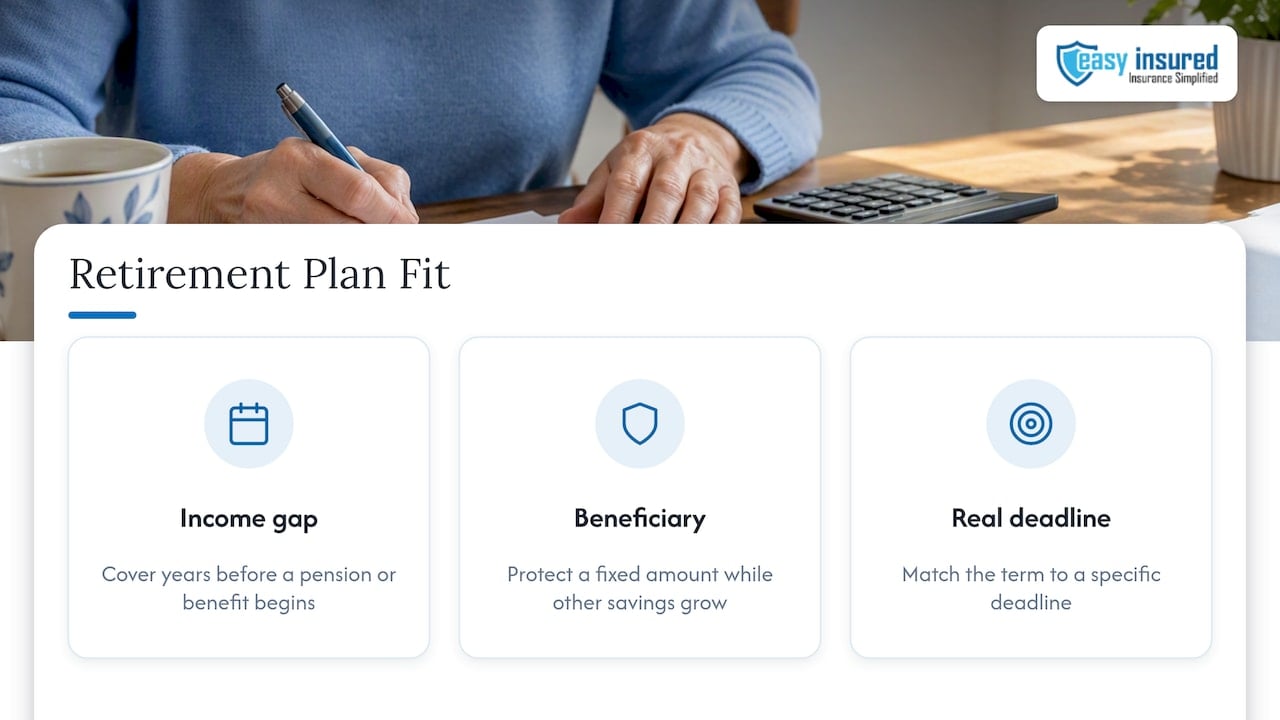
A term certain annuity rarely stands alone. We typically see it used alongside other guaranteed income sources to cover a specific gap, such as the years between early retirement and when a pension or benefit begins, or to protect a fixed amount for a beneficiary while other savings keep growing. Matching the term to a real deadline, rather than a comfortable-sounding number, is usually what separates a useful contract from an overpriced one.
A client review typically starts with your existing documents: current annuity or RRIF statements, a list of your fixed expenses during the gap you’re trying to cover, and any beneficiary designations already on file. From there, the conversation moves to whether a term certain annuity, a life annuity or a blend of both actually fits the timeline you’re planning around.
A guarantee is only as useful as the deadline it’s built to match.
— Frank
How we help you compare annuity options
Choosing between a term certain annuity, a life annuity and other retirement income tools usually comes down to your specific timeline and tax situation, and getting that match right matters more than the headline payment number. Our retirement and estate planning services are built to walk through that comparison with you rather than leave you reading rate tables alone.

A first review typically covers a document checklist (your statements, beneficiary designations and any registered-plan balances), a clear list of your income goals and deadlines, and an early flag on any tax issues tied to RRSP or RRIF transfers. From there we can also look at how an annuity fits alongside broader retirement income planning, including steps to manage OAS clawback exposure.
- It is helpful to line up term length against your actual deadlines, not a generic default.
- Registered-plan tax consequences should be flagged before you commit funds.
- Annuity decisions should be connected to your wider estate and retirement plan.
If you’re ready to talk through your options, reach out through our services page to set up a review.
This article is general information, not a substitute for advice from a qualified financial advisor. Consult a qualified financial professional about your own circumstances before acting on anything here.
FAQ
What does the term annuity period refer to?
The term annuity period is the fixed number of years you choose at purchase during which the insurer guarantees your payments, commonly ranging from 5 to 40 years depending on the contract, according to Canada.ca. Payments stop once that period ends, regardless of whether you’re still alive.
What is the maximum age at which I can buy an annuity?
There’s no single maximum age for buying a term certain annuity itself, but registered-plan purchases often limit the term so payments end by age 90, under rules described by Canada.ca. Advanced life deferred annuities carry their own separate age and transfer limits set by the CRA.
How long is a fixed term annuity?
A fixed term, or term certain, annuity can run anywhere from a few years to several decades, with terms up to 40 years available in some contracts according to Canada.ca. The right length depends on the specific gap or deadline you’re trying to cover, such as a pension start date.
Are annuities better than stocks?
Annuities and stocks solve different problems: an annuity guarantees fixed payments for a set period or for life, while stocks offer growth potential with no income guarantee. A term certain annuity is generally a better fit when you need predictable income to cover a known deadline, while stocks suit longer-term growth goals that can tolerate market swings.
Sources
- Annuities – Government of Canada (Financial Consumer Agency of Canada)
- Canada
- Understanding Decumulation Products – Financial Services Regulatory Authority of Ontario (FSRA)