
Start with the Canadian Retirement Income Calculator, pull your CPP and OAS estimates, and add in your RRSP, TFSA, and workplace pension balances. Aim for roughly 60–80% of your pre-retirement income as your target, then run at least two or three scenarios that test different CPP start ages and withdrawal orders. Do this before you decide anything else, because timing and sequencing choices you make now can swing your lifetime after-tax income by tens of thousands of dollars.
TL;DR:
- Most retirement income in Canada can be optimized by testing different CPP start ages and withdrawal sequences before deciding on the final plan.
- Running at least three scenarios for CPP start ages (60, 65, 70) can reveal significant income differences and impact OAS clawback exposure.
- The recommended withdrawal order is non-registered first, then TFSA, followed by RRSP or RRIF, but adjustments are advisable if RRSP balances are large.
- Delaying CPP and OAS payments increases lifetime benefits, but timing must be balanced against clawback thresholds and personal health factors.
- Using government tools alongside a detailed spreadsheet and considering insurance options helps create a resilient, personalized retirement plan.
Table of Contents
- How Do You Estimate Retirement Income Planning in Canada?
- What’s the Best Order to Withdraw Retirement Accounts?
- When Should You Start CPP and OAS to Maximize Income?
- How Much Retirement Income Do You Actually Need?
- Your Retirement Income Planning Checklist
- How Do Inflation and Investment Returns Change Your Projections?
- Should Couples Split Pension Income in Retirement?
- How guaranteed income and insurance fit into your retirement plan
- How Easy-insured Helps You Turn Projections Into a Real Plan
- Sources
- FAQ
How Do You Estimate Retirement Income Planning in Canada?
Retirement income planning in Canada starts with three government tools, not a guess. The Canadian Retirement Income Calculator is the recommended starting point because it pulls together CPP, OAS, and your own savings into a single projected monthly figure. Pair it with the OAS benefits estimator and the Benefits Finder tool, which flags provincial and federal programs you might qualify for beyond the basics.
Before you open any calculator, gather these documents:
- Your CPP Statement of Contributions (available through your My Service Canada Account)
- OAS residence history if you’ve lived outside Canada for any stretch of adulthood
- Current RRSP and TFSA balances, plus contribution room remaining
- A workplace pension statement showing accrued value or annual benefit
- Non-registered investment account totals and their adjusted cost base
- Your anticipated retirement age and, if married, your spouse’s expected income
Once you have those numbers, run at least three scenarios: CPP starting at 60, at 65, and at 70. For each one, compare projected monthly income, your replacement rate against current earnings, and how close you land to the OAS clawback threshold. The differences between these scenarios are often bigger than people expect, especially once you factor in how deferred CPP compounds over a decade.
Pro Tip: Build a simple spreadsheet that logs your assumptions, inflation rate, expected investment return, and life expectancy, alongside each scenario’s output. Revisit it every year, because a small change in your RRSP balance or a new pension statement can shift your entire withdrawal plan.
What’s the Best Order to Withdraw Retirement Accounts?
The default sequencing most planners recommend is non-registered accounts first, then TFSA, then RRSP or RRIF last. The logic is straightforward: non-registered accounts get taxed on growth every year anyway, so draining them first stops the tax bleeding early, while TFSA and RRSP assets keep compounding tax-sheltered as long as possible.
That said, this order isn’t universal. Some retirees benefit from flipping it, especially if they have a large RRSP relative to their income needs.
- Draw non-registered assets first to stop annual taxable growth and preserve tax-sheltered room elsewhere.
- Consider an RRSP meltdown if your RRSP balance is large. This means withdrawing more than the minimum in your 60s, before OAS and mandatory RRIF minimums kick in, to smooth out your tax bracket over more years rather than facing a wall of taxable income in your 70s and 80s.
- Hold TFSA withdrawals for flexibility, using them in years when you need extra cash without triggering clawback exposure, since TFSA withdrawals never count as income for OAS or GIS calculations.
- Reassess RRIF minimums annually, since the mandatory withdrawal rate rises with age and can eventually push you into a higher bracket regardless of your spending needs.
Dynamic withdrawal approaches, where you adjust the percentage based on portfolio performance each year, tend to hold up better against sequence-of-returns risk than a static formula. Decumulation planning is genuinely more complex than saving for retirement, and modelling more than one sequence before you commit is worth the afternoon it takes.
Pro Tip: Stress-test your withdrawal plan against a market downturn in your first five retirement years. A 20% portfolio drop right after you stop working does far more damage than the same drop a decade in, because there’s no paycheck left to absorb it.
When Should You Start CPP and OAS to Maximize Income?
That adds up to a significant gap between the earliest and latest start dates. The commonly cited breakeven age, where total lifetime CPP payments from deferring catch up to starting early, lands somewhere around 80 to 82, depending on your health, other income, and how the money would have been invested otherwise.
OAS works on a similar deferral logic: delaying past 65 boosts your monthly payment for every month you wait, up to age 70. The catch is the OAS recovery tax, often called the clawback, which reduces your OAS once your net world income crosses a set threshold.
The OAS clawback mechanic: Once your net world income exceeds the annual threshold, Canada.ca reduces your OAS payment by 15 cents for every dollar above that line, and if your income climbs high enough, your OAS can be reduced to zero. The exact dollar threshold is indexed and changes each year, so check the current figure on Canada.ca before you finalize any withdrawal plan.
A few practical moves reduce clawback exposure:
- Time large RRIF withdrawals for lower-income years rather than bunching them
- Lean on TFSA withdrawals in years when you’re close to the threshold
- Split eligible pension income with a lower-earning spouse to bring both incomes under the line
- Consider deferring CPP if you’re still working past 65, since the extra income could otherwise trigger clawback anyway
How Much Retirement Income Do You Actually Need?
The standard benchmark most planners use is 60% to 80% of your pre-retirement income, and where you land in that range depends heavily on whether your mortgage is paid off, how much you expect to spend on health care, and whether you want to leave an inheritance.
A rough sense of scale helps here. A moderately sized portfolio, drawn conservatively at about a low single-digit percentage annually, generates an income amount before tax that supplements CPP and OAS. Adding these benefits, a couple with a large savings portfolio can often target a moderate total household income before tax, though actual numbers vary depending on contribution history and residency.
A few factors consistently push the target higher than the standard range; understanding options like insurance and funding for medical equipment can also influence how you plan for anticipated health costs.
- Carrying a mortgage or other debt into retirement
- Anticipated health costs, including long-term care
- A goal of leaving a meaningful legacy to children or a charity
- Longer-than-average life expectancy in your family history
Your Retirement Income Planning Checklist
Turning estimates into an actual plan comes down to four steps, done in order.
- Gather your statements. Pull your CPP Statement of Contributions, OAS eligibility details, workplace pension statement, and current RRSP/TFSA/non-registered balances.
- Run the numbers twice. Use the Canadian Retirement Income Calculator for a government-grade estimate, then build or use a spreadsheet to model two or three withdrawal sequences side by side.
- Compare the outputs. Look at after-tax income in each scenario, how close each one pushes you to OAS clawback, and what your RRIF minimums will look like once you turn 71.
- Decide your next move. If your situation is straightforward, one income source, no spouse, modest savings, you may be comfortable managing this yourself. If you’ve got a business, a large RRSP, blended income sources, or estate concerns, a certified financial planner earns their fee here.
Pro Tip: If you do book a planning session, bring your actual account statements rather than round-number estimates. A planner working from your real RRSP balance and real CPP statement can catch clawback risk or sequencing errors that a back-of-napkin conversation would miss entirely.
How Do Inflation and Investment Returns Change Your Projections?
Every retirement projection rests on two assumptions you don’t control: how fast prices rise and how well your investments perform. Get either one wrong by even a percentage point, and a 25 or 30 year retirement plan can look very different by year 15.
A retiree who assumes 2% inflation but experiences 4% for a stretch, as many did in recent years, can find their fixed withdrawal buying noticeably less than planned within a decade.
Investment return assumptions carry similar risk in the opposite direction. This is why serious retirement models don’t use a single fixed return; they test a range, often running a conservative case, a moderate case, and an optimistic case side by side. If your plan only survives under the optimistic assumption, it isn’t a plan yet. It’s a hope.
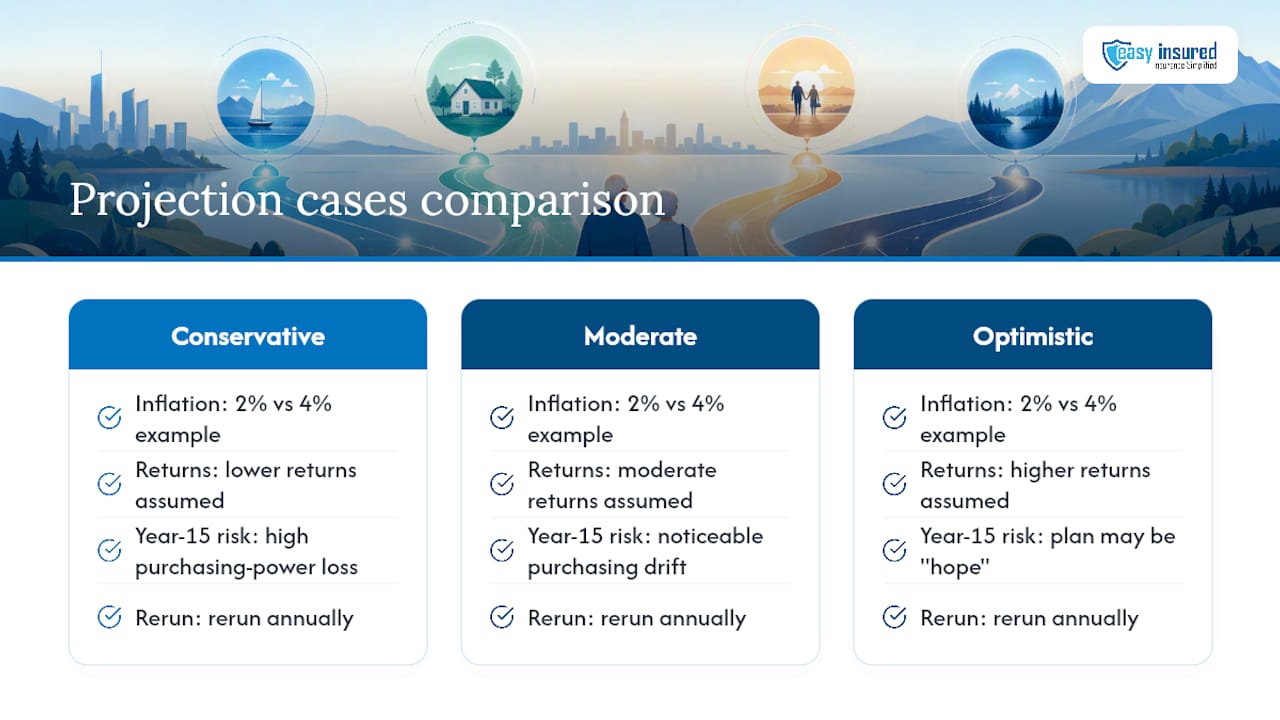
Rerunning your projections annually with updated inflation and return figures, rather than trusting a projection built five years ago, catches these drifts before they become a real problem.
Should Couples Split Pension Income in Retirement?
If one partner is in a much higher tax bracket than the other, this single move can save thousands of dollars a year by shifting income to the lower-earning spouse’s bracket.
Pension income splitting also interacts directly with the pension income credit, a modest but real tax credit available on the first portion of eligible pension income for anyone 65 or older, or in certain cases earlier, if the income comes from a qualifying pension. A couple where only one spouse has pension income can effectively double up on this credit by splitting income so both partners each claim their own portion.
Timing matters too. Spousal RRSP contributions made years before retirement, structured so the higher earner contributes to a plan the lower earner will eventually draw from, can achieve a similar income-smoothing effect, though attribution rules mean the contributions need to sit for a few years before withdrawal to avoid being taxed back to the contributing spouse. For couples with a meaningful income gap heading into retirement, reviewing both pension splitting and spousal RRSP structure with a planner before the RRIF conversion deadline hits at 71 is worth the conversation.
How guaranteed income and insurance fit into your retirement plan
Government calculators tell you what your income will likely be. They don’t tell you what happens if markets drop the year you retire, or if a health event forces an early, unplanned withdrawal. That’s where insured products earn their place in a retirement plan rather than sitting on the sidelines as an afterthought.
Annuities and segregated fund contracts can convert a portion of savings into a guaranteed income floor, which takes pressure off your market-based withdrawals during a downturn. Disability and critical illness coverage protect the accumulation phase itself. Someone who has to raid an RRSP at 55 because of a serious illness has permanently changed their retirement math. On the estate side, beneficiary designations and probate planning directly affect how efficiently your RRIF, TFSA, and non-registered assets pass to your family, and that efficiency is part of decumulation planning, not a separate conversation that happens after you’ve already drawn down everything.
— Frank
How Easy-insured Helps You Turn Projections Into a Real Plan
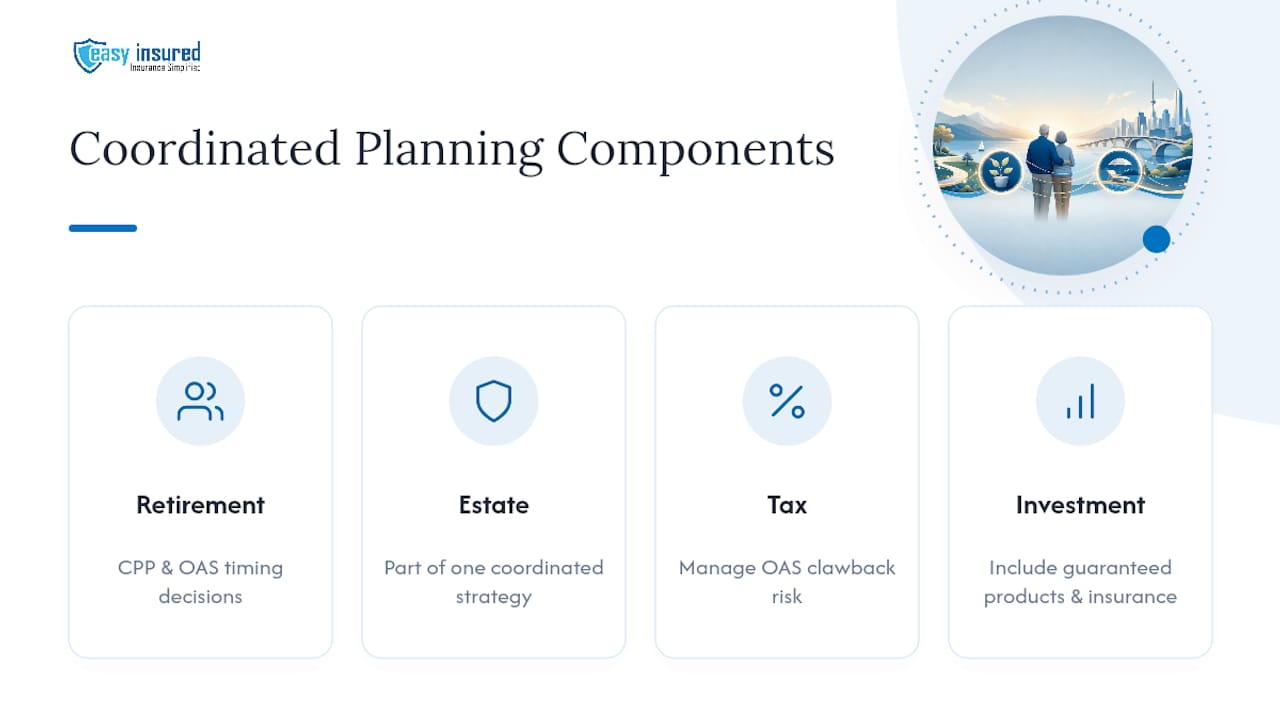
Running the government calculators gets you an estimate. Turning that estimate into a plan that survives a market downturn, a health scare, or an OAS clawback surprise usually takes a second set of eyes. Easy-insured works with Canadian families and business owners on exactly that gap, combining retirement planning, estate planning, tax planning, and investment planning into one coordinated strategy rather than treating each piece separately.

If part of your retirement income depends on guaranteed products or insurance protecting your savings from an early drawdown, that’s also part of the conversation. Whether you need a term life policy to protect a mortgage during your accumulation years or disability insurance to keep an illness from derailing your RRSP, those pieces belong in the same plan as your CPP and OAS timing decisions, not bolted on later. Book a consultation through the services page and bring your CPP statement, RRSP balance, and retirement age target. That’s enough to start a real, numbers-based conversation.
This article is general information, not a substitute for advice from a qualified financial advisor. Consult a qualified financial professional about your own circumstances before acting on anything here.
Sources
Every dollar you pull from a registered account, RRSP or RRIF, gets added to your taxable income for that year, taxed at your marginal rate just like employment income was. CPP and OAS are also fully taxable. TFSA withdrawals sit outside this system entirely; they’re tax-free and don’t touch your taxable income line at all, which is why they’re such a flexible tool in years when you’re trying to stay under the OAS clawback threshold.
Non-registered accounts get gentler treatment. Only 50% of capital gains get taxed, dividends from Canadian corporations receive a dividend tax credit that lowers their effective rate, and interest income is taxed fully but only on what you earn, not your original deposit.
This mix creates real planning opportunities. If you’re in a low-income year, perhaps the gap between when you retire and when CPP or a workplace pension kicks in, that’s often the cheapest window you’ll ever have to withdraw from an RRSP. Pulling money out while you’re in a lower bracket, rather than waiting until mandatory RRIF withdrawals force your hand in your mid-70s, can meaningfully lower your lifetime tax bill. The reverse mistake, letting an RRSP balloon untouched until 71, often creates exactly the high-income, high-clawback situation retirees are trying to avoid. Coordinating withdrawal timing with your marginal tax bracket, rather than pulling a flat amount every year, is one of the more underused levers in Canadian retirement planning.
- Canadian Retirement Income Calculator
FAQ
What Is the $1,000 a Month Rule for Retirees?
It’s a simplified planning heuristic, not a formal government benchmark, and it doesn’t account for CPP, OAS, or your personal tax situation, so treat it as a starting conversation, not a target.
How Many Canadians Have $1,000,000 Saved at Retirement?
A relatively small share of Canadian retirees reach a very large savings portfolio, since most rely on a combination of CPP, OAS, workplace pensions, and personal savings rather than a single large portfolio. The government’s own guidance stresses that public pensions provide a base, not full replacement income, which is exactly why blending sources matters more than hitting one savings number.
What Is a Good Monthly Retirement Income in Canada?
A couple with combined CPP, OAS, and modest savings might target $4,000 to $6,000 a month, while someone with a paid-off home and lower expenses might need considerably less.
How Long Will $500,000 Last in Retirement in Canada?
Combined with CPP and OAS, that portfolio often supports a modest but workable retirement, though longevity, health costs, and investment returns all shift that timeline in either direction.
Should I Take CPP at 60 or Wait Until 70?
Taking CPP at 60 gives you income sooner but permanently reduces your monthly payment, while waiting until 70 maximizes it. The breakeven point, where total lifetime payments from waiting catch up to starting early, typically falls around age 80 to 82, so your decision should weigh your health, family longevity, and whether you need the income sooner rather than later.