
Whether an annuity payment is fully taxable or only partly taxable in Canada depends on how it was funded and how the contract is classified. Registered-plan annuities, built with RRSP, RRIF, or pension money, are generally fully taxable when received. Non-registered annuities split each payment into taxable interest and non-taxable return of capital, with the split determined by prescribed or non-prescribed rules. Either way, expect a T4A, T4RIF, or T5 slip, and check whether pension-income splitting helps your household.
TL;DR:
- Fully registered-plan annuity payments are taxed as employment income because they are considered a continuation of the original registered savings.
- Non-registered annuities split each payment into tax-free return of capital and taxable interest, with the exact split depending on contract type, age, guarantee period, and interest rates used.
- Prescribed non-registered annuities spread taxable interest evenly over payments, while non-prescribed contracts tax interest as earned, often resulting in higher early-year taxable income.
- Annuity income reporting varies by slip type, and the withholding tax applied is only an estimate; total tax liability depends on your overall income and deductions.
- Confirm each annuity’s classification and payment details with your insurer before buying to avoid unexpected tax surprises at year-end.
Table of Contents
- How Registered and Non-Registered Annuities Are Taxed
- Prescribed vs. Non-Prescribed Taxation Rules
- Which Tax Slips and Return Lines Report Your Annuity Income
- RPP Annuity Rules Under Section 147.4
- Pension-Income Splitting and Household Tax Effects
- What to Ask Your Insurer Before You Buy
- What Happens to an Annuity’s Tax Treatment After Death
- How Inflation Indexing Changes the Tax Math
- Foreign Annuities and Canadian Tax Residents
- Frank’s Practical Perspective: Where Clients Actually Go Wrong
- Getting Tax-Aware Advice Before You Buy an Annuity
- Sources
- FAQ
How Registered and Non-Registered Annuities Are Taxed
The tax treatment splits along one line: where did the money come from before it bought the annuity?
Annuities funded with RRSP, RRIF, or registered pension plan (RPP) money are treated as continuations of those registered savings. The Canada Revenue Agency’s annuity guidance confirms that once payments start, the full amount is generally included in income for the year received, just like a pension check. There’s no capital portion to carve out, because the capital was never taxed going in.
Non-registered annuities work differently. You bought this one with money that already had tax paid on it, so the CRA doesn’t tax the whole payment again. The Financial Consumer Agency of Canada explains that each payment blends three things: return of your original capital, interest the insurer credits you, and a mortality pooling factor from other annuitants in the pool. Only the interest piece gets taxed.
Picture a non-registered annuity paying monthly amounts, part of which is your capital returning tax-free, and part is taxable interest. The exact split depends on:
- Whether the contract is prescribed or non-prescribed
- Your age and the guarantee period at purchase
- Current interest rates baked into the original pricing
That’s the piece most people miss when they see one “annuity payment” number and assume it’s all taxable, or worse, assume none of it is.
Prescribed vs. Non-Prescribed Taxation Rules
Non-registered annuities fall into one of two tax buckets, and the difference changes how much tax you owe in the early years versus later ones.
- Prescribed annuity contracts spread the taxable interest evenly across every payment for the life of the contract, so your reported income barely moves year to year. Income Tax Regulations, section 304 sets the qualifying conditions: payments have to be equal (or follow an approved indexing formula), and there are limits on guaranteed terms and payment frequency.
- Non-prescribed contracts, sometimes called accrual-based, tax the interest as it’s earned inside the contract rather than spreading it evenly. That usually front-loads the taxable portion into the early years, when the insurer’s internal interest crediting is highest relative to the shrinking capital balance.
The practical effect shows up at tax time and at benefit-review time. A non-prescribed contract can push more income into your return in years three through seven than a prescribed contract would, which matters if you’re close to an Old Age Security clawback threshold or an income-tested benefit cutoff.
Pro Tip: Ask the issuer directly whether your contract meets the section 304 conditions for prescribed treatment. Don’t assume it’s prescribed just because it pays a level amount. Some level-payment contracts still fail the technical test.
Which Tax Slips and Return Lines Report Your Annuity Income
Annuity income doesn’t show up as one universal line item. It depends on the slip the issuer sends you.
- T4A, box 024: used for specified annuity amounts, common with non-registered prescribed contracts.
- T4RIF, boxes 16 and 22: used when the annuity was purchased inside a RRIF structure.
- T5, box 19: used for certain accrued interest amounts on non-prescribed contracts.
- NR4: issued instead of the above if you’re a non-resident of Canada receiving Canadian annuity income.
On your return, most annuity income lands on line 11500 (other pensions and superannuation), with the pension-income amount credit calculated separately and any elected pension-income splitting reflected on line 21000 for the transferring spouse and line 11600 for the receiving spouse. Line 31400 captures the federal pension-income amount, a small but real credit worth claiming.
Here’s the part people get wrong: the tax withheld at source on your slip is not your final tax bill. It’s a rough estimate the issuer applies. Your actual liability depends on your total income for the year, your province or territory’s rate, and every credit and deduction you’re entitled to. Reconcile the two before assuming you’re square with the CRA.
RPP Annuity Rules Under Section 147.4
Annuities bought with registered pension plan money follow a distinct set of rules under section 147.4 of the Income Tax Act. When your RPP entitlement converts into an annuity that satisfies this provision, the acquisition itself isn’t a taxable event. You’re not deemed to have received a lump sum just because your pension changed form. Payments as they come in are treated as ordinary RPP benefits, taxed the same way a monthly pension check would be.
The catch: if that annuity contract is later materially altered, commuted, or exchanged for a different product, the change can trigger a deemed receipt. That means the CRA may treat you as having received the full commuted value in that year, all at once, as taxable income. CRA’s technical folio on pension benefits treats these acquisitions under separate rules from a straightforward personal annuity purchase, and the distinction matters.
Before swapping a pension entitlement for an annuity, or before amending one you already hold, get the plan documentation and confirm with a tax professional that the change won’t be read as a deemed disposition. This isn’t a spot to guess.
Pension-Income Splitting and Household Tax Effects
Married and common-law couples can split eligible pension income, including many annuity payments, using Form T1032. Up to 50% of eligible pension income can be allocated from one spouse’s return to the other’s, on paper only, no money actually changes hands.
Done right, this can lower the household’s combined tax bill by moving income from a higher bracket to a lower one. Done without checking the math, it can backfire.
- Splitting raises the receiving spouse’s net income, which can trigger or increase OAS repayment for that spouse if they’re near the clawback threshold.
- It can also change eligibility for income-tested credits like the GST/HST credit or age amount.
- The CRA’s own guidance notes splitting decisions should be modeled at the household level, not assumed automatically beneficial.
Run both scenarios, split and unsplit, before filing. Tax software usually does this automatically, but double check it against your actual OAS and credit thresholds rather than trusting the default.
What to Ask Your Insurer Before You Buy
A few pointed questions before signing an annuity contract can save you a confusing tax season later.
- Get the tax classification in writing. Ask specifically whether the contract is registered or non-registered, and if non-registered, whether it’s prescribed or non-prescribed under section 304.
- Confirm the slip type and box number you’ll receive each year, T4A, T4RIF, or T5, and ask for a sample slip if the issuer has one.
- Request an illustration that separates the taxable interest portion from the return-of-capital portion for a typical payment year.
- Nail down guarantee terms: indexing provisions, survivor benefit options, and any commutation rights, since altering these later can change the tax outcome.
Pro Tip: Keep every contract page and illustration you receive, even the ones that seem redundant. If a discrepancy shows up between what the insurer reports and what you expected, those documents are your first line of defense.
What Happens to an Annuity’s Tax Treatment After Death
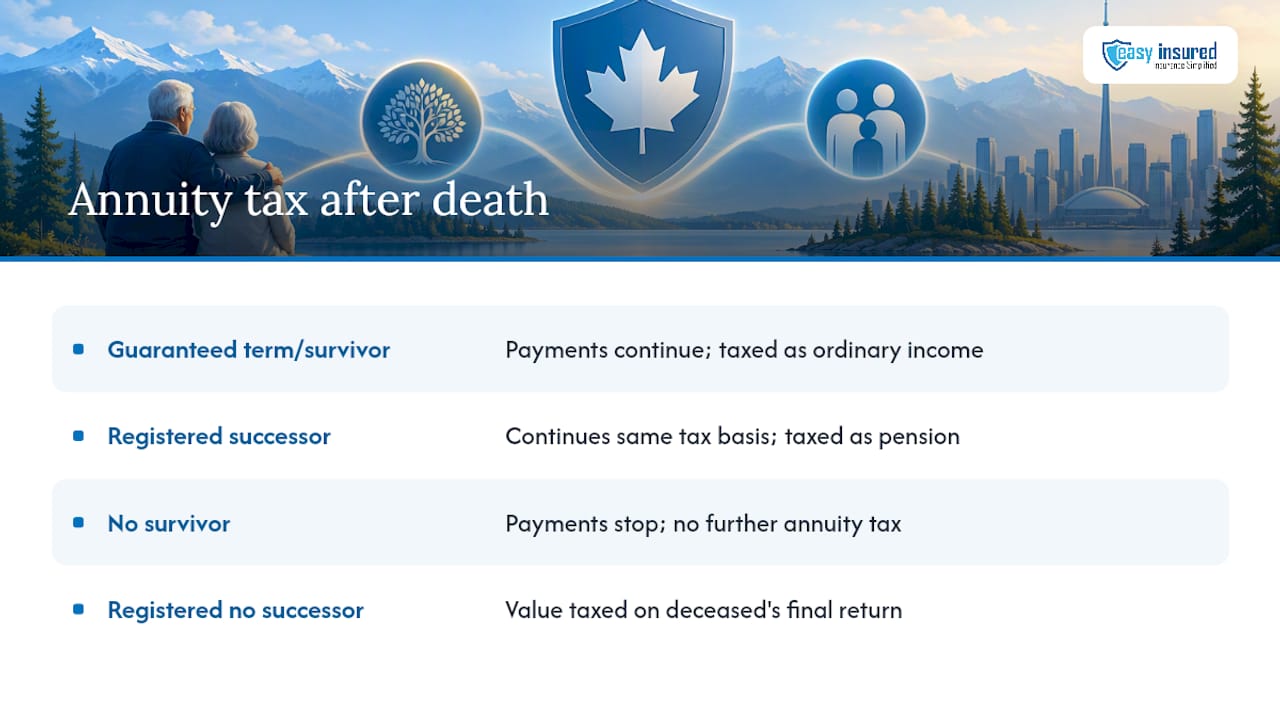
Death doesn’t automatically end an annuity’s tax obligations, and what happens next depends heavily on the guarantee structure chosen at purchase.
If the annuity had a guaranteed term or a survivor benefit built in, payments typically continue to a named beneficiary or spouse, taxed to that person the same way they would have been taxed to the original annuitant, as ordinary income on the applicable slip. A registered-plan annuity passing to a surviving spouse who is named as a successor annuitant usually continues on the same tax basis, with payments taxed as pension income to the survivor going forward.
If there was no survivor benefit and no remaining guarantee period, payments simply stop, and there’s often no further tax consequence tied to the annuity itself.
Where things get more complicated is with registered-plan annuities that don’t have a qualifying successor structure. Depending on how the RPP or RRIF-derived annuity was set up, the value can be included in the deceased’s final tax return as income in the year of death, similar to how an unmatured RRIF gets taxed on death absent a qualifying survivor. This is exactly the kind of detail that needs plan documentation, not assumptions, because the outcome varies by contract wording and by whether a spouse or dependent was named correctly at setup. Anyone holding a registered annuity should confirm survivor designations well before this becomes an issue, and coordinate that review with broader estate planning to avoid an unpleasant surprise for the estate or the surviving spouse.
How Inflation Indexing Changes the Tax Math
Indexed annuities, ones where payments rise over time to track inflation, complicate the tax picture more than people expect.
For prescribed non-registered contracts, section 304 allows certain approved indexing formulas without disqualifying the contract from prescribed treatment. That means the interest portion can still be spread relatively evenly, even as the total payment grows. But the indexing formula has to match what the regulations permit, an insurer using an unapproved escalation method risks bumping the contract into non-prescribed territory, which changes the taxable proportion of every payment going forward.
For registered-plan annuities, indexing doesn’t change the basic rule, the whole payment is taxable regardless of whether it’s flat or rising with inflation. The practical issue there isn’t the tax rate on the payment itself, it’s that a growing payment stream steadily increases your taxable income over the years, which can eventually push you into a higher bracket or closer to the OAS clawback threshold, even though your purchasing power hasn’t actually improved much.
Either way, indexing is a trade-off between guaranteed protection against inflation and a starting payment that’s meaningfully lower than a flat annuity would offer. That trade-off deserves the same scrutiny as the choice between guaranteed income and market-linked growth, where flexibility and certainty pull in opposite directions.
Foreign Annuities and Canadian Tax Residents
Canadian residents owe tax on their worldwide income, and that includes annuity payments from a foreign insurer, a US annuity, a UK pension annuity, or any other cross-border product.
The CRA doesn’t care where the contract was issued. If you’re a Canadian tax resident, foreign annuity income generally gets reported on your Canadian return the same way domestic annuity income would, typically on line 11500 as other pension income, converted to Canadian dollars at the exchange rate in effect when received. The catch is that foreign annuities rarely arrive with a T4A or T4RIF slip. You’re often responsible for tracking and reporting the income yourself, based on statements from the foreign issuer.

Foreign withholding tax adds another layer. Many countries withhold tax at source on payments to non-residents, and Canada’s tax treaties with countries like the United States and the United Kingdom can reduce that withholding rate or allow a foreign tax credit on your Canadian return to avoid double taxation. Whether a specific treaty applies, and at what rate, depends entirely on the country and the type of annuity involved, so this isn’t a place to generalize. Anyone receiving or considering a foreign-sourced annuity should get a qualified tax professional to review the specific treaty provisions before assuming the domestic rules apply cleanly.
Frank’s Practical Perspective: Where Clients Actually Go Wrong
Most tax mistakes I see with annuities aren’t complicated. They’re basic misunderstandings that a five-minute conversation with the issuer could have prevented.
The biggest one: confusing the tax withheld on a slip with the actual tax owed.
The second biggest: electing pension-income splitting without testing what it does to OAS clawback or credits. Splitting isn’t automatically good. Model both scenarios first.
My honest advice: verify the tax classification in writing before you buy, ignore glossy marketing language, and ask for a sample slip. If you’re touching an RPP conversion, a large lump-sum purchase, or you’ve got cross-border residency questions, that’s when you bring in a tax professional or a certified financial planner, not after you’ve already signed.
— Frank
Getting Tax-Aware Advice Before You Buy an Annuity
Advisory services often help clients match annuity structures to the tax outcome they want, beyond just the payment number that looks biggest on paper.

Our retirement planning service starts with the paperwork most people skip: your existing contract draft, any tax slips from prior years, and your pension statements if an RPP is involved. From there, a certified financial planner walks through whether a prescribed or non-prescribed structure fits your situation, how pension splitting would affect your household once OAS is factored in, and what documentation to request from the issuer before you sign anything. This is one option among qualified advisers, and we’d encourage you to compare written contract terms regardless of who you work with. If you want a second set of eyes on an annuity quote or an existing contract, book a consultation with our team and bring your documents. We’ll walk through the tax mechanics together before you commit to anything.
This article is general information, not a substitute for advice from a qualified financial advisor. Consult a qualified financial professional about your own circumstances before acting on anything here.
Sources
FAQ
How Much Tax Do I Pay on Annuity Income?
It depends on the funding source. Registered-plan annuity income is generally fully taxable at your marginal rate, while non-registered annuities tax only the interest portion, with the CRA determining the split based on prescribed or non-prescribed rules.
What Is the Biggest Disadvantage of an Annuity?
The most cited drawback is loss of flexibility. Once you annuitize, your capital is generally locked into a fixed payment stream, and you give up the ability to access a lump sum or adjust to changing needs the way you could with investment-linked products.
How Much Does a $100,000 Annuity Typically Pay Per Month in Canada?
There’s no single typical figure. Payout depends on your age, sex if the issuer uses it in pricing, whether it’s a single or joint life design, the guarantee period, indexing choices, and current market rates when you buy, so getting a personalized quote matters more than any published average.
Do I Have to Pay Tax on an Annuity?
In most cases, yes, some portion is taxable. Registered-plan annuities are fully taxable, and non-registered annuities are partly taxable on the interest component, reported on a T4A, T4RIF, or T5 slip depending on the contract.