
You must convert your RRSP into a RRIF (or another eligible retirement income option) no later than December 31 of the year you turn 71, and your first minimum withdrawal is due the following year. That minimum equals the RRIF’s fair market value at the start of the year multiplied by a CRA-prescribed factor tied to your age or your spouse’s age. Every dollar withdrawn counts as taxable income, and amounts above the minimum can trigger withholding tax.
TL;DR:
- Each RRIF is calculated separately using its December 31 balance; factors rise with age, while qualifying accounts opened before 1993 follow different rules.
- Before the first payment, you can elect your spouse’s age to lower the minimum, but the choice is permanent and cannot later be reversed.
- Minimum withdrawals are taxable without source withholding, while excess amounts face withholding; spreading payments can smooth income and limit marginal tax pressure.
- To keep excess funds tax deferred, request a direct transfer to another registered plan or eligible annuity; receiving the cash first makes the transfer taxable.
- Without a successor annuitant or qualifying survivor transfer, the RRIF’s full value at death enters the deceased’s final tax return, potentially raising the estate’s bill.
Table of Contents
- How the minimum withdrawal is calculated and when it applies
- Prescribed factors and sample withdrawal rates by age
- When to convert your RRSP and when withdrawals begin
- Tax treatment and withholding for RRIF withdrawals
- Using a spouse or common-law partner’s age to lower your minimum
- Excess withdrawals, transfers and practical options
- Death and successor-annuitant rules: what happens to a RRIF at death
- Practical planning tips from Easy-insured and Frank
- How we advise clients on RRIF withdrawals
- Planning your RRIF withdrawals
- FAQ
- Sources
How the minimum withdrawal is calculated and when it applies
Your RRIF provider calculates the required payment using the fair market value (FMV) of your account on December 31 of the previous year, then applies the prescribed factor for your age that year. If you hold more than one RRIF, each account’s minimum is calculated separately based on its own FMV.
The process works like this:
- Find your RRIF’s FMV as of December 31 of the prior year.
- Locate your prescribed factor for the current year based on your age (or your spouse’s, if elected).
- Multiply FMV by the factor to get your required minimum withdrawal.
- Confirm the figure with your institution, since many display it automatically on year-end statements.
Minimums do not apply in the year you open the RRIF. They start the following calendar year, which gives you a full year of tax deferral before withdrawals are mandatory.
A RRIF opened with $300,000 at age 71 requires a minimum withdrawal of 5.28%, or $15,840, in the first mandatory year. That figure resets annually as both your balance and your factor change.
Prescribed factors and sample withdrawal rates by age
The CRA’s prescribed factor chart sets the exact percentage for every age, and the rate climbs each year to draw down the account over your lifetime. A few reference points show the pattern:
- At age 71, the factor is 5.28% of the RRIF’s value.
- At age 75, it rises to 5.82%.
- At age 90, it reaches 11.92%.
Qualifying RRIFs set up before 1993 follow different factor rules, so check the CRA chart if your account predates that cutoff.
Say your RRIF holds $250,000 at the start of the year you turn 75. The same balance at age 90 would require $29,800, which illustrates how fast the required draw accelerates as you age.

When to convert your RRSP and when withdrawals begin
The deadline is firm: your RRSP must become a RRIF by December 31 of the year you turn 71, and the first minimum payment is due the year after that. You can convert earlier if it suits your cash flow or tax situation, since there’s no minimum age to open a RRIF.
- You choose the payment frequency: monthly, quarterly, annually, or in-kind transfers of investments.
- Converting before 71 lets you start smaller, planned withdrawals while in a lower tax bracket.
- If you miss setting a payment date, most institutions will automatically pay out the minimum by year-end to keep you compliant.
Tax treatment and withholding for RRIF withdrawals
RRIF withdrawals are taxable income in the year you receive them, reported to you and the CRA on a T4RIF slip. The minimum amount is not subject to withholding tax at source, but anything you withdraw above the minimum is, with the rate depending on the excess amount and your province.
- Minimum withdrawals: taxable, but generally no withholding tax applied when paid.
- Excess withdrawals: subject to withholding tax in addition to being fully taxable.
- T4RIF amounts get reported as pension income on your personal tax return.
- Spreading withdrawals across the year, rather than taking one lump sum, can help manage your marginal tax rate.
Pro Tip: Review your expected total income before deciding on a lump-sum versus periodic withdrawal schedule. Our breakdown of RRSP withholding tax walks through how those rates are structured and what you can do to avoid an unnecessary surprise at tax time.
Using a spouse or common-law partner’s age to lower your minimum
Before your first RRIF payment, you can elect to use your spouse or common-law partner’s age instead of your own to calculate the prescribed factor. Once made, this election is permanent for that RRIF and cannot be reversed later.
- A younger spouse’s age produces a lower prescribed factor, which reduces your mandatory minimum withdrawal.
- The election affects only how the minimum is calculated, not how withdrawals are taxed once received.
- It’s a useful lever for anyone who wants to preserve capital longer without changing who owns or receives the income.
Excess withdrawals, transfers and practical options
Any amount you withdraw above your required minimum is an excess amount, and how you move it determines whether it stays tax-deferred.
- Direct transfers of excess amounts to an RRSP, another RRIF, an SPP, a PRPP, or toward an eligible annuity can preserve tax deferral.
- If the funds pass through your hands as cash first, the transfer becomes taxable, so always request a direct institution-to-institution transfer.
- If you have unused TFSA contribution room, moving excess withdrawals into a TFSA after they’re taxed can still be a smart long-term move, since future growth becomes tax-free.
Pro Tip: Ask your institution for a direct transfer form before requesting any withdrawal above your minimum: it’s the only way to avoid triggering tax you didn’t need to pay yet.
Death and successor-annuitant rules: what happens to a RRIF at death
When a RRIF annuitant dies, the fair market value of the account is generally deemed received and included in the deceased’s final tax return. There are exceptions that can defer this tax hit.
- If a spouse or common-law partner is named successor annuitant, the RRIF simply continues under their name with no deemed disposition.
- A qualifying survivor who transfers the eligible part of the RRIF by the required deadline can also defer the tax that would otherwise apply.
- Without one of these transfer arrangements in place, the full FMV at death is added to the deceased’s income for that tax year, which can push the estate into a significantly higher bracket.
Practical planning tips from Easy-insured and Frank
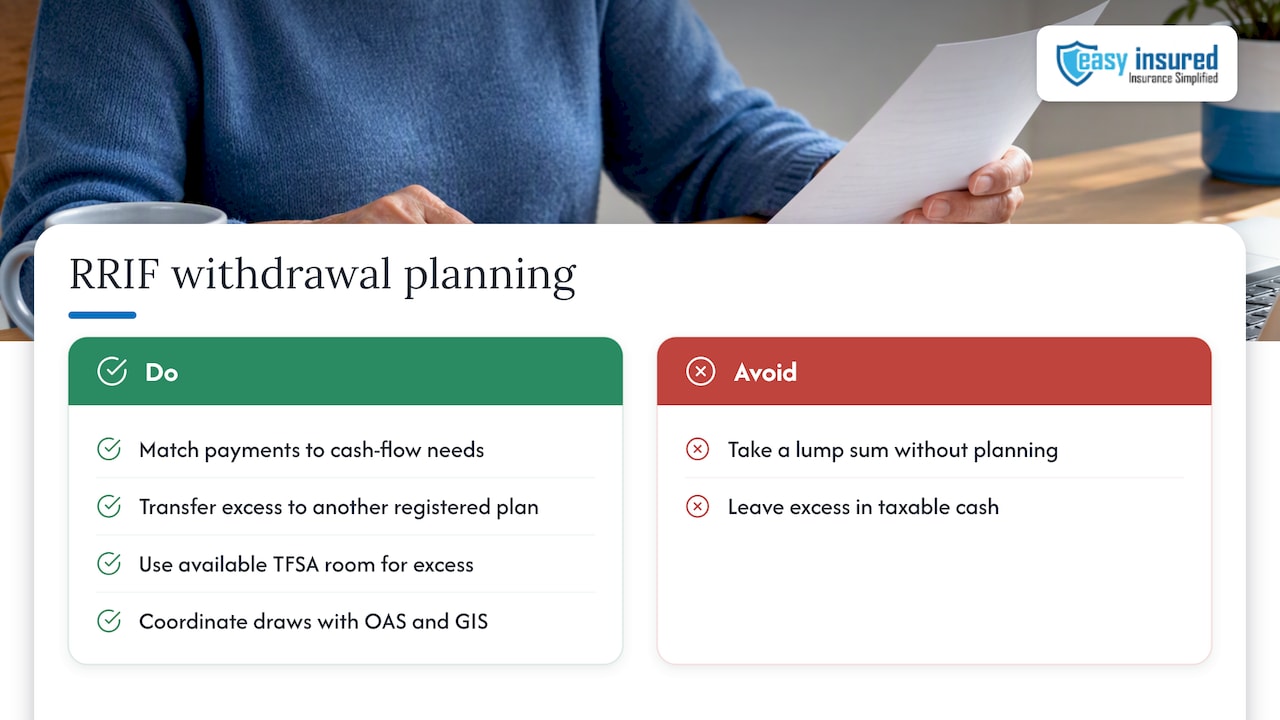
Match your RRIF payment schedule to when you actually need the cash: monthly payments smooth out income and reduce the odds of an unplanned withholding hit on a lump sum. If you don’t need the money, transfer any excess directly to another registered plan or into a TFSA with available room rather than letting it sit as taxable cash. Coordinating your RRIF draws with OAS and GIS eligibility matters too, since higher withdrawals can affect both. A personalized review can catch issues a general checklist won’t.
How we advise clients on RRIF withdrawals
We build RRIF withdrawal plans around tax smoothing first: spreading income across years and brackets rather than taking the path of least resistance. We also check beneficiary and successor annuitant designations early, since that paperwork determines what happens to the account at death, not the withdrawal schedule itself. Larger balances, a recent inheritance, or an estate that spans more than one province are exactly the situations where a second set of eyes earns its cost. For readers who want more detail on related registered-plan rules, our guide to RESP withdrawal limits covers similar timing traps.
— Frank
Planning your RRIF withdrawals
A RRIF withdrawal schedule is only one piece of a retirement income plan, and getting the sequencing wrong can cost more in tax than it needs to. Our retirement planning work looks at your full income picture, not just the mandatory minimum, alongside investment planning and estate planning built around your beneficiary designations.

A first conversation typically covers:
- A review of your current or upcoming RRIF withdrawal schedule against your actual cash-flow needs.
- Tax-smoothing options, including spousal age elections and direct transfer opportunities.
- A beneficiary and successor annuitant check so your RRIF passes the way you intend.
If you’re weighing a related decision, such as using RRSP funds toward a home purchase, our mortgage partners at Dream House Mortgage outline how Home Buyers’ Plan withdrawal and repayment rules interact with your broader registered-plan strategy. Reach out through our services page to set up a review of your own RRIF plan.
This article is general information, not a substitute for advice from a qualified financial advisor. Consult a qualified financial professional about your own circumstances before acting on anything here.
FAQ
When must I convert my RRSP into a RRIF?
You must convert your RRSP into a RRIF, or another eligible retirement income option, by December 31 of the year you turn 71. Your first mandatory minimum withdrawal is due the following calendar year, not the year of conversion.
What’s the difference between an RRSP and a RRIF?
An RRSP is a savings vehicle designed to accumulate retirement funds with tax-deferred growth, while a RRIF is the income vehicle it converts into, with mandatory annual minimum withdrawals once established. You can contribute to an RRSP but not to a RRIF, and a RRIF requires you to start drawing money out rather than putting it in.
Can I cash out my RRIF in Canada?
Yes, you can withdraw more than the required minimum from a RRIF at any time, though amounts above the minimum are subject to withholding tax in addition to being fully taxable. There’s no restriction preventing a full cash-out, but doing so moves the entire remaining balance into your taxable income for that year.
What’s the most tax-efficient way to withdraw from a RRIF?
Spreading withdrawals across the year rather than taking a lump sum, and withdrawing only the minimum when possible, generally keeps more of your income in a lower tax bracket. Where you have unused TFSA room, moving taxed excess withdrawals into a TFSA can let future growth happen tax-free going forward.
What counts as a good monthly retirement income in Canada?
There’s no single fixed figure, since a comfortable monthly income depends on your location, debt load, and lifestyle costs. A RRIF withdrawal schedule should be built around your actual expenses and other income sources, such as OAS and CPP, rather than a generic target.