
The RRSP contribution deadline for the 2025 tax year is March 2, 2026. Contribute by that date and the amount reduces your 2025 taxable income. Miss it by a single day and the contribution still counts, but it applies to 2026 instead.
- What a contribution by March 2, 2026 does: It creates a deduction on your 2025 return, potentially generating a refund or reducing a balance owing when you file this spring.
- Where the date comes from: The Canada Revenue Agency (CRA) sets the deadline as the first 60 days of the new calendar year. In 2026, day 60 falls on March 2.
Key date: March 2, 2026 is the last day to contribute to your RRSP and claim the deduction on your 2025 tax return.
Table of Contents
- How the RRSP contribution deadline 2026 actually works
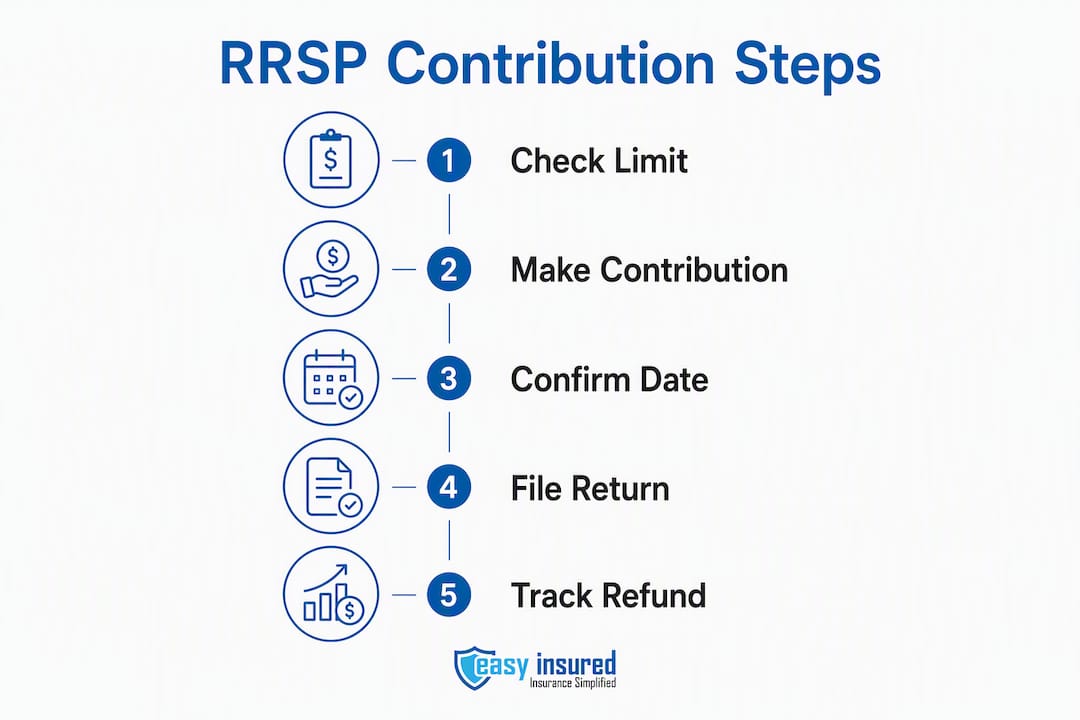
- Steps to make sure your contribution counts before the cutoff
- How contribution room, limits, and age rules affect your deadline
- Other deadlines you should know alongside the RRSP cutoff
- What to do if you miss the March 2, 2026 deadline
- Tax-planning tips from a financial planning perspective
- Key Takeaways
- Why timing your RRSP contribution is about more than the calendar
- Easy-insured can help you get RRSP timing right
- Authoritative sources to verify dates and limits
How the RRSP contribution deadline 2026 actually works
The “first 60 days” rule is the legal mechanic behind every RRSP deadline. CRA allows contributions made during the first 60 days of a calendar year to be designated toward the prior tax year. For 2026, that window runs from January 1 through March 2.
What that means in practice: a contribution you make on February 10, 2026 can appear on your 2025 return, not your 2026 return. You choose which year to claim it on when you file. The qualifying contribution window for the 2025 return runs from March 4, 2025 through March 2, 2026.
A quick example: You deposit $5,000 into your RRSP on February 20, 2026. When you file your 2025 return in April, you claim that $5,000 as a 2025 deduction. Your 2025 taxable income drops by $5,000. The contribution receipt from your financial institution will show the February date, which is all CRA needs.
The exact March cutoff can shift slightly depending on leap years and weekends. In a standard year, day 60 is March 1. Because 2026 is not a leap year and March 1 falls on a Sunday, the deadline shifts to the next business day: March 2, 2026.
Pro Tip: If you plan to transfer funds from an external bank account into your RRSP, initiate the transfer no later than February 26. Settlement can take 24–48 hours, and CRA counts the date the RRSP issuer receives the funds, not the date you clicked “send.”
Steps to make sure your contribution counts before the cutoff
Getting the money into your RRSP before midnight on March 2 is the goal. Here is how to do it without surprises.
- Confirm your contribution room. Log in to CRA My Account or check your most recent Notice of Assessment. Your available RRSP deduction limit is printed there. Contributing more than your room (plus the $2,000 buffer) triggers a penalty tax.
- Choose your RRSP account. Decide whether you are contributing to your own RRSP, a spousal RRSP, or both. The account must already be open before you transfer funds.
- Initiate the transfer early. For online transfers between accounts at the same institution, same-day or next-day settlement is typical. For transfers from an external bank, allow at least 2–3 business days.
- Confirm receipt with your financial institution. After the transfer, log in or call to verify the funds appear in the RRSP account with a date of March 2 or earlier. CRA treats the receipt date as the contribution date, not the initiation date.
- Save your confirmation. Download or print the transaction confirmation and the RRSP receipt your institution will issue. You will need the receipt when you file.
Timing by transfer method:
- In-branch cash or cheque: Same-day receipt if deposited during business hours on or before March 2.
- Online transfer within the same institution: Usually settles same day or next business day.
- Inter-institution electronic transfer (EFT): Allow 2–3 business days; initiate by February 26 at the latest.
- Mailed cheque: Risky this close to the deadline; the issuer’s receipt date controls, not the postmark.
Pro Tip: TD and other major banks confirm that settlement timing, not initiation timing, determines which tax year your contribution belongs to. When in doubt, call your RRSP issuer the day after the transfer to confirm the receipt date on file.
How contribution room, limits, and age rules affect your deadline
Finding your limit
Your RRSP deduction limit for 2025 appears on your 2024 Notice of Assessment or inside CRA My Account. It reflects 18% of your 2024 earned income, up to the 2025 RRSP dollar limit of $32,490, plus any unused room carried forward from prior years, minus any pension adjustment.

For 2026, the RRSP dollar limit rises to $33,810, which matters if you are planning contributions for the 2026 tax year after the March 2 deadline passes.
Unused room carries forward
Missing the March 2 deadline does not cost you your contribution room. Unused RRSP room carries forward indefinitely. If you skip a year entirely, that room accumulates and is available whenever you are ready to use it. This is worth knowing if cash flow is tight in early 2026.
The age-71 cutoff
You must close your RRSP by December 31 of the year you turn 71. That means the last day you can contribute to your own RRSP is December 31 of that year, regardless of the first-60-days window. If you turn 71 in 2026, you cannot use the March 2, 2026 deadline to contribute to your own plan; your window closed on December 31, 2025. You can still contribute to a spousal RRSP if your spouse is younger than 71.
The $2,000 over-contribution buffer
CRA allows a $2,000 lifetime over-contribution buffer before the 1% per month penalty tax kicks in. Once you exceed your total deduction limit by more than $2,000, the penalty applies to the excess amount for every month it remains in the plan. This buffer is not an annual allowance; it is a one-time lifetime cushion. Use it carefully.
- Contributions over your limit by $1 to $2,000: no penalty, but no deduction on the excess.
- Contributions over your limit by more than $2,000: 1% per month penalty tax on the excess until withdrawn.
- Always verify your room before contributing, especially if you have multiple RRSP accounts.
Other deadlines you should know alongside the RRSP cutoff
The March 2 date gets most of the attention, but a few related deadlines are worth keeping on your radar.
Home Buyers’ Plan (HBP) and Lifelong Learning Plan (LLP): These programs let you withdraw from your RRSP tax-free under specific conditions. Their repayment rules operate on a separate schedule from the annual contribution deadline. HBP repayments are due by December 31 each year (or the amount is added to your income). LLP repayments follow a similar annual schedule. Neither program’s repayment deadline is March 2. Check the CRA Home Buyers’ Plan and Lifelong Learning Plan pages for your specific repayment year.
December 31, age-71 cutoff: As noted above, this is the hard stop for contributing to your own RRSP. It is not tied to the first-60-days window and cannot be extended.
T4 and RRSP receipt slips: Financial institutions must mail RRSP contribution receipts by the end of February for contributions made in the last 10 months of the prior year, and by May 1 for contributions made in the first 60 days of the new year. National Bank confirms that January and February contributions count toward the prior tax year, and the receipt will reflect the contribution date. Keep these receipts; you will need them to claim the deduction.
What to do if you miss the March 2, 2026 deadline
Missing the cutoff is not a financial disaster. Here is what actually happens and what to do next.
- Confirm the contribution date on your receipt. If your RRSP issuer received the funds on March 3 or later, the contribution applies to the 2026 tax year, not 2025. Do not claim it on your 2025 return.
- Apply the contribution to your 2026 return. A post-deadline contribution is still a valid RRSP contribution. It reduces your 2026 taxable income when you file next year.
- Check your carry-forward room. Your unused 2025 room does not disappear. It rolls into 2026 and will appear on your 2025 Notice of Assessment. You can use it at any point before you turn 71.
- Watch for over-contribution risk. If you contributed in early 2026 thinking it would count for 2025, and you also contributed earlier in the year, verify your total does not exceed your 2026 room plus the $2,000 buffer. A missed deadline that accidentally creates an over-contribution is the one scenario worth a call to a tax advisor.
The unused contribution room carries forward indefinitely, so the real cost of missing the deadline is a one-year delay on the tax deduction, not a permanent loss of room.
Tax-planning tips from a financial planning perspective
The deadline is a trigger, not a strategy. Here is how to think about RRSP timing more deliberately.
Use carry-forward room when your income is higher. Contributing the maximum every year sounds disciplined, but it is not always optimal. If you expect a significant income increase in 2027 or beyond, deferring some contributions and claiming them in a higher-income year produces a larger tax refund. Carrying forward unused room is often the smarter long-term move for taxpayers whose income is still climbing.
Reinvest your tax refund. An RRSP contribution at a 40% marginal rate on $10,000 generates roughly a $4,000 refund. Spending that refund is the most common mistake. Putting it back into your RRSP or TFSA the following year compounds the tax-deferred growth effect significantly over a 20-year horizon. National Bank’s guidance on this point is clear: reinvesting the refund is where the real long-term gain lives.
Coordinate RRSP decisions with your estate plan. Your RRSP passes outside your estate if you have named a beneficiary directly on the plan. A surviving spouse or common-law partner can receive the RRSP proceeds as a tax-deferred rollover. Without a named beneficiary, the full value is included in your estate and taxed as income in the year of death. Reviewing beneficiary designations alongside your annual RRSP contribution is a step most Canadians skip. It is also worth understanding how estate planning strategies can reduce the tax hit on registered assets at death.
Spousal RRSP contributions split future income. Contributing to a spousal RRSP reduces your taxable income now and builds retirement assets in your spouse’s hands, where withdrawals may be taxed at a lower rate. The attribution rules apply if your spouse withdraws within three calendar years of your last contribution, so timing matters.
Pro Tip: If your situation involves large carry-forward room, a spousal RRSP, or RRSP assets that form a significant part of your estate, a conversation with a financial planner before the deadline is worth more than any generic checklist. The interaction between marginal rates, beneficiary rules, and estate taxes is where real money is saved or lost.
For complex situations, including estate interactions or large contributions, professional advice pays for itself.
Key Takeaways
The RRSP contribution deadline for the 2025 tax year is March 2, 2026, and contributions received by that date reduce your 2025 taxable income.
| Point | Details |
|---|---|
| Exact deadline | March 2, 2026 is the last day to contribute and claim the deduction on your 2025 return. |
| Receipt date controls | CRA uses the date your RRSP issuer receives funds, not when you initiated the transfer. |
| Unused room carries forward | Missing the deadline does not erase your room; it accumulates indefinitely for future years. |
| $2,000 over-contribution buffer | CRA charges a 1% per month penalty only on amounts exceeding your limit by more than $2,000. |
| Easy-insured planning support | Easy-insured can help coordinate your RRSP strategy with estate planning and insurance decisions. |
Why timing your RRSP contribution is about more than the calendar
Most articles stop at the date. The part worth thinking about is what the contribution decision connects to.
An RRSP contribution is not just a tax move. It is a retirement savings decision, an estate planning variable, and sometimes an insurance planning trigger all at once. The refund it generates can fund a term life policy that protects your family while the RRSP grows. The beneficiary designation on the plan determines whether your spouse receives a tax-deferred rollover or your estate faces a large income inclusion; it is important to review such details as part of understanding estate plans, wills and power of attorneys. The marginal rate at which you claim the deduction determines whether contributing now or deferring to a higher-income year actually makes sense for your situation.
The deadline is real and worth meeting. But the bigger risk is treating the contribution as a checkbox rather than a decision point. Canadians who coordinate their RRSP timing with their broader financial picture, including insurance coverage, estate documents, and income projections, consistently come out ahead of those who simply deposit the maximum every March.
If your situation is straightforward, the steps in this article are enough. If it involves a spousal RRSP, large carry-forward room, a business interest, or an estate with registered assets, a conversation with a qualified advisor before March 2 is the highest-value thing you can do.
Easy-insured can help you get RRSP timing right
Knowing the deadline is step one. Knowing what to do with the contribution, the refund, and the plan documents is where most Canadians need a second opinion.

Easy-insured works with Canadian families and business owners to align RRSP contributions with the broader financial picture: marginal-rate planning, spousal RRSP strategy, beneficiary designations, and the insurance coverage that protects the plan while it grows. The firm offers financial planning services that go beyond the deadline date and into the decisions that actually move the needle on retirement outcomes. For clients whose RRSP forms a significant part of their estate, Easy-insured also coordinates term life and investment-linked coverage to ensure the plan is protected at every stage.
Easy-insured can help you:
- Review your available contribution room and confirm the right amount to contribute before March 2.
- Coordinate your RRSP strategy with your estate plan and beneficiary designations.
- Identify whether a spousal RRSP or carry-forward deferral makes more sense for your income trajectory.
- Connect your RRSP refund to an insurance or investment strategy that compounds the benefit.
Contact Easy-insured to get a personalized review before the March 2, 2026 deadline.
Authoritative sources to verify dates and limits
Use these official and bank resources to confirm the deadline, your contribution room, and procedural details before you act.
| Source | What it verifies | Why it’s useful |
|---|---|---|
| CRA Important Dates | March 2, 2026 deadline | Official government source for the exact date |
| CRA Contribution Limits | 2025 limit ($32,490) and 2026 limit ($33,810) | Official annual dollar limits by year |
| CRA How Contributions Affect Your Limit | Qualifying window, carry-forward, $2,000 buffer | Covers over-contribution rules and room mechanics |
| TD RRSP Deadlines | March 2, 2026; 60-day rule; recordkeeping tips | Major bank explainer with practical timing guidance |
| National Bank RRSP Deadlines | Jan/Feb contribution designation; prior-year rules | Confirms how early-year contributions are assigned |
| CRA Home Buyers’ Plan | HBP repayment rules and schedule | Separate from the March 2 deadline |
| CRA Lifelong Learning Plan | LLP repayment rules | Separate repayment schedule from contribution deadline |
Confirm your specific limit by logging in to CRA My Account or reviewing your 2024 Notice of Assessment. Your RRSP issuer can also confirm the receipt date on any contribution you have already made.
This article is general information, not tax or financial advice. Confirm your specific contribution room, deadlines, and filing obligations with CRA or a qualified tax professional before acting.