
When you withdraw from an RRSP in Canada, your financial institution generally withholds 10%, 20%, or 30% depending on the amount, with Quebec using different fractions, and non-residents face a flat 25% baseline. That withheld amount is a prepayment toward your final tax bill, not the bill itself.
TL;DR:
- RRSP withdrawals over $15,000 are subject to a 30% withholding rate outside Quebec, which increases to roughly 29% when including Quebec’s provincial tax.
- Large withdrawals can result in over-withholding if your marginal tax rate is lower than the flat rate, potentially leading to a refund when you file your taxes.
- The withholding is a prepayment, so your final tax liability depends on your total yearly income and may be higher or lower than the amount withheld.
- Certain programs like the Home Buyers’ Plan or Lifelong Learning Plan allow tax-free withdrawals without withholding, provided repayment conditions are met.
- Non-residents face a flat 25% withholding rate, but treaty agreements can reduce this rate, and the institution is responsible for remitting the withheld amount.
Table of Contents
- Official withholding rates for residents and Quebec specifics
- Why withholding is a prepayment, not your final tax bill
- Exceptions and transfers that avoid withholding
- Non-resident withholding rules and payer obligations
- Reporting and slips: what to look for at tax time
- Practical planning: timing, in kind withdrawals, and locked in accounts
- What this means for your retirement and estate plans
- Getting personalized help with RRSP withdrawal timing
- Where these rules come from
- Sources
- FAQ
Official withholding rates for residents and Quebec specifics
The Canada Revenue Agency sets RRSP withholding in tiers tied to how much you take out in a single withdrawal, not your income level. For residents outside Quebec, the rates on withdrawals are:
- 10% on withdrawals up to $5,000.
- 20% on the portion between $5,001 and $15,000.
- 30% on anything above $15,000.
Quebec residents see a different split. The federal component drops to 5%, 10%, or 15% across the same thresholds, but Quebec adds its own provincial withholding, historically around 14%, which pushes the combined totals to roughly 19%, 24%, and 29% across the same three bands.
A few worked examples make the math concrete. Withdraw $3,000 outside Quebec and the institution holds back $300, leaving you $2,700. Withdraw $10,000 and the 20% tier applies to the whole amount, so $2,000 is withheld and $8,000 lands in your account. Withdraw $20,000 and the 30% tier applies to the full sum, meaning $6,000 is withheld before you see a dollar. In Quebec, that same $20,000 withdrawal would see roughly $5,800 withheld once the combined federal and provincial rate is applied.
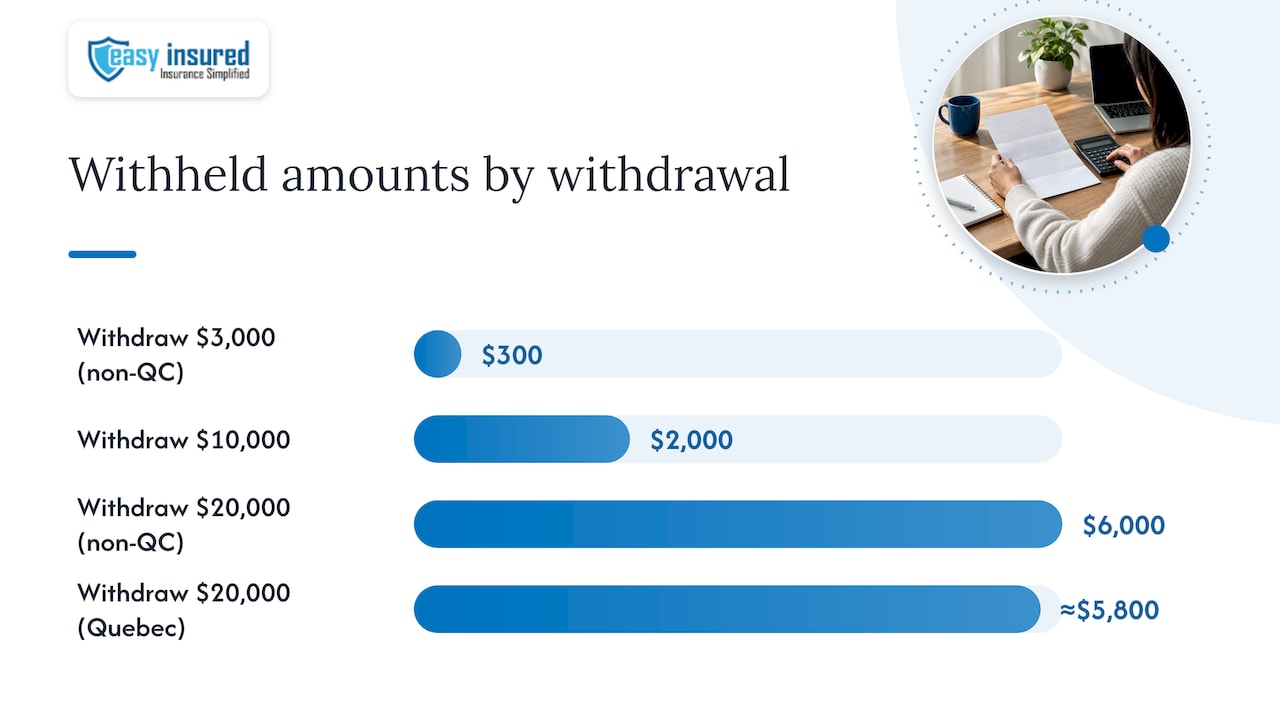
These are single-withdrawal thresholds. Some institutions review withdrawals made within a short window of each other and may apply the rate for the combined total, so spacing out withdrawals does not reliably reduce the tier you fall into.
Why withholding is a prepayment, not your final tax bill
The tiered rate above is a flat estimate applied at the moment of withdrawal. Your actual tax owing depends on your total income for the year and your marginal tax rate, which could be higher or lower than the amount withheld. RRSP withdrawals must be added to your taxable income and reconciled when you file, using the slip your institution sends you.
Reconciling the amount on your return follows a fixed sequence:
- Locate your T4RSP slip, which shows the gross withdrawal in box 22 and the tax already deducted in box 30.
- Report the gross withdrawal amount on line 12900 of your tax return.
- Claim the tax already deducted on line 43700, which reduces the balance owing or increases your refund.
The outcome depends heavily on your income that year. Someone who withdraws $10,000 in a year with little other income might have $2,000 withheld but owe closer to $1,000 once their marginal rate is applied, producing a refund. Someone who withdraws the same $10,000 on top of a full-time salary might land in a higher bracket where their real tax liability exceeds $2,000, leaving a balance due in April.
Exceptions and transfers that avoid withholding
Not every RRSP withdrawal triggers withholding tax. Two federal programs let you access RRSP funds tax-free up front, provided you follow the repayment rules, and transfers to other registered vehicles can defer withholding entirely.
- The Home Buyers’ Plan lets eligible first-time buyers withdraw up to a total limit without withholding, repayable over 15 years; missed repayments are added to your income for that year instead of being withheld at source.
- The Lifelong Learning Plan allows tax-free withdrawals for eligible education, within annual limits, with its own repayment schedule; a missed installment is similarly taxed as income rather than withheld.
- A direct transfer to a RRIF or an eligible annuity avoids withholding at the moment of transfer, since no cash leaves the registered system; tax applies later as you draw income from the new vehicle.
- Locked-in RRSPs and group RRSPs often restrict or prohibit direct withdrawals altogether, so check with your plan administrator before assuming the standard withholding tiers even apply to your account.
These exceptions matter most around major life events, like a home purchase or a return to school, and at age 71 when RRSPs must convert to a RRIF, an annuity, or be collapsed entirely.
Non-resident withholding rules and payer obligations
If you live outside Canada when you withdraw from your RRSP, the default withholding rate jumps to 25% under Part XIII of the Income Tax Act, regardless of the amount withdrawn. This is meaningfully different from the tiered resident rates and applies as a flat percentage on the full withdrawal.
- Tax treaties between Canada and your country of residence may reduce that 25% rate; the specific treaty rate for your situation is detailed in Information Circular IC76-12R8.
- The financial institution acts as the payer and is legally required to withhold the correct amount, remit it to the CRA, and file an NR4 information return reporting the gross amount and tax withheld.
- Late remittance can trigger a penalty of 10%, rising to 20% for cases of gross negligence, plus daily compounding interest, so institutions tend to apply these rules strictly.
- Depending on your country’s own tax rules, the Canadian tax withheld may be claimable as a foreign tax credit against your domestic tax liability, which is worth confirming with a tax guide for non-resident withholding.
Reporting and slips: what to look for at tax time
Three documents govern how RRSP withdrawals get reported, and matching the right box to the right line prevents errors.
- The T4RSP slip is issued to residents and shows the gross withdrawal in box 22 and tax deducted in box 30, which you report on lines 12900 and 43700 respectively.
- The NR4 slip serves the same purpose for non-residents, with payers required to file it alongside their NR4 summary by the CRA’s annual deadline, a process explained further in this T4 and slip filing guide.
- Form T3012A applies when you want to withdraw unused RRSP contributions without the usual withholding, since you already paid tax on that money going in and a waiver prevents double withholding.
Keep these slips with your tax records, since mismatches between what you report and what the CRA receives from your institution are a common source of reassessment letters.
Practical planning: timing, in kind withdrawals, and locked in accounts
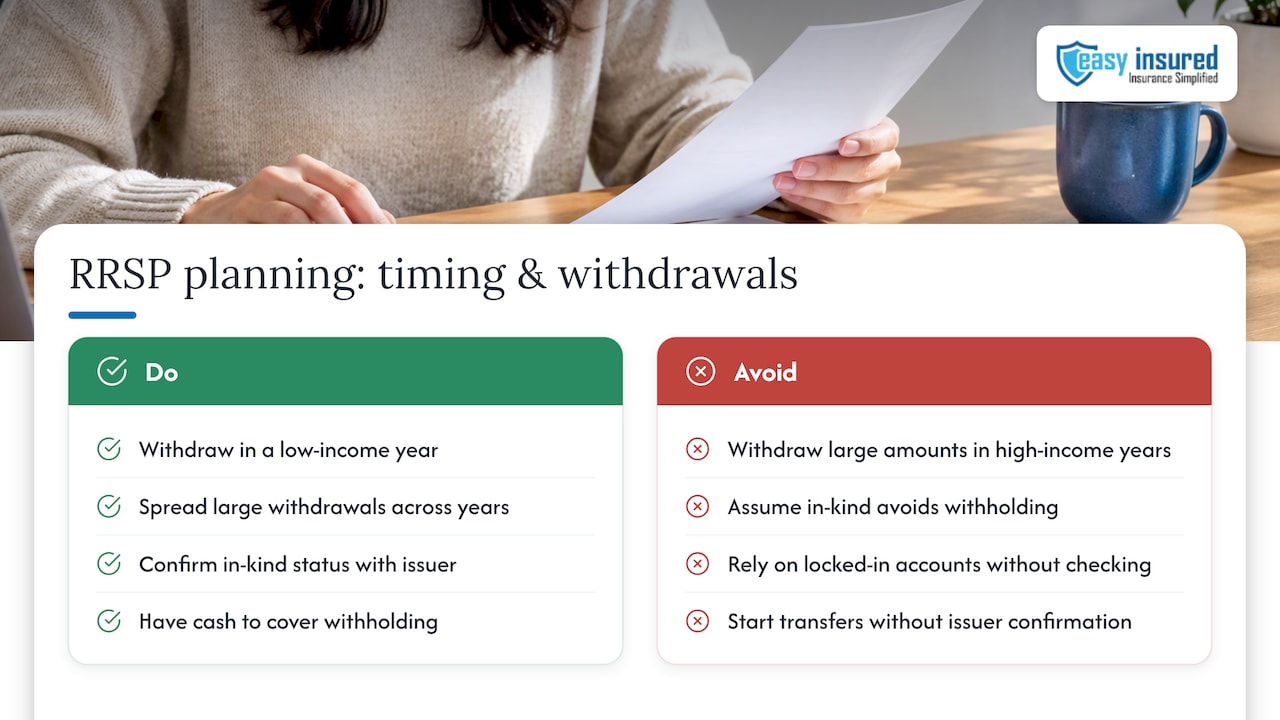
The rules above leave real room for planning, and most of it comes down to timing and paperwork. Withdrawing a large RRSP amount in a year when your other income is low, such as a sabbatical or early retirement year before government benefits start, keeps your real tax bill closer to the amount withheld. Spreading a large withdrawal across two calendar years can also keep each year’s income in a lower bracket, a strategy covered in more detail in our RRSP meltdown approach for retirees drawing down registered accounts.
In-kind withdrawals, where you move investments rather than cash out of the RRSP, still trigger withholding. Your institution needs cash on hand to cover the withheld portion or it may need to sell part of your holdings to generate it, so confirm with your issuer before initiating the transfer.
Locked-in RRSPs and many group RRSPs restrict withdrawals outright, and the rules for unlocking them vary by province and plan type, a topic worth reviewing if you are relying on a locked-in account as part of your retirement income.
Pro Tip: Before any large RRSP withdrawal, ask your institution for a written breakdown of the withholding amount and confirm whether the transaction counts as in-kind, since that changes what you need to have in cash.
What this means for your retirement and estate plans
RRSP withholding feels like a tax penalty, but it is really a cash flow problem dressed up as one. The bigger risk isn’t the withholding tier itself, it’s withdrawing without a plan for how that income stacks against your other sources in a given year, which can quietly erode decades of tax-deferred growth in a single bad-timing decision.
— Frank
Getting personalized help with RRSP withdrawal timing
Working out the right year, the right amount, and the right sequence for RRSP withdrawals gets harder once pensions, CPP, and other income sources enter the picture, and a spreadsheet only goes so far.

Easy Insured offers a few ways to get that picture mapped out properly:
- Retirement planning that sequences RRSP, RRIF, and other income sources around your actual tax brackets.
- Estate planning that accounts for how registered accounts get taxed at death.
- Financial planning with a certified planner who looks at withdrawal timing alongside insurance and investment accounts together.
If spreadsheets and CRA guides aren’t cutting it, book a consult through our services page and get a plan built around your actual numbers.
Where these rules come from
These figures and rules come directly from CRA publications, which are updated periodically and worth checking for the current year.
- Tax rates on RRSP withdrawals
- Lifelong Learning Plan rules
- Withdrawing from your own RRSPs
- NR4 non-resident withholding guidance
Non-residents should check their specific treaty rate rather than assume the 25% baseline applies.
This article is general information, not a substitute for advice from a qualified financial advisor. Consult a qualified financial professional about your own circumstances before acting on anything here.
Sources
FAQ
How much withholding tax applies to a $15,000 RRSP withdrawal?
A $15,000 RRSP withdrawal falls at the top of the 20% tier, so your institution withholds $3,000, leaving you $12,000. In Quebec, the combined federal and provincial withholding would be closer to 24% of the amount, so the figure would be higher.
How can you avoid RRSP withholding tax?
You can avoid immediate withholding by using the Home Buyers’ Plan or the Lifelong Learning Plan for eligible purposes, or by transferring funds directly to a RRIF or annuity instead of taking cash. Both program withdrawals carry repayment obligations, and missing a repayment adds that amount to your taxable income instead.
What is withholding tax on an RRSP?
RRSP withholding tax is the amount your financial institution holds back at the time of withdrawal and sends to the CRA on your behalf, before you ever file a return. It is a prepayment toward your actual tax owing for the year, not a final calculation of what you owe.
What happens if you withdraw $20,000 from your RRSP?
A $20,000 withdrawal falls into the top tier, so 30% is withheld, meaning $6,000 is held back and $14,000 reaches your account. The full $20,000 still counts as taxable income for the year, so your final tax owing depends on your total income and marginal rate once you file.