
An insured retirement plan uses an overfunded permanent life insurance policy plus loans against its cash value to deliver tax-advantaged retirement income. It’s usually the right fit only after you’ve maxed out your RRSP and TFSA room and can commit to funding premiums for 15 to 20 years. For most Canadians, that rules it out. For high earners with leftover cash flow and a genuine need for permanent insurance, it can be a legitimate piece of the puzzle. The details on tax treatment and lending decide whether it actually pays off.
TL;DR:
- The strategy only benefits high earners who have exhausted RRSP and TFSA room and can commit to premiums for at least 15 years.
- Overfunding the policy accelerates cash value growth, but lapsing or overfunding too aggressively can trigger significant tax liabilities.
- Policy loans and collateralized bank loans enable tax-advantaged retirement income, but require careful monitoring of interest rates and loan-to-value ratios.
- The approach is unsuitable for those without a permanent insurance need or limited cash flow, as costs and risks outweigh benefits.
- Regular reviews are essential to prevent policy drift, maintain proper loan-to-value limits, and ensure the plan remains financially viable.
Table of Contents
- What Is an Insured Retirement Plan and How Does It Work
- Weighing the Real Pros and Cons of an IRP
- Who Should Actually Consider an IRP
- The Canadian Tax and Lending Details That Decide If This Works
- Where IRPs Go Wrong: Lapse Risk, MEC Risk, and Rate Spreads
- Setting Up an Insured Retirement Plan: A Practical Roadmap
- How Easy-insured Evaluates IRPs for Canadian Clients
- Get an Insured Retirement Plan Illustration Built for Your Situation
- Sources
What Is an Insured Retirement Plan and How Does It Work
A permanent life insurance policy, whether whole life or universal life, builds cash value inside the contract that grows tax deferred as long as it stays within federal exemption limits. An insured retirement plan takes that mechanism further by deliberately overfunding the policy well beyond the minimum premium needed to keep it in force, pushing extra dollars into the cash value so it compounds faster.
The payoff comes later. Instead of withdrawing cash directly (which can trigger tax on the gain), you either take a loan against the policy itself or use the cash value as collateral for a line of credit at a bank or other lender. Structured correctly, that borrowed money isn’t taxable income the year you receive it.

This only works while the policy stays active, a concept well explained in Family Guard Life & Health’s retirement income solutions. Illustrations need to run out for decades, not years, because the strategy depends on compounding continuing uninterrupted. Lapse the policy while a loan is outstanding, and the tax bill you deferred can land all at once.
Weighing the Real Pros and Cons of an IRP
The appeal is straightforward: tax-deferred growth inside the policy, a path to tax-free cash in retirement through loans rather than withdrawals, and a death benefit that can settle the loan balance and pass remaining value to heirs outside probate in most provinces. Structured properly, loan proceeds also avoid showing up as taxable income, which matters for anyone watching income-tested benefits.
The downsides are just as real:
- Early surrender charges can be steep if you need to unwind the policy in the first decade.
- Cost of insurance and administrative fees create ongoing drag that eats into net returns, especially in the early years.
- The strategy demands active monitoring; a policy left unattended can drift into trouble.
- Cash access has limits, and pushing premiums too aggressively risks the policy being reclassified as a Modified Endowment Contract equivalent, changing its tax treatment.
The trade-off, in plain terms: you give up the flexibility of a simple savings account in exchange for tax deferral and leverage, but only if you keep the policy funded and monitored for the long haul.
Who Should Actually Consider an IRP
An insured retirement plan tends to fit a narrow profile. Advisor guidance consistently points to people in their 40s and 50s with high, stable income, who’ve already filled their RRSP and TFSA room, and who have a genuine need for permanent life insurance anyway, not just a savings vehicle wearing an insurance costume.
Before moving forward, confirm these:
- You’ve maxed RRSP and TFSA contribution room and still have surplus cash flow every year.
- You can commit to premium funding for at least 15 years without needing that cash for other goals.
- You qualify medically for a substantial permanent policy at a reasonable rate.
- You have, or expect to have, an estate or business succession need that permanent insurance would serve regardless of the retirement-income angle.
If any of those don’t apply, cheaper and simpler options usually win. Scotia Wealth Management’s guidance frames IRPs as supplemental, not foundational, which is the right way to think about them.
The Canadian Tax and Lending Details That Decide If This Works
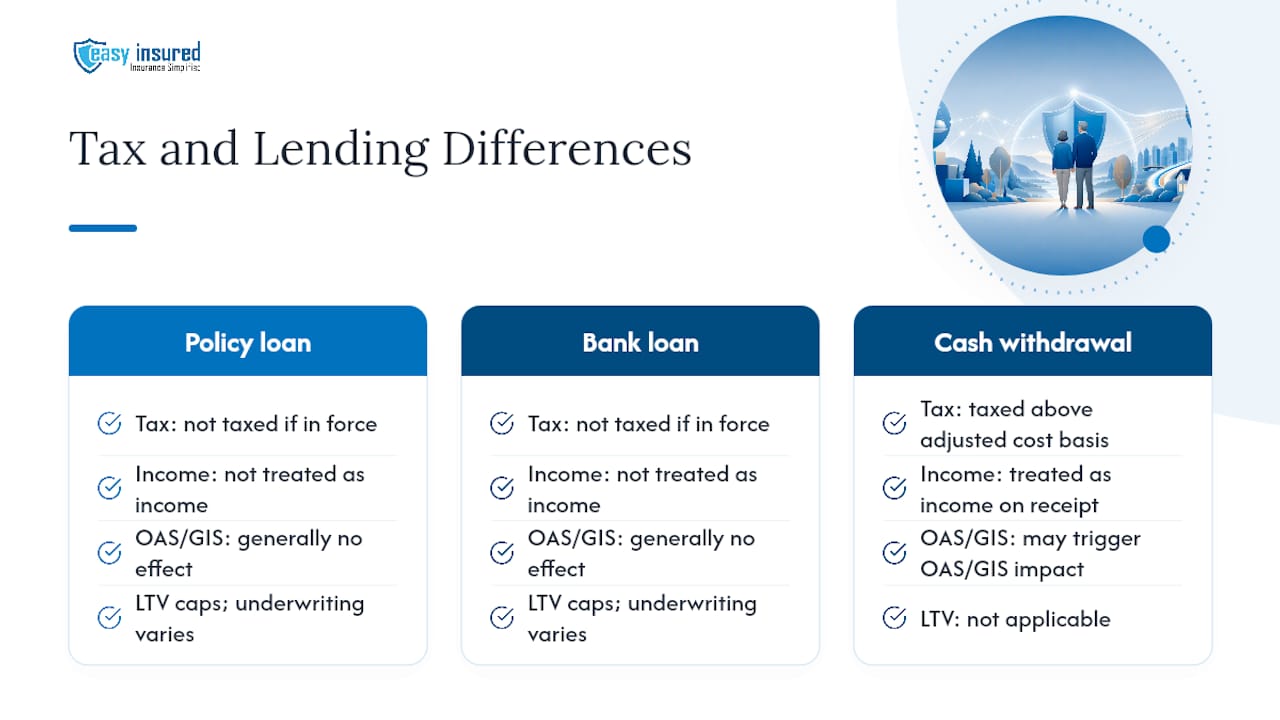
Policy loans and collateralized bank loans aren’t taxed as income the year you take them, unlike a direct cash withdrawal from the policy, which can trigger tax on the portion above your adjusted cost basis. That distinction is the entire reason the strategy exists. But it only holds while the policy stays in force.
Pro Tip: Keep a cash reserve outside the policy equal to at least a year or two of loan interest. It’s the cheapest insurance against being forced to lapse a policy at the worst possible moment.
Because the loan itself isn’t income, proceeds generally don’t trigger the Old Age Security clawback or reduce Guaranteed Income Supplement eligibility the way an RRIF withdrawal would. That’s a meaningful advantage for retirees trying to stay under OAS thresholds, though it depends entirely on the loan being structured and documented correctly.
Lenders don’t extend credit against your policy’s full cash value. Loan-to-value limits typically cap what you can borrow, and availability can tighten if a lender changes its underwriting appetite. Whether your policy carries direct or non-direct recognition of dividends also affects your real borrowing cost, since non-direct recognition can reduce dividend crediting on the portion you’ve borrowed against. Tax rules and lending appetite both shift over time, so any illustration you’re shown should be treated as one scenario among several, not a guarantee.
Where IRPs Go Wrong: Lapse Risk, MEC Risk, and Rate Spreads
The single biggest danger is a policy lapsing while a loan balance is outstanding. When that happens, the loan amount above your cost basis becomes taxable income in the year of lapse, a result advisors call phantom income because you owe tax on money you don’t actually receive.
- Overfunding too aggressively can push a policy into a different tax classification, eliminating the deferral you set out to capture.
- If loan interest rates run higher than the policy’s crediting rate for an extended stretch, the loan balance can grow faster than the cash value supporting it.
- Annual reviews aren’t optional; they’re the mechanism that catches drift before it becomes a crisis.
Pro Tip: Ask for an illustration that assumes a lower crediting rate and a higher loan rate than the insurer’s default. If the plan still works under that stress test, it’s built on realistic footing.
Setting Up an Insured Retirement Plan: A Practical Roadmap
- Confirm your RRSP and TFSA room is fully used and that you have consistent surplus cash flow to sustain premiums for 15 years or more.
- Choose between whole life and universal life based on how much control you want over investment allocation versus guaranteed cash value growth.
- Request illustrations from multiple insurers using conservative crediting and loan-rate assumptions, and confirm lender loan-to-value rules upfront.
- Put monitoring rules in writing: at what loan-to-cash-value ratio do you reduce borrowing, and under what conditions would you switch strategies entirely?
This isn’t a set-and-forget product. It’s a decades-long commitment that needs a real review schedule.
How Easy-insured Evaluates IRPs for Canadian Clients
Frank has spent years helping Canadian business owners and families sort genuine retirement strategies from products that only look good on a glossy illustration. Easy-insured’s evaluation process starts with the same question every time: has this client actually maxed out their registered accounts, or is an IRP being pitched before the basics are covered?
From there, the checklist runs through funding capacity, insurability, and how the policy integrates with existing estate and business succession planning. An IRP that isn’t reviewed annually against realistic interest-rate assumptions isn’t a plan. It’s a bet.
— Frank
Get an Insured Retirement Plan Illustration Built for Your Situation
Running the numbers on an insured retirement plan without seeing multiple insurer illustrations is guessing with extra steps. Easy-insured builds out policy design, requests comparative illustrations across carriers, connects clients with lenders that understand collateralized policy loans, and stays on for the annual reviews that keep the plan from drifting off course.

That last part is where most self-directed IRPs fail: nobody checks back in five years to see if the loan-to-value ratio has crept past a safe range. Easy-insured’s process includes that review as a standing item, not an afterthought. If you’re weighing whole life against universal life as the base policy, or you want a second opinion on an illustration a bank has already shown you, book a planning call and get numbers built around your actual income, insurability, and timeline rather than a generic sales scenario.
Sources
For a technical breakdown of IRP mechanics, client profiles, and lender risk, the BMO Insurance advisor guide remains one of the more detailed public resources. Scotia Wealth Management’s suitability overview is worth reading before assuming this strategy applies to you. And if you’ve encountered the unrelated federal Investment Readiness Program, note that it’s a social-finance grant program with no connection to retirement insurance planning, despite the shared acronym.
This article is general information, not a substitute for advice from a qualified financial advisor. Consult a qualified financial professional about your own circumstances before acting on anything here.
- The BMO® Insured Retirement Plan: Advisor Guide
- What Is an Insured Retirement Plan? How It Works
- Pros and Cons of Insured Retirement Plan (IRP) – Tax Partners