
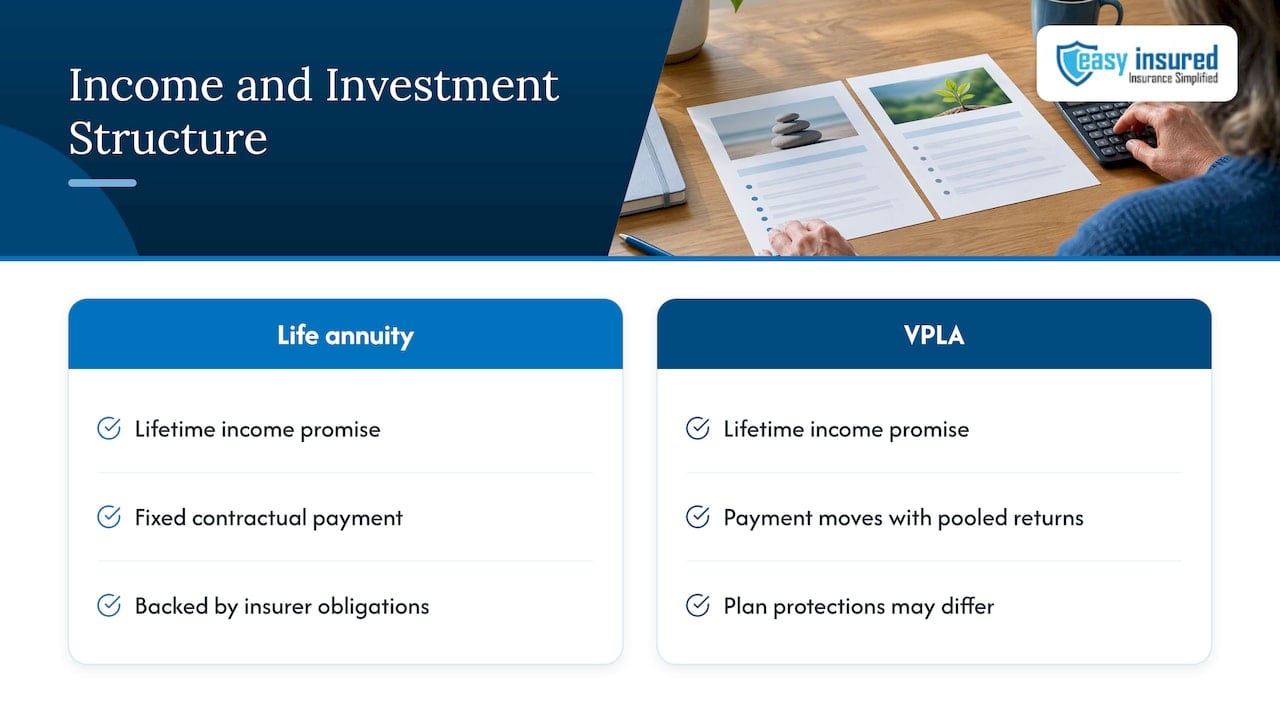
A life annuity pays a fixed, insurer-guaranteed income for as long as you live, while a variable-payment life annuity (VPLA) pays lifetime income that moves up or down with pooled investment returns. The simple rule: pick a guaranteed life annuity to cover essential bills, and consider a VPLA only for spending you can adjust if payments drop. Regulators including the Financial Consumer Agency of Canada, FSRA, and the CRA all stress that fees can change the comparison significantly.
TL;DR:
- A basic single life contract stops payments at death with no residual value; guaranteed periods or survivor continuation protect beneficiaries but reduce regular income.
- A VPLA payment can fall with pooled investment results, and an uninsured arrangement may expose payments to investment loss without an insurer guarantee.
- Funding rules differ: ALDAs can draw from registered accounts, while VPLA payments typically come through pooled pension plans; the source determines your tax slip.
- An ALDA must start paying by the end of the calendar year you turn 85, and only eligible registered plans can fund it.
- Ask for management fees, advice compensation, rider and surrender costs, plus a weak market VPLA projection, because costs may come directly out of investment returns.
Table of Contents
- What a Conventional Life Annuity Actually Guarantees
- How a Variable-Payment Life Annuity Changes the Math
- Tax Rules and Registered-Plan Transfers for ALDAs and VPLAs
- Weighing Predictability, Upside, and Survivor Protection
- Questions to Ask Before Signing an Annuity Contract
- Putting the Decision Rule Into Practice
- Our Take on Choosing Between the Two
- How We Help You Compare Guarantees, Fees, and Transfer Routes
- FAQ
- Sources
What a Conventional Life Annuity Actually Guarantees
A conventional life annuity is a contract where you hand an insurer a lump sum in exchange for income that continues for the rest of your life, regardless of how long that turns out to be. The FCAC’s own example illustrates the mechanics: a $100,000 life annuity purchased at age 65 and paying $500 a month would return the full purchase amount by around age 82, yet payments keep arriving for life if you outlive that point.
Insurers make this promise through an insurance contract that transfers longevity and investment risk to the insurer. Before comparing quotes, check which contract features are included, since they change both the payment size and what happens to your money after death.
- A single-life annuity pays for the annuitant’s lifetime and stops at death unless the contract includes a guarantee or survivor continuation.
- A joint-life option can continue payments to a surviving spouse or partner.
- A guaranteed period (commonly 5, 10, 15, or 20 years) pays a beneficiary if you die early in the contract.
Without a guarantee period or survivor option, a basic life annuity ends at death with no residual value, a point worth confirming before signing anything, according to federal retirement planning guidance.
How a Variable-Payment Life Annuity Changes the Math
A variable-payment life annuity shares the same core promise of lifetime income, but part of each payment moves with the performance of a pooled investment fund rather than staying fixed. The Canada Revenue Agency treats VPLAs as a distinct product category with their own transfer and reporting rules, separate from both traditional annuities and retail variable annuity contracts.
A VPLA’s variable portion can change with pooled investment results. Ask how the plan calculates and adjusts payments.
Pro Tip: Ask whether the VPLA you’re reviewing is issued through an insured group arrangement or an uninsured pooled plan, since the protections differ.
A VPLA sits between a fully guaranteed annuity and a self-managed drawdown account. You get some participation in investment performance without managing a portfolio yourself, but payments are not fixed. The Financial Services Regulatory Authority of Ontario draws a clear line here: a life annuity is an insurance contract backed by an insurer’s obligations, while uninsured decumulation products, including some variable arrangements, can be exposed to investment loss with no insurer standing behind the payments.
Tax Rules and Registered-Plan Transfers for ALDAs and VPLAs
Where the money comes from matters as much as which product you buy. An advanced life deferred annuity (ALDA) must be issued by a licensed annuities provider and must begin paying by the end of the year you turn 85, a hard deadline that shapes when you can fund one.
Both ALDAs and VPLAs draw from specific registered sources, but not interchangeably:
- RRSPs, RRIFs, money-purchase RPPs, PRPPs, and DPSPs can fund an ALDA under the conditions the CRA lists.
- VPLA payments typically flow from pooled registered pension plan arrangements, reported differently for tax purposes than a standard RRIF-funded annuity.
- The slip you receive (T4A versus T4RIF) depends on which registered plan funded the annuity, not just the annuity type itself.
A Life Income Fund (LIF) is a different vehicle entirely: it keeps you in control of investments and locks you into minimum and maximum withdrawal percentages set by provincial regulation, whereas an annuity exchanges that control for a fixed contractual payment. Our life insurance tax checklist covers related documentation worth reviewing before any registered-plan transfer.
Weighing Predictability, Upside, and Survivor Protection
The decision between a guaranteed annuity and a VPLA comes down to practical trade-offs that affect your household budget differently.
Payment predictability is the clearest split: a traditional annuity locks in a fixed amount for budgeting purposes, while a VPLA’s payment can rise or fall with the pooled fund’s results. That variability cuts both ways. A VPLA’s investment exposure means payments can change with pooled investment results, while a fixed annuity provides a fixed payment.
Survivor and death-benefit options change the comparison again. Adding a guaranteed period or joint-life option to either product reduces the regular payment but creates value for a spouse or estate that a single-life contract does not.
Liquidity differs sharply as well:
- A life annuity or VPLA may limit access to a lump sum after purchase, so check the contract terms before deciding.
- A LIF or RRIF keeps some flexibility, though withdrawal rules and limits may apply.
Fees deserve equal attention. The Canadian Investment Regulatory Organization notes that costs on investment-linked income products are often deducted from returns rather than billed visibly, which makes the true cost easy to underestimate unless you ask directly.
Questions to Ask Before Signing an Annuity Contract
Bring these questions to any quote review or advisor meeting so you are comparing contracts on equal terms rather than on headline payment size alone.
- Ask exactly who legally guarantees the payments and what portion of the contract wording actually promises a fixed amount.
- Request full fee disclosure, including management fees, advice or distribution compensation, and any rider or surrender costs, as CIRO guidance recommends.
- Confirm the guarantee period, survivor continuation percentage, and exactly how the death benefit is calculated.
- If funding from an RRSP, RRIF, RPP, or PRPP, confirm the ALDA or VPLA eligibility rules and which tax slip you should expect to receive.
- Ask for the insurer’s solvency information and a sample projection showing a weak-market VPLA scenario, not just an optimistic one.
Pro Tip: Request the same five answers in writing from every quote you compare, so you’re judging contracts side by side rather than from memory.
Our estate planning checklist covers several of the same document-gathering steps if you’re coordinating an annuity decision with a broader estate plan.
Putting the Decision Rule Into Practice
Frank brings this comparison back to a straightforward recommendation: cover essential monthly expenses, like housing and utilities, with guaranteed income first, then use a variable component only for the spending categories you could trim if payments dipped; for insight on building a stable future, see the advantages of holding luxury assets for long-term legacy here. This sequencing matches the FSRA’s framing of life annuities as guaranteed spending coverage rather than a growth vehicle.
At Easy Insured, our services exist to help you apply that sequencing to your own numbers, particularly when a registered-plan transfer is involved and the paperwork needs a second set of eyes before you commit.
Our Take on Choosing Between the Two
It may help to consider whether a combination suits your needs rather than treating this as an either-or decision. A guaranteed life annuity may suit people seeking stable income for essential costs. A VPLA may suit people who can tolerate payment changes and want exposure to pooled investment results. The right choice depends on your income needs, risk tolerance, and estate goals.
— Frank
How We Help You Compare Guarantees, Fees, and Transfer Routes
Choosing between a fixed and variable annuity gets easier once someone reviews the actual contract wording, fee schedule, and transfer paperwork alongside you rather than leaving you to decode it alone. We offer retirement planning that includes reviewing guarantee language, fee disclosures, and the registered-plan transfer route that applies to your situation.

Before reaching out, gather your current account statements, any quotes you’ve already received, and a clear sense of whether survivor income matters to your household. If you’re also weighing how an annuity fits alongside existing life insurance, our whole life coverage page is worth a look first. From there, a no-obligation review with our team can walk through your specific numbers and flag anything the fine print leaves out.
This article is general information, not a substitute for advice from a qualified financial advisor. Consult a qualified financial professional about your own circumstances before acting on anything here.
FAQ
Are Variable Annuities a Form of Life Insurance?
No, variable annuities and life annuities are not life insurance. Life insurance pays a death benefit when you die, while annuities primarily pay you income while you’re alive, and the FCAC notes these products solve opposite financial risks and can be used together in a retirement plan.
What Happens to Payments if I Choose a Basic Life Annuity With No Guarantee Period?
A basic single-life annuity with no guarantee period stops paying immediately when you die, leaving no residual payment to a beneficiary. Adding a guaranteed period, such as 10 or 15 years, or a joint-life option changes this but typically lowers your regular payment amount in exchange for that protection.
How Does a Life Income Fund Differ From Buying an Annuity?
A Life Income Fund (LIF) keeps you in control of how the money is invested and subjects you to minimum and maximum annual withdrawal limits set by provincial regulation. An annuity exchanges capital for contractual lifetime payments, with no ongoing investment decisions to make.
When Must an Advanced Life Deferred Annuity (ALDA) Start Paying?
An ALDA must begin paying out by the end of the year you turn 85, according to CRA rules. It can be funded from sources including an RRSP, RRIF, money-purchase RPP, PRPP, or DPSP, subject to the conditions listed for each.
Why Can Fees Matter So Much When Comparing Annuity Quotes?
Fees on investment-linked or variable-payment annuity products are often deducted directly from returns rather than billed as a separate visible charge, which the Canadian Investment Regulatory Organization warns can make the true cost easy to underestimate. Always ask for a full breakdown of management fees, advice compensation, and any rider or surrender costs before comparing quotes.
Sources
- Canada
- Understanding Decumulation Products | Financial Services Regulatory Authority of Ontario
- Fees and Costs | Canadian Investment Regulatory Organization