
A RRIF and a LIRA are not rivals you pick between. They sit at different stages of the same road. A LIRA is where locked-in pension money waits and grows, with no contributions and no ordinary withdrawals. A RRIF is an income account that pays you out, and it normally holds money that came from an RRSP. The account you convert a LIRA into is usually a LIF, a locked-in cousin of the RRIF, and that is where most of the confusion starts.
Below, we explain what each account does, how they differ on withdrawals and tax, what happens at retirement, and the questions to settle before you move any money.
TL;DR
- A LIRA is a locked-in savings account for pension money from a former employer. You can’t contribute to it or withdraw from it freely. A RRIF is an income account that pays you a yearly amount.
- A LIRA does not turn into a plain RRIF. It converts to a LIF (or in some provinces an LRIF), which is a RRIF with locking-in rules and a yearly maximum.
- RRIF withdrawals above the minimum have no cap. LIF withdrawals do, and the rules depend on the province or federal jurisdiction of your former pension.
- Both produce taxable income. Withholding tax at the bank is only a down payment on what you owe.
- Before converting, confirm the pension jurisdiction, your age, your spouse’s age and your other income.
Table of Contents
- What each account actually is
- RRIF vs LIRA side by side
- Why jurisdiction changes your answer
- What happens to a LIRA at 65 or 71
- How withdrawals work in practice
- Which is better for you?
- The costs of getting it wrong
- A short checklist before you convert
- Our perspective
- Plan the switch with a certified planner
- FAQ
- Sources
What each account actually is
The LIRA: locked-in savings
A locked-in retirement account, or LIRA, works much like an RRSP in one respect: the money grows tax-deferred until you take it out. It differs in the way that matters. According to National Bank, you can neither contribute to a LIRA nor withdraw from it the way you would from an RRSP. The money usually arrives when you leave an employer and move your pension value out of the plan.
MoneySense describes LIRAs as analogous to RRSPs with different rules, usually originating from an employer pension you contributed to in a former job. The locking-in exists to protect you from spending the money before retirement.
You will sometimes see the term LRSP. It is generally the same kind of locked-in account under another name, with the same restrictions.
The RRIF: income without a lock
A registered retirement income fund is the account you use to turn RRSP savings into a stream of payments. The Canada Revenue Agency’s information circular on RRIFs sets out how a RRIF is defined and registered. In practice, you move your RRSP into a RRIF, keep investing inside it, and withdraw at least a minimum each year.
The main feature is flexibility. You can take more than the minimum whenever you want, subject to withholding tax on the excess. There is no maximum.
The LIF: the account people mean when they say RRIF for locked-in money
Sun Life explains that a LIF is a type of RRIF that pays income from locked-in pension assets. It follows RRIF-style minimums, but adds a yearly maximum so the money lasts through your retirement. That maximum is the dividing line between the two accounts.
RRIF vs LIRA side by side
| Feature | LIRA | RRIF |
|---|---|---|
| Purpose | Accumulate locked-in pension money | Pay retirement income |
| Typical source of funds | Pension from a former employer | RRSP |
| Contributions | Not allowed after the transfer | Not allowed (you fund it by transferring) |
| Withdrawals | Restricted, only under limited unlocking rules | Minimum each year, no maximum |
| Governing rules | Pension standards law of the province or federal government | Income Tax Act |
| Next step | Convert to a LIF, LRIF or locked-in annuity | Keep withdrawing, or buy an annuity |
The fairer comparison is often LIF vs RRIF, because those two are both income accounts. The LIF has a cap and the RRIF does not. The LIRA vs RRSP comparison is the savings-stage mirror: both grow tax-deferred, but only the RRSP lets you add money and take it out when you choose.
Why jurisdiction changes your answer
Most people assume one national rulebook. There isn’t one. National Bank notes that because pension standards legislation belongs to either a province or the federal government depending on where you worked, your locked-in rules differ. That includes how much you can take from a LIF and whether you can unlock part of a LIRA.
That means two neighbours with identical balances can have different options. One may qualify for a small one-time unlocking or have a different maximum formula. The other may be stuck with tighter limits. The first step is always to find out which pension legislation governs the source money. Your statement from the financial institution usually states it, or the plan administrator can confirm.
Some provinces also offer a locked-in income account called an LRIF, which the Canada Revenue Agency groups with the LIF as arrangements that meet both pension locking-in requirements and RRIF requirements. Names differ, the idea does not.
If you want a closer look at ways the locked-in rules can loosen, we wrote about unlocking a locked-in RRSP in Canada.
What happens to a LIRA at 65 or 71
Nothing forces a conversion at 65. A LIRA sits and grows until you decide to start income. The usual deadline for converting to an income account falls at the end of the year you turn 71, and the same applies to an RRSP. If you let the deadline arrive, your options narrow to a locked-in income account or an annuity.
When a LIRA converts, you generally have three choices:
- A LIF (or LRIF where available): Flexible investing, a minimum and a maximum each year.
- A life annuity from an insurer: Guaranteed payments, no investment decisions, usually no flexibility afterward.
- A combination: Part to a LIF, part to an annuity, which can work well if you want a guaranteed base and some room to adjust.
If you also hold an RRSP, it can become a RRIF at the same time. That gives you one locked-in income account and one flexible one. Many retirees draw the flexible RRIF more heavily in good-income years and keep the LIF closer to its minimum, or the other way round, depending on tax.
Our article on RRIF withdrawal rules and age 71 timing walks through the timing detail.
How withdrawals work in practice
Minimums
Every RRIF and LIF must pay a minimum each year after the year it is opened. The Canada Revenue Agency explains that the carrier calculates the minimum by multiplying the fair market value of the plan at the start of the year by a prescribed factor tied to age. The percentage rises as you get older, so a balance that does not grow will pay out larger fractions over time.
The minimum is a floor, not a recommendation. It says nothing about whether the amount covers your living costs.
Maximums (LIF only)
A RRIF has no ceiling. A LIF does, and the ceiling formula depends on your jurisdiction. That is why a single national table for LIF maximums would mislead you. Ask your provider for the maximum that applies to your plan for the current year.
Tax on what you take out
All RRIF and LIF payments are taxable income. When you take more than the minimum, the institution withholds tax at source. Under current CRA rates for residents outside Quebec, withholding is 10% on amounts up to $5,000, 20% on amounts over $5,000 up to $15,000, and 30% above $15,000. Quebec residents see 5%, 10% and 15% at the same thresholds.

A worked example makes it concrete. Say you take $15,000 above the minimum from a RRIF and you live outside Quebec. The withholding is 10% of the first $5,000 ($500) plus 20% of the next $10,000 ($2,000), for $2,500 in total. That is only withholding. If your marginal rate is higher, you will owe the difference when you file. If it is lower, you will get some back.
The same page applies to RRSP withdrawals, which is why the withholding tax article on our site is useful if you are planning amounts near those thresholds.
Which is better for you?
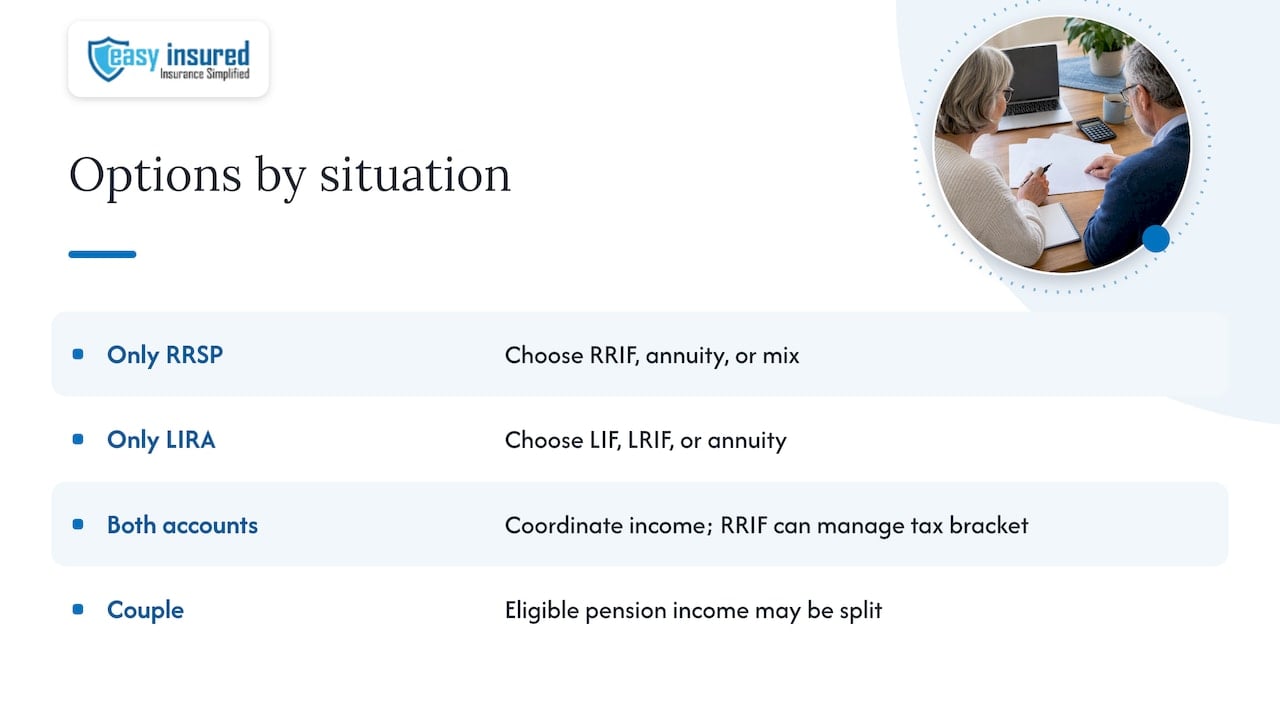
The honest answer is that this is the wrong question if you hold both a LIRA and an RRSP. The more useful question is how to draw from each over time. Here are the situations we see most often.
You have only an RRSP. You are choosing between a RRIF, an annuity or a mix. A RRIF suits you if you want control. An annuity suits you if you want certainty.
You have only a LIRA. You will end up in a LIF, LRIF or annuity. The decision is about how much to hold in each and when to start.
You have both. Plan the combined income. A flexible RRIF can help you manage the tax bracket in a year when a locked-in LIF is paying near its maximum. Spreading withdrawals across years can matter for income-tested benefits, which we cover in our guide to avoiding the OAS clawback.
You are a couple. Eligible pension income may be split with a spouse. The Canada Revenue Agency’s pension splitting page is the place to check what qualifies, since payments from some arrangements are treated differently from life annuity payments. Our pension splitting scenarios show how that plays out for retired couples.
The costs of getting it wrong
Three mistakes are common.
- Treating a LIRA like an RRSP. People assume they can cash out at will. Most cannot, and requests that fall outside the unlocking rules are refused.
- Ignoring tax on the way out. Large lump sums push income into higher brackets. Smaller, planned withdrawals over several years usually cost less than one big one.
- Missing the conversion deadline. Waiting until the last year can leave you rushing to choose between products without comparing them.
A fourth, quieter one: not naming a beneficiary or successor annuitant. What happens to the remaining balance at death depends on the account type, the beneficiary designation and, for locked-in plans, sometimes the pension legislation. If you are married, a spouse can often be named, and that can defer tax. Our estate planning checklist covers the documents that stop probate delays.
A short checklist before you convert
- Confirm the jurisdiction for each locked-in account and ask for its current-year LIF maximum.
- List every income source you expect: pensions, CPP, OAS, RRIF, LIF, and any employment or business income.
- Estimate the tax cost of different withdrawal levels, not just the minimum.
- Decide how much guaranteed income you want from an annuity, if any.
- Review beneficiary designations and your will.
- Look at whether spousal age can be used to reduce the minimum, if you have a younger spouse. Your provider can tell you how it works.
Our perspective
Most people who come to us have a LIRA they forgot about, or an RRSP they never planned to draw. The question is rarely which account is better. It is how the pieces fit together with the rest of a retirement income plan.
We look at the LIF and RRIF as one income engine with different valves. The locked-in side gives you less room to move, so we plan it first: its maximum, its jurisdiction and its minimum. Then we use the flexible RRIF, TFSA and other savings to fill the gaps and manage the tax bracket year by year.
We also treat insurance as part of the same plan. A retirement that depends on one spouse’s pension income is exposed if that spouse dies early. Life insurance can replace the lost income or cover the tax bill on a RRIF at death, and for some families it keeps registered money in the plan rather than forcing it to be sold. We look at that case by case, and we do not suggest it suits everyone. Our piece on whether an insured retirement plan is right for you explains the trade-offs.
If a retirement plan feels like a pile of jargon, that is a sign it needs to be explained properly, with your numbers on the table.
— Frank
Plan the switch with a certified planner
If you hold a LIRA, an RRSP or both and want to see what the income would look like, our retirement planning and estate planning services cover the conversion decision, withdrawal sequencing and beneficiary review. If you are also weighing how to protect a spouse or business partner, we can look at life insurance options alongside the plan. We do not publish prices for planning, so the first step is a conversation.
FAQ
Can I convert my LIRA to a RRIF?
Not directly. A LIRA holds locked-in money, so it normally converts to a LIF or LRIF, which are the locked-in versions of a RRIF, or to a life annuity. Sun Life describes a LIF as a type of RRIF for locked-in pension assets. Some jurisdictions allow part of the money to be unlocked, so ask your provider what applies to you.
What are the disadvantages of a RRIF?
The main one is that you must withdraw a minimum every year, and all of it is taxable. Because the percentage rises with age, a balance that does not grow will pay out more over time. Large withdrawals can also affect income-tested benefits, so it helps to plan amounts before you take them.
How much tax on a $15,000 RRIF withdrawal?
For a resident outside Quebec, withholding on a $15,000 withdrawal above the minimum is $2,500, based on the CRA withholding rates. That is not your final tax. The full amount is added to your income and taxed at your marginal rate when you file.
What happens to a LIRA when you turn 65?
Nothing automatic. The account stays locked in and keeps growing until you convert it to an income account or annuity, normally by the end of the year you turn 71. You can choose to start income earlier, depending on the pension rules that govern the money.
Sources
- LIF: Life Income Fund, Sun Life Canada
- Learn about LIRAs and LIFs, National Bank
- RRSP to RRIF, and LIRA to LIF, MoneySense
- IC78-18R7 Registered Retirement Income Funds, Canada.ca
- Minimum amount from a RRIF, Canada.ca
- Tax rates on withdrawals, Canada.ca
- Pension income splitting, Canada.ca