
Yes, you can access funds in a locked-in RRSP in Canada, but only under specific, jurisdiction-dependent rules. Financial hardship, small-balance provisions, age-55 one-time unlocking, shortened life expectancy, and non-residency are the main doors in. Which ones apply to you depends on whether federal or provincial pension law governs your account, and every route requires forms, evidence, and sometimes your spouse’s signature.
TL;DR:
- Unlocking a locked-in RRSP is limited to specific grounds such as financial hardship, small balances, age 55, shortened life expectancy, or non-residency, with varying provincial rules.
- The maximum amount unlockable often depends on the YMPE, which is $74,600 in 2026, with half of that amount frequently serving as a cap for small-balance and hardship withdrawals.
- The process requires forms and evidence from the account issuer, and spousal consent is usually mandatory, especially for hardship and unlocking applications.
- Unlocked funds are taxable income and lose creditor protection, and the tax withheld at withdrawal often underestimates your actual tax liability.
- Unlocking should be a last resort after exploring alternatives like loans or transfers, as it is irreversible and reduces future retirement income.
Table of Contents
- What Is a Locked-In RRSP, and Why Does Jurisdiction Matter?
- What Grounds Let You Unlock a Locked-In RRSP?
- How Much Money Can You Actually Unlock?
- What’s the Process, and Does Your Spouse Need to Sign Off?
- What Happens to Your Taxes and Creditor Protection?
- How Do You Confirm Whether Your RRSP Is Locked?
- What a Certified Planner Wants You to Ask Before Unlocking
- Should You Unlock Your LIRA, or Leave It Alone?
- How Easy-Insured Helps You Plan Before You Unlock
- Sources
- FAQ
What Is a Locked-In RRSP, and Why Does Jurisdiction Matter?
A locked-in RRSP holds money that started life inside a workplace pension plan, not money you contributed directly. When you leave an employer, that pension value transfers into a locked-in account instead of a regular RRSP, and pension law keeps it locked to make sure it still functions as retirement income decades later. The CRA is direct about this: if your RRSP is locked in, you generally cannot withdraw from it the way you would a normal RRSP, and confirming your account’s status starts with a call to your issuer.
You’ll see several names attached to these accounts, and they aren’t interchangeable:
- LRSP (Locked-In RRSP): the holding account for transferred pension funds before retirement, similar in structure to an RRSP but restricted by pension legislation.
- LIRA (Locked-In Retirement Account): the term used in most provinces for the same type of account. LIRA and locked-in RRSP are largely the same thing under different provincial naming conventions.
- LIF (Life Income Fund): the income-paying account you convert into, similar to a RRIF but with annual maximum withdrawal limits.
- RLIF (Restricted Life Income Fund): a federally regulated version of a LIF that allows a one-time transfer of up to 50% of its value in some cases.
Whether you’re stuck with strict rules or have more flexibility depends on who regulated the original pension. Federally regulated employers (banks, airlines, telecoms, interprovincial transportation) fall under the Office of the Superintendent of Financial Institutions. Provincially regulated employers, which is most of the workforce, fall under regulators like FSRA in Ontario or the BC Financial Services Authority. The unlocking menu differs meaningfully between them.
One date matters regardless of jurisdiction: by December 31 of the year you turn 71, your locked-in RRSP or LIRA must convert into a LIF, RLIF, or a locked-in annuity. You cannot leave it as-is indefinitely, the way TD’s overview of LIRA mechanics lays out.
What Grounds Let You Unlock a Locked-In RRSP?
Five main categories cover almost every legitimate unlocking scenario in Canada, though not every province offers all five.
- Financial hardship. If your income is low or you’re facing high medical, disability, or rental costs relative to income, you may qualify to withdraw a portion. FSRA Ontario’s guidance requires a sworn attestation and supporting evidence, and the amount you can access typically depends on your income relative to a set threshold, not a flat percentage.
- Small-balance or small-pension unlocking. If the total value in your locked-in accounts falls below a set percentage of the YMPE, you may be able to unlock the entire balance in one shot. This is the cleanest exit, since there’s usually no hardship test involved.
- Age-55 one-time unlocking. Several provinces let you transfer up to 50% of your locked-in balance into an unrestricted RRSP or RRIF once you reach age 55, provided you route it through an RLIF or similar vehicle. Federally regulated RLIFs generally give you a 60-day window after the transfer to decide whether to unlock that portion.
- Shortened life expectancy. If a physician certifies that your life expectancy is likely under two years, most jurisdictions allow you to withdraw the full locked-in balance as a lump sum or transfer it out entirely.
- Non-residency. If you’ve been a non-resident of Canada for tax purposes for at least two years, many plans allow full unlocking, subject to the plan administrator’s discretion and paperwork confirming your non-resident status.
Quick reference: the OSFI unlocking chart sets the 2026 YMPE at $74,600, and that single figure anchors most of the small-balance and hardship calculations used across federal and provincial rules.
Provincial variation is real and it trips people up constantly. Ontario, Alberta, and British Columbia all offer some version of financial hardship and small-balance unlocking, but the age-55 one-time option and its cap (usually 50%, though it varies) exist in some provinces and not others, according to comparative summaries like Kalkine’s provincial breakdown. Federally regulated RLIFs follow OSFI’s rules regardless of which province you live in, which is its own source of confusion for people who assume provincial rules automatically apply.
How Much Money Can You Actually Unlock?
The math starts with the Year’s Maximum Pensionable Earnings, which sits at $74,600 for 2026. Half of that, $37,300, is the figure that shows up repeatedly in small-balance and unlocking calculations across federal and several provincial frameworks.
If your LIRA holds $32,000, you likely qualify to unlock the whole thing in one application, assuming your jurisdiction uses that threshold. If it holds $45,000, you’re over the line and need a different route.
Financial hardship unlocking works differently. Instead of a flat cap, most provinces calculate a maximum withdrawal tied to your expected income for the year. Someone with little to no income might be permitted to withdraw an amount equal to half of the YMPE in combined hardship applications for the year, while someone with moderate income might only qualify for a partial withdrawal or none at all.
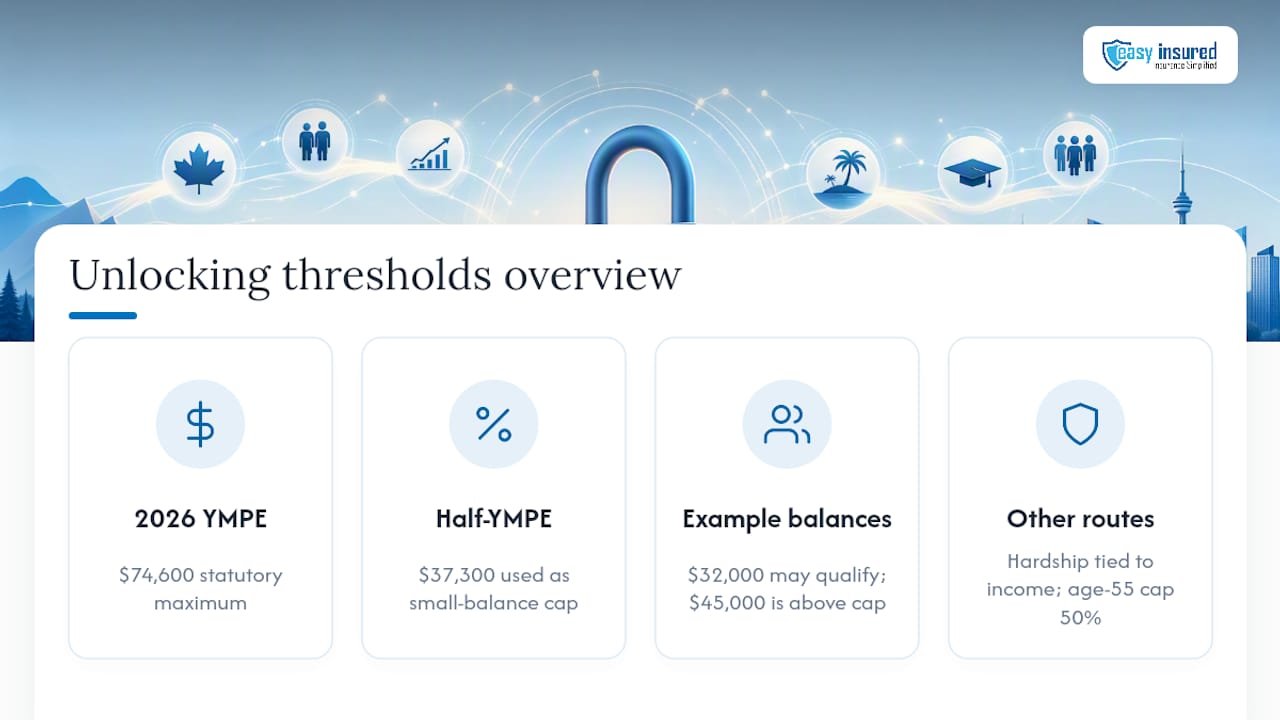
Age-55 one-time unlocking usually caps out at 50% of the account’s value at the time of transfer. Here’s a simplified illustration:
These numbers are illustrative only. Your province, your specific plan text, and whether your account is federal or provincial can all shift the actual cap.
These numbers are illustrative only. Your province, your specific plan text, and whether your account is federal or provincial can all shift the actual cap. A LIRA administered under Quebec rules won’t necessarily mirror a LIRA administered under Manitoba rules, even with identical balances.
What’s the Process, and Does Your Spouse Need to Sign Off?
Start with your account issuer, the bank or investment firm actually holding the LIRA or LRSP. They know which pension jurisdiction applies and can tell you which forms you need before you go looking elsewhere.
- Getting the right forms. OSFI publishes generic attestation forms for federally regulated plans directly on its unlocking guidance page. Provincial regulators like FSRA publish their own versions for hardship and small-balance applications.
- Evidence requirements. Financial hardship applications usually need proof of income (tax returns or pay stubs), and sometimes medical bills or rent receipts if you’re claiming shelter or medical cost hardship. Shortened life expectancy claims require a signed physician’s certification. Non-residency claims need documentation establishing when you left Canada.
- Spousal or common-law partner consent. If you have a spouse or common-law partner, most unlocking applications require their written attestation waiving their entitlement to the funds, since locked-in accounts are designed partly to protect a surviving partner’s retirement security.
- Timing. Processing can take anywhere from a few weeks to a couple of months depending on the issuer and the complexity of the application. Some jurisdictions limit how many unlocking categories you can combine in a single calendar year.
Pro Tip: Call your issuer before you fill out anything. Ask them directly which pension jurisdiction your account falls under, because the wrong form gets rejected and resets your timeline by weeks.
What Happens to Your Taxes and Creditor Protection?
Unlocked money is taxable income in the year you receive it, unless you route it into a tax-deferred vehicle like an RRSP or RRIF where the rules allow that instead of a cash payout. A $20,000 hardship withdrawal added on top of your regular income can push you into a higher marginal bracket for that year, and it can also affect income-tested benefits like the GST/HST credit or Guaranteed Income Supplement eligibility down the road.
The bigger, less obvious cost is what you give up structurally:
- Creditor protection disappears. Locked-in funds are generally shielded from creditors and bankruptcy proceedings. Once unlocked and deposited into a regular account, that shield is gone.
- The decision is permanent. You can’t relock funds once they’ve left the locked-in structure, even if your financial situation improves later.
- Tax withholding rarely covers the full bill. Issuers withhold tax at source, but the rate often falls short of what you’ll actually owe once the income is added to your return.
Industry commentary on this, including Taxtips, consistently flags the creditor protection loss as the consequence people overlook until it matters. Staggering withdrawals across two tax years, or transferring into an RRSP instead of taking cash where that’s permitted, can soften both the tax hit and the protection loss.
How Do You Confirm Whether Your RRSP Is Locked?
You don’t have to guess. A few concrete steps clear this up fast.
- Check your statements and transfer paperwork. Locked-in accounts are labeled as such. Look for LIRA, LRSP, or “locked-in” directly on your statement, or in the transfer documents from when you left your employer.
- Call your issuer first. The financial institution holding the account, or the original pension plan administrator if it hasn’t been transferred yet, can confirm the jurisdiction and locked status immediately.
- Escalate if the answer is unclear. For federally regulated plans, OSFI’s pension guidance is the authority. For provincial plans, your provincial regulator, such as FSRA in Ontario or BCFSA in British Columbia, handles it. For tax questions specifically, the CRA’s withdrawal guidance fills in the gaps.
- If you’re eligible to unlock, gather documents early. Income proof, medical documentation, or non-residency evidence takes time to assemble, so start before you need the money urgently.
What a Certified Planner Wants You to Ask Before Unlocking
Unlocking makes sense for a genuine, often one-time need: a medical emergency, funeral costs, or a documented shortened life expectancy. It makes less sense as a fix for ongoing cash flow problems, because it permanently reduces retirement income to solve a recurring issue that will likely resurface.
Before applying, weigh alternatives: a short-term line of credit, a policy loan against permanent life insurance, or restructuring cash flow through insured retirement plan strategies can sometimes cover the same gap without touching locked-in retirement capital.
Bring these questions to any advisor or issuer conversation:
- Which pension jurisdiction governs my account, and which unlocking categories does it actually offer?
- What’s the realistic processing timeline, and can I combine more than one unlocking ground this year?
- Does my spouse or common-law partner need to sign an attestation, and what happens if they decline?
- What will I actually owe in tax once this is added to my income, not just what gets withheld at source?
Pro Tip: Ask your issuer for the withholding rate on the withdrawal specifically, then compare it to your marginal tax rate for the year. The gap between the two is usually bigger than people expect.
Should You Unlock Your LIRA, or Leave It Alone?
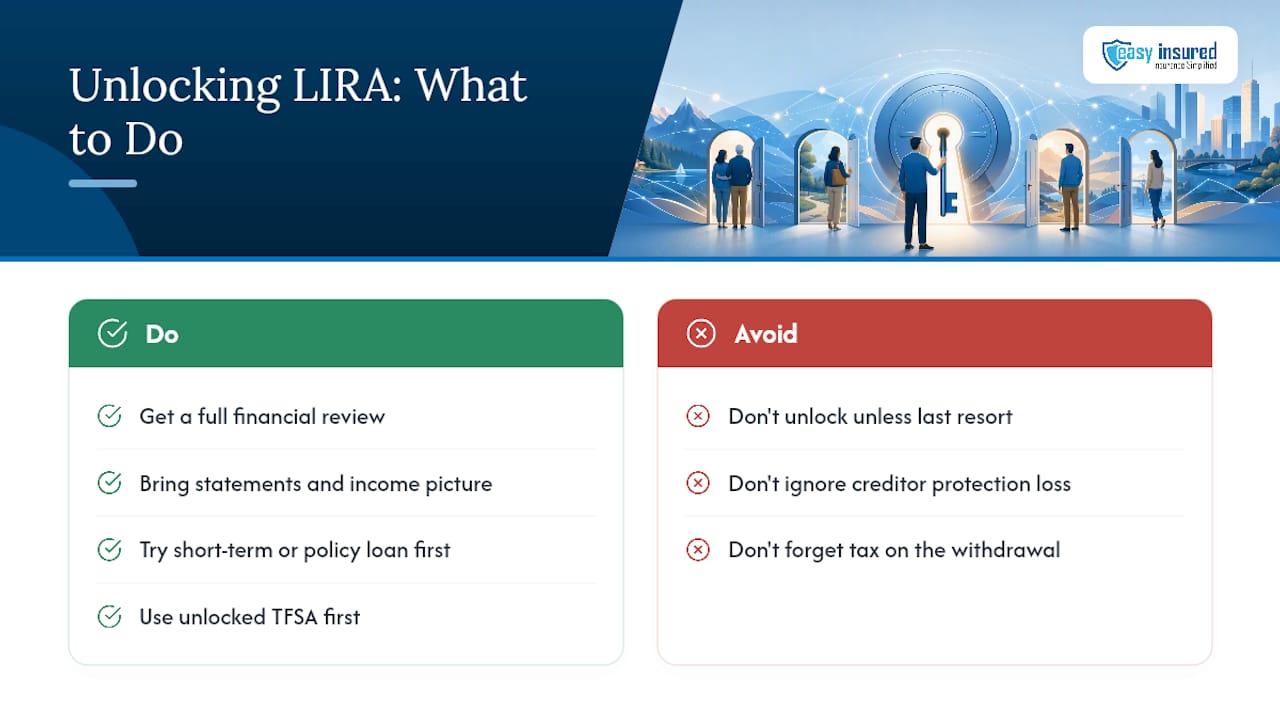
My honest read on this: unlocking should be the last option you reach for, not the first. It’s irreversible, it strips away creditor protection permanently, and it converts a shielded retirement asset into taxable income in a single stroke. If the need is a one-time expense and you have any other route, a short-term loan, a policy loan, drawing from an unlocked TFSA, take that route first.
A full financial planning review is typically recommended before anyone signs an unlocking attestation, because the tax and long-term income effects are rarely as simple as the withdrawal amount suggests. If you’re weighing this decision, bring your account statements and a rough income picture to that conversation. It changes the advice significantly.
— Frank
How Easy-Insured Helps You Plan Before You Unlock
Unlocking a LIRA is a one-way decision, and the tax bill often lands harder than expected once withholding falls short of your real marginal rate. Easy-insured’s retirement planning and financial planning services walk through exactly that math with a certified financial planner before you sign anything, factoring in your income for the year, your provincial jurisdiction, and whether a transfer into an RRSP or insured retirement plan beats a straight cash withdrawal.

Before your consultation, gather your locked-in account statements, your most recent tax return, and any documentation tied to your unlocking ground, whether that’s medical bills, proof of non-residency, or a physician’s certification. Easy-insured’s financial planning page has more on how these sessions work. Book a no-obligation consult to find out whether unlocking, transferring, or an alternative liquidity option fits your actual numbers before you file a single form.
This article is general information, not a substitute for advice from a qualified financial advisor. Consult a qualified financial professional about your own circumstances before acting on anything here.
Sources
- Unlocking funds from a pension plan or from a locked-in retirement savings plan – OSFI
- Canada
- Withdrawing from locked-in accounts because of financial hardship – FSRA Ontario
FAQ
Can I Withdraw Money From a Locked-In RRSP?
Only under specific unlocking grounds set by federal or provincial pension law, such as financial hardship, small-balance provisions, age-55 one-time unlocking, shortened life expectancy, or non-residency. There’s no general-purpose withdrawal option the way there is with a regular RRSP, and each ground has its own forms and evidence requirements.
What Does It Mean if Your RRSP Is Locked-In?
It means the money originated in a workplace pension plan and pension legislation, not just tax rules, restricts how and when you can access it. The CRA confirms that locked-in RRSP holders generally cannot withdraw funds outside the recognized unlocking categories.
What Is the Difference Between an RRSP and a Locked-In RRSP?
A regular RRSP holds your own contributions and you can withdraw from it anytime, though you’ll pay tax and lose the contribution room. A locked-in RRSP or LIRA holds transferred pension money and stays restricted by provincial or federal pension standards designed to preserve it as retirement income.
Why Is It Better to Leave Your LIRA Locked?
Leaving it locked preserves creditor protection and keeps the full balance working toward retirement income instead of triggering an immediate tax bill. Once you unlock funds, that protection is gone permanently and the withdrawal is taxed as income in the year you receive it, a tradeoff advisory sources consistently flag as easy to underestimate.
How Do I Know Which Regulator Governs My Locked-In Account?
Check whether your former employer was federally regulated (banking, airlines, telecoms, interprovincial transport) or provincially regulated, which covers most employers. Your issuer can confirm this directly, and federal accounts fall under OSFI while provincial accounts fall under regulators like FSRA in Ontario or BCFSA in British Columbia.