
Canada has no inheritance tax. If a parent, spouse or relative leaves you money or property, you do not pay tax simply because you received it, and you do not report the inheritance as income. The catch is that the person who died is taxed on their final return, and the estate pays that bill before you receive anything. That is where most of the confusion, and most of the surprises, come from.
This guide explains what is taxed, who pays, and what you can do about it, whether you expect to inherit or you are planning to leave something behind.
TL;DR
- Canada has no federal or provincial inheritance tax. Heirs generally do not pay tax on what they receive or report it as income.
- The deceased is treated as having sold their capital property just before death, so the estate can owe capital gains tax and income tax on registered accounts.
- Probate fees are a provincial matter, separate from income tax, and vary widely by province.
- Executors who distribute before getting a CRA clearance certificate can be personally liable for unpaid tax.
- Income you earn on inherited money is taxable to you, and U.S. property can trigger U.S. estate tax for Canadians.
Table of Contents
- Is inheritance taxable in Canada?
- Why people believe Canada has an inheritance tax
- What the estate pays: the final tax return
- Probate fees are not income tax
- A quick map: who pays what
- The executor’s exposure
- The U.S. estate tax wrinkle
- What you should do after you inherit
- How to reduce the bite when you are the one leaving the estate
- Our perspective: the tax is rarely the real problem
- Where Easy Insured can help
- FAQ
- Sources
Is inheritance taxable in Canada?
For the person receiving it, almost never. The Canada Revenue Agency lists most gifts and inheritances among the amounts that are not reported or taxed. You do not enter a $50,000 cash inheritance on your tax return, and you do not owe tax on it.
This holds whether the money arrives as cash, a house, shares or a share of a business. What changes from one asset to another is the tax the estate paid before handing it over, and the tax you may face later when you sell or earn income from what you received.
A few practical points follow from this:
- You do not file anything just because you inherited. There is no inheritance form for the recipient in the ordinary case.
- The amount you receive is net. If the estate owed tax, the executor pays it first. Your share is what remains.
- Later events are yours. Interest, dividends and capital gains after you take ownership belong on your own return.
Why people believe Canada has an inheritance tax
Three things create the impression.
First, the United States and several European countries do tax heirs or estates directly, and Canadians hear about it. A TD Wealth tax and estate planner describes this as the source of the question she hears most often.
Second, Canada does tax the deceased person. The estate pays real money at death, and that reduces what the family receives. To an heir, a smaller inheritance feels like a tax even though the law taxes the estate, not the recipient.
Third, probate fees look like a tax. They are charged on the estate’s value in many provinces and are easy to confuse with an inheritance levy. More on that below.
What the estate pays: the final tax return
When someone dies, the legal representative files a final (terminal) return. Whether the person had a will or not, the deceased is deemed to have disposed of all assets immediately before death. Nothing is actually sold, but the tax system treats it as if everything was, at fair market value.
This is called deemed disposition, and it creates two main categories of tax.
Capital gains on non-registered assets
If the deceased owned investments outside registered accounts, or real estate that was not their principal residence, the increase in value since purchase is a capital gain. According to TD Wealth, generally 50% of unrealized capital gains are taxable for these assets. A cottage or rental property bought decades ago is the classic example: the gain may be large, and the estate needs cash to pay the resulting tax.
A family home that qualifies as the deceased’s principal residence is typically treated differently, and a surviving spouse can often receive property on a tax-deferred basis. Because the rules depend on the facts, an estate accountant should confirm how each asset is treated.
Registered accounts: RRSPs and RRIFs
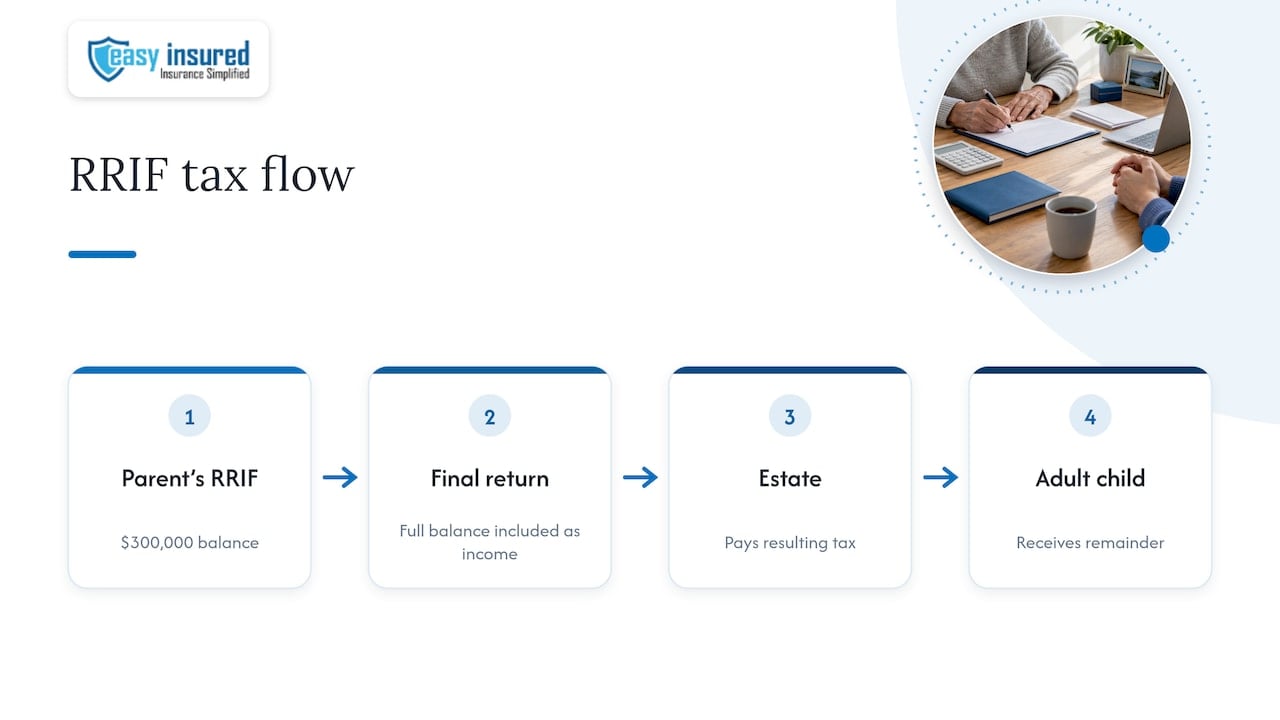
RRSPs and RRIFs are generally included in full as income on the final return, unless they pass to a surviving spouse. Naming a non-spouse beneficiary does not erase that. As the TD guidance explains, the full value stays taxable on the final return, and the beneficiary receives the remainder only after the estate pays the associated tax.
Here is a simple illustration, with invented round numbers and no tax rates applied. A parent dies with a $300,000 RRIF and a named adult child as beneficiary. The full $300,000 lands on the parent’s last return as income. The tax on it is paid out of the estate, and the child receives what is left. The beneficiary designation sends the money outside the will, but it does not remove the tax.
If you want to understand how the timing of withdrawals shapes that outcome while the account holder is alive, our piece on RRIF withdrawal rules and the age 71 tax timing covers it. For the cost of taking money out of an RRSP, see RRSP withholding tax and what to do about it.
TFSAs
TFSAs are the friendliest account at death. The balance is not taxed as income to the estate, and a spouse named as successor holder can keep the account’s tax-free status. Growth after the date of death on a TFSA that goes to a non-spouse beneficiary can become taxable, so the details matter. Our guide to TFSA successor holder rules and Quebec risks walks through the options.
Probate fees are not income tax
Probate is the court process that confirms a will and gives the executor authority to act. The fees attached to it are not federal taxes. Estate law, including wills and probate fees, falls under provincial and territorial jurisdiction, so the amount depends on where the person lived and what they owned.
Several points are worth knowing:
- Fees are generally calculated on the value of assets that pass through the will, which can include real estate and unregistered accounts.
- Assets with a named beneficiary, such as many insurance policies and registered accounts, and jointly held assets with right of survivorship may fall outside the estate for probate purposes.
- Probate fees and funeral expenses are generally not deductible from the income tax payable on the final return, according to the same federal page.
Provincial differences are significant. We keep a current comparison in Canada probate fees by province, and if you live in the largest province, there is a dedicated guide on how to avoid probate in Ontario. For the process itself, read probate in Canada: a clear guide for executors.
A quick map: who pays what
| Item | Who is taxed or charged | Where it shows up |
|---|---|---|
| Cash or property you inherit | Nobody, on receipt | Not reported by the heir |
| Deemed capital gains on non-registered assets | The estate | Deceased’s final return |
| RRSP or RRIF to a non-spouse | The estate | Deceased’s final return as income |
| RRSP or RRIF to a surviving spouse | Generally deferred | Taxed later, when the spouse withdraws |
| Probate fees | The estate | Provincial fee, paid to the court or province |
| Income earned on inherited money | The heir | Heir’s own tax return |
| U.S. estate tax on U.S. assets | The estate | U.S. filing, where thresholds apply |
The executor’s exposure
The person who administers the estate carries real responsibility. The legal representative handles the deceased’s affairs, including filing returns and settling what is owed.
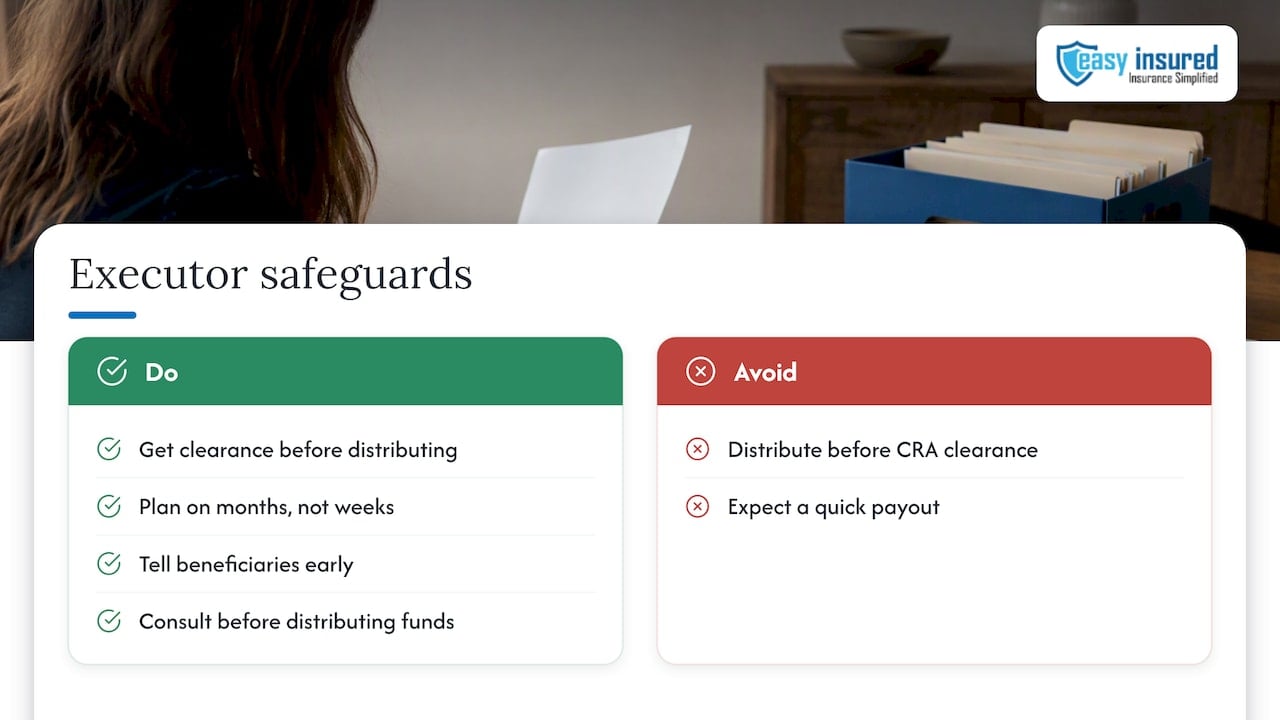
The key safeguard is the clearance certificate. If the representative distributes estate property before getting one from the CRA, they can be personally liable for the deceased’s unpaid tax. The CRA’s current service standard aims to process these requests within 120 calendar days, 90% of the time. Plan on months, not weeks, and tell beneficiaries early so nobody expects a quick payout.
Liquidity is the second trap. If the tax bill is large and the estate holds mostly a cottage or a business, there may be no cash to pay it. Fidelity notes that when liquid assets fall short, the CRA may pursue beneficiaries or force a sale of assets, including a family property. Executors who are also beneficiaries should see an estate lawyer or accountant before distributing anything.
Our executor’s one page checklist lays out what to confirm before any funds move.
The U.S. estate tax wrinkle
Canadians with a Florida condo, an Arizona vacation home or a portfolio of U.S. stocks can face a real estate tax, just not a Canadian one. Tax planners cited by Fidelity point to a threshold often around US$60,000 for non-Americans above which U.S.-situated assets may create a liability. Treaty relief can reduce or eliminate it in some cases, but the filings are complex. If you hold U.S. property or securities, get cross-border advice before you assume nothing is owed.
What you should do after you inherit
The inheritance itself is tax-free. What you do next is not.
- Park the money before deciding. A high-interest savings account is fine for a few months while you sort out your priorities.
- Expect tax on the earnings. National Bank notes that income earned from investing an inheritance is fully taxable to you.
- Think twice about joint debts. The same source warns that using inherited money to pay down a joint mortgage can have legal consequences if the relationship ends, depending on province and marital status.
- Know your cost base. Property you inherit is generally treated as acquired at its fair market value when you received it. Keep the valuation, because it sets the starting point for any gain when you later sell.
- Use your own registered room. Inherited cash can go into your TFSA or RRSP if you have contribution room, so future growth is sheltered.
How to reduce the bite when you are the one leaving the estate
You cannot make the deemed disposition disappear, but you can make sure the estate can afford it and that the right people receive the right assets.
- Estimate the final tax bill. List non-registered investments, secondary properties, business shares and registered accounts, then work out what a final return might look like. An accountant can model it in an afternoon.
- Create liquidity. Life insurance paid to a named beneficiary or to the estate can cover the tax on a cottage or RRIF without forcing a sale. This is the classic use of permanent coverage in estate planning.
- Use spousal rollovers where they fit. Registered accounts and capital property can often pass to a spouse on a deferred basis. The tax is not gone, but it moves to a later date.
- Keep beneficiary designations current. A divorce, a new child or a death in the family can leave an old form pointing the wrong way.
- Trim probate exposure. Joint ownership, beneficiary designations and trusts can all reduce what runs through the will, but each has side effects. Read how to avoid probate in Canada before you retitle anything.
- Write down where things are. Our estate planning checklist covers the documents that stop delays, and estate planning strategies to reduce estate taxes goes deeper on structure.
Our perspective: the tax is rarely the real problem
When families come to us after a death, the issue is almost never that Canada taxes inheritances. It is that nobody told the estate it would owe tax, so the executor is staring at a six-figure bill with a house, a RRIF and no cash.
We look at estates the way a lender would look at a loan: what is owed, when, and from which pool of money. If the answer is “from selling the family cottage,” that is a planning gap, and it is fixable while the owner is still alive. A modest permanent life policy, a better beneficiary structure or a spousal rollover plan often costs far less than a forced sale.
The second pattern we see is paperwork written for one era of a family. A will from before a second marriage, or a designation naming a former partner, can undo everything else. We would rather spend an hour reviewing documents than watch a family spend two years in dispute.
You should not need to speak insurance or tax jargon to make these decisions. Ask for the numbers in plain terms, ask what happens if you die next year, and ask who pays the tax. If an advisor cannot answer those three, keep looking.
— Frank
Where Easy Insured can help
We are an insurance and financial planning brokerage serving Canadian families and business owners. If you are worried about an estate tax bill, we can help you work out how to fund it through life insurance, including whole life and term life, and coordinate it with estate planning. If you are an executor or heir dealing with a death now, final expense insurance and our financial planning service are good starting points. Our advisors work with certified financial planners and keep the process free of jargon.
FAQ
How much can you inherit tax free in Canada?
There is no limit. The recipient does not pay tax on the amount inherited, whether it is $5,000 or $5 million. What can reduce the amount is tax the estate owes on the deceased’s final return and any probate fees, which are settled before distribution.
Do you have to report inheritance money to the CRA?
In the ordinary case, no. Most inheritances are among the amounts the CRA says you do not report or pay tax on. You do report income you earn afterward, such as interest or dividends, and any gain when you sell inherited property.
Is it better to gift or inherit property in Canada?
It depends on the property and the family. Gifting a non-principal residence in life generally triggers a deemed sale at fair market value, so the giver can face the capital gain at that point. Leaving it in a will triggers the same idea at death, so the better route turns on timing, probate, and who needs the property. Get advice from an accountant and an estate lawyer before transferring title.
Can an heir be forced to pay the deceased’s tax debt?
Usually the estate pays first, and the executor is the person at risk if they distribute without a clearance certificate. If the estate lacks cash, the CRA can look to beneficiaries or require assets to be sold, according to Fidelity’s explanation. Ask the executor whether a certificate has been obtained before accepting a large distribution.
Sources
- CRA: Amounts that are not reported or taxed
- TD Wealth: How does inheritance tax work in Canada?
- CRA Income Tax Audit Manual, Chapter 17
- Canada.ca: What to do when someone dies, estates and wills
- CRA: Represent someone who died
- CRA: Service standards 2026-2027
- Fidelity: Canadian inheritance tax, is there such a thing?
- National Bank: Investing inheritance money