
Canada has no formal estate tax, but death still triggers a substantial tax bill. Under the Income Tax Act, every Canadian is deemed to have sold all capital property at fair market value the moment they die. That deemed disposition can generate a capital gains tax hit, probate fees on top, and a liquidity crunch that forces heirs to sell assets they wanted to keep. The right estate planning strategies to reduce estate taxes can defer, split, or eliminate much of that burden before it arrives.
Here are the core methods that actually move the needle:
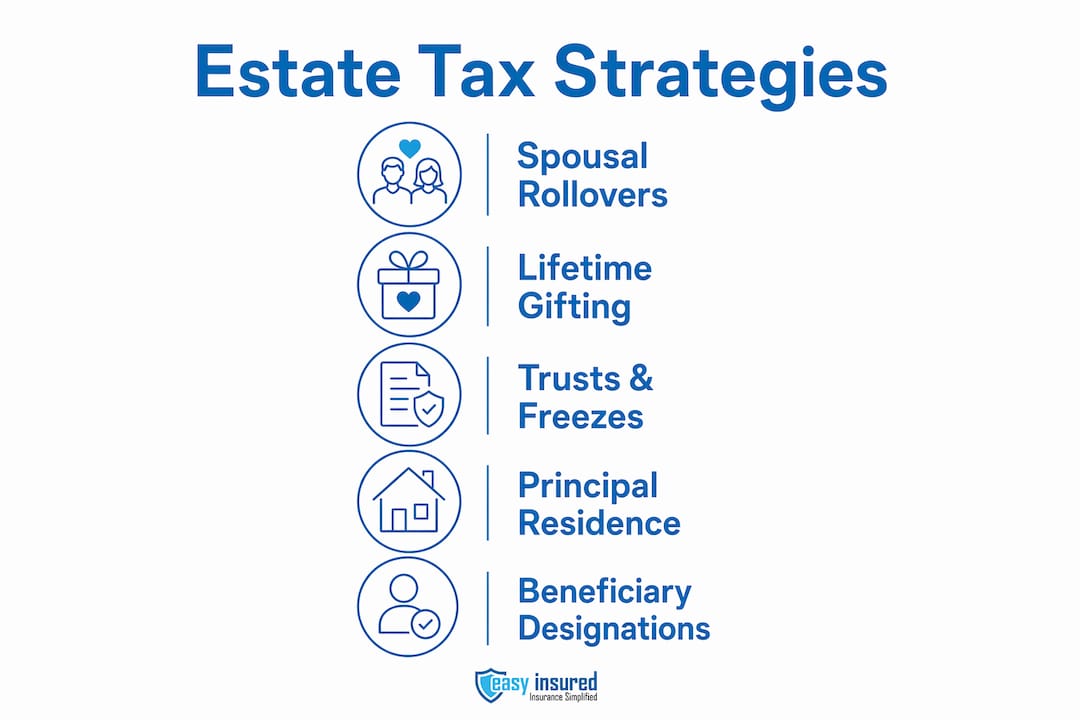
- Spousal rollover under ITA section 70(6): Assets transfer to a surviving spouse at original cost base, deferring capital gains tax entirely until the spouse sells or dies.
- Lifetime gifting: Transferring appreciated assets while alive can shift future gains to recipients, though the gift itself triggers a deemed disposition at fair market value.
- Trusts (alter ego, joint partner, testamentary): These structures defer or split tax liabilities, keep assets out of probate, and give you control over how wealth passes.
- Life insurance: A joint last-to-die policy pre-funds the final tax bill with tax-free proceeds, solving the liquidity problem without forced asset sales.
- Principal residence exemption: Shelters capital gains on a qualifying home from tax entirely.
- Beneficiary designations and joint ownership: Assets with named beneficiaries or held jointly bypass probate fees, though capital gains tax still applies.
- Graduated rate estate (GRE): For 36 months after death, the estate is taxed at graduated personal rates rather than the flat top trust rate.
Each of these strategies works best when coordinated. The sections below break down how they interact with Canadian tax law and where the real planning opportunities sit.
Table of Contents
- How estate taxes actually work in Canada at death
- The most effective estate planning strategies to reduce estate taxes
- Special considerations for business owners and high-net-worth families
- Charitable giving and other tactics that further reduce estate taxes
- How life insurance supports effective Canadian estate planning
- Tax implications for RRSPs, RRIFs, and RESPs in estates
- Easy-insured helps you build a tax-efficient estate plan
- Key Takeaways
How estate taxes actually work in Canada at death
Canada does not have a formal estate tax or inheritance tax. What it does have is a set of rules that create an equivalent burden through a different mechanism.
Deemed disposition is the starting point. The CRA treats every deceased person as having sold all capital property at fair market value immediately before death. If a cottage purchased for $200,000 is worth $800,000 at death, the estate faces a $600,000 capital gain. At the prevailing inclusion rate, half of the capital gain amount enters the final return as taxable income.
A note on the inclusion rate: the 2025 federal budget proposed raising it to two-thirds, but that change was deferred. The capital gains inclusion rate for deemed dispositions at death remains one-half (50%) for 2026, as confirmed by the CRA, providing planning certainty. Probate fees are provincial charges on the estate’s gross value before debts, and they vary significantly:
- Ontario: approximately 1.5% on assets over $50,000
- British Columbia: approximately 1.4% on assets over $25,000
- Alberta: capped at $525 regardless of estate size
- Quebec: no probate fees on notarial wills
Key distinctions worth knowing:
- Beneficiary designations on RRSPs, TFSAs, RRIFs, and life insurance policies pass those assets directly to named beneficiaries, bypassing probate entirely.
- Joint tenancy with right of survivorship also avoids probate, but does not eliminate the deemed disposition tax on accrued gains.
- Graduated rate estate status applies for 36 months after death, letting the estate use graduated personal income tax rates rather than the flat top rate applied to ordinary trusts.
The practical upshot: a well-structured estate can legally reduce both the capital gains exposure and the probate fees, but only if the planning happens before death.
The most effective estate planning strategies to reduce estate taxes
Spousal rollovers under ITA section 70(6)
The spousal rollover is Canada’s most powerful single tool for deferring capital gains at death. When assets transfer to a surviving spouse or common-law partner, they move at the original adjusted cost base rather than fair market value. No capital gain is triggered. The tax defers until the surviving spouse sells the asset or dies.

This applies to most capital property, including investment portfolios, rental properties, and business interests. The executor can also elect out of the rollover for specific assets when it makes sense, for example to use up remaining capital losses or the lifetime capital gains exemption.
Lifetime gifting
Giving assets away while alive reduces the estate’s value, which lowers both the deemed disposition exposure and probate fees. The catch: gifting a capital property triggers a deemed disposition at fair market value on the date of the gift, just as death would. Cash gifts carry no immediate tax consequence, but gifting a stock portfolio or rental property does.
The strategy works best for assets with low accrued gains, or when the recipient is in a lower tax bracket and can absorb the gain more efficiently. Gifting to a spouse is subject to attribution rules, meaning income earned on the gifted asset may still be attributed back to the donor.
Trusts for tax deferral and control
Three trust types dominate Canadian estate planning:
- Alter ego trust: Available to individuals 65 or older. Assets transfer to the trust at cost base, deferring gains. The settlor retains full control and use during their lifetime. At death, the trust assets bypass probate.
- Joint partner trust: Same mechanics as an alter ego trust but for spouses. Both spouses can use and control the assets. The deemed disposition occurs at the second death.
- Testamentary trust: Created by a will. Useful for income splitting among beneficiaries, particularly minor children or family members in lower tax brackets.
Before the 21-year deemed disposition rule forces a trust to recognize gains, trustees can roll assets out to Canadian-resident beneficiaries at adjusted cost base, deferring the tax further.
Pro Tip: Coordinate your trust documents with your will and your final tax filing strategy before you finalize either. A trust that bypasses probate but conflicts with your will’s executor powers can create expensive legal disputes.
Estate freezes and family trusts
An estate freeze locks in the current value of appreciating assets, typically a business or investment portfolio, so future growth accrues to the next generation rather than the estate. The owner exchanges growth assets for fixed-value preferred shares. A family trust then holds the common shares, and future appreciation flows to beneficiaries through the trust.

Family trusts used in estate freezes must be structured carefully to comply with CRA attribution rules and general anti-avoidance provisions. Done correctly, the freeze caps the owner’s eventual capital gains exposure at today’s value while shifting tomorrow’s gains to heirs at lower tax cost.
Principal residence exemption
A property qualifies for the principal residence exemption if it was ordinarily inhabited by the owner or their family in each year of ownership. The exemption shelters the full capital gain from tax. Only one property per family unit can be designated per year, so families with multiple properties need to plan which designation maximizes the tax savings.
Beneficiary designations and joint ownership
Naming beneficiaries directly on RRSPs, RRIFs, TFSAs, and life insurance policies keeps those assets out of the estate entirely. They transfer directly to the named person, avoiding probate fees and the delays of estate administration. Joint tenancy on real estate works similarly for probate purposes, though the capital gains tax on the deceased’s share still applies.
The planning nuance: an RRSP or RRIF with no named beneficiary collapses into the estate and triggers full income inclusion on the final return. Naming a spouse as beneficiary allows a tax-deferred rollover to their own RRSP.
Special considerations for business owners and high-net-worth families
The core problem for business owners at death is not the tax rate. It is the timing. A $3 million capital gain on a private company’s shares generates a tax bill due within six months of death, and private company shares are not liquid. That mismatch forces estates to either borrow at unfavorable terms or sell the business at a discount.
Holding company structures combined with estate freezes and family trusts address this directly. The operating company’s value is frozen at the owner’s level; future growth flows to a family trust holding common shares. The owner’s preferred shares carry a fixed redemption value, which becomes the taxable estate exposure. That number is known in advance, which means it can be pre-funded.
Pipeline planning is another tool specific to estates with operating companies. Rather than triggering double taxation (once at the corporate level and again as a dividend to the estate), a pipeline plan extracts the corporation’s value as a capital gain. The estate uses a holding company and promissory notes to convert dividend income into capital gains treatment, cutting the effective tax rate significantly.
Corporate-owned life insurance (COLI) adds a liquidity layer. The corporation owns and pays premiums on a permanent life insurance policy. At death, the death benefit credits the corporation’s Capital Dividend Account, allowing tax-free capital dividends to flow to the estate or heirs. The net result: the tax bill gets paid without selling the business, and the heirs receive the full value of the enterprise.
Pro Tip: Estate planning for business owners requires a team, not a single advisor. A tax accountant, an estate lawyer, and a licensed insurance advisor working from the same plan will catch gaps that any one of them would miss alone.
Charitable giving and other tactics that further reduce estate taxes
Charitable donations made in a will, or by the estate within 60 months of death, generate donation tax credits that reduce the final tax payable. A graduated rate estate can carry those credits back to the year of death or forward within the GRE’s 36-month window, giving the executor flexibility to apply them where they do the most work.
Donating publicly traded securities directly (rather than selling them first and donating cash) eliminates the capital gain on the donated shares entirely. The estate receives the full donation credit with no capital gains inclusion. For large estates with significant investment portfolios, this can be one of the most efficient tax moves available.
Additional tactics worth knowing:
- Multiple wills: In Ontario and some other provinces, a secondary will covering private company shares and certain other assets can avoid probate fees on those assets entirely, since private company shares often do not require probate for transfer.
- Strategic TFSA use: A TFSA with a named successor holder (available to spouses) transfers the full balance tax-free. Without a successor holder, the TFSA loses its exempt status after death, and any growth after the date of death becomes taxable.
- RRSP/RRIF beneficiary planning: Naming a financially dependent child or grandchild as beneficiary can spread the income inclusion over their lifetime through an annuity, reducing the tax hit compared to a lump-sum inclusion on the final return.
- Timing of charitable gifts: Large donations in the year of death can offset the capital gains triggered by deemed disposition, particularly when the estate holds appreciated securities.
For retirees thinking about how estate planning fits into a broader retirement portfolio strategy, the interaction between registered accounts, non-registered investments, and charitable giving deserves careful attention well before the estate planning stage.
How life insurance supports effective Canadian estate planning
Life insurance is not just a safety net. In the context of estate planning, it is a pre-funding mechanism that converts a future tax liability into a known, manageable premium.
Permanent life insurance (whole life and universal life) builds cash value on a tax-deferred basis inside the policy. That growth is not taxed annually, unlike interest income in a non-registered account. At death, the death benefit pays out tax-free to the named beneficiary or to the estate, providing immediate liquidity exactly when it is needed most.
Joint last-to-die policies are the standard tool for funding the “final tax.” Because the spousal rollover defers capital gains until the second death, the real tax exposure crystallizes when the surviving spouse dies. A joint last-to-die policy pays out at that moment, matching the timing of the liability precisely. Premiums are lower than two individual policies because the insurer pays only once.
Life insurance is the only financial instrument that can guarantee a specific dollar amount will be available on a specific date, regardless of market conditions. For estate planning, that certainty is worth more than the rate of return.
Corporate-owned life insurance takes this further. The corporation pays premiums from pre-tax corporate dollars (more efficient than personal after-tax dollars), and the death benefit credits the Capital Dividend Account. Heirs receive tax-free capital dividends. The Estate Bond strategy takes this concept one step further: moving capital from a taxable investment account into a permanent life insurance policy converts taxable growth into tax-exempt growth, increasing the net legacy passed to heirs.
Key life insurance benefits for estate planning:
- Death benefits bypass probate when a beneficiary is named directly
- Permanent policies provide tax-deferred cash value accumulation
- Joint last-to-die policies match payout timing to the actual tax liability
- Corporate-owned policies fund the Capital Dividend Account for tax-free dividends
- Universal life policies offer flexible premium structures suited to business owners with variable cash flow
Pro Tip: Review your life insurance coverage every time your estate plan changes, including after a business restructuring, a property purchase, or a significant change in investment portfolio value. The coverage amount that made sense five years ago may not match today’s tax exposure.
Easy-insured works with Canadian families and business owners to design life insurance solutions that integrate directly with their estate plans, from joint last-to-die policies to corporate-owned structures tied to holding companies.
Tax implications for RRSPs, RRIFs, and RESPs in estates
Registered accounts carry some of the largest tax exposures in a Canadian estate, and they are also among the most plannable.
RRSPs and RRIFs are fully included in income on the final return unless they roll over to a qualifying beneficiary. The full fair market value of the account is treated as income in the year of death, potentially pushing the estate into the top marginal rate. The exceptions:
- A spouse or common-law partner named as beneficiary can roll the RRSP or RRIF into their own registered account with no immediate tax.
- A financially dependent child or grandchild with a disability can roll the funds into their own RRSP.
- A financially dependent child or grandchild (not disabled) can use the proceeds to purchase a fixed-term annuity to age 18, spreading the income over several years.
Without any of these rollovers, a $500,000 RRIF collapses entirely into the final return. At a combined federal-provincial marginal rate above 50% in most provinces, that means more than $250,000 in tax on that account alone.
TFSAs are simpler but still require attention. A spouse named as successor holder takes over the account with no tax and no impact on their own TFSA contribution room. Any other beneficiary receives the balance tax-free up to the date of death, but growth after death is taxable. The account loses its exempt status once the holder dies unless a successor holder is in place.
RESPs present a different issue. If the beneficiary (the student) has not used the plan, the estate has limited options. The subscriber’s estate can transfer the RESP to another eligible beneficiary, collapse the plan (returning contributions tax-free but triggering income inclusion on the grant money and growth), or, in some cases, roll the accumulated income into the subscriber’s RRSP if contribution room exists. Planning ahead, particularly by naming a contingent subscriber, avoids the forced collapse scenario.
The common thread across all registered accounts: beneficiary designations and successor holder designations are the single highest-leverage planning step, and they cost nothing to update.
Easy-insured helps you build a tax-efficient estate plan
Estate planning in Canada involves more moving parts than most families expect. The tax deferral from a spousal rollover, the liquidity from a joint last-to-die policy, the probate savings from proper beneficiary designations, and the income splitting from a testamentary trust all need to work together. Getting one piece right while ignoring the others leaves real money on the table.

Easy-insured brings together life insurance, financial planning, and estate planning services under one roof for Canadian families and business owners. Whether you need a whole life policy to pre-fund your final tax bill, a corporate-owned structure tied to your holding company, or a straightforward review of your beneficiary designations, Easy-insured’s advisors work with your existing accountant and lawyer to fill the gaps. The goal is a plan where the tax bill is known, funded, and that does not force your heirs to sell what you built. Connect with Easy-insured to get a personalized estate planning review and find out exactly what your current exposure looks like.
Key Takeaways
Canada’s most effective estate tax reduction strategy combines spousal rollovers, permanent life insurance, and properly structured trusts to defer capital gains, fund the final tax bill, and keep assets out of probate.
| Point | Details |
|---|---|
| Spousal rollover defers tax | ITA section 70(6) transfers assets at cost base, pushing capital gains tax to the surviving spouse’s death or sale. |
| 50% inclusion rate confirmed for 2026 | The capital gains inclusion rate on deemed dispositions at death remains one-half (50%) for 2026, as confirmed by the CRA. |
| Life insurance funds the final tax | Joint last-to-die policies pay out tax-free proceeds exactly when the surviving spouse’s estate faces its largest tax bill. |
| Beneficiary designations bypass probate | Naming beneficiaries on RRSPs, TFSAs, and life insurance avoids probate fees and speeds up asset transfer to heirs. |
| Easy-insured for integrated planning | Easy-insured combines life insurance and estate planning services to help Canadian families reduce tax exposure and preserve wealth. |