
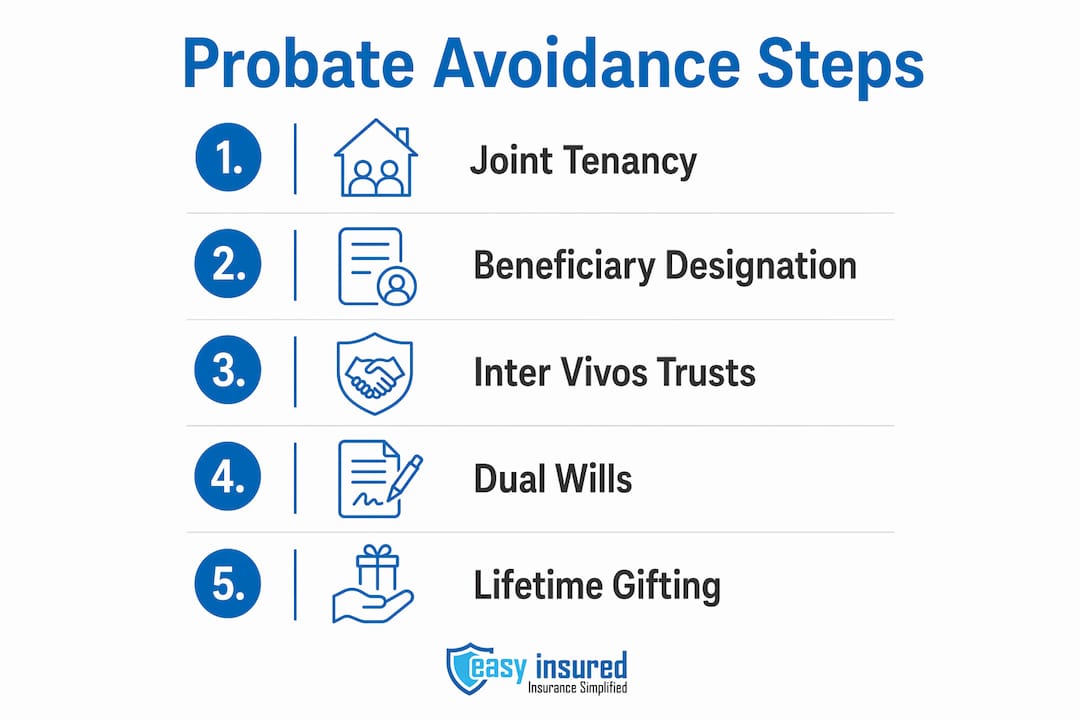
Avoiding probate in Ontario comes down to a handful of legal tools used before death, not after, supported by specialized tax planning services focused on minimizing probate-related consequences. The most effective strategies are joint tenancy with right of survivorship, named beneficiary designations on registered accounts and life insurance, inter vivos trusts, alter ego trusts for those 65 and older, and dual wills for business owners. Used correctly, these methods can keep assets out of the probate process entirely, saving your estate the Estate Administration Tax and months of court delays. Used carelessly, they create tax problems, creditor exposure, and family disputes that cost far more than the fees they were meant to avoid.
The core strategies at a glance:
- Joint tenancy with right of survivorship: Real estate and bank accounts pass directly to the surviving co-owner, bypassing probate.
- Beneficiary designations: RRSPs, RRIFs, TFSAs, and life insurance policies transfer directly to named beneficiaries, often within 30–60 days versus 6–18 months for a probated estate.
- Inter vivos (living) trusts and alter ego trusts: Assets held in trust never form part of the probate estate.
- Dual wills: A secondary will governs assets that don’t require probate, potentially reducing probate exposure by a significant percentage depending on asset composition.
- Lifetime gifting: Transferring assets before death removes them from the estate, though capital gains tax may apply.
Good probate avoidance is coordinated. A beneficiary designation that contradicts your will, or a joint tenancy added without legal advice, can force probate or trigger litigation even when the intention was to avoid both.
What is probate in Ontario, and when is it required?
Probate is the court process that confirms a will is valid and gives the executor legal authority to manage and distribute the estate. In Ontario, this means applying for a Certificate of Appointment of Estate Trustee and paying the Estate Administration Tax: $0 on the first $50,000 of estate value, then $15 for every $1,000 above that. On a $1 million estate, that’s roughly $14,250 in tax alone, plus legal fees and months of waiting before the executor can sell or transfer anything.
Probate is generally required when:
- The deceased solely owned real property registered in Land Titles Absolute.
- Financial institutions or other asset holders require a court-issued certificate before releasing funds.
- The estate includes accounts with no named beneficiary.
- There is no will, or the will’s validity is disputed.
Not every estate needs it. Jointly owned property with survivorship rights, registered accounts with named beneficiaries, and life insurance proceeds all pass outside the estate by default. The type and ownership structure of assets, not the size of the estate, usually determines whether probate is unavoidable.
Joint tenancy vs. tenants-in-common: Joint tenancy includes the right of survivorship, meaning the surviving co-owner inherits automatically. Tenants-in-common (TIC) does not. Under TIC, the deceased’s share passes through the estate and typically requires probate. If your goal is to avoid probate on a house in Ontario, the ownership structure on title must say “joint tenants,” not “tenants in common.”
Probate avoidance methods: what works, what backfires
Joint tenancy and the survivorship application
Joint tenancy with right of survivorship is the most common probate avoidance tool for real estate. When one owner dies, the property passes automatically to the surviving owner without court involvement. A formal survivorship application is still required, but it’s simpler and faster than full probate, and it doesn’t trigger Estate Administration Tax on the property’s value.

The catch is who you add to title. Between spouses, joint tenancy is usually straightforward. Adding an adult child as a joint tenant is a different matter entirely. That child gains a present ownership interest, which means the property can be exposed to their creditors, divorce settlements, or government benefit clawbacks. Joint tenancy can also bypass the fairness your will was designed to preserve, leaving other children with nothing from that asset.
Pro Tip: Before adding anyone to title, ask a lawyer whether the arrangement creates a resulting trust or a true gift of ownership. The answer changes your tax exposure and your estate plan.
Beneficiary designations: the cleaner path for registered assets
For RRSPs, RRIFs, TFSAs, and life insurance, a named non-estate beneficiary is usually the cleanest probate avoidance tool available. The asset passes directly to that person, outside the estate, with no court involvement and no Estate Administration Tax. Funds typically reach beneficiaries within 30–60 days, compared with the 6–18 months a probated estate can take.
The risk is neglect. Designations made years ago often survive major life changes: divorce, remarriage, the death of a named beneficiary. A designation that names the estate instead of a person defeats the whole purpose. Review every registered account separately, confirm the named beneficiary is a person and not “my estate,” and make sure the designation matches your current will and family situation.
Inter vivos trusts and alter ego trusts
An inter vivos trust, created during your lifetime, removes assets from your estate entirely. The trustee manages and distributes those assets according to the trust deed, with no probate required. This structure works well when you want control over when a beneficiary receives funds, need to protect a vulnerable or disabled beneficiary, or are managing a blended family where a simple will creates conflict.

Alter ego trusts are available only to Canadians aged 65 or older. Under the Canadian Income Tax Act, they defer income tax and avoid probate, making them particularly useful for seniors who want to retain control of assets while protecting them from the estate administration process. Alter ego trusts also provide meaningful protection for vulnerable beneficiaries in Ontario estates.
Pro Tip: Trusts require careful drafting and ongoing administration. A trust set up incorrectly, or left unmanaged, can create the very delays and disputes it was meant to prevent.
Dual wills and the First Dealings Exemption
Business owners with private corporation shares have a powerful option: dual wills. The primary will covers assets that require probate; the secondary will governs assets that can pass without it, including closely held shares. The secondary will is structured so it doesn’t need to be filed with the court, potentially reducing probate exposure significantly depending on asset composition.
Ontario also offers the First Dealings Exemption for properties converted from the Registry system to Land Titles Conversion Qualified (LTCQ) status. The first transfer after that conversion can, under the right conditions, bypass probate entirely. On a typical GTA home, that exemption can save $14,000 or more in Estate Administration Tax alone. The catch: any ownership change registered after the LTCQ conversion may nullify the exemption, and the estate needs a secondary will in place to keep the property out of the probate application.
Lifetime gifting
Gifting assets before death removes them from the estate and eliminates any probate exposure on those assets. The drawback is immediate: you lose control of the asset at the time of the gift. Gifting appreciated property can also trigger capital gains tax, so the tax cost sometimes exceeds the probate savings. Gifting works best for cash, personal property, or assets with little appreciation, not for a family home you still live in.
Which Ontario probate and estate planning providers can help?
Choosing the right professional matters as much as choosing the right strategy. Three providers stand out for Ontario residents working through probate avoidance in 2026.
| Provider | Service specialization | Pricing transparency | Geographic coverage | Google rating | Best for |
|---|---|---|---|---|---|
| Levitt Lightman Dewar & Graham LLP | Wills, estate planning, real estate, family law | Transparent, fair fees; no specific rates listed publicly | Etobicoke and GTA | 4.7★ (137 reviews) | Full-service estate planning with personal legal counsel in the GTA |
| Canadian Estate Planning | Estate planning education, executor tools, seminars | Purchasable documents and seminars; no rates listed | Canada-wide | 5★ (4 reviews) | Self-directed learners needing affordable tools and checklists |
| B.I.G. Probate Law Group | Probate law, estate administration, executor counsel | Fixed-fee service with no-surprise pricing guarantee; free consultation | Ontario-wide | — | Executors who need transparent, predictable probate legal support |
Levitt Lightman Dewar & Graham LLP is a family-run firm serving Etobicoke and the broader GTA, covering wills, estate administration, real estate, and family law under one roof. Their positioning around fair, understandable fees and modern technology makes them a practical choice for Ontario residents who want coordinated legal advice across multiple estate planning documents, not just a standalone will.
Canadian Estate Planning takes a different approach entirely. Rather than legal counsel, it offers executor handbooks, checklists, testator guides, and estate planning seminars designed to help Canadians understand the process and prepare their own documents. For someone who wants to learn before they hire, or who needs affordable self-help tools to complement professional advice, it fills a real gap.
B.I.G. Probate Law Group focuses exclusively on probate and estate administration across Ontario. Their fixed-fee model and no-surprise pricing guarantee address the most common frustration executors face: not knowing what the legal bill will be until it arrives. The free initial consultation makes it easy to assess whether your estate actually needs full probate or whether a simpler path exists.
Easy-insured and estate planning: a different kind of support

The providers above handle the legal side of probate avoidance. Easy-insured covers the financial side, and the two work together more often than people expect. Life insurance structured correctly can fund estate taxes, equalize inheritances between children, or replace assets transferred out of the estate through gifting or trusts. A whole life policy with a named beneficiary passes outside the estate entirely, adding liquidity exactly when an estate needs it most, without going through probate.
Easy-insured offers life insurance, disability and critical illness coverage, and estate planning services for Ontario families and business owners. If your estate plan involves trusts, dual wills, or significant gifting, the insurance layer is what keeps the plan from leaving your family short on cash at the wrong moment. Reach out to Easy-insured to see how life insurance fits your specific probate avoidance strategy.
Key Takeaways
Avoiding probate in Ontario requires coordinated legal tools, not a single isolated change, because a beneficiary designation that contradicts your will or a joint tenancy added without advice can force probate or trigger litigation.
| Point | Details |
|---|---|
| Joint tenancy risk | Adding an adult child to title exposes property to their creditors and divorce claims. |
| Beneficiary designations | Named non-estate beneficiaries on RRSPs, RRIFs, and life insurance bypass probate and pay out within 30–60 days. |
| Dual wills for business owners | A secondary will can reduce probate exposure by a significant percentage for estates with private corporation shares. |
| First Dealings Exemption | LTCQ properties may avoid probate on the first transfer, saving $14,000 or more in Estate Administration Tax on a typical GTA home. |
| Easy-insured’s role | Life insurance with a named beneficiary adds estate liquidity outside probate, supporting any Ontario estate plan. |