
If you put more into your RRSP than your deduction limit allows, the Canada Revenue Agency (CRA) charges a tax of 1% per month, but only on the part of the excess that is more than $2,000 over your limit. The tax keeps running every month until you withdraw the extra money or new room opens up. The fix is usually simple and cheap if you act early, and expensive if you ignore the notice.
This guide shows how the $2,000 buffer works, how to calculate the tax with a worked example, how to file Form T1-OVP, how to take the excess out, and when the CRA may cancel the tax.
TL;DR
- The CRA charges 1% per month on RRSP contributions that exceed your deduction limit by more than $2,000.
- The $2,000 buffer is a cushion, not free room: you cannot deduct that amount from your income.
- If you owe the tax, file Form T1-OVP and pay within 90 days after the end of the year in which the excess existed.
- You can withdraw the excess (Form T3012A avoids withholding in eligible cases) or ask the CRA in writing to waive the tax using Form RC2503 if the error was reasonable.
- Check your room in CRA My Account before every large contribution, not after.
Table of Contents
- What counts as an RRSP excess contribution
- The $2,000 buffer: what it does and does not do
- How to calculate the penalty: a worked example
- What to do the day you spot an overcontribution
- How to withdraw the excess
- Filing Form T1-OVP and paying the tax
- Can the CRA cancel the tax?
- Common ways people go over
- How to avoid the penalty in the first place
- Our perspective
- Get a second set of eyes on your RRSP
- FAQ
- Sources
What counts as an RRSP excess contribution
An excess contribution happens when your unused RRSP, PRPP and SPP contributions from prior years, plus what you put in during the current calendar year, add up to more than your RRSP deduction limit plus $2,000. The CRA explains this on its excess contributions page: a 1% monthly tax applies to the amount that goes beyond your limit by more than $2,000.
Two details trip people up:
- Unused contributions count. Money you contributed in earlier years and never deducted still sits against your room. It is not “gone” just because it is in the plan.
- The test is on your deduction limit, not on what you actually claimed. Contributing is not the same as deducting. You can contribute and choose to deduct later, but the contribution still has to fit under your limit plus the buffer.
How your deduction limit is built
The CRA works out your RRSP deduction limit from several pieces. According to its page on how contributions affect your RRSP deduction limit, they include:
- Unused room at the end of the previous year.
- The lesser of 18% of your earned income from the previous year or the annual dollar limit ($32,490 for 2025).
- Pension adjustments or prescribed amounts, which reduce room if you belong to a workplace pension plan.
- Pension adjustment reversals and net past service pension adjustments, which can add or subtract room.
Your number is printed on your latest notice of assessment and shown in CRA My Account. Use that figure, not a rough 18% estimate. People with a pension plan, a recent job change or a pension adjustment reversal are the ones whose own estimate is most often wrong.
The $2,000 buffer: what it does and does not do
The CRA lets you go over your limit by up to $2,000 without the monthly tax. That is a lifetime allowance for honest mistakes, such as a pre-authorized contribution that ran a month too long or a small miscalculation.
The buffer has three limits you should know:
- You cannot deduct it. Those extra dollars do not reduce your taxable income. They simply sit in the plan, growing tax-sheltered, until new room appears.
- It is a threshold, not a deductible. Once you pass $2,000 over, the 1% applies only to the amount above the $2,000, as the CRA describes it. Still, you are better off treating the buffer as a safety net than as a plan.
- Room that opens later absorbs it. Each new year adds room (18% of last year’s earned income, up to the dollar limit). Once that room is big enough, the earlier excess becomes a normal deductible contribution and the tax stops.
There is a practical point for people who contribute in the first 60 days of a year. Those contributions can count toward the prior year’s return, so you need to know which year’s room you are using. Our guide to the RRSP contribution deadline covers the timing.
How to calculate the penalty: a worked example
The formula is simple: take the excess over your limit, subtract the $2,000 buffer, and multiply by 1% for each month it stays in the plan.
Say your RRSP deduction limit is $10,000 and you have no earlier unused contributions. You contribute $15,000.
| Step | Amount |
|---|---|
| Contribution | $15,000 |
| Deduction limit | $10,000 |
| Excess over limit | $5,000 |
| Less lifetime buffer | $2,000 |
| Amount subject to tax | $3,000 |
| Tax per month (1%) | $30 |
| Tax if left a full year | $360 |
Those figures are our own arithmetic on a hypothetical case. Your actual result depends on your exact limit, the month the contribution was made and any earlier excess.
The CRA’s page says the tax may not apply to amounts you withdraw before the end of the month you contributed them. In other words, a quick correction can reduce or erase the charge for that month. After that, every month the excess is still there adds another 1%.
This is why a $30 per month problem is not worth ignoring. The tax is not large at first, but it repeats until the excess is gone, and the CRA will also notice a late T1-OVP.
What to do the day you spot an overcontribution
Speed matters because the clock runs monthly. A sensible order:
- Confirm the number. Open CRA My Account and compare your deduction limit with your contributions, including those made in the first 60 days of the year and any transfers or spousal contributions.
- Decide whether the excess is temporary. If you expect new room within a few months (for example, a large income year just ended), you may choose to leave the money in. If not, withdraw it.
- Withdraw the unused contributions if needed. See the next section.
- File T1-OVP if you owe tax. More on this below.
- Consider asking for relief. If the error was reasonable and you are fixing it, you can request a waiver.
How to withdraw the excess
The CRA says you may leave unused contributions in your plan or withdraw them. Its page on withdrawing the unused contributions sets out the main points:
- A withdrawal is generally included in your income for the year.
- You may be able to deduct an equal amount, which offsets the inclusion, if the CRA’s timing and other conditions are met.
- If you qualify and have not yet withdrawn the money, Form T3012A lets your financial institution release it without withholding tax.
- Otherwise, report the withdrawal and calculate the eligible deduction on Form T746.
- Unused contributions you leave in the plan can still attract the 1% monthly tax.
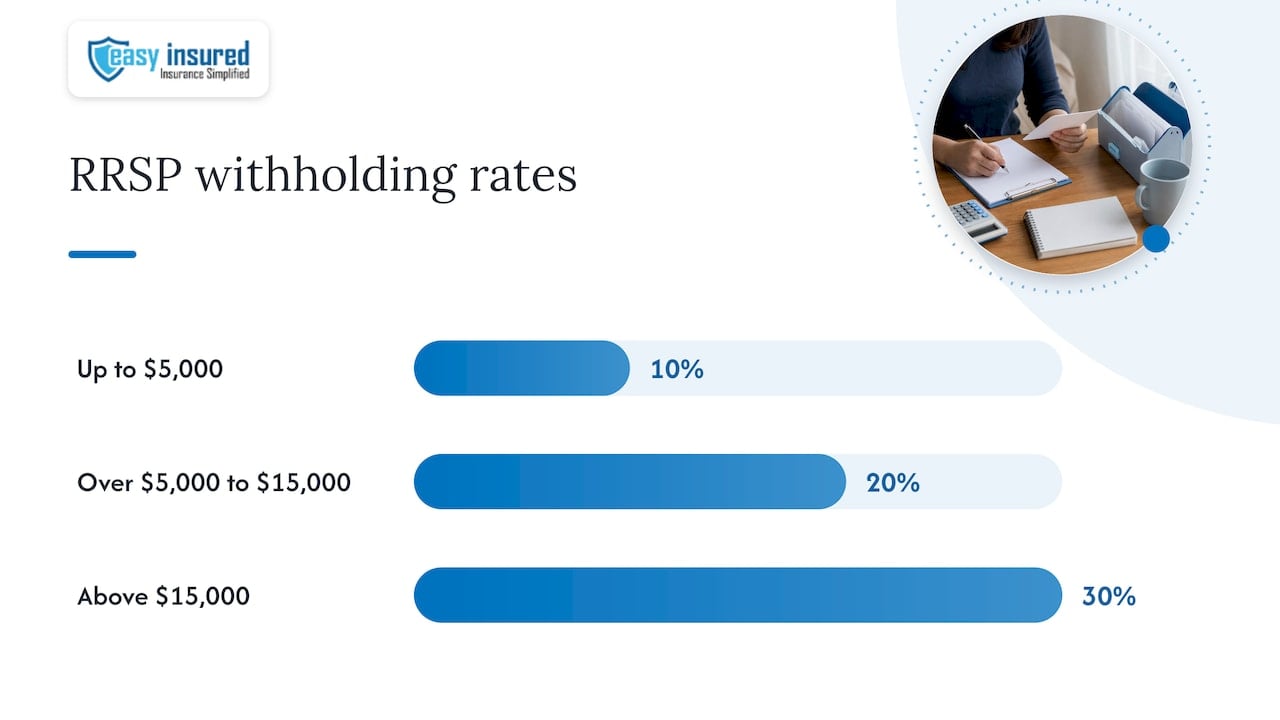
The T3012A route is the cleanest, because ordinary RRSP withdrawals are subject to withholding. Under the CRA’s rates on withdrawals, residents outside Quebec see 10% withheld up to $5,000, 20% on amounts over $5,000 up to $15,000, and 30% above $15,000. In Quebec, provincial tax is withheld as well. The CRA also warns that withholding may not cover everything you owe, so you could pay more when you file. If you withdraw without T3012A, you can lose cash flow for months before you claim the offsetting deduction. Our explainer on RRSP withholding tax walks through that cash-flow gap.
Ask your institution whether it processes T3012A requests and how long it takes. Some need the signed form and a few business days.
Withdrawing an excess is not the same as a normal withdrawal
A regular RRSP withdrawal is taxable income and permanently removes room you cannot get back. Taking out a genuine excess that was never deductible is different: with the T3012A or T746 process, you are undoing a mistake, not cashing out savings. Keep that distinction in mind when you hear that RRSP withdrawals are always costly.
Filing Form T1-OVP and paying the tax
T1-OVP is the Individual Tax Return for RRSP, PRPP and SPP Excess Contributions. If you owe the 1% tax, the CRA says to send the return and pay no later than 90 days after the end of the year in which you had the excess contributions. For an excess that existed during 2026, that puts the deadline around the end of March 2027.
A few practical points:
- It is separate from your regular T1 return. Filing your income tax return on time does not file T1-OVP for you.
- Use the form for each year you had a taxable excess. If the excess carried through several years, each year needs its own calculation.
- You calculate month by month. Keep a note of when each contribution was made and when any withdrawal took effect.
- Late filing can add charges. Do not wait for a notice if you know you owe.
If you never filed a T1-OVP you should have, or filed one with errors, the CRA’s guide to RRSPs and other registered plans notes that the Voluntary Disclosures Program can be used to correct previously unfiled or incorrect returns without penalty, as long as the CRA has not already started a review. That route is worth discussing with an accountant before you send anything.
Can the CRA cancel the tax?
Sometimes. The CRA says you can ask in writing for the tax to be waived or cancelled if the excess came from a reasonable error and you are taking, or have taken, reasonable steps to eliminate it. The request goes on Form RC2503 with supporting documents.
What tends to make a request credible:
- A clear explanation of the mistake, such as a bank error, a misreported pension adjustment or a late notice of assessment.
- Proof you corrected it: a T3012A, a withdrawal confirmation or your institution’s records.
- Copies of the relevant statements and your notice of assessment.
What does not help: saying you did not know the rules, or leaving the excess in place with no plan. The CRA’s wording is about reasonable error plus reasonable steps, and the second part is something you control.
Common ways people go over
Most overcontributions are not deliberate. These are the patterns we see most often when people ask for a review of their registered accounts:
- Changing jobs mid-year. A new pension plan creates a pension adjustment that lowers room, but the notice may arrive after you have already contributed.
- Automatic contributions. A pre-authorized plan keeps running after you reach your limit.
- Multiple accounts. Contributions at two institutions are easy to lose track of. The limit is yours, not per account.
- Lower income. Room is based on last year’s earned income. If your earnings dropped, so did this year’s room.
- Group RRSP contributions. Employer matching contributions count against your room too.
- Spousal RRSPs. A contribution to a spouse’s plan uses your room, not theirs. Read the spousal RRSP rules before you split contributions.
If you run a business, a lumpy income year also changes how much you should contribute. When your income is uneven, planning around a cash buffer sized to your income gap can keep you from stretching to meet an RRSP deadline with money you may need back.
How to avoid the penalty in the first place
- Read the number on your notice of assessment and log in to CRA My Account before each large contribution.
- Pause automatic contributions when you approach the limit, and restart after you check the new year’s room.
- Track all accounts in one place, including group plans and spousal accounts.
- Recheck room after any job, pension or income change.
- Use the TFSA when RRSP room runs out. It has its own limit and its own penalty, so check your figures there too. Our guides on the TFSA contribution limit and the TFSA overcontribution penalty cover that account.
Our perspective
We meet this problem most with business owners and families who save in several places: an RRSP at a bank, a group plan at work, a spousal account and sometimes a corporate plan. Nobody is reckless. The trouble is that no single institution sees the whole picture, and the CRA only counts the total.
Our view is that the penalty is rarely the real cost. The real cost is the lost planning: money tied up in an account where it cannot be deducted, a withholding bill on a rushed withdrawal, and the stress of a notice you did not expect. We think one annual review beats any single fix. Once a year, we line up your notice of assessment, your pension adjustment, your contributions and your plans for the next 12 months, then decide how much goes where. Retirement savings, tax planning and estate planning all feed from the same set of numbers, so we handle them together.
If you are already over, do not wait for the next statement. Work out the amount, decide whether to withdraw or wait for room, and file on time. The penalty is mild compared with what happens when it is ignored for years.
— Frank
Get a second set of eyes on your RRSP
If you are not sure how much room you have, or you have already gone over, we can help you sort out the numbers and build a plan for your registered accounts. Our advisors work with families and business owners across Canada on retirement, investment and tax planning, so your RRSP, TFSA and other savings work together instead of getting in each other’s way.

We can also help you protect what you are building. Business owners often pair their retirement savings with life insurance and disability cover, so a health event does not force a withdrawal from the plan.
FAQ
What happens if I overcontribute to my RRSP by less than $2,000?
Nothing, in terms of tax. The CRA allows a lifetime buffer of $2,000 over your limit before the 1% monthly tax applies. You cannot deduct those extra dollars, so they will not lower your taxable income until new room opens up.
What is Form T1-OVP?
It is the Individual Tax Return for RRSP, PRPP and SPP Excess Contributions. If you owe the 1% tax, you file it and pay within 90 days after the end of the year in which the excess existed. It is separate from your regular income tax return.
How much can I withdraw from my RRSP without penalty?
There is no penalty for withdrawing, but withdrawals are taxable income and have withholding of 10%, 20% or 30% depending on the amount. To remove a genuine excess without withholding, ask your institution about Form T3012A. Withholding may not cover the full tax, so you may owe more at filing.
Can the CRA waive the overcontribution tax?
Yes, in some cases. You can ask in writing on Form RC2503 if the excess came from a reasonable error and you have taken or are taking reasonable steps to remove it. Attach documents that show what happened and how you fixed it.
Does the tax stop after I withdraw the excess?
Yes, the 1% applies to months in which the excess remains in the plan. Withdraw quickly, because the CRA may not charge the tax on amounts removed before the end of the month they were contributed.
Sources
- Excess contributions, Canada Revenue Agency
- How contributions affect your RRSP deduction limit, Canada Revenue Agency
- Withdrawing the unused contributions, Canada Revenue Agency
- Tax rates on withdrawals, Canada Revenue Agency
- RRSPs and other registered plans for retirement, Canada Revenue Agency