
The CRA charges a 1% monthly tax on the highest excess amount sitting in your TFSA, starting from the very first dollar over your limit. There’s no grace threshold. If you’ve gone over, withdraw the excess now, then file a TFSA Return (Form RC243) and pay any tax owed by the CRA deadline. Every month you wait adds another 1%.
TL;DR:
- The CRA charges a 1% monthly tax on the highest amount of excess contribution in your TFSA during each month, starting immediately after you exceed your limit with no threshold.
- Overcontributions are only flagged by the CRA after the annual report, which may be over a year later, so you should keep detailed records and monitor your contributions independently.
- To fix an overcontribution, withdraw the excess immediately, file Form RC243, and pay any owed tax by June 30 following the year of excess; prompt action reduces penalties.
- The CRA may waive the penalty tax if you took quick corrective steps and can document that the overcontribution was a reasonable mistake, but waiver is discretionary.
- Spreading contributions across multiple accounts greatly increases the risk of accidental overcontribution; maintaining a centralized log helps prevent exceeding your total available room.
Table of Contents
- How the TFSA Overcontribution Tax Is Calculated
- When Does the CRA Notice a TFSA Excess Contribution?
- How Do You Fix a TFSA Overcontribution?
- Can You Get the TFSA Penalty Cancelled?
- Worked Examples: What a TFSA Overcontribution Actually Costs
- How to Avoid a TFSA Overcontribution in the First Place
- When a Financial Planner Can Help With TFSA Issues
- A Straight Take on TFSA Overcontribution Penalties
- Get Help Sorting Out a TFSA Overcontribution
- Sources
- FAQ
How the TFSA Overcontribution Tax Is Calculated
The CRA doesn’t average your balance or prorate anything. It looks at the highest excess amount your TFSA held at any point during each calendar month, then applies 1% to that figure for that month. This is why a five-day overcontribution can cost the same as one that sat for three weeks.
There’s also no forgiveness zone. Unlike some registered accounts with buffer amounts, the TFSA overcontribution tax applies from the first dollar over your room. Contribute $500 too much, and you owe $5 for every month it remains, even if the rest of your account is perfectly within limits.
A few mechanics catch people off guard:
- The tax uses the highest excess in the month, not the average or the ending balance.
- Contributing and withdrawing the same excess within the same calendar month still triggers that month’s 1% tax. The CRA doesn’t pro-rate for partial months or same-month corrections.
- Each month is calculated separately, so a $2,000 excess sitting for three months isn’t one flat penalty. It’s recalculated monthly based on whatever the highest balance was in each of those three periods.
When Does the CRA Notice a TFSA Excess Contribution?
Your bank or brokerage doesn’t report your TFSA activity in real time. Financial institutions submit annual TFSA records to the CRA by the end of February for the prior calendar year, which means the CRA typically doesn’t flag an overcontribution until late spring of the following year.
That lag matters. If you overcontributed in March 2026, the CRA likely won’t send anything until spring 2027, by which point the penalty has been quietly compounding for over a year. A few things to keep straight while you wait:
- An educational letter simply flags a possible excess and asks you to review your contributions; it isn’t a bill.
- A Notice of Assessment confirms the actual tax owed after you’ve filed Form RC243.
- CRA My Account often lags behind your real-time contributions since it relies on the same annual institutional reporting.
Don’t treat silence from the CRA as a clean bill of health. Keep your own consolidated log of every deposit and withdrawal across all your TFSA accounts, and check CRA My Account periodically as a cross-reference, not your primary source of truth.
How Do You Fix a TFSA Overcontribution?
Once you know you’re over your limit, speed matters more than anything else. Here’s the order of operations:
- Withdraw the excess amount immediately. Every month that passes before you pull the money out adds another 1% charge on the highest balance that month.
- File Form RC243, the TFSA Return, even though your financial institution will separately report the withdrawal to the CRA. The report from your bank doesn’t substitute for your own filing.
- Pay any tax owed by June 30 of the calendar year following the year the excess applied. Tax owed for 2026 is due by June 30, 2027.
- Confirm your Notice of Assessment after filing to make sure the CRA’s calculation matches what you reported, and correct any discrepancy right away.
Pro Tip: File RC243 even if you’re requesting a waiver for the penalty at the same time. The CRA generally wants the return on record before it will consider canceling any part of the tax, so filing late to “wait and see” usually backfires.
Payment can be made online through CRA My Payment, at your bank, or by mail with a remittance voucher. Once processed, your Notice of Assessment will reflect the final tax calculated, which should match your own math from Form RC243 if you filled it out correctly.
Can You Get the TFSA Penalty Cancelled?
The CRA has discretion to cancel or waive the 1% tax if the overcontribution resulted from a reasonable error and you took prompt corrective action. This isn’t automatic. You have to ask, and you have to show your work.
That’s a world apart from a deliberate overcontribution designed to exploit the account. The CRA treats intentional overcontributions as an “advantage” and can tax them at rates up to 100%, wiping out any benefit entirely.
To strengthen a reasonable-error request:
- Document the exact date you discovered the excess and the date you withdrew it.
- Keep transaction statements or screenshots showing contribution and withdrawal dates from every institution involved.
- Write a short explanation of what caused the error (a math mistake, a transfer mix-up, multiple accounts you lost track of).
- Submit everything alongside your RC243, not months later.
Worked Examples: What a TFSA Overcontribution Actually Costs
Numbers make this concrete. Here’s how the math plays out in three common scenarios.
That third row is the one people misunderstand most. New contribution room only opens up on January 1 of the following year. Withdrawing money mid-year does not create new room right away. It only stops future penalty accumulation once the excess itself is withdrawn, or once new annual room absorbs it on January 1.
How to Avoid a TFSA Overcontribution in the First Place
Most overcontributions aren’t reckless. They’re bookkeeping failures across multiple accounts, or a misunderstanding of when withdrawn room comes back.
- Track every TFSA you hold, not just one. If you have accounts at two or three institutions, keep a single running log of contributions and withdrawals across all of them, because the CRA looks at your total room, not room per account.
- Remember that a withdrawal generally doesn’t restore room until January 1 of the next calendar year, unless you already had unused room sitting there. Recontributing a withdrawal within the same year is one of the most common triggers for an accidental excess.
- Check your CRA My Account transaction summary periodically, understanding it reflects institutional reporting with a lag, not same-day activity.
- Set a personal reminder before making any large TFSA deposit to recheck your room first.
Pro Tip: Keep a simple spreadsheet with three columns: date, account, and amount (positive for contributions, negative for withdrawals). A running total at the bottom tells you instantly whether you’re about to go over, without waiting on the CRA’s annual reporting cycle.
When a Financial Planner Can Help With TFSA Issues
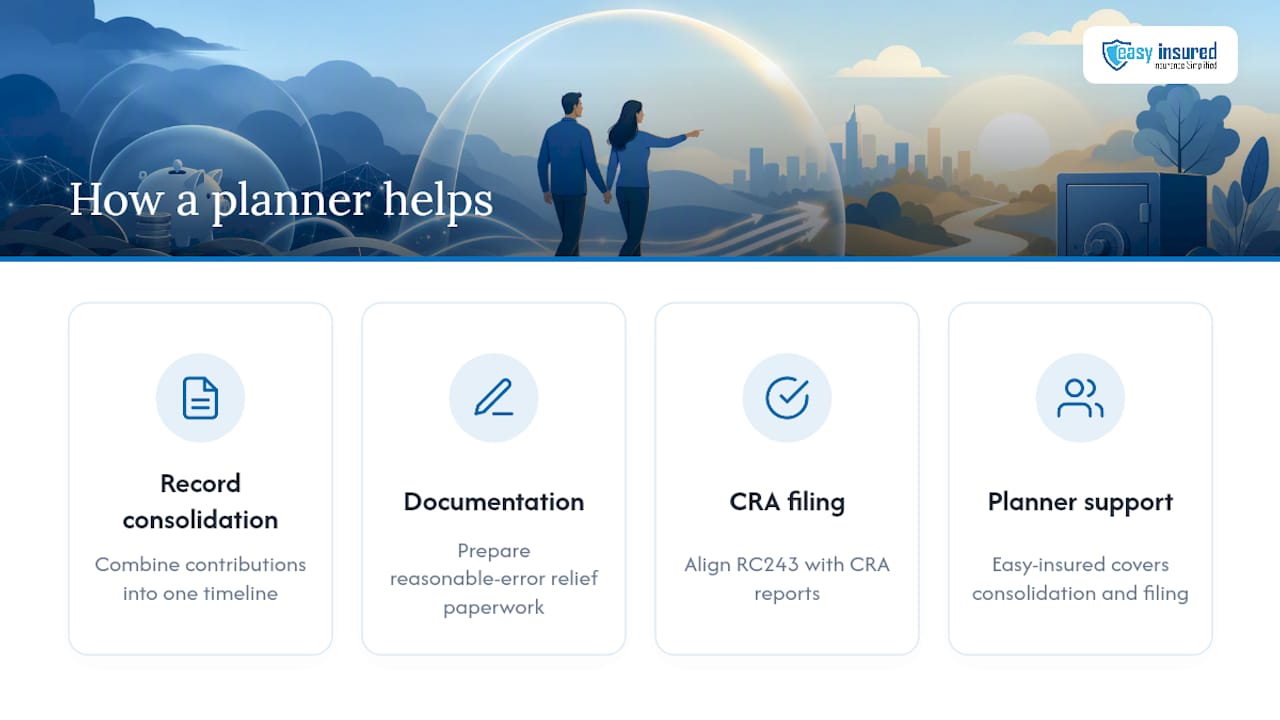
Complex situations warrant a second set of eyes: overcontributions spread across multiple institutions, an excess tied to a period of non-residency, or a relief request that needs a clear paper trail. A planner can consolidate scattered contribution records into one timeline, help prepare documentation for a reasonable-error request, and make sure your RC243 filing lines up with what the CRA actually reports. Easy-insured’s financial planning services cover this kind of record consolidation and filing support for readers who’d rather not sort it out alone.
A Straight Take on TFSA Overcontribution Penalties
The 1% monthly tax rewards speed, not perfection. Nobody plans to overcontribute. What separates a $5 mistake from a $500 mistake is how fast you act once you notice it. Pull the excess out first, document the timeline while it’s fresh, then file RC243. If your situation spans multiple accounts or involves a non-residency wrinkle, get a second set of eyes on it before you guess at the math.
— Frank
Get Help Sorting Out a TFSA Overcontribution
Untangling a TFSA overcontribution across two or three institutions is exactly the kind of paperwork most people put off, and putting it off is what turns a small penalty into a bigger one. Financial planners can help Canadian individuals and business owners consolidate scattered contribution records, prepare documentation for CRA correspondence, and build a filing timeline that holds up if you’re requesting relief for a reasonable error.

Beyond TFSA cleanup, the same planning conversation often covers retirement planning, estate planning, and tax planning, since a contribution room mistake is rarely an isolated issue. If you’re dealing with an excess right now or just want your TFSA and RRSP tracking cleaned up before it becomes a problem, visit the financial planning services page to book a conversation with a planner.
This article is general information, not a substitute for advice from a qualified financial advisor. Consult a qualified financial professional about your own circumstances before acting on anything here.
FAQ
What Happens if I Accidentally Overcontribute to My TFSA?
Withdraw the excess right away and file Form RC243 to report and pay the tax.
What Is the Penalty Tax on Excess TFSA Contributions?
It applies every month the excess sits there, with no minimum threshold before it kicks in.
Does the CRA Notify You if You Overcontribute to a TFSA?
Yes, but not right away. Financial institutions report TFSA activity by the end of February each year, so the CRA typically sends notice in late spring of the following year. Don’t wait for that letter; check your own records and act as soon as you spot an excess.
Can the CRA Waive the TFSA Overcontribution Tax?
The CRA can cancel the tax if the excess resulted from a reasonable error and you took prompt corrective action, but it’s discretionary, not automatic. You need to request it and provide documentation showing when you discovered the mistake and when you fixed it.
How Many Canadians Have Large Balances in Their TFSA?
Specific numbers about Canadians holding very large TFSA balances are not publicly available from the CRA. Still, it is clear that managing contribution limits carefully is important for all holders, as higher account totals can lead to larger penalties if overcontributions occur.