You can take money out of a First Home Savings Account (FHSA) at any time, but the tax treatment depends on why you take it. A qualifying withdrawal to buy or build your first home in Canada is tax-free. Anything else is a taxable withdrawal, added to your income for the year. The rest of this guide covers the conditions, the paperwork, the deadlines and the mistakes that turn a tax-free withdrawal into a tax bill.
TL;DR
- A qualifying withdrawal is tax-free only if you meet every condition: Canadian resident, first-time home buyer, a written agreement to buy or build a home in Canada, and a plan to live in it as your main home.
- You must give your FHSA issuer Form RC725 before the money comes out. Without it, the withdrawal is treated as taxable.
- After your first qualifying withdrawal, you have until December 31 of the following year to close all your FHSAs.
- Money that is not used for a home can move tax-free to your own RRSP or RRIF, but only as a direct transfer.
- Withdrawing and then re-contributing to an RRSP by hand is a taxable event and uses up your RRSP room.
Table of Contents
- What counts as a qualifying withdrawal
- Who is a first-time home buyer for a withdrawal
- Step by step: making a tax-free withdrawal
- What happens if the withdrawal does not qualify
- Closing the FHSA after you buy
- Moving unused FHSA money to an RRSP or RRIF
- FHSA and the Home Buyers’ Plan together
- If you are not a Canadian resident
- Mistakes that cost buyers money
- After the keys: budgeting for the first year
- Our perspective: the withdrawal is the easy part
- Protecting the home you are about to buy
- FAQ
- Sources
What counts as a qualifying withdrawal
The Canada Revenue Agency (CRA) lets you take all the property out of your FHSA tax-free to buy or build a home in Canada, provided you meet every eligibility condition. Meeting most of them is not enough. If one condition fails, the withdrawal is treated as taxable and reported as income on your return for the year you received it, according to the CRA’s response quoted by Advisor.ca.
The conditions in plain language:
- You are a Canadian resident. You must be a resident when you make your first qualifying withdrawal and stay one until you acquire the home.
- You are a first-time home buyer. The definition is covered in the next section.
- You have a written agreement. This is a purchase agreement, or a contract to build, for a home in Canada. The agreement must be in place before October 1 of the year after the year of the withdrawal.
- You intend to live in the home. It must become your principal place of residence within one year of acquiring it.
- You complete the request form. Form RC725 goes to your FHSA issuer.
There is no minimum time the money must sit in the account. In principle, you could open an FHSA and make a qualifying withdrawal once you meet the conditions, though only the contributions you have room for will have gone in.
Who is a first-time home buyer for a withdrawal
This is where people trip up. The CRA says the term means something different when you open an FHSA than when you make a qualifying withdrawal.
When you open the account, your spouse’s or common-law partner’s home ownership history also counts. When you withdraw, you are tested on your own history. In short, you qualify if you did not live in a home that you owned, or jointly owned, as your principal residence in the current calendar year or in any of the previous four calendar years. Advisor.ca’s explainer adds a narrow exception: you can own or jointly own the home you are buying for up to 30 days before the withdrawal.
Two practical consequences:
- A partner who owned a home does not, by that fact alone, block your withdrawal, though it may have blocked you from opening the account in the first place. Check the CRA’s wording against your own dates.
- If you sold a home you lived in three years ago, you are probably not a first-time buyer yet. Count calendar years, not 48 months.
Step by step: making a tax-free withdrawal
- Confirm your eligibility against the conditions above. The CRA also publishes a short questionnaire that walks you through them on its RC725 page.
- Sign the written agreement to buy or build the home. Keep a copy; you may need it if the CRA asks.
- Complete Form RC725, the request to make a qualifying withdrawal. If you plan more than one qualifying withdrawal for the same home, the form is set up to cover that.
- Give the form to your FHSA issuer before the withdrawal. Issuers have their own processing times, so allow for them when your closing date is fixed.
- Receive the funds and use them toward the home.
- Move in within one year of acquiring the home, and remember your closing deadline for the account (below).
If you hold more than one FHSA, the same logic applies across all of them, and all must be closed by the deadline.
What happens if the withdrawal does not qualify
A taxable withdrawal is any amount that fails the tests above: you are not buying a home, you missed the October 1 timing, you are a non-resident, or you never gave the issuer a qualifying form. The CRA states that it must be included in your income and is subject to withholding tax at the time of withdrawal.
A few points matter in practice:
- The amount counts as income, so it can push you into a higher marginal bracket for the year.
- The withholding at source is not necessarily your final tax. Your final bill is settled when you file your return.
- A taxable withdrawal generally does not give back your FHSA participation room, unless it is designated to fix an excess contribution.
If you want to understand how withholding on registered plan withdrawals works more broadly, our piece on RRSP withholding tax in Canada explains how the amounts are taken and why they can differ from what you finally owe.
Closing the FHSA after you buy
Many buyers assume the account must be emptied the day they get the keys. It does not. The CRA says you should close all your FHSAs on or before December 31 of the year following the year of your first qualifying withdrawal.
Example: you make your first qualifying withdrawal in June 2026. You have until December 31, 2027 to close the account. That gives you time to decide what to do with whatever is left.
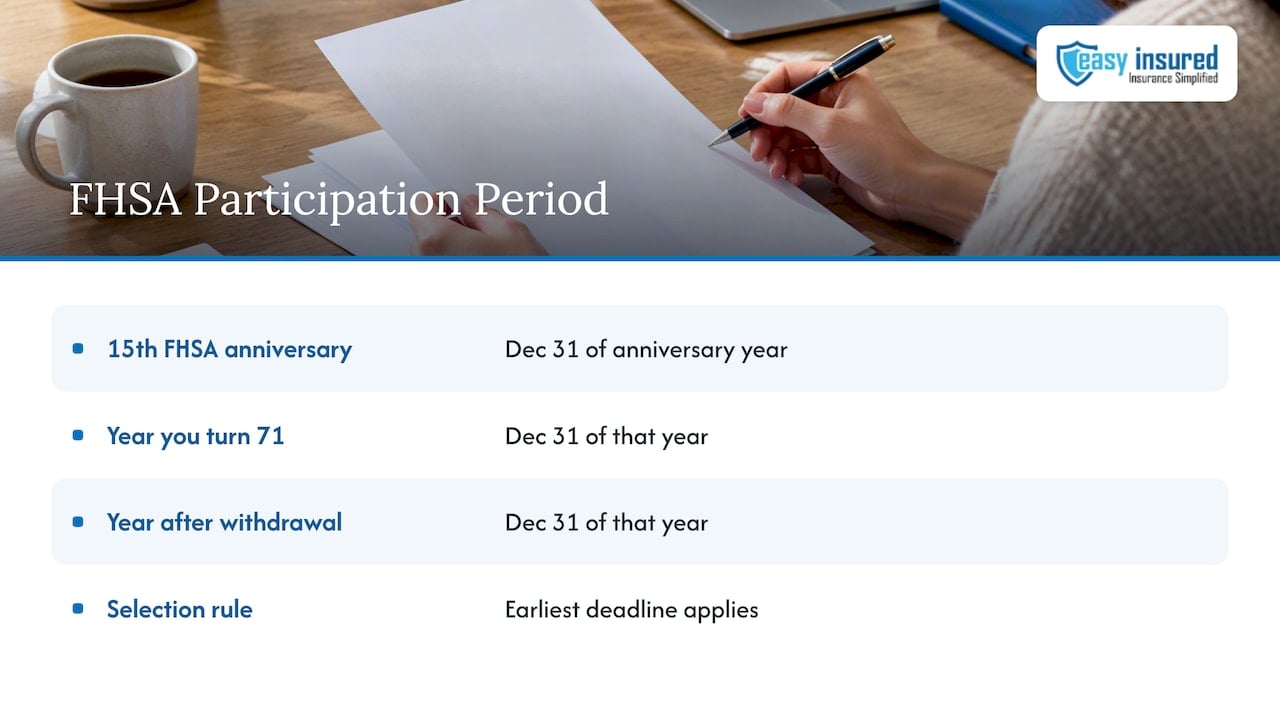
The broader limit is the maximum participation period. It ends on December 31 of the year of the earliest of three events: the 15th anniversary of opening your first FHSA, the year you turn 71, or the year after your first qualifying withdrawal. Property still in the account after the deadline is treated as income, so do not let the date slip by.
Moving unused FHSA money to an RRSP or RRIF
If you never buy a home, or you have money left over, you have a tax-efficient exit. You can transfer FHSA property directly to your own RRSP or RRIF without tax consequences, provided it is a direct transfer and you do not have an excess FHSA amount. The CRA’s form for this is RC721.
The method matters:
| Route | Tax result | Effect on RRSP room |
|---|---|---|
| Direct transfer with Form RC721 | No tax on the transfer | Does not use your RRSP deduction room or restore FHSA room |
| Withdraw to your bank, then contribute to your RRSP | Taxable withdrawal, with withholding | Counts as a new RRSP contribution and uses your room |
Do it by direct transfer. The manual route taxes you first and then asks you to find RRSP room for money that has already been taxed.
If RRSPs are new to you, our guide to the RRSP Home Buyers’ Plan shows the other registered route to a first home, and how it differs on repayment. Once you reach retirement age, the RRIF withdrawal rules cover what happens to transferred funds.
FHSA and the Home Buyers’ Plan together
The FHSA and the RRSP Home Buyers’ Plan are separate programs with their own eligibility tests. You can use both for the same purchase if you meet each program’s conditions when you withdraw. The main difference is repayment: HBP withdrawals must be paid back into your RRSP over time, while FHSA qualifying withdrawals do not need to be repaid. That is why many buyers draw on the FHSA first and look at the HBP for a larger down payment.
Before you rely on a combined plan, check that the dates line up. The HBP has its own occupancy and timing rules, and a plan that works on paper can fail on the closing date.
If you are not a Canadian resident
Residency is strict. The CRA explains in its guidance on non-residents and FHSAs that there are limits on how you can use your account if you leave Canada. In particular, you cannot make a tax-free qualifying withdrawal while you are a non-resident. If you may move abroad for work before your purchase closes, plan the sequence carefully, because a withdrawal made at the wrong time is taxable.
Mistakes that cost buyers money
- Skipping the form. Withdrawing without RC725 on file turns an otherwise qualifying purchase into a taxable withdrawal.
- Missing the October 1 rule. The written agreement must be in place before October 1 of the year following the withdrawal. A delayed build or a deal that falls through can break this.
- Forgetting the closing deadline. December 31 of the year after your first qualifying withdrawal is firm.
- Moving money by hand. Cashing out and re-contributing to an RRSP costs you tax and contribution room.
- Mixing up the two first-time buyer tests. The test at opening is not the test at withdrawal.
- Buying a home you will not occupy. A rental or investment property is not a qualifying home. You must occupy the home as your principal residence within one year.
After the keys: budgeting for the first year
A qualifying withdrawal covers the purchase, but the first year of ownership brings costs the down payment does not. If your new home needs work, a practical guide for first-time renovators from an Ottawa-area contractor explains why planning, permits and documentation matter before you start. Keep an emergency cash buffer as well. Our comparison of a TFSA versus a savings account helps you decide where that buffer should sit.
Our perspective: the withdrawal is the easy part
We spend more time with clients on what happens around the withdrawal than on the withdrawal itself. The form is straightforward. The trouble comes from timing, from the mismatch between two definitions of “first-time buyer”, and from a mortgage that leaves a family exposed if one earner cannot work.
A first home usually means the biggest debt a family has ever carried. We suggest buyers settle three questions before they sign. Can we pay the mortgage if one income stops? Does the surviving partner keep the house if one of us dies? And where does the leftover FHSA money go, if there is any? A certified financial planner can map these out in one conversation, so the tax-free withdrawal does not sit alone with a mortgage that nothing protects.
For most households, mortgage protection, life insurance and disability cover belong in the same plan as the down payment. They are part of what makes the purchase safe, not a separate topic for later.
— Frank
Protecting the home you are about to buy
If you are planning a purchase with an FHSA, we can help you look at the whole picture: how the down payment fits your savings, and how to protect the mortgage with life insurance or disability insurance. Our financial planning service starts with your goals and your timeline, not a product.
FAQ
Can I withdraw money from my FHSA at any time?
Yes, nothing locks the money in. What changes is the tax. A qualifying withdrawal for a first home is tax-free, while any other withdrawal is taxable income and is subject to withholding when it is paid out.
How much tax do I pay on a non-qualifying FHSA withdrawal?
There is no fixed rate. The amount is added to your income for the year and taxed at your marginal rate, and withholding is taken when you withdraw. Your final tax is settled when you file your return.
Can I roll my FHSA into my RRSP?
Yes. A direct transfer to your own RRSP or RRIF with Form RC721 has no tax consequences, as long as you have no excess FHSA amount. A manual withdrawal followed by an RRSP contribution is taxable and uses your contribution room.
How long do I have to close my FHSA after buying a home?
You should close all your FHSAs by December 31 of the year following the year of your first qualifying withdrawal. Buy in 2026 and the deadline is December 31, 2027.
Do I need to repay an FHSA withdrawal?
No. Unlike the RRSP Home Buyers’ Plan, a qualifying FHSA withdrawal does not have to be paid back.
Sources
- Withdrawals and transfers out of your FHSAs, Canada.ca
- Closing your FHSA, Canada.ca
- First Home Savings Account (FHSA), Canada.ca
- Non-residents and FHSAs, Canada.ca
- RC725 Request to Make a Qualifying Withdrawal from your FHSA, Canada.ca
- What are the FHSA qualifying withdrawal rules? Advisor.ca
- Why first-time renovators need guidance, HMJ Contracting