
For short-term emergency cash, a regular savings account wins on simplicity. For tax-free investing and medium- to long-term goals, a TFSA usually comes out ahead. The Canada Revenue Agency sets the 2026 TFSA annual contribution limit at $7,000. Keep reading: short-term readers should jump to the savings account section, long-term investors to the TFSA use cases below.
TL;DR:
- Using a TFSA makes sense for investments with growth potential that are unlikely to be withdrawn within a year, due to contribution limits and withdrawal rules.
- Emergency funds should stay in a regular savings account to ensure instant access and full liquidity, especially during crises.
- Maximize contribution room carefully each year, avoid over-contributing, and track withdrawals to prevent penalties of 1% per month on excess amounts.
- Workers with higher marginal tax rates benefit more from sheltering income inside a TFSA, especially for dividend stocks and interest-generating assets.
- Planning for estate transfer requires selecting the correct designation, as a successor holder preserves TFSA tax benefits, unlike beneficiary designations.
Table of Contents
- At-a-glance differences: tax, contribution rules, liquidity, and protections
- When a TFSA makes more sense for your goals
- When a regular savings account is the better choice
- TFSA mechanics every Canadian must follow
- Common pitfalls and planning trade-offs
- Frank’s practical checklist: using TFSA and savings accounts in a plan
- A sequencing note worth repeating
- How we help you put a TFSA plan into action
- FAQ
- Sources
At-a-glance differences: tax, contribution rules, liquidity, and protections
The two accounts solve different problems, and the differences show up most clearly in how each one treats tax and access.
- Tax treatment: growth and withdrawals inside a TFSA are tax-free, while interest earned in a regular savings account is taxed as ordinary income at your marginal rate.
- Contribution limits: the TFSA caps new contributions at $7,000 for 2026, with unused room carrying forward indefinitely; a regular savings account has no deposit limit at all.
- Liquidity: both accounts let you withdraw anytime, but TFSA withdrawals only restore contribution room on January 1 of the following year, a timing rule that trips up a lot of people.
- Deposit protections: eligible deposits, including many deposit-style TFSAs, may be covered by CDIC at member institutions, but TFSA holdings like stocks, ETFs or mutual funds are not CDIC-protected, so check with your issuer before assuming coverage.
A savings account is built for access. A TFSA is built for shelter. Choosing between them usually comes down to how soon you need the money and whether you want that growth taxed along the way.
When a TFSA makes more sense for your goals
A TFSA earns its keep once your time horizon stretches past a year or two and you want investment growth that is not taxed at all. CRA’s 2023 TFSA statistics show average fair market values ranging from about $33,632 to $73,646 per individual across income brackets, which tells you plenty of Canadians already treat the TFSA as a long-term accumulation vehicle rather than a parking spot for spare cash.
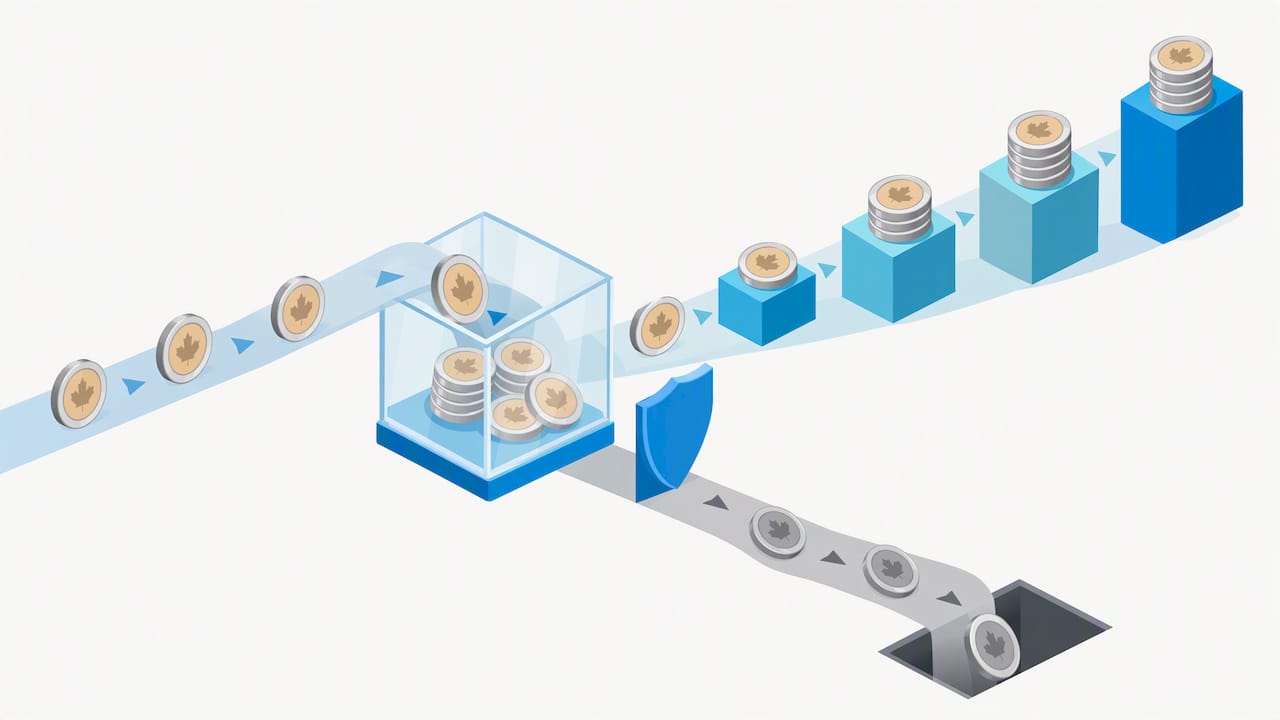
The gap widens with higher-taxed income. Interest income is taxed at your full marginal rate outside a TFSA, while inside one it is not taxed at all, a point the TFSA vs non-registered account comparison also makes when weighing where to hold fixed-income products. That gap compounds every year the money stays invested.
A TFSA tends to fit:
- Medium- to long-term goals such as a down payment several years out, a sabbatical fund, or retirement top-up savings.
- Higher-yield holdings like dividend stocks, ETFs, or GICs, where sheltering the income matters more than for cash sitting at near-zero interest.
- A sequencing slot after an emergency fund and often before non-registered investing, with RRSP priority depending on your marginal tax bracket.
If a home purchase is part of the picture, the TFSA vs FHSA comparison for Calgary buyers walks through how a TFSA stacks up against the First Home Savings Account for a down payment strategy.
When a regular savings account is the better choice
Emergency funds belong in a savings account, full stop. You need instant access, no tracking of contribution room, and no penalty for touching the money at 2 a.m. during a crisis.
High-interest savings accounts (HISAs) are the obvious short-term workhorse, though the interest they pay is still taxed as income, which matters if you are holding a large cash cushion for a long stretch rather than months.
- Keep it liquid: emergency funds and goals under a year or two rarely benefit from TFSA-style sheltering if you are only earning modest interest anyway.
- Compare fees and access: look at monthly fees, e-transfer limits, and whether the account links easily to your chequing account for quick transfers.
- Confirm CDIC membership: verify the institution is a CDIC member so eligible deposits are protected up to the insured limit.
Pro Tip: Keep three to six months of expenses in a savings account before contributing a dollar to long-term TFSA investments.
TFSA mechanics every Canadian must follow
The rules are simple once you see them written out, but small timing mistakes cost real money.
- Know your annual limit. The 2026 TFSA contribution limit is $7,000, matching the $7,000 limit set for 2024 and 2025; unused room from past years carries forward with no expiry.
- Track withdrawals carefully. Money you withdraw does not free up new room until January 1 of the next calendar year, a rule our TFSA contribution limit guide breaks down with common error examples.
- Avoid over-contribution penalties. Exceeding your room triggers a 1% per month tax on the excess until it is withdrawn, and room does not accumulate for years you were a non-resident of Canada.
- Know what you can hold. A TFSA can hold cash, GICs, stocks, ETFs, mutual funds, annuity contracts, or arrangements in trust, giving you far more flexibility than a basic deposit account.
- Verify your room before contributing. Financial institutions report TFSA transactions to CRA on a lag, so cross-check your own records rather than relying solely on your CRA account balance in early spring.
Common pitfalls and planning trade-offs
The most expensive mistake is recontributing in the same calendar year you withdrew, which pushes you over your limit and into the 1% monthly penalty. Non-residents also need to watch their status carefully, since contribution room does not accrue for years spent outside Canada.
- A TFSA does not allow you to claim capital losses, which matters for active traders who might otherwise offset gains elsewhere.
- Non-registered accounts allow unlimited contributions and tax-loss harvesting, useful once your TFSA room is maxed or you trade frequently.
- Large lump sums are better planned with a professional before moving money between account types.
Frank’s practical checklist: using TFSA and savings accounts in a plan
I built this into four steps for clients working through the same question: define your time horizon, check your actual contribution room rather than guessing, choose holdings that match your risk tolerance inside the TFSA, and name a successor holder or beneficiary properly. That last step matters more than most people expect, since a spouse named as successor holder preserves TFSA tax status in a way a beneficiary designation does not.
Naming a successor holder versus a beneficiary changes the tax outcome for your spouse or estate, not just who receives the money.
Our guide to naming a TFSA successor walks through the choice in detail, and large lump sums or estate integration are good reasons to consult a planner rather than guess.
— Frank
A sequencing note worth repeating
My own view: most Canadians overthink the order. Build your emergency fund in a savings account first, then max out your TFSA before worrying about an RRSP, unless your marginal tax rate makes RRSP deductions clearly worth more right now. Anyone with a complex estate or large lump sum should talk to a planner before moving money.
— Frank
How we help you put a TFSA plan into action
We provide guidance on TFSA room calculations, beneficiary and successor options, and retirement sequencing to help your tax-free savings fit within your broader financial planning.

- Investment planning that places the right holdings inside your TFSA, RRSP, or non-registered account.
- Retirement planning that sequences your accounts around your actual marginal tax rate.
- Estate planning that gets successor and beneficiary designations right the first time.
Start a conversation about your investment planning and estate planning services and we will help you map the plan to your goals.
This article is general information, not a substitute for advice from a qualified financial advisor. Consult a qualified financial professional about your own circumstances before acting on anything here.
FAQ
How many Canadians have over $100,000 in TFSAs?
CRA’s 2023 statistics report average fair market values per individual ranging from about $33,632 to $73,646 across income brackets, not a specific count above $100,000. Those figures suggest sizable balances are common among longtime contributors, but CRA does not publish a breakdown at that exact threshold.
What is the disadvantage of a TFSA?
A TFSA caps how much you can contribute each year, at $7,000 for 2026, and it does not let you claim capital losses the way a non-registered account does. Over-contributing also triggers a 1% monthly penalty on the excess until it is corrected.
How long can money stay in a TFSA?
There is no mandatory time limit; money can stay in a TFSA indefinitely, and many Canadians use it for long-term accumulation rather than short-term saving. Unused contribution room also carries forward with no expiry.
Can I leave my TFSA to my children?
Yes, though the tax outcome depends on how you name them. A successor holder designation is only available to a spouse or common-law partner and preserves TFSA tax status, while children named as beneficiaries generally receive the proceeds under different reporting rules, so it is worth reviewing your beneficiary designation with a planner.