
You can take money out of your TFSA at any time, for any reason, and you will not pay tax on it. The rule that catches people is not the withdrawal. It is the re-contribution: the room you free up does not return until January 1 of the next calendar year, and putting money back too soon triggers a tax of 1% per month.
This guide walks through how withdrawals work, when your room comes back, what the penalties look like in practice, and how to keep a clean record so the CRA never sends you a surprise bill.
TL;DR
- Withdrawals from a TFSA are tax-free and can be made at any time, in any amount. There is no withdrawal penalty.
- The amount you withdraw is added back to your contribution room on January 1 of the following year, not right away.
- Re-contributing in the same year is only safe if you still have unused room from before the withdrawal. Otherwise the excess is taxed at 1% per month.
- Keep your own running ledger. The CRA’s online figure can lag by months.
- For a TFSA you hold at death, naming a successor holder (not just a beneficiary) matters for your spouse or common-law partner.
Table of Contents
- How TFSA withdrawals work
- When your contribution room comes back
- Penalties: what actually costs you money
- Can you withdraw anytime without consequences?
- Multiple TFSAs and keeping your own records
- TFSA withdrawals compared with other registered accounts
- Common mistakes to avoid
- What happens to your TFSA at death
- Our perspective on TFSA withdrawals
- Working with us on your plan
- FAQ
- Sources
How TFSA withdrawals work
A TFSA is a registered account where growth and withdrawals are not taxed. According to the CRA, withdrawals are not subject to income tax and do not reduce the contributions you have made during the year. You do not have to report them as income, and they do not affect income-tested benefits.
There is no waiting period, no minimum holding time and no cap on how much you can take out. If you hold your TFSA in a savings deposit, the money is available as fast as your institution processes the request. If it holds investments such as mutual funds, GICs or segregated funds, the practical limit is how quickly those can be sold or redeemed, and whether a term deposit is locked until maturity. That is a product feature, not a TFSA rule, so check the terms of whatever you hold.
Also, there are no mandatory withdrawals. Unlike a RRIF, a TFSA has no age at which you must start drawing it down.
Withdrawal versus transfer
Moving money from one of your TFSAs to another is not the same as withdrawing. If you take cash out yourself and deposit it into a new TFSA, the CRA treats that as a withdrawal followed by a new contribution. That can use up room you did not mean to use. Ask the receiving institution to arrange a direct transfer between the two financial institutions, so nothing counts as a withdrawal or a contribution.
When your contribution room comes back
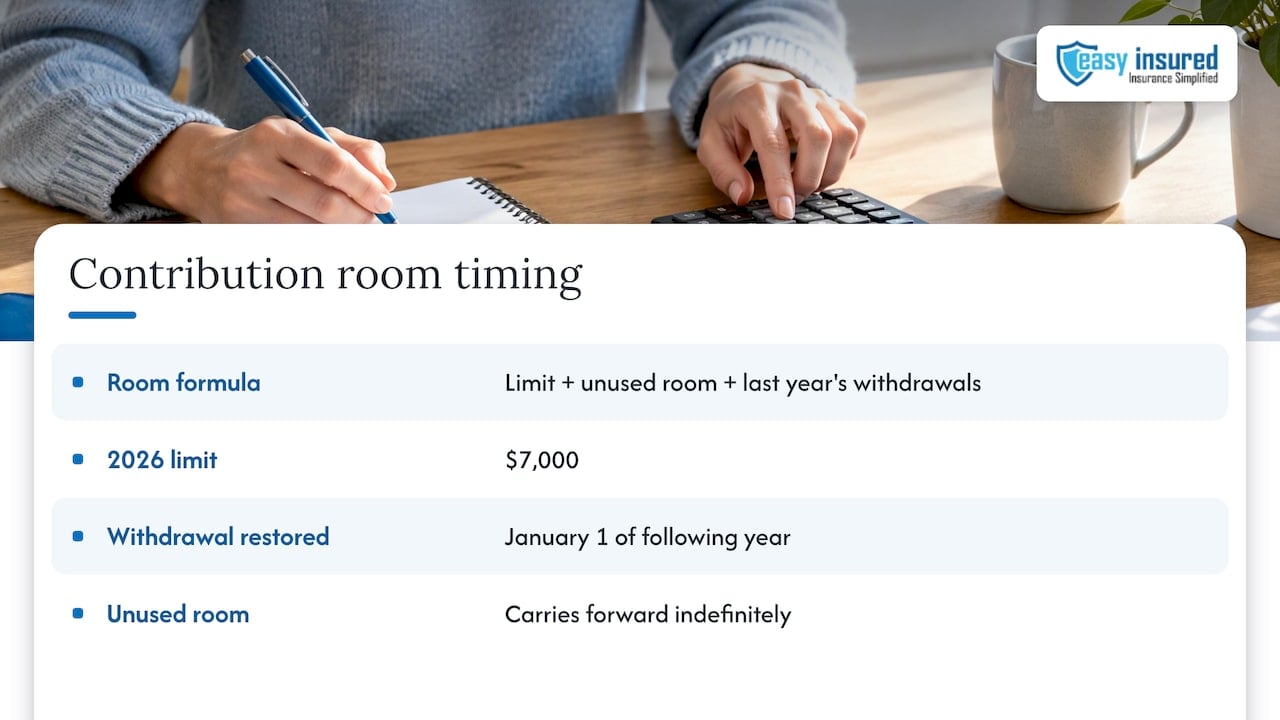
This is the rule most people get wrong. When you withdraw, the amount is added back to your contribution room on January 1 of the following calendar year. It is not restored the moment the money leaves.
The 2026 TFSA dollar limit is $7,000, and it is added to your room on January 1. Your total room is that year’s limit, plus unused room carried forward from prior years, plus withdrawals made in the previous year. Unused room carries forward indefinitely.
A worked example
Say it is March 2026 and you have $3,000 of unused room, with $20,000 already in your TFSA.
- You withdraw $10,000 for a roof repair. Your TFSA now holds $10,000.
- Your available room for 2026 is still $3,000. The $10,000 does not return yet.
- If you put $10,000 back in November 2026, you exceed your room by $7,000. That excess is taxed at 1% per month while it stays in the account.
- On January 1, 2027, the $10,000 is added to your room, along with the new annual limit. You can re-contribute then without any problem.
The safe version: wait until January, or only re-contribute up to the unused room you had before the withdrawal.
Penalties: what actually costs you money
There is no penalty for withdrawing. The costs come from over-contributing. The CRA taxes excess amounts at 1% per month for as long as the excess remains in the account.
A few things make this tax harsher than it looks:
- It is calculated on the highest excess in the month. Pulling the extra money out mid-month does not erase that month’s charge.
- It repeats every month. Each additional month of delay brings the same tax again, so acting quickly once you spot the excess matters.
- It can wipe out gains. On a $7,000 excess, one month costs $70, and twelve months costs $840, whether or not the money earned anything.
If you have already gone over, our guide on how to stop the 1% monthly TFSA penalty and fix overcontributions lays out the correction steps.
Can you withdraw anytime without consequences?
From a tax standpoint, yes. In practice, three things deserve a pause before you pull money.
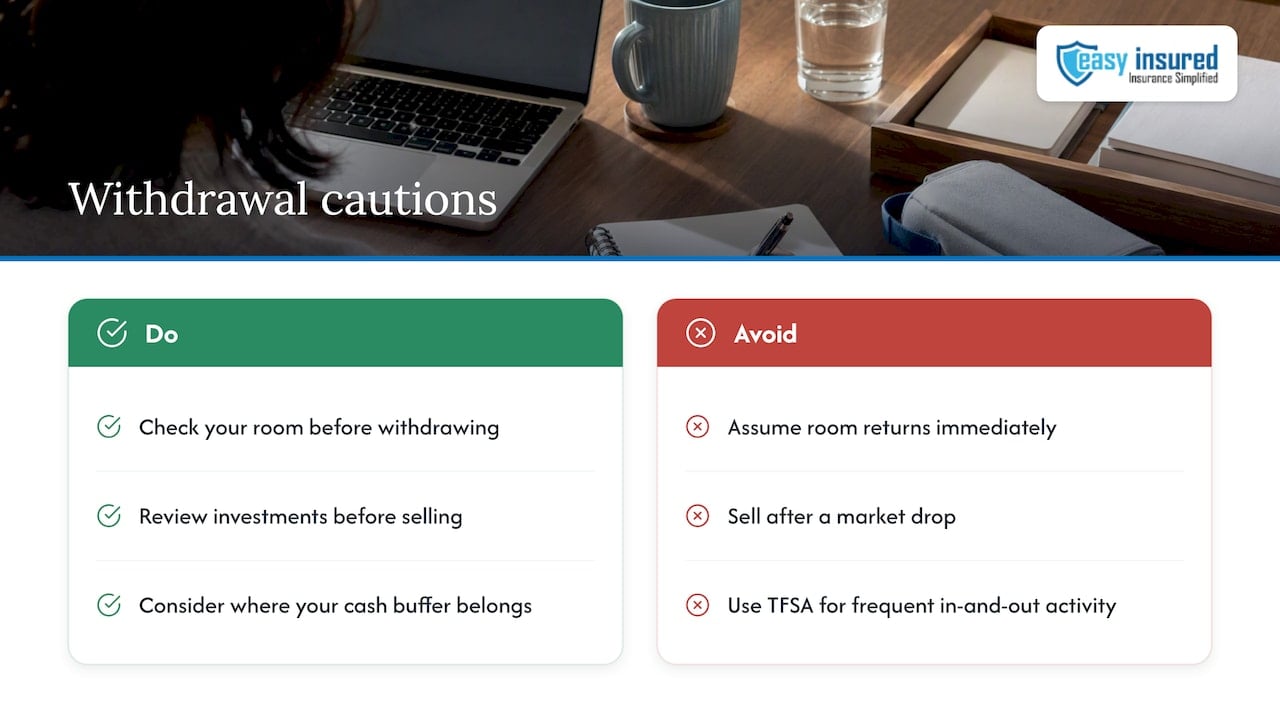
1. The room you lose in the meantime. If you are close to your total room, a withdrawal shrinks the tax-sheltered space available to you this year. The money you take out may take until January to be eligible again.
2. The investments you sell. If your TFSA holds market investments, selling after a drop locks in the loss. You cannot claim a capital loss on a TFSA against other income.
3. Treating it like a chequing account. Planning guidance repeatedly warns against using a TFSA for frequent in-and-out activity, because the annual reset makes accidental over-contributions common. If you need a flexible cash buffer, think about what belongs in the TFSA and what belongs elsewhere. We compare the options in TFSA vs savings account for Canadians.
Multiple TFSAs and keeping your own records
You can hold more than one TFSA, at different institutions. Your limit, however, is a single combined figure. Total contributions across all accounts cannot exceed your room, and no institution sees what you did elsewhere.
The CRA’s information also runs behind. It says that TFSA records from 2025 will be processed by April 2026, so the figure in My Account may not reflect what you did last year, let alone last month. The CRA itself advises checking your numbers against your financial institution records.
A simple ledger solves most problems. Keep one sheet, with these columns:
| Date | Institution | Deposit | Withdrawal | Room remaining |
|---|---|---|---|---|
| Jan 1 | All | Room opens: prior unused + new limit + last year’s withdrawals | Starting figure | |
| Each transaction | Which account | Amount in | Amount out | Running total of unused room |
Record withdrawals as withdrawals, but do not add them back to the room figure until January 1 of the next year. For step-by-step room calculation, see our TFSA contribution limit guide.
TFSA withdrawals compared with other registered accounts
People often search for TFSA rules when they are really comparing accounts. Here is how the treatment differs.
| Account | Tax on withdrawal | Room restored | Key limit |
|---|---|---|---|
| TFSA | None | January 1 of next year | Any time, any amount |
| RRSP | Taxable income, tax withheld at source | No | Withholding rates start at 10% on withdrawals up to $5,000 and rise with the amount |
| RRSP, Home Buyers’ Plan | Not withheld up to the limit; must be repaid | Repayment schedule | $60,000 |
| RESP | Rules depend on the type of payment | n/a | See our RESP guide |
The contrast with the RRSP is the practical one. RRSP withdrawals are added to your income, and the institution withholds tax up front. If you are weighing where to draw from, read our guides on RRSP withholding tax and the Home Buyers’ Plan. If you are drawing money for a child’s schooling, see the RESP withdrawal rules. Later in life, RRIF withdrawals bring mandatory minimums that a TFSA never has.
A common planning idea for retirees is to draw from the TFSA in years when taxable income would otherwise push them into a higher bracket or affect income-tested benefits. Because TFSA withdrawals are not income, they do not count toward those thresholds. Our piece on retirement income planning to avoid OAS clawback shows how that fits into a wider plan.
Common mistakes to avoid
- Re-contributing in the same year without enough room. The most frequent source of penalty tax.
- Cash transfers between institutions. Use a direct transfer.
- Relying only on the CRA portal. Its figure may be months behind your actual activity.
- Ignoring the age of majority and residency rules. Contribution room accrues only while you are eligible, so newcomers and those who lived abroad should verify their room before depositing.
- Assuming the account passes to your family automatically. More on that next.
What happens to your TFSA at death
Withdrawal rules also matter to your heirs. The CRA distinguishes between a successor holder and a beneficiary. A successor holder is a spouse or common-law partner who takes over the account itself. A designated beneficiary receives the proceeds as a payout, and what happens after death varies with the situation.
Whether TFSA assets avoid probate depends on provincial and territorial succession law and on the exact wording of your contract and will. Quebec in particular works differently. If you are married or have a common-law partner, check how your contract names them. We cover this in TFSA successor holder rules and Quebec risks and a short walkthrough on naming a beneficiary. For the wider picture, our estate planning checklist covers the documents that prevent probate delays.
Our perspective on TFSA withdrawals
We see the TFSA as the most flexible account most families own, and also the most misused. The flexibility invites people to treat it as a chequing account. The annual reset then turns a small timing mistake into a tax bill that eats the gains the account was supposed to protect.
Our approach is to give each account a job. Emergency money, the cash you may need in the next year or two, should be easy to reach and should not be exposed to market swings. Long-term growth money can sit in the TFSA, invested for the long run, and left alone. For business owners, we push this further: separate personal emergency savings from business reserves, and do not use the TFSA to smooth out business cash flow.
We also tie it to protection. A TFSA is not an insurance plan. If a disability or serious illness stops your income, the TFSA becomes the emergency fund you drain, and the withdrawals cost you years of tax-free growth. Disability and critical illness coverage exist so that your savings can keep compounding. That is a conversation we have with families and business owners alongside the investment plan, not after it.
— Frank
Working with us on your plan
If you want a second set of eyes on how your TFSA, RRSP and insurance fit together, our team offers investment, retirement and estate planning for families and business owners across Canada. Tell us how you plan to use the money, and we will help you decide what to hold where, and what to protect with insurance rather than savings.
FAQ
Can you withdraw from a TFSA anytime?
Yes. The CRA allows withdrawals of any amount at any time, and they are not taxed. The only practical limits are the terms of your investments, such as a locked-in term deposit, and the timing of when your room returns.
Is there a penalty for withdrawing from a TFSA?
No. The penalty applies to over-contributions, which are taxed at 1% per month on the excess. A withdrawal by itself costs nothing in tax. The mistake is putting the money back in the same calendar year when you do not have enough unused room.
When can I put the money back after a withdrawal?
The withdrawn amount is added back to your room on January 1 of the following year. Before then, you can only contribute up to the unused room you already had. If you are unsure of your figure, check your ledger and your institution’s records before depositing.
Do TFSA withdrawals count as income?
No. They are not reported as income on your return, which is why they are useful for managing taxable income in retirement. Check your own situation with a tax professional if you also receive income-tested benefits.
Can I have more than one TFSA?
Yes, at different institutions. Your contribution room is one combined total across all of them, so track every deposit and withdrawal yourself, and use direct transfers when moving money between accounts.
Sources
- Withdrawing from a TFSA, Canada.ca
- How to contribute to a TFSA, Canada.ca
- Calculate your TFSA contribution room, Canada.ca
- What happens when a TFSA holder dies, Canada.ca
- How to participate in the Home Buyers’ Plan, Canada.ca