
A residual disability benefit pays you a share of your normal disability benefit that matches the share of income you lose when you can still work, but only part of the time or at lower pay. If your earnings could drop without stopping entirely, a rider is worth pricing. Check your policy’s minimum-loss threshold, and note that tax treatment depends on who pays the premium.
TL;DR:
- Many policies require at least a 20% income loss, and own occupation wording may preserve eligibility when you return in a different role.
- Insurers usually multiply the percentage of earnings lost by your base monthly benefit, but contract caps and earnings definitions can reduce the payment.
- Prioritize an adequate base benefit; consider a residual rider next if commissions, freelance income, contract work, or physical labor could cause earnings to fall gradually.
- In Canada, benefits are generally tax free if you pay the full premium; premiums paid by employers typically make benefits taxable.
- Expect periodic income reports and pay stubs or tax records, and notify the insurer when earnings fall; incomplete or late reports can delay payments.
Table of Contents
- What is a residual disability benefit and when does it pay?
- How residual benefits are calculated, step by step
- Who qualifies: eligibility rules and thresholds to check
- Residual vs partial vs total disability: the practical differences
- Is a residual disability rider worth it? A decision checklist
- Taxation, offsets and how other income affects your net benefit
- How claims for residual benefits work
- Why I would fix the base benefit before shopping for riders
- How we help you estimate benefits and compare riders
- FAQ
- Sources
What is a residual disability benefit and when does it pay?
A residual disability benefit pays in proportion to the earnings you lose, not for a complete inability to work. You are still on the job in some form, but your paycheck has shrunk, and the policy tops up part of the gap.
It is designed to supplement what you still earn, not replace your income entirely. Two common situations show how it works:
- Reduced hours after an injury. A contractor with a back injury can only manage reduced hours, so billings fall and the benefit pays a matching portion.
- Lower-paid duties. A sales manager recovering from a health event moves into a smaller role at lower pay, and the benefit covers part of the difference.
- Gradual return to work. Someone coming back after a long absence builds hours slowly, and the benefit tapers as earnings recover.
The common thread is a measurable drop in income, backed by documents. If your earnings are steady while you are recovering, a residual benefit may never be triggered. If your pay is variable or depends on how many hours you can physically work, it matters much more.
How residual benefits are calculated, step by step
Most policies use one simple formula: residual payout equals the percentage of income lost multiplied by your base monthly disability benefit. Your insurer defines “income lost” by comparing your pre-disability earnings to what you earn now.
Start with your pre-disability earnings, then subtract your current earnings to find the loss. Divide the loss by the pre-disability figure to get a percentage. Finally, multiply that percentage by your base monthly benefit.
Worked example: 40% lost earnings × a $1,500 base benefit = $600 per month.
Walk through it with an illustrative example.
Policies often cap payouts or limit the percentage payable relative to pre-disability earnings. That means your total income, wages plus benefit, may be held below a ceiling. Read how your contract defines pre-disability earnings, because averaging periods and bonus treatment change the math.
- Find your pre-disability monthly earnings.
- Subtract current monthly earnings to get the loss.
- Divide the loss by pre-disability earnings for the percentage.
- Multiply by your base monthly benefit.
Who qualifies: eligibility rules and thresholds to check
Qualifying comes down to a few clauses in your contract. Scan for these before you assume you are covered:
- Minimum income loss. Many companies require a loss of income of at least 20% before any residual benefit is paid. A loss below your policy’s threshold may mean you get nothing.
- Disability definition. A policy built on your own occupation asks whether you can do the job you actually held. Regular or any occupation wording is tougher, because working in a different capacity can disqualify you. Our guide to own occupation disability insurance explains the difference.
- Individual versus group. Group plans often tie benefits to employer salary records and may handle partial work differently than an individual policy you own.
- Proof of loss. Expect to document earnings both before and after the disability began.
Wording changes outcomes, so ask for the exact definitions in writing. Two policies with the same headline benefit can pay very differently when you return to work part-time.
Residual vs partial vs total disability: the practical differences
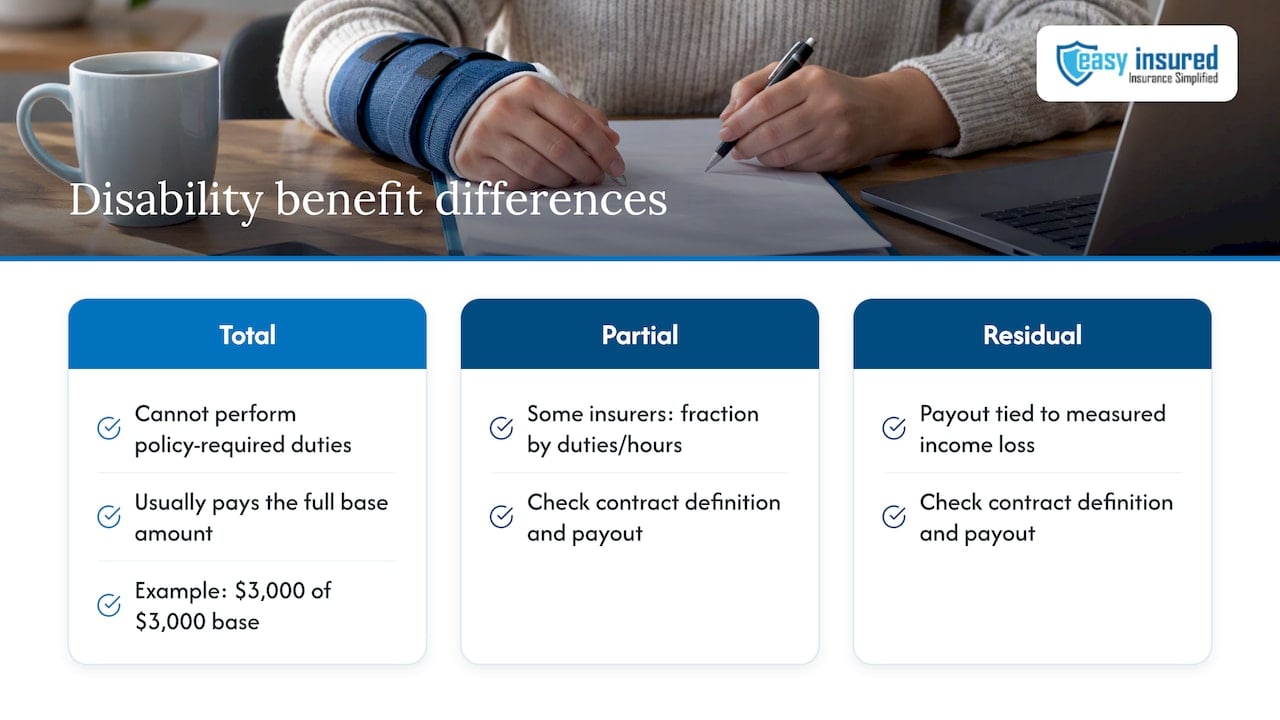
Total disability means you cannot perform the duties the policy requires, as the policy defines them. Benefits are usually the full base amount. The definition itself, not your doctor’s opinion alone, decides whether you meet it.
People often use “partial” and “residual” interchangeably, and in everyday conversation that is fine. Some insurers, though, treat partial disability as a set fraction tied to reduced duties or hours, while residual disability is tied to measured income loss. Always check which term your contract uses and how it pays.
A comparison with illustrative figures shows the gap. Take a $3,000 base benefit. Under total disability, you collect $3,000. The same injury produces three different checks depending on the wording.
Is a residual disability rider worth it? A decision checklist
A rider adds value when your income can fall without going to zero. That describes commission-based pay, variable freelance revenue, self-employment and physical trades where a return to work is likely to be gradual. If you are salaried with steady hours and an employer who accommodates reduced duties, the case is weaker.
Compare the rider’s added premium with the cost of raising your base benefit. We generally advise prioritizing the base benefit before riders, since a larger base also scales up any residual payout. If the base is already adequate, a rider becomes the logical next layer.
Work through this checklist:
- Estimate your worst realistic partial-earnings loss, for example a 40% drop for six months.
- Request a quote for the rider and for a higher base benefit.
- Compare what each pays in your worst-case scenario.
- Check the rider’s minimum-loss threshold and any cap.
- Confirm how earnings are measured if your income is irregular.
Pro Tip: Bring payroll or tax records to your quote, because insurers measure partial loss against your earnings, and irregular income gets priced differently from a flat salary.
Taxation, offsets and how other income affects your net benefit
Who pays the premium decides the tax result. In Canada, if you pay the entire premium yourself, benefits are generally tax-free, while employer-paid premiums typically make benefits taxable. That applies to residual benefits as well as total disability. Our post on whether long-term disability benefits are taxable goes deeper, and the disability tax rules article covers related credits.
Offsets are the second filter. Government disability payments or other group plans can reduce what your insurer pays, so your total replacement is often capped within the 60% to 85% range that policies commonly target.
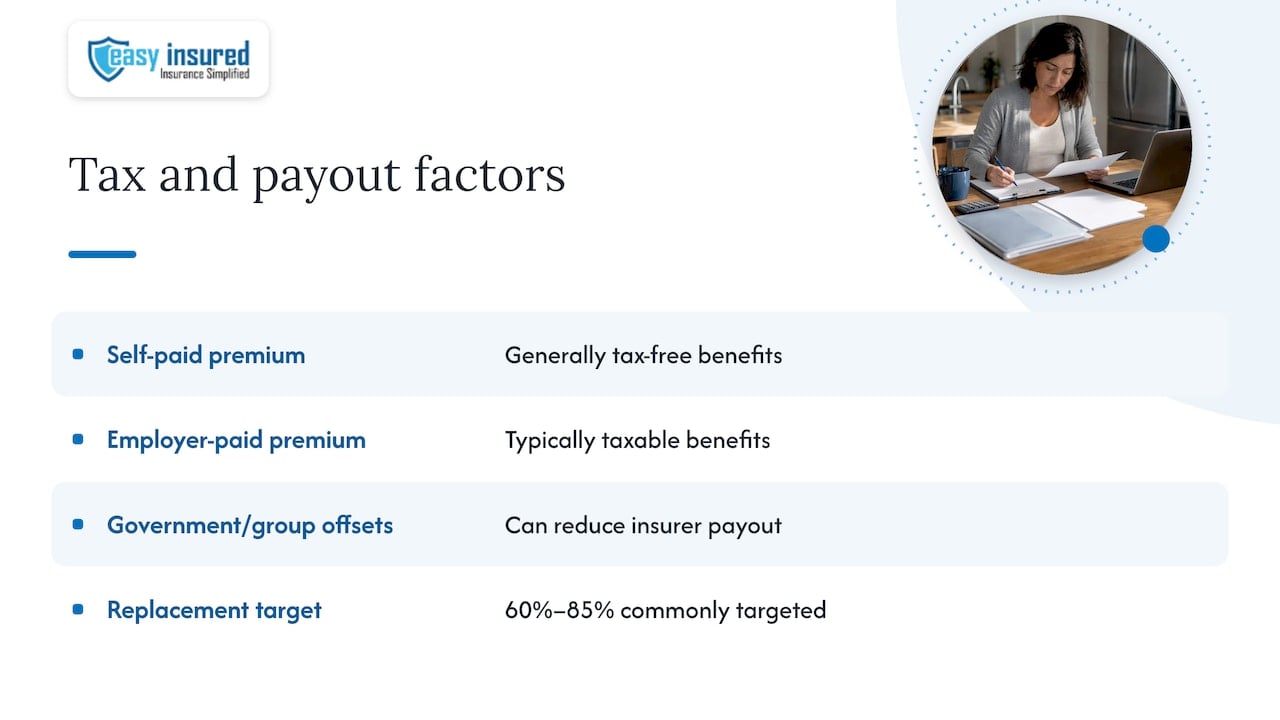
A $600 benefit from a policy you paid for yourself arrives as $600.
How claims for residual benefits work
Residual claims need more paperwork than a total disability claim, because your income keeps changing. Insurers commonly require ongoing income documentation and periodic reporting to show your earnings loss still meets the policy threshold.
- Notify the insurer and request claim forms as soon as your earnings start to fall.
- Submit the medical form. CLHIA introduced a harmonized initial disability medical form intended to reduce physician administrative burden and speed access to benefits.
- Serve the elimination period. This waiting period runs from the start of disability until payments begin, and the length is set in your policy. Our article on disability elimination periods shows how to cover that gap.
- Report income on schedule. Expect periodic statements, pay stubs or tax records.
- Track the benefit period, since it defines how long payments can continue.
Keep copies of everything you submit. Late or incomplete income reports are a common reason payments get delayed.
Why I would fix the base benefit before shopping for riders
Most people go looking for a clever rider when their base benefit is simply too small. A residual payout is a fraction of that base, so a thin base produces a thin check in every scenario. Fix that first, then layer on the rider if your income is likely to dip rather than disappear.
If your pay moves around, whether through commissions, contract work or self-employment, talk to a broker before you decide. Variable income is where policy wording does the most damage or the most good. Walk in with payroll records and a copy of your policy wording, and the conversation gets specific fast.
— Frank
How we help you estimate benefits and compare riders
We offer disability insurance and advisory support to people who want a real number, not a guess. When you work with us, we compare a higher base benefit against a residual rider using your own income history, then check each policy’s definitions, loss thresholds and tax treatment. If you also want help placing disability coverage inside a wider plan, our financial planning services cover that too.

Request a tailored quote or a policy review today at Easy-insured.
This article is general information, not a substitute for advice from a qualified financial advisor. Consult a qualified financial professional about your own circumstances before acting on anything here.
FAQ
What is a residual disability?
A residual disability is a situation where you can still work, but at reduced hours or pay, and your policy pays a proportional benefit for the lost income. It sits between full working capacity and total disability. The payout depends on the percentage of earnings lost.
What is the difference between residual and partial disability?
The terms are often used interchangeably, but insurers can define them differently. Residual benefits generally track measured income loss, while a partial benefit may be a fixed fraction tied to reduced duties. Read your contract’s definitions to see which applies.
How much disability will I get if I make $40,000 a year?
It depends on your policy’s replacement percentage and offsets, with typical ranges between 60% and 85% of income used as a guide. Taxation depends on who paid the premiums.
What happens after 2 years on disability?
Many policies change their definition of disability at a set point, shifting from your own occupation to any occupation you are suited for. This varies by contract, so check the clause in your policy. Group plans and individual plans handle the switch differently.
Sources
- Canada
- CLHIA – Initial disability medical forms harmonized to help relieve physician administrative burden
- Understanding Residual Benefits in Disability Insurance
- Insurancebusinessmag