
Whether your disability benefits get taxed comes down to one question: who paid the premiums? Let your employer cover the premium, and the Canada Revenue Agency usually treats the payout as taxable income. Layer on the Disability Tax Credit, CPP disability rules, and the disability supports deduction, and the real answer depends on your specific paperwork, so check your slips before assuming either way.
TL;DR:
- Benefits from fully employee-paid premiums are generally tax-free, while employer-paid premiums are usually taxable income and may appear on T4 or T4A slips.
- Cost-shared plans with partial employer contributions result in taxable benefits proportional to the employer-funded portion, potentially creating surprises on tax slips.
- Claiming the Disability Tax Credit can reduce tax owed significantly, but eligibility depends on certified severe impairments, and past eligibility can be adjusted retroactively up to 10 years.
- CPP disability benefits are fully taxable, requiring voluntary tax withholding requests to avoid unexpected taxes at year-end, and the Child Disability Benefit depends on DTC approval.
- Proper documentation and understanding of premium sources are crucial before filing, especially when structuring coverage or switching payment arrangements to optimize tax outcomes.
Table of Contents
- Disability Insurance Tax Canada Rules: Who Pays the Premium?
- When Are Disability Benefits Taxable in Canada?
- Disability Tax Credit Eligibility and 2026 Amounts
- CPP Disability, the Canada Disability Benefit, and the Child Disability Benefit
- Disability Supports Deduction vs. Medical Expense Tax Credit
- Reporting Disability Income and Premiums Correctly
- A Practical Checklist Before You File
- Why Tax Clarity Changes Your Real Income Protection
- Tax-Smart Disability Coverage With Easy-insured
- Sources
- FAQ
Disability Insurance Tax Canada Rules: Who Pays the Premium?
The premium payer is the whole ballgame. Group plans muddy this more than most people realize, because “employer plan” doesn’t automatically mean “employer-paid.”
- Employer pays 100%: the premium is often a taxable benefit to you now, but your future payout is generally tax-free if the plan qualifies as a wage-loss replacement plan.
- You pay 100% out of pocket, after tax: no deduction today, but benefits are tax-free later.
- Cost-shared plans: your taxable share of any future benefit is prorated to whatever percentage the employer contributed.
- Self-employed individual policies: premiums aren’t deductible against business income, which is precisely why the eventual benefit stays tax-free.
Payroll reporting reflects this split. Employer-paid group premiums often show up under T4 box 40 or T4A box 028, depending on the plan structure.
Pro Tip: Pull your benefits booklet and your last pay stub before you file anything. If you can’t tell from those two documents who paid what share of the premium, call your HR department and ask directly.
When Are Disability Benefits Taxable in Canada?
Three scenarios cover almost every case:
- Fully employee-paid premiums. You funded the entire premium after tax. The Financial Consumer Agency of Canada confirms these benefits are generally tax-free, whether the payout comes from short-term or long-term coverage.
- Fully employer-paid, non-group or non-qualifying plans. The benefit is typically fully taxable, added to your income for the year you receive it.
- Cost-shared plans with partial employer funding. Only the employer-funded portion of the benefit gets taxed. A 60/40 split, employer to employee, generally means 60% of your monthly payout is taxable and 40% isn’t.
Here’s the detail that trips people up: even a small employer contribution can flip the entire tax treatment for that portion of the benefit. Someone who assumed their long-term disability check was tax-free because they “mostly” paid the premium can be surprised by a T4A slip at tax time. Wage-loss replacement plans carry their own exemption logic, and coordination with provincial disability programs can further reduce what actually lands in your bank account, even before tax is applied.
Disability Tax Credit Eligibility and 2026 Amounts
The Disability Tax Credit isn’t a cash benefit. It’s a non-refundable credit that reduces the tax you owe, and it serves as the gateway to several bigger programs.
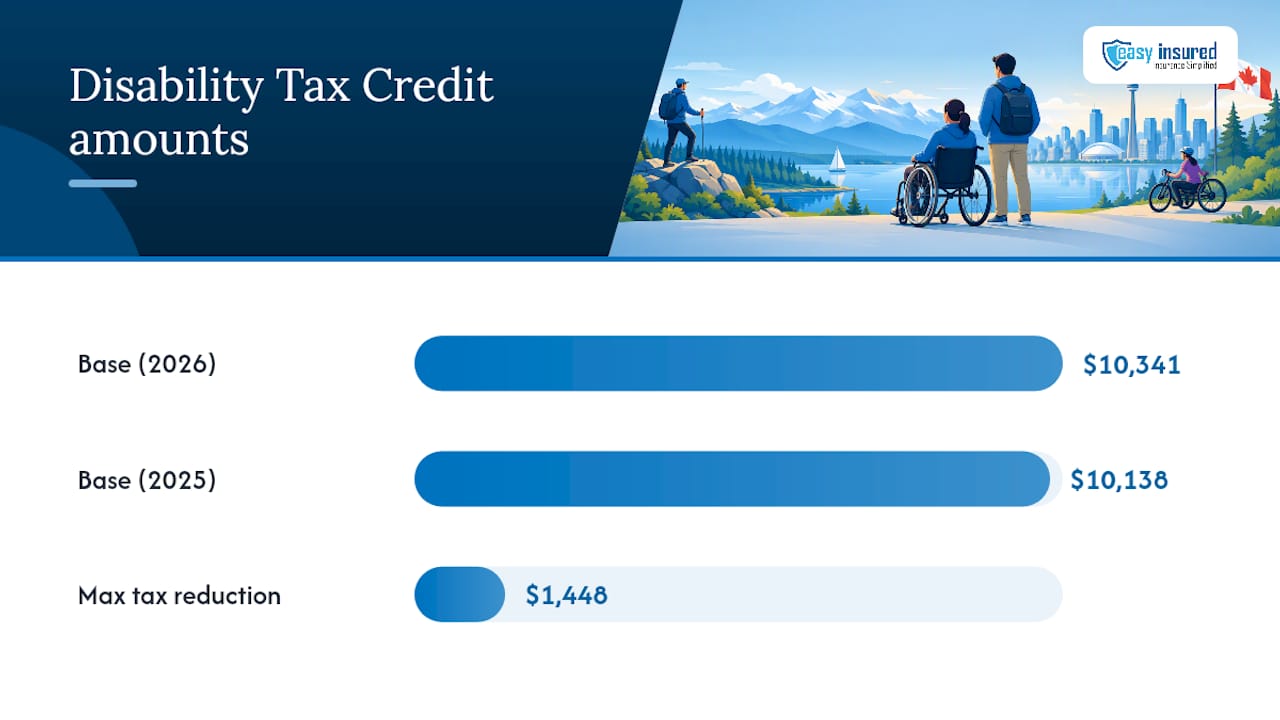
For 2026, the federal base amount is $10,341, up from $10,138 in 2025, translating to a federal tax reduction of up to $1,448. Families with a child under 18 who qualifies can claim an additional supplement on top of the base amount.
- Eligibility hinges on having a severe and prolonged impairment in physical or mental functions, certified by a medical practitioner.
- The impairment can qualify through a single “marked restriction” in one basic activity of daily living, or through the cumulative effect of significant restrictions in two or more areas.
- Approval opens the door to a Registered Disability Savings Plan, the Canada Disability Benefit, and the Child Disability Benefit.
- You apply using Form T2201, split into Part A (completed by you or your representative) and Part B (completed by a medical practitioner).
- If you qualify now but were eligible in prior years and never claimed, the CRA allows adjustments going back up to 10 years.
Recent federal measures have focused on easing access to the DTC and cutting the paperwork burden, reflecting its role as the entry point for so many other supports.
CPP Disability, the Canada Disability Benefit, and the Child Disability Benefit
Government disability programs each carry their own tax treatment, and none of them mirror private insurance rules exactly.
- CPP disability benefits count as taxable income in full. The 2026 maximum monthly amount is $1,741.20, and Service Canada does not automatically withhold tax. You need to request voluntary withholding using form ISP-3520CPP, or you risk a balance owing, and possibly quarterly instalments, at filing time.
- The Child Disability Benefit pays a maximum of $290 per month for one qualifying child, $580 for two, and $870 for three, for the July 2026 to June 2027 benefit year, with the amount reducing once adjusted family net income exceeds $82,847.
- Eligibility for the Child Disability Benefit flows directly from DTC approval for the child, another reason the DTC application matters even when there’s no adult tax credit at stake.
- If you receive both CPP disability and a private long-term disability benefit, check with your insurer about offset clauses. Many private policies reduce the payout dollar for dollar against CPP disability income.
Disability Supports Deduction vs. Medical Expense Tax Credit
These two provisions overlap in confusing ways, and you cannot claim the same expense under both.
- Understand what the disability supports deduction covers. Under section 64 of the Income Tax Act, eligible expenses (attendant care, note takers, certain devices) are deducted from income if they were paid to let you work, run a business, or attend school.
- Compare it against the medical expense tax credit. The deduction reduces income directly; the credit reduces tax owed at a set rate. Run both calculations, since the better outcome depends on your income level and total expenses.
- Keep your paperwork airtight. Receipts and, in many cases, a signed certification are required, and special rules apply if the expense was incurred while temporarily outside Canada.
Pro Tip: If you’re self-employed and paying for supports that let you keep working, calculate the deduction first. It usually beats the credit for anyone with a five-figure disability supports expense in a given year.
Reporting Disability Income and Premiums Correctly
Slips tell the story if you read them right. A taxable employer-paid premium generally shows up in T4 box 40 or T4A box 028, which then flows into your total income for the year.
- Check whether your disability amount and any unused portion transferred from a dependant are reflected correctly on your return.
- Past-year DTC amounts get claimed through a T1 adjustment request, not a fresh return.
- If a T4A shows disability income you believe should be tax-free, contact the plan administrator before you file, not after.
- Setting up CPP withholding takes one form (ISP-3520CPP) and prevents a nasty surprise the following April.
A Practical Checklist Before You File
Frank at Easy-insured has seen the same mistake repeatedly: people assume tax treatment instead of confirming it. Before you file, work through this list.
- Confirm exactly who paid your disability premiums, and in what proportion, for every year you received benefits.
- Save every pay stub, T4, and T4A related to disability coverage, not just the ones from this tax year.
- Apply for the DTC if you have a qualifying impairment, even if you don’t expect to owe much tax. It opens the door to RDSP and CDB eligibility.
- Note the dates of any past eligibility so you can request retroactive DTC adjustments.
Pro Tip: Talk to an advisor before restructuring who pays your premiums. Switching from employer-paid to self-paid coverage sounds simple, but the timing of that switch determines which benefits remain taxable.
Call in professional help when your situation involves partial employer contributions, a self-employed policy you’re designing from scratch, or coordinating an RDSP alongside private coverage. Those are the cases where a small structuring decision now changes your after-tax income for years.
Why Tax Clarity Changes Your Real Income Protection
Your disability policy’s real value is its after-tax replacement rate, not the number printed on the illustration. Verify premium sources and DTC eligibility before you need the benefit, not after.
— Frank
Tax-Smart Disability Coverage With Easy-insured
Disability coverage should be structured around the tax outcome you actually want, not just the premium quote. If you’re choosing between employer-paid and self-paid coverage, or reviewing a group plan that might be creating a taxable benefit you didn’t expect, that structuring decision is exactly where Easy-insured’s disability insurance advisory work adds value.

A policy review looks at who pays each premium dollar, how your existing group coverage is reported, and whether a personal policy alongside your group plan makes sense for tax purposes. Business owners weighing group plan design should also look at Easy-insured’s broader financial planning services for coordinating disability coverage with retirement and estate strategies. Bring your benefits booklet, your last two pay stubs, and any DTC correspondence to your consultation, and request a coverage review today.
This article is general information, not a substitute for advice from a qualified financial advisor. Consult a qualified financial professional about your own circumstances before acting on anything here.
FAQ
Who Is Eligible for the $10,341 Disability Tax Credit?
The 2026 DTC base amount is $10,341, giving a federal tax reduction up to $1,448 for anyone with a severe, prolonged impairment certified on Form T2201.
Do You Get a T4 for Disability Benefits?
You may receive a T4 or a T4A, depending on how the benefit was structured and who paid the premium. Employer-paid disability benefits typically appear on a T4A, while some employer-reported taxable premiums show up as a T4 box 40 amount.
What Is the “Disability Tax” in Canada?
There’s no separate disability tax. The phrase usually refers to how disability benefits get added to your regular taxable income when your employer paid the premiums, per CRA and FCAC guidance.
Can I Deduct Disability Insurance Premiums?
Individual disability insurance premiums generally aren’t tax-deductible, and self-employed individuals cannot write them off against business income. That non-deductibility is actually the trade-off that keeps your future benefit tax-free if you’re paying the full premium yourself.
Is Disability Insurance Taxable if My Employer Pays Part of the Premium?
Yes, partially. The portion of your benefit tied to the employer-funded share of the premium is generally taxable, while the employee-funded share stays tax-free, based on the premium-source rule.