
A rider is an optional add-on that tailors your disability policy. It is useful for specific risks but never a substitute for a sufficiently large base monthly benefit. The riders you’ll see most often are own-occupation, partial or residual, cost-of-living adjustment (COLA), future increase options, and catastrophic disability. Each one solves a narrow problem, and the right mix depends on your job, your income pattern, and your existing group coverage.
TL;DR:
- Specialists whose training transfers poorly should compare own occupation wording carefully; many policies revert to any occupation after 24 months.
- Partial disability riders may require a 15% to 20% income loss before paying, while others calculate benefits proportionally; inspect the contract formula.
- COLA riders start after 12 continuous months, cap annual increases at 3% to 6%, and may raise premiums by 20% to 40%.
- Employer paid premiums generally make benefits taxable; personal after tax premiums generally produce tax free benefits, so compare spendable income, not headline amounts.
- Early career buyers expecting higher income should consider future increase options, which can raise coverage without new medical evidence after qualifying events.
Table of Contents
- Common disability insurance riders and what each covers
- How riders affect your premium and your tax bill
- How to decide which riders you actually need
- When riders earn their premium and when they don’t
- How riders interact with your policy’s definitions and triggers
- How specific riders play out in real claims
- Common exclusions and limits worth knowing before you buy
- How much riders vary between insurers
- Our approach to advising on disability riders
- How we can help you review your disability coverage
- FAQ
- Sources
Common disability insurance riders and what each covers
A rider is an optional provision that expands or limits a disability policy to match your financial situation, career, and lifestyle, according to a submission reviewed by a parliamentary committee. Riders can add inflation protection, guarantee future coverage increases, or narrow the definition of disability in your favor. Understanding what each one actually triggers matters more than collecting as many as you can afford.
Own-occupation versus regular occupation is the single biggest distinction in disability coverage. An own-occupation definition pays a benefit if you can’t perform the specific duties of your usual job, even if you could work in a different field. A regular-occupation or “any occupation” definition only pays once you can’t work in any job suited to your training and experience. Surgeons, dentists, and other specialists with narrow, high-income skill sets tend to value own-occupation protection because their training doesn’t transfer easily to lower-paying work.
Partial or residual disability riders pay a reduced benefit when an illness or injury cuts your income or working hours without eliminating them entirely. Payout formulas vary: some policies calculate the benefit as a percentage of income lost, while others use an hours-worked test. Read the formula carefully, since a policy that pays only when income drops below a steep threshold behaves very differently from one that pays proportionally from the first dollar of loss.
Cost-of-living adjustment (COLA) riders increase your monthly benefit during a long claim to help it keep pace with inflation. These riders typically trigger only after 12 months of continuous disability, with annual increases capped at a fixed rate, often in the 3% to 6% range, or indexed to CPI, as outlined in Canada Revenue Agency guidance on wage loss replacement plans.
Future increase or guaranteed purchase options let you raise your benefit amount at set intervals or life events, such as a raise or a new child, without new medical evidence. This matters if your health changes later and you’d otherwise be uninsurable at a higher amount.
Catastrophic disability (CAT) riders add an extra monthly payout on top of the base benefit when a disability is severe enough to prevent activities of daily living, such as bathing or dressing without help. These are worth a look for anyone with dependents or a mortgage that would be unmanageable on a reduced income.
A few others show up often enough to flag briefly:
- Waiver of premium stops your premium payments once you’re disabled and collecting benefits.
- Return of premium refunds a portion of premiums paid if you never file a claim.
- Student loan protection covers loan payments specifically during a disability claim.
- Lump-sum enhancement riders add a one-time payout for specific triggering events rather than ongoing monthly income.
How riders affect your premium and your tax bill
Riders add cost, and some add considerably more than others. COLA riders can raise premiums by roughly 20% to 40%, according to CRA’s archived guidance on wage loss replacement plans, which is a meaningful jump for a feature that only activates after a year of continuous disability.
Tax treatment is where a lot of buyers get surprised, and it depends entirely on who pays the premium:
- If your employer pays the premium on a group plan, the benefit you receive during a claim is generally taxable income.
- If you pay the premium yourself with after-tax dollars, benefits are generally received tax-free.
This distinction, confirmed by CRA’s payroll benefits guidance, changes the real value of a policy more than most riders do. A $4,000 monthly benefit that’s fully taxable can leave you with less spendable income than a $3,000 benefit that’s tax-free, depending on your marginal rate. We cover the mechanics of this in more detail in our piece on whether long-term disability benefits are taxable.
Elimination periods also shape a rider’s real-world value. A COLA rider sitting behind a 90-day elimination period and a 12-month trigger for its own increases is a long-term bet, not a near-term cushion. Before comparing quotes, calculate the after-tax monthly income each policy would actually deliver during a claim, not just the headline benefit amount.
How to decide which riders you actually need
Start with a short checklist before you look at a single rider:
- Confirm your base monthly benefit replaces enough of your take-home income to cover fixed expenses.
- Check existing group or workplace coverage so you don’t pay twice for the same protection.
- Identify the income risks unique to your job, such as a specialized skill set or variable self-employed earnings.
- Set a separate budget for riders only after the base benefit is adequate.
When you’re reviewing a quote or policy with an advisor, ask direct questions:
- “Show me the policy wording that defines partial disability.”
- “How is the COLA calculated, and when does it start applying?”
- “Will my benefit be offset by other income, like CPP disability or an employer top-up?”
- “What’s a sample payout calculation for a claim lasting two years?”
Watch for red flags in the policy wording itself: a narrow definition of disability that quietly shifts from own-occupation to any-occupation after a set period, unclear language about offsets against other income sources, uncapped benefit durations that sound generous but hide conditions, or elimination periods left vague or undefined. Ask the insurer for a written, plain-language statement on how benefits will be taxed in your specific situation, since verbal assurances during a sales call don’t hold up at claim time.
Pro Tip: Ask for a sample claim scenario in writing before you buy, not after you file one.
When riders earn their premium and when they don’t
A COLA rider only pays for itself if a claim runs long enough to hit its trigger, typically past the 12-month mark. For someone on a tight budget, a larger base benefit often delivers more reliable protection per premium dollar than an expensive COLA rider that may never activate.
- Own-occupation riders deliver outsized value for specialists whose training doesn’t transfer, such as surgeons or trade professionals with a single area of expertise.
- Future purchase options suit early-career buyers who expect income growth or rising financial obligations, since they lock in insurability before health changes.
- Catastrophic riders matter most when severe-loss exposure, like total loss of independence, would leave dependents without enough income to manage daily care costs.
Buyers should secure the largest possible base monthly benefit before adding riders, since riders solve narrower problems and can be a poor use of a limited premium budget.
Recent coordination across the industry is also easing claims friction. The Canadian Life and Health Insurance Association announced a harmonized disability medical form in 2025, reducing the paperwork physicians handle when initiating short- and long-term disability claims. That kind of administrative alignment can shorten the time between filing a claim and seeing a first payment, regardless of which riders you hold.
How riders interact with your policy’s definitions and triggers
A rider doesn’t operate independently of your base policy, it modifies how the base contract’s definitions and triggers apply. A catastrophic rider, for example, only activates once you meet the base policy’s own disability definition and then clear an additional, stricter threshold tied to loss of independence. If the base contract uses a regular-occupation definition but you’ve added an own-occupation rider, the rider effectively overrides that definition for a set period, often two years, before reverting to the stricter standard.
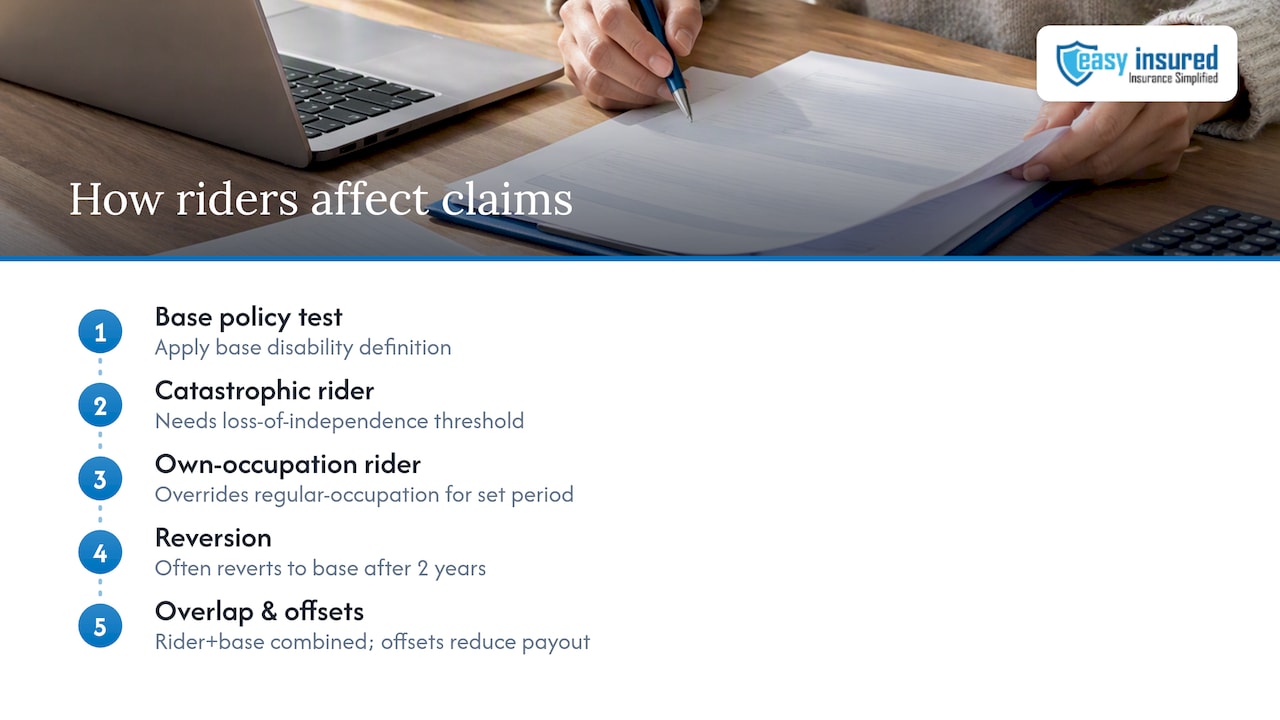
Overlaps can also create confusion at claim time. A partial disability rider and a COLA rider might both reference “monthly benefit,” but one calculates from your pre-disability income and the other from the current benefit amount, which are not the same number once a partial payout is already in effect. Offset clauses compound this: if your policy reduces benefits for other income sources, like CPP disability, that offset typically applies to the combined benefit plus rider payout, not just the base amount. Reading the full contract, not just the rider summary page, is the only reliable way to catch these interactions before you need the money.
How specific riders play out in real claims
Picture a self-employed consultant with an own-occupation rider who develops a repetitive strain injury that ends her ability to perform surgery-adjacent procedural work, but she could still teach or consult in an adjacent field. Because her rider defines disability by her specific pre-injury occupation, she qualifies for full benefits even while earning some income elsewhere, something a regular-occupation policy would likely have denied once any work became possible.
Consider a tradesperson with a partial disability rider who loses the use of one hand temporarily after surgery. His income drops by 40% rather than disappearing, and the residual rider calculates a proportional payout based on that income-loss percentage rather than requiring total work stoppage to trigger any payment.
A third scenario: someone with a COLA rider files a claim that lasts three years following a severe accident. The COLA rider, silent for the first 12 months, begins adjusting the monthly benefit upward from year two onward, offsetting inflation that would otherwise erode the real value of a fixed payout over a multi-year claim.
Common exclusions and limits worth knowing before you buy
Most riders come with conditions that narrow when they actually pay. Own-occupation riders frequently revert to a stricter any-occupation definition after a set period, commonly 24 months, so the protection you thought you bought changes partway through a long claim. Partial or residual riders often require a minimum income-loss percentage, sometimes 15% to 20%, before any payout begins, which excludes smaller income dips entirely.
Future increase options typically cap how much you can add at each opportunity and may require you to exercise the option within a narrow window after a qualifying event, like a new mortgage. Miss the window and the option lapses. Catastrophic riders usually define “loss of independence” narrowly, often tied to a specific list of activities of daily living, so a serious but differently defined impairment might not qualify. COLA riders cap annual increases, meaning a sharp inflation spike in a single year won’t be fully offset. None of these limits make a rider worthless, but they do mean the marketing description and the actual contract language can diverge in ways that only show up during a claim.
How much riders vary between insurers
Not every insurer offers the same menu of riders, and even when two companies offer a rider with the same name, the underlying formula, trigger, and cap can differ substantially. Some insurers bundle certain riders into the base policy automatically, while others sell them as fully optional add-ons priced separately. Appendices published by provincial medical associations document how optional riders and their eligibility rules vary by insurer and specialty, which is worth checking if your profession has access to association-sponsored group plans.
Negotiating room exists, but it’s usually about coverage structure rather than price. You can often adjust the elimination period length, choose between a fixed or indexed COLA, or select which riders bundle together to hit a target premium. Licensed agents are required to disclose these mechanics clearly under provincial consumer protection rules, so ask for a side-by-side comparison of two or three insurers before committing, since the same rider name can mean meaningfully different protection depending on who underwrites it.
Our approach to advising on disability riders
We start every disability review by confirming the base monthly benefit is adequate before discussing a single rider. For self-employed clients and specialized professionals, we weigh own-occupation and future increase options carefully against income variability, then model the after-tax replacement income so the number on paper matches what actually lands in a bank account during a claim. Riders earn a place in a policy only when they solve a real, specific risk.
— Frank
How we can help you review your disability coverage
Choosing the right mix of base benefit and riders is easier with a second set of eyes on the actual policy wording, not just the brochure. Our disability insurance services include a review built around exactly the gaps this article covers, and our guide for self-employed Canadians walks through buy-up strategies for variable income.

A policy review with our team typically includes:
- A line-by-line read of your policy’s disability definitions and rider triggers.
- A tax treatment check based on who pays your premiums.
- Modeling of your after-tax replacement income against your actual monthly expenses.
| What we check | Why it matters |
|---|---|
| Rider trigger wording | Confirms when a rider actually pays versus when it sounds like it should |
| Tax treatment of premiums | Determines whether your benefit arrives taxable or tax-free |
| Base benefit adequacy | Flags whether riders are filling a real gap or padding a policy that’s already short |
If you’re weighing a home purchase alongside your income protection planning, a vetted local REALTOR® match can help you understand carrying costs before you lock in a mortgage that depends on that income.
This article is general information, not a substitute for advice from a qualified financial advisor. Consult a qualified financial professional about your own circumstances before acting on anything here.
FAQ
Which rider pays a monthly income due to a disability?
The base disability income policy itself pays the core monthly benefit, while riders like the own-occupation or catastrophic rider can add to or modify that payout during a qualifying claim. Partial and residual riders also pay a reduced monthly amount when a disability cuts your income without stopping it entirely.
What is a disability rider?
A disability rider is an optional provision added to a policy that expands or narrows coverage to match a specific need, such as inflation protection or a guaranteed future increase, according to industry definitions compiled for a parliamentary submission. It modifies the base policy rather than replacing it.
Can you give me an example of an insurance rider?
A cost-of-living adjustment (COLA) rider is a common example: it increases your monthly disability benefit during a long claim, typically starting after 12 months, to help the payout keep pace with inflation. Another example is a future increase option, which lets you raise your coverage later without new medical evidence.
What does the disability rider on term insurance cover?
A waiver of premium rider, often attached to term life policies, suspends premium payments if you become disabled, keeping the life insurance coverage active without added cost. It doesn’t replace income the way a standalone disability income policy does. We cover similar riders in more depth in our guide to life insurance riders.
Sources
- Canadian Life and Health Insurance — submission (Our Commons committee brief)
- Canada
- CLHIA — Initial disability medical forms harmonized to help relieve physician administrative burden (2025)