
They are not alternatives. Health insurance pays for care and services you use, such as prescriptions, dental and vision. Critical illness insurance pays you a one-time, tax-free-in-most-cases lump sum if you are diagnosed with a covered condition, and you spend it on whatever the diagnosis does to your life. In Canada, most people need the first through their province and workplace, and many also need the second to protect their income, savings and family.
This guide explains what each product does, how critical illness cover compares with disability and life insurance, and how to think about a coverage amount.
TL;DR
- Health insurance covers the cost of care and services. Critical illness insurance pays a lump sum on diagnosis of a covered condition, and you decide how to use it.
- Provincial plans cover most health care needs. Workplace plans fill some gaps, such as prescription drugs, dental and vision.
- Critical illness pays once, in a lump sum. Disability insurance pays monthly and replaces part of your income. Life insurance pays only on death.
- Policy definitions, exclusions and the survival period decide whether a claim pays, so read them before you buy.
- Size the amount by adding up lost income, extra costs and debts, then subtract what you already have.
Table of Contents
- How the two products work
- Critical illness vs income protection (disability insurance)
- Critical illness vs life insurance
- What a critical illness policy will and will not pay
- How much critical illness insurance do you need?
- A simple way to layer your coverage
- Perspective: why we start with the gaps, not the product
- Talk it through with us
- FAQ
- Sources
How the two products work
Health insurance: paying for care
In Canada, provincial and territorial health plans cover most health care needs. Workplace or private plans can cover services those plans do not, such as prescription drugs, dental care and vision care. This is what people usually mean by “health insurance” here: it reimburses a bill or pays a provider for a service you received.
It does not hand you cash to use as you wish, and it does not replace a paycheque.
Critical illness insurance: paying you
Critical illness insurance pays an amount if the insured suffers from a critical illness that satisfies the definition in the contract. The federal consumer agency describes it as usually a one-time lump-sum payment on diagnosis.
The money is yours. The Quebec regulator notes the benefit can be used however you see fit, including private health care, home care, children’s expenses or adapting a vehicle. That freedom is the whole point, and it is what a reimbursement plan cannot offer.
Side by side
| Health insurance | Critical illness insurance | |
|---|---|---|
| What triggers it | A claim for a covered service or product | Diagnosis of a condition that meets the contract definition |
| What it pays | The cost of the service, within plan limits | A fixed lump sum |
| Who decides how it is spent | The plan, by what it covers | You |
| Typical gaps it fills | Drugs, dental, vision, other services outside provincial plans | Lost income, travel for treatment, home help, debts, private care |
| Main condition | You use a covered service | You meet the definition and the survival period |
Critical illness vs income protection (disability insurance)
This is the comparison readers most often make, and the two are easy to confuse. Both help when illness stops you working, but they pay differently.
Disability insurance pays periodic benefits and replaces a percentage of the income you earned before disability, for example 66%. Critical illness insurance pays the agreed amount when the illness matches the contract definition, as long as you meet the survival requirement.
The practical difference:
- Trigger. Disability pays when you cannot work, whatever the cause that the policy recognizes. Critical illness pays when you are diagnosed with a named condition, even if you keep working.
- Shape. Disability is a monthly income stream. Critical illness is one payment.
- Gaps. A heart attack survivor may return to work in a few months and never qualify for long-term disability, yet still face large one-off costs. A back injury may qualify for disability but is not on any critical illness list.
For most working people the two complement each other. We break down exactly when each one pays in Disability vs Critical Illness in Canada, and explain why the headline percentage is not what you keep in Disability Insurance in Canada. If you are self-employed, there is no employer plan behind you, so disability insurance for self-employed Canadians deserves its own look.
Critical illness vs life insurance
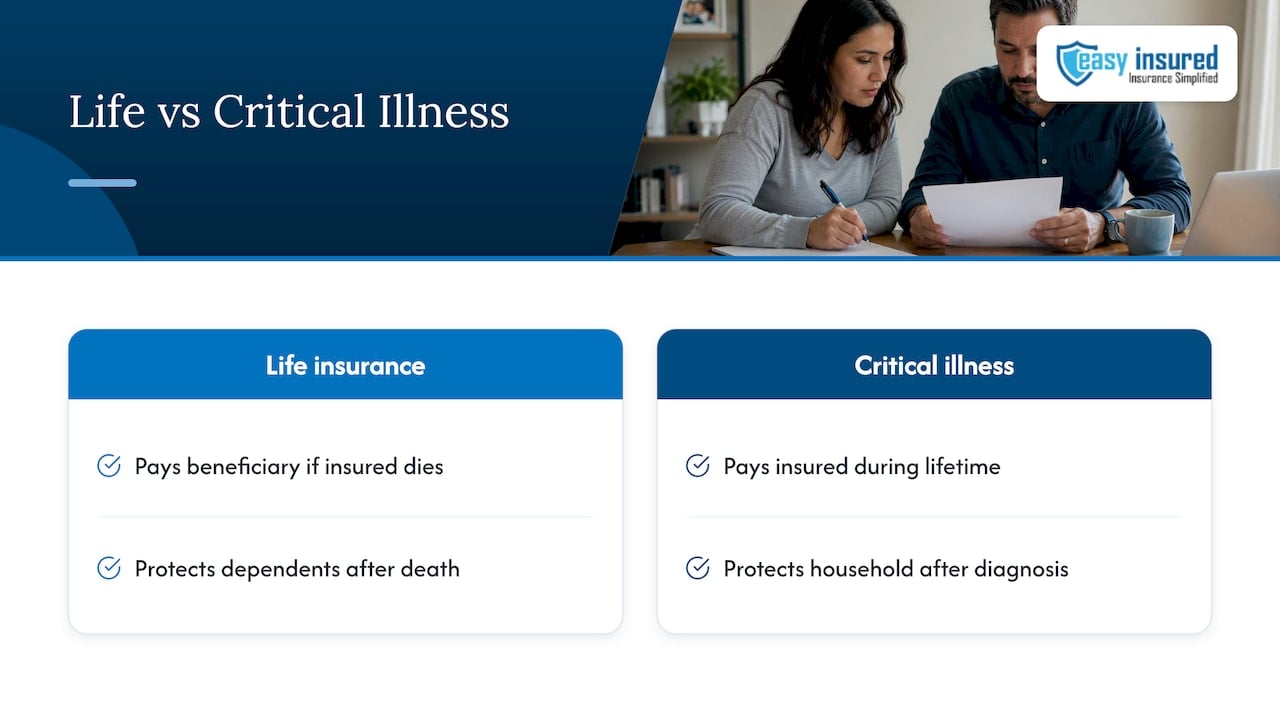
Life insurance pays the beneficiary if the insured dies while the contract is in effect. Critical illness insurance pays during the insured’s lifetime. One protects the people who depend on you after you are gone. The other protects you and the household while you are alive and dealing with a serious diagnosis.
Many families hold both, and some policies attach critical illness as a rider to a life policy. That can be convenient, but a rider and a standalone policy differ in cost, flexibility and payout structure, so compare them rather than assuming. If you are weighing term, whole or universal life, our Term Life and Whole Life pages explain the basics.
Homeowners get a related question: does mortgage protection already cover this? Mortgage disability and critical illness insurance may make mortgage payments to your lender, and those plans usually bundle several products. The same federal page advises checking whether your employer or another policy already meets your needs before you buy. Our comparison of mortgage protection and life insurance goes deeper.
What a critical illness policy will and will not pay
A lump sum sounds simple. The conditions behind it are where claims succeed or fail.
Definitions matter
A policy pays only for illnesses that meet its written definition. The Canadian Life and Health Insurance Association publishes voluntary benchmark definitions for critical illnesses, reviewed in 2024, to reduce consumer confusion. Insurers can still define conditions within their own contracts, so two policies that both list “cancer” may not pay in the same situations. For example, early-stage or low-risk cancers are often treated differently from invasive ones. Our guide to the 26 CLHIA critical illness conditions sets out the diagnosis rules in plain language.
The survival period
In general, you must survive at least 30 days after diagnosis for the insurer to pay. Check the exact period in your contract, along with the exclusions.
Your free-look window
Industry guidance calls for a 10-day “free look” period for individual life and accident and sickness contracts, so you can review a new policy and cancel for a refund within that time. Use it to reread the definitions against your own health history and family risks.
If something goes wrong
If you dispute a decision, the Ombudservice for Life and Health Insurance is a free, independent dispute resolution service for Canadian life and health insurance policyholders.
How much critical illness insurance do you need?
There is no official formula. A common planning approach is to estimate what a serious diagnosis would cost you, then subtract what you already have. Work through it in four steps.
- Income gap. Decide how many months you would want to step back from work without financial pressure. Multiply your monthly take-home pay by that number. Many people choose somewhere between six and twelve months. Treatment, recovery and a gradual return to work often take longer than people expect, so be honest about your job.
- Extra costs. Add costs that provincial and workplace plans may not cover: travel and lodging for treatment, parking, home help, childcare, private care or equipment, and adapting a home or vehicle.
- Debts. Decide whether you want the option of reducing the mortgage or other debts during a hard period.
- Subtract what exists. Take away savings you are willing to use, group coverage through work, and any disability benefit you would realistically receive.
A worked example
Suppose a parent takes home $5,000 a month and wants nine months of cushion: that is $45,000. They estimate $12,000 for home help and childcare and $6,000 for travel and other out-of-pocket costs. The total is $63,000. They would be willing to draw $8,000 from a TFSA, and have no group critical illness cover. The gap is $55,000, so they might look at a policy in the range of $50,000 to $60,000 and then check the premium against their budget.
That example is illustrative, not a recommendation. Your numbers will differ, and a larger amount costs more in premiums.
Differences for families and business owners
- Families with one main earner should weigh the loss of that income more heavily and consider coordinating with disability cover.
- Business owners have no employer plan by default and face fixed business costs while away. The AMF lists business overhead among the factors to consider alongside current coverage, expenses, savings and non-employment income. Overhead is usually handled with a separate product, explained in our business overhead expense guide, while critical illness helps with personal finances and with cash for key-person transitions. Our life insurance for business owners guide covers the death-benefit side.
A simple way to layer your coverage
Work from the base up:
- Provincial plan. You have this by residence.
- Workplace health and dental. Check what it covers for drugs, dental and vision, and whether it ends if you leave the job.
- Disability insurance. Protects the paycheque over months or years.
- Critical illness insurance. Adds a lump sum for the diagnosis moment and the costs around it.
- Life insurance. Protects dependants if you die.
You do not need every layer at the same size. A single person with no dependants and strong savings may need less than a couple with young children and a new mortgage.
Perspective: why we start with the gaps, not the product
When families and business owners come to us, they rarely ask for critical illness insurance by name. They ask what would happen to the household if one of them got seriously ill. We start there, with the budget, the debts and what an employer plan actually provides, and only then talk about product.
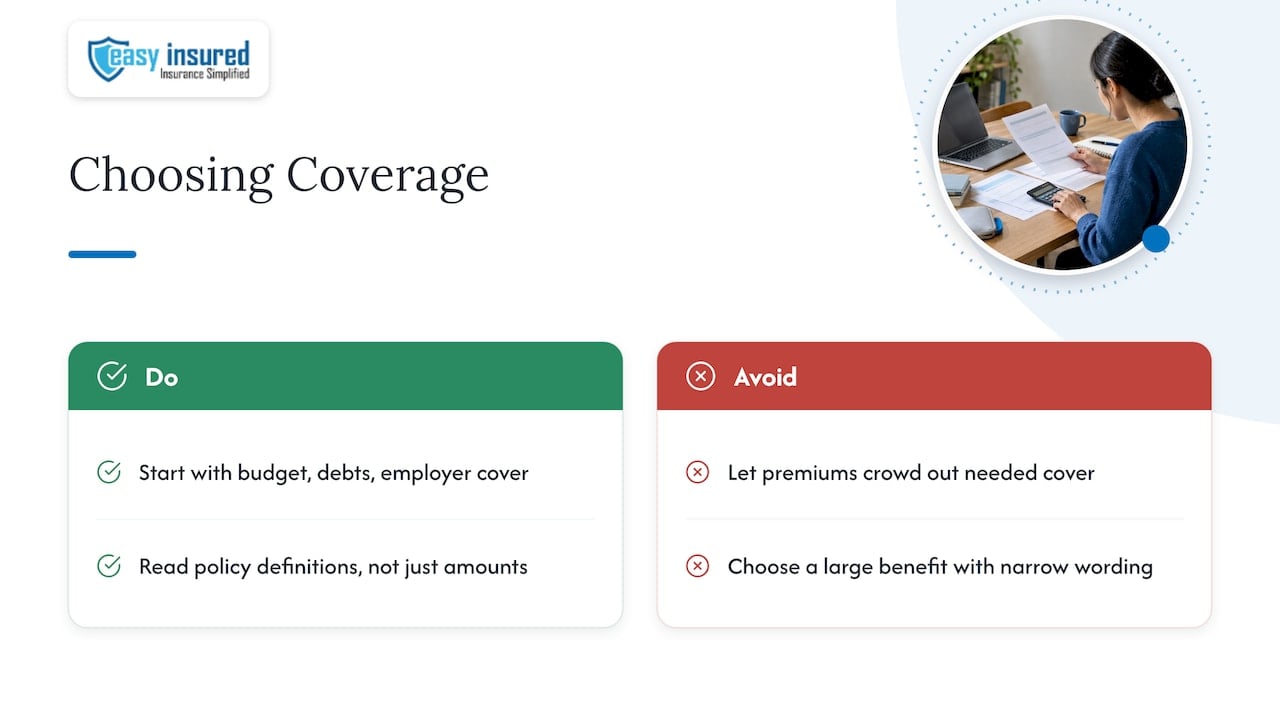
Our view is that critical illness insurance earns its place when the lump sum solves a problem nothing else solves: a self-employed owner with no sick pay, or a household that depends on one income. It is a poor fit when the premium would crowd out cover you need more, such as disability or term life. We would rather see you hold two well-chosen policies than four you cannot keep paying for.
We also push clients to read definitions, not just the headline amount. A large benefit with narrow wording is worth less than a moderate benefit that pays in the situations you fear.
— Frank
Talk it through with us
If you want help sizing cover, we can compare critical illness, disability and group options for your household or business, and a certified financial planner can place them within your wider plan. Start with our critical illness insurance page, or read the overview in Critical Illness Insurance in Canada: What You Need to Know. If you are an employer, see our group insurance plans.
FAQ
Is critical illness insurance the same as health insurance?
No. Health insurance pays for care and services, such as prescriptions, dental and vision, and in Canada provincial plans cover most health care needs. Critical illness insurance pays you a lump sum when you are diagnosed with a covered condition. You choose how to spend it.
Do I need critical illness insurance if I have a workplace plan?
Possibly. Workplace plans commonly cover services such as drugs, dental and vision, and some employers offer group critical illness or disability cover. Check exactly what yours includes and whether it stays with you if you change jobs, then decide whether a personal policy fills the gap.
Does critical illness insurance replace disability insurance?
No. Disability insurance pays monthly and replaces a percentage of your income while you cannot work. Critical illness pays one amount once you are diagnosed with a covered illness and meet the survival period. They address different risks, and many people hold both.
Does critical illness insurance pay out if I die?
Not as a living benefit. Critical illness insurance pays during your lifetime, while life insurance pays your beneficiary on death. Some policies combine the two, so read how yours treats death within the survival period.
Sources
- Critical illness insurance, AMF
- Disability insurance (salary insurance), AMF
- Health insurance, Financial Consumer Agency of Canada
- Optional mortgage insurance products, Financial Consumer Agency of Canada
- Critical Illness Benchmark Definitions, CLHIA
- Guideline G10, 10-Day Insurance Contract Rescission Right, CLHIA
- Consumer Guides, CLHIA