
Why life insurance for business owners is different from personal coverage
Life insurance for business owners does more than replace lost income. It protects the company itself: covering business debts, funding ownership transfers, and keeping operations running when a key person dies. Personal life insurance handles your family’s mortgage and living costs. Business coverage handles payroll, buy-sell agreements, and lender obligations that personal policies were never designed to touch.
Canadian business owners face a specific set of risks that employees simply don’t carry. Your income, your partners’ livelihoods, your outstanding loans, and your succession plan all depend on you staying alive and healthy. A well-structured policy addresses all of it.
Core reasons Canadian business owners need life insurance:
- Replace lost business income and cover operating costs after an owner’s death
- Pay off business loans and lines of credit so lenders can’t force a sale
- Fund a buy-sell agreement, letting surviving partners buy out the deceased owner’s share
- Protect the company against losing a key person whose skills drive revenue
- Equalize estate distributions so non-business heirs receive fair value without forcing a sale
- Provide succession planning liquidity for tax obligations and ownership transfers
Financial risks that make coverage critical for Canadian business owners
Business owners carry financial exposure that most employees never face. When you own the company, your death can trigger a chain of events that threatens everyone connected to it.
Key risks life insurance protects against:
- Business debt: Banks often require personal guarantees on business loans. If you die, that debt doesn’t disappear. A policy can pay it off before lenders act.
- Income loss: Your family may rely entirely on business income. Without it, they face immediate financial pressure while also managing grief.
- Key person dependency: Many small businesses depend on one or two people for client relationships, technical expertise, or leadership. Losing that person without a cash buffer can be fatal to the company.
- Buy-sell funding: Without a funded buy-sell agreement, surviving partners may lack the cash to buy out a deceased owner’s share, forcing a sale or family conflict.
- Estate tax exposure: Business assets transferred at death can trigger significant tax liabilities. Life insurance provides the liquidity to pay those taxes without selling the business.
Pro Tip: Business owners often assume their personal policy covers business risks. It doesn’t. Buy-sell funding and key person protection require separate, purpose-built policies.
What types of life insurance policies are available for Canadian business owners?

Three main policy types cover the needs of Canadian business owners, each suited to different time horizons and goals.
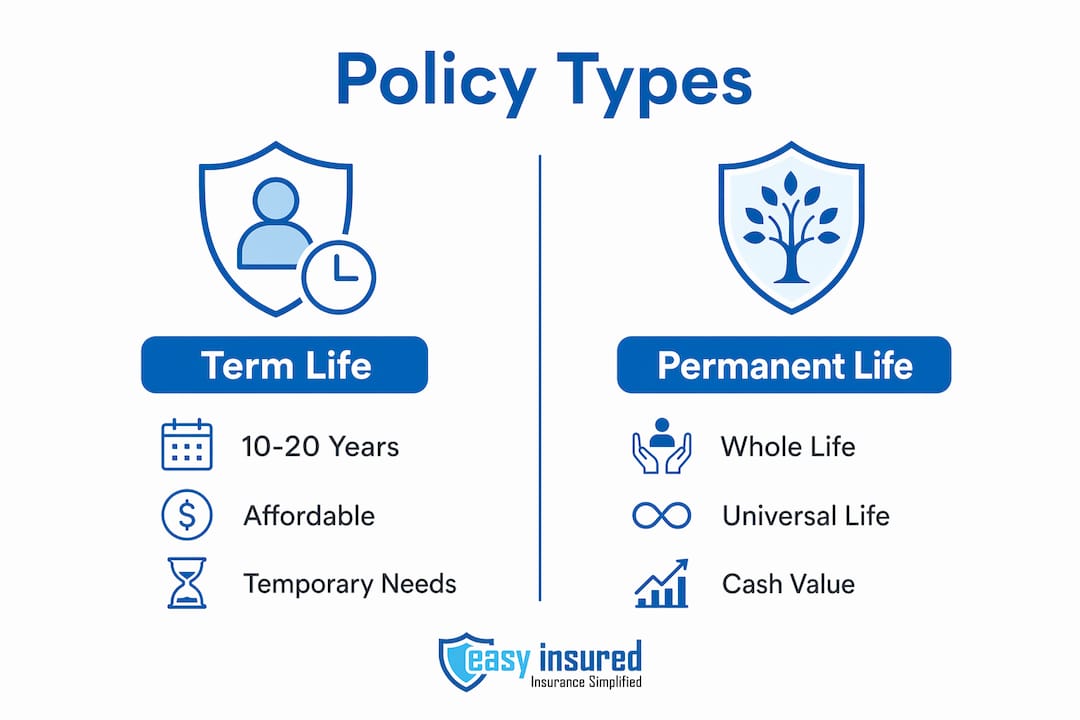
| Policy Type | Coverage Length | Best For | Corporate Ownership Possible? |
|---|---|---|---|
| Term life | 10–20 years | Covering business loans, buy-sell agreements during growth phase | Yes |
| Whole life | Lifetime | Permanent key person coverage, estate equalization, cash value accumulation | Yes |
| Universal life | Lifetime (flexible) | Business owners wanting adjustable premiums and investment-linked growth | Yes |
Term life is the most affordable option and works well when the need is temporary, such as covering a business loan with a defined payoff date or funding a buy-sell agreement during the company’s early years. Term life coverage is straightforward and easy to understand.
Whole life builds cash value over time and provides permanent protection. It suits business owners who need lifelong coverage for estate equalization or want a policy that accumulates value the corporation can borrow against. Whole life insurance is the most common choice for corporate-owned policies.

Universal life combines permanent coverage with a flexible investment component. Premiums can be adjusted within limits, and the policy’s cash value grows based on investment performance. Universal life appeals to business owners who want flexibility as their company’s financial picture evolves.
Corporate ownership matters here. When a corporation owns and pays premiums on a policy, the death benefit can flow through the capital dividend account, potentially reaching shareholders tax-free. However, premiums are generally not tax-deductible unless the policy is used as collateral for a commercial loan.
Benefits of life insurance that go beyond protecting your family
Business life insurance for owners delivers advantages that personal coverage simply can’t replicate.
- Business continuity: A death benefit gives the company cash to cover payroll, rent, and operating costs while leadership transitions.
- Key person protection: The payout funds recruiting, training, and revenue replacement when a critical employee or founder dies.
- Buy-sell agreement funding: Partners can buy out a deceased owner’s share without liquidating assets or taking on new debt.
- Tax efficiency: Death benefits received by a corporation are generally tax-free, and the capital dividend account mechanism can pass that value to shareholders without personal tax in many cases. Review this with a qualified accountant before relying on it.
- Estate equalization: If one child runs the business and another doesn’t, a life insurance payout can give the non-business heir equivalent value without forcing a sale.
- Loan collateral: Some lenders accept a life insurance policy as collateral, and in those cases the premiums may become tax-deductible.
For business owners thinking beyond insurance into broader estate planning, coordinating your policy with your will and shareholder agreements is where the real planning value lives.
What does business life insurance actually cost in Canada?
Premium costs vary by age, health, coverage amount, smoking status, and policy type. Term life is consistently cheaper than permanent coverage for the same face amount.
| Coverage Amount | Policy Type | Approximate Monthly Premium (Healthy, Non-Smoker, Age 45) |
|---|---|---|
| $500,000 | 20-year term | Lower end of the market |
| $1,000,000 | 20-year term | Mid-range for healthy applicants |
| $1,000,000 | Whole life | Significantly higher than term |
| — | 20-year term | Higher, but often still manageable |
Cost reality check: PolicyMe lists term life coverage starting from $18/month for eligible applicants, as of July 2024. Business owners typically require higher coverage amounts, increasing the monthly premium well above entry-level pricing. Your actual premium depends on your health history, the coverage amount, and whether the policy is personally or corporately owned.
The gap between term and permanent premiums is real. A $1,000,000 whole life policy for a 45-year-old business owner will cost several times more per month than a 20-year term policy for the same person. The trade-off is that whole life never expires and builds cash value.
How to choose the right policy for your Canadian business
Choosing the right coverage starts with separating your personal financial needs from your business obligations. They overlap but aren’t the same problem.
Key decision factors:
- Business structure: Incorporated businesses can hold policies corporately, unlocking the capital dividend account benefit. Sole proprietors typically hold policies personally.
- Coverage purpose: Is this for a buy-sell agreement, key person protection, debt coverage, or estate planning? Each purpose may call for a different policy type.
- Policy flexibility: Universal life allows premium adjustments; term life does not. If your business cash flow fluctuates, flexibility has real value.
- Riders: Disability waiver of premium, critical illness riders, and accidental death benefits can extend a policy’s usefulness significantly.
- Advisor credentials: Work with an advisor holding an LLQP (Life License Qualification Program) credential. That’s the Canadian licensing standard for life insurance advisors, and it’s non-negotiable for anyone giving you product-specific recommendations.
Pro Tip: Never sign a corporate-owned policy without first confirming the tax treatment with your accountant. The capital dividend account rules are powerful but technical, and a misstep can cost more than the premium savings.
For a broader view of how life insurance fits into your overall financial picture, financial planning resources can help you connect the dots between coverage, retirement savings, and business succession.
Comparing top Canadian life insurance providers for business owners
Eight providers serve Canadian business owners across a range of needs, from no-medical-exam simplified issue to full-service advisory relationships.
| Provider | Coverage Types | Specialization | No Medical Exam? | Best For | Rating |
|---|---|---|---|---|---|
| Canadian LIC® – Harpreet Puri | Life, critical illness, Super Visa | Comprehensive local advisory | Yes | Business owners needing critical illness alongside life coverage | 4.9★ |
| Specialty Life Insurance | Term, guaranteed life, AD&D | Hard-to-insure Canadians | Yes | Simplified applications, guaranteed coverage up to $50,000 | 3.8★ |
| PolicyMe | Term, critical illness, health/dental | Online self-service | Streamlined online | Tech-savvy owners wanting transparent pricing from $18/month | 4.9★ (570) |
| Foresters Financial | Life, savings solutions | Community membership, legacy planning | Varies by product | Owners valuing insurer stability and community focus since 1874 | 3.1★ (218) |
| Toronto Life Financial Group Inc | Life, critical illness, wealth management, group benefits | Personal advisor model since 1996 | Yes | Clients who want a dedicated advisor, not an online portal | 5★ (135) |
| Canada Life Capital Corporation | Term life, health/dental, small business benefits | Integrated employee benefits | Varies | Businesses needing life coverage bundled with group benefits | 1.5★ (214) |
| Canada Protection Plan Inc | Simplified issue, preferred life, critical illness | No-medical-exam leader in Canada | Yes | Hard-to-insure professionals and high-risk occupations | 3.8★ (80) |
| Life Protection Canada Inc | Term, whole, universal, critical illness, disability | Independent multi-provider brokerage | Yes | Owners wanting unbiased comparison across multiple carriers | 5★ (10) |
Canadian LIC® – Harpreet Puri stands out for business owners who want critical illness coverage alongside life insurance under one advisor relationship. The breadth of products, including Super Visa insurance, reflects a practice built for clients with layered needs.
PolicyMe is the clearest choice for a business owner who wants to get a term policy in place quickly without broker appointments. As of July 2024, pricing starts at $18/month for eligible applicants, and the online application handles critical illness and health coverage in the same session.
Canada Protection Plan fills a specific gap: business owners in physically demanding or high-risk industries who get declined elsewhere. Their simplified issue model means no medical exam and a faster decision.
Foresters Financial brings something the others don’t: an A (Excellent) rating from A.M. Best and a track record stretching back to 1874. For a business owner funding a long-term buy-sell agreement, insurer financial strength matters as much as premium cost.
Life Protection Canada Inc operates as an independent brokerage with no fees and no obligation, comparing policies across multiple carriers. That model suits business owners who want to see the full market before committing.
Toronto Life Financial Group Inc has operated since 1996 with a personal advisor model. No online-only applications here; every client works directly with an advisor, which suits complex business insurance situations.
Canada Life Capital Corporation is the strongest fit when a business needs life insurance integrated with a full employee benefits package, drawing on over 175 years of Canadian service.
Specialty Life Insurance covers Canadians who struggle to qualify elsewhere, with guaranteed life coverage up to $50,000 and AD&D up to $500,000 through a simplified application.
How to apply for business owner life insurance in Canada
Applying for a business life insurance policy follows a clear sequence. Skipping steps early creates gaps that surface at claim time.
- Assess your coverage needs. Calculate business debt, income replacement requirements, buy-sell agreement values, and key person risk separately. Add your personal family protection needs on top.
- Choose personal or corporate ownership. Incorporated business owners should discuss corporate ownership with their accountant before applying. The tax treatment differs significantly from personal ownership.
- Select the right policy type. Term life for time-limited needs like a business loan. Whole or universal life for permanent obligations like estate equalization or long-term key person coverage.
- Work with an LLQP-licensed advisor. An independent broker can compare quotes across multiple carriers. A captive agent can only offer their employer’s products.
- Complete the application and medical underwriting. Most policies above $500,000 require a medical exam. No-medical-exam options exist through providers like Canada Protection Plan and Specialty Life Insurance, but coverage limits are lower.
- Review the policy before signing. Confirm beneficiary designations, ownership structure, and any riders. For corporate-owned policies, have your lawyer review the shareholder agreement alignment.
- Coordinate with your shareholder agreement. A buy-sell agreement funded by life insurance only works if the policy terms and the legal agreement match. Review both documents together.
Easy-insured: a direct path to business life insurance in Canada
Easy-insured works differently from the providers compared above. Rather than locking you into one carrier’s products, Easy-insured gives Canadian business owners access to term life, whole life, universal life, critical illness, disability, and group benefits across multiple insurers, with financial planning and estate planning built into the same conversation.
The practical difference: you get a policy matched to your business structure, not the one a single carrier happens to offer. Whether you need whole life coverage for a corporate-owned buy-sell agreement, term life to cover a business loan, or critical illness protection for a key person, Easy-insured can compare options and build a plan that fits how your business actually operates. Get your quote at Easy-insured today.
Key Takeaways
Corporate-owned life insurance is the most tax-efficient structure for Canadian business owners, but premiums are only deductible when the policy is used as loan collateral.
| Point | Details |
|---|---|
| Business vs. personal coverage | Personal life insurance doesn’t cover buy-sell agreements or key person risk; separate business policies are required. |
| Corporate ownership advantage | Death benefits can flow through the capital dividend account, potentially reaching shareholders tax-free. |
| Policy type by purpose | Term life suits time-limited business debts; whole or universal life suits permanent needs like estate equalization. |
| Cost starting point | PolicyMe lists term coverage from $18/month; business owners typically need higher face amounts at higher premiums. |
| Easy-insured approach | Easy-insured compares term, whole, and universal life across carriers, with financial and estate planning included. |
En juillet 2024, le prix d’entrée de PolicyMe pour l’assurance vie temporaire reste à partir de 18 $/mois, mais la plupart des propriétaires d’entreprise requièrent des montants de couverture plus élevés, ce qui augmente le coût mensuel.