
Critical illness insurance pays you a tax-free lump sum if you’re diagnosed with a covered serious condition — cancer, heart attack, stroke, and others — and you can spend that money however you need, no receipts required.
Three things to know before you read further:
- Who benefits most: Canadians carrying a mortgage, single-income families, and anyone whose provincial health plan won’t cover lost wages, private specialists, or home modifications during recovery.
- The payout: A one-time, lump-sum payment you control completely — medical bills, childcare, mortgage payments, or travel for treatment.
- The main catch: Pre-existing conditions are typically excluded, and most policies require you to survive a set period after diagnosis before the payout is released.
Ready to compare plans? Easy-insured helps Canadians get CI quotes quickly — more on that below.
Table of Contents
- How critical illness insurance works in Canada
- What conditions does CI insurance typically cover?
- Common exclusions and limits that can reduce or deny your claim
- Policy types and riders: what are your options?
- How much does CI insurance cost in Canada?
- How much CI coverage do you actually need?
- CI insurance vs. disability vs. life insurance: which do you need?
- How to file a CI claim in Canada
- Is critical illness insurance worth it in Canada?
- Key Takeaways
- The gap most Canadians don’t plan for
- How Easy-insured can help you find the right CI coverage
- Useful sources and further reading
How critical illness insurance works in Canada
The mechanics are straightforward, but a few details trip people up if they skip the fine print.

Step 1: Apply while you’re healthy. Insurers underwrite CI policies medically, which means they review your health history. Pre-existing conditions are usually excluded permanently — if you had symptoms of a condition before the policy started, that condition may never be covered. Applying early, before health issues arise, preserves your full coverage.
Step 2: Your policy is structured around a benefit amount, a waiting period, and a “first diagnosis after” rule. You choose how much coverage you want (say, $100,000). The policy only pays for conditions first diagnosed after the policy takes effect. Some policies also include a waiting period — typically 90 days from the policy start — during which no claim can be made.
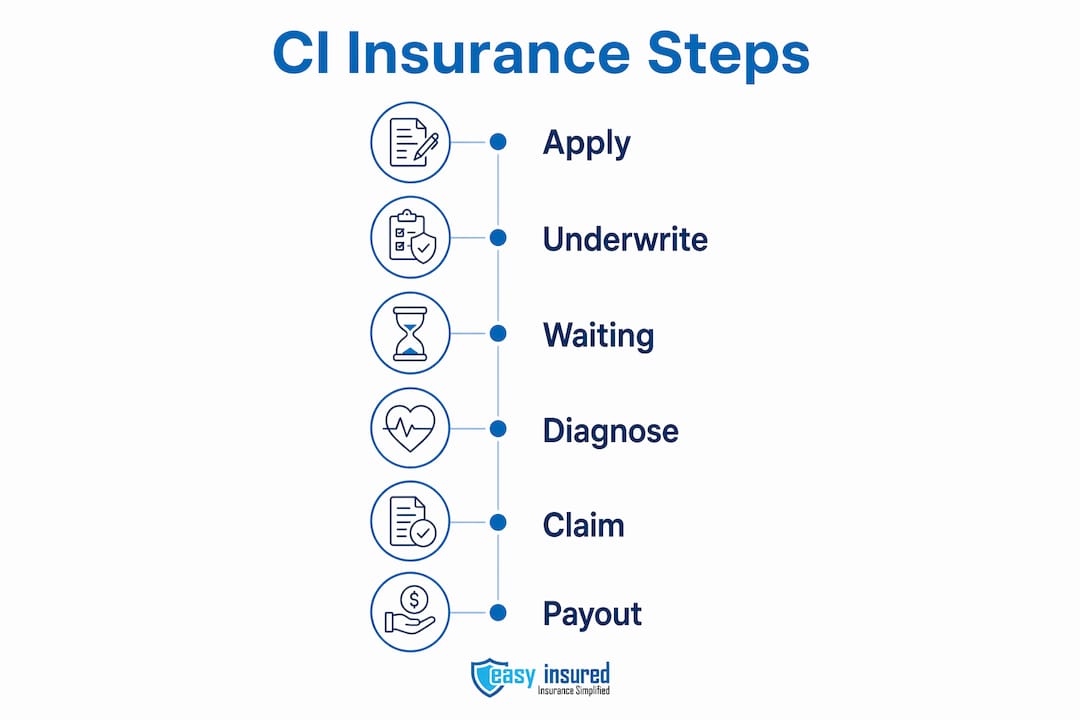
Step 3: Diagnosis triggers the claim process. Once you’re diagnosed with a covered condition, you notify your insurer, submit medical documentation, and satisfy the survival period (usually 30 days after diagnosis, though this varies by policy and condition). After the insurer reviews your file and confirms eligibility, the lump sum is paid.
Step 4: Spend the money as you see fit. The payout is yours to use however you need — private treatment, mortgage payments, childcare, home renovations, or simply replacing lost income while you recover. No receipts, no approval process for spending.
| Milestone | Typical Timeline |
|---|---|
| Application and underwriting | 2–6 weeks |
| Policy waiting period (if any) | 90 days from start |
| Survival period after diagnosis | 30 days (varies by condition) |
| Insurer claim review | 2–4 weeks after documents submitted |
| Lump-sum payout | Within days of approval |
Pro Tip: Apply for CI coverage before you turn 40 if you can. Premiums are significantly lower when you’re younger and healthier, and you lock in your rate before any health changes affect your eligibility.
What conditions does CI insurance typically cover?
Most Canadian CI policies cover a core set of serious conditions, but the exact list — and the exact definitions — vary by insurer. That variation matters more than most people realize.
Commonly covered conditions include:
- Cancer (life-threatening)
- Heart attack
- Stroke
- Kidney failure
- Major organ transplant (heart, lung, liver, kidney, pancreas)
- Coronary artery bypass surgery
- Multiple sclerosis
- Parkinson’s disease
- Alzheimer’s disease
- Aortic surgery
- Blindness, deafness, or loss of limbs
- Benign brain tumors
- Severe burns
Typical covered illnesses include heart attack, stroke, kidney failure, major organ transplant, and many cancers, but policy definitions vary widely. Some policies add neurological and degenerative diseases; others keep the list tight.
Partial and staged payouts exist in some policies. Early-stage cancer, mild coronary artery disease, or angioplasty may trigger a partial benefit — often 10–25% of the full sum — rather than the complete payout. These partial benefits are useful, but they usually reduce or eliminate the remaining coverage for that condition.
The exact wording for claims determines eligibility. Two policies that both “cover cancer” can have materially different triggers. One might require a specific pathology report; another might exclude certain cancer types entirely. Read the definition language line by line, not just the condition name.
Common exclusions and limits that can reduce or deny your claim
Knowing what CI insurance doesn’t cover is just as important as knowing what it does.
Pre-existing conditions are the most common reason claims are denied. If you had symptoms, a diagnosis, or treatment for a condition before your policy started, that condition is typically excluded — sometimes permanently, sometimes for a defined look-back period (often two years). This is why applying while healthy is so critical.
Survival and waiting periods are standard features, not fine print surprises. Most policies require you to survive 30 days after diagnosis before the payout is released. Some conditions have different survival requirements. The waiting period at policy start (usually 90 days) means a diagnosis in the first three months won’t be covered at all.
Behavioural exclusions are also common. Self-inflicted injuries, substance abuse, and criminal activity typically void a claim. Policies may also exclude conditions arising from war or participation in high-risk activities, depending on the insurer.
The single-payment nature of most CI policies means once you claim, the policy is done. Many policies pay a single lump sum; partial payouts for less severe conditions exist in some plans, but they usually reduce the remaining benefit dollar-for-dollar.
Watch for this clause: “The insured must survive 30 days from the date of diagnosis as confirmed by a licensed physician.” If your policy uses a different survival period — or ties it to a specific treatment milestone — that changes when you can actually access your money. Always confirm the survival period for each covered condition, not just the headline number.
Pro Tip: Ask your advisor for the full policy wording, not just the marketing summary. The definitions section — not the brochure — is what the insurer uses when assessing your claim.
Policy types and riders: what are your options?
CI insurance isn’t one-size-fits-all. The structure you choose affects both your premium and how long your coverage lasts.
Term critical illness covers you for a fixed period — 10, 20, or 30 years, or to a specified age (often 65 or 75). Premiums are lower than permanent CI, but coverage expires. If you’re still alive and healthy at the end of the term, the policy ends with no payout.
Permanent (level) critical illness keeps you covered for life with level premiums that don’t increase as you age. It costs more upfront, but the premium you pay at 35 is the same at 65.
Common riders and add-ons:
- Return of premium (ROP): If you never make a claim, you get your premiums back — either at policy expiry or death. This reduces the “wasted money” concern but adds meaningfully to your monthly cost.
- Children’s coverage: Extends CI protection to your children under a rider, typically covering a shorter list of conditions relevant to pediatric illness.
- Partial/early-stage payouts: Pays a smaller benefit for less severe diagnoses (early-stage cancer, angioplasty), preserving some value even when the full trigger isn’t met.
- Combined life + CI policies: Bundle life insurance and CI coverage in one product. Useful for simplicity, though the trade-offs in coverage depth are worth examining carefully.
Return-of-premium riders reduce the risk that premiums feel “wasted” but add cost. Consider ROP only if you value premium return over a lower ongoing price.
| Policy Type | Premium Pattern | Coverage Duration | Best For |
|---|---|---|---|
| Term CI | Lower, fixed for term | Expires at set age/date | Budget-conscious buyers, mortgage coverage |
| Permanent CI | Higher, level for life | Lifelong | Long-term protection, estate planning |
| Term CI + ROP | Highest for term | Expires, premiums returned | Those who want a safety net on premiums |
| Life + CI combo | Varies | Depends on life policy | Simplicity seekers, bundled protection |
How much does CI insurance cost in Canada?
Several variables drive your premium, and understanding them helps you budget realistically.
The primary price drivers:
- Age: The single biggest factor. Younger applicants pay substantially less.
- Sex: Biological sex affects actuarial risk calculations and premium pricing.
- Smoking status: Smokers pay significantly higher premiums than non-smokers.
- Health history: Conditions, medications, and family history all affect underwriting.
- Coverage amount: A $50,000 benefit costs less than a $250,000 benefit.
- Policy type: Permanent CI costs more than term; ROP riders add further cost.
- Number of covered conditions: Broader coverage lists typically mean higher premiums.
CI premiums generally rise with age; some illustrative pricing approaches show cost per $5,000 or per $10,000 of coverage to estimate monthly premiums. As a general reference, a healthy non-smoking 40-year-old might pay roughly a few dollars per month per $5,000 of coverage — so a $30,000 benefit incurs a moderate monthly premium. Past age 65, that same $5,000 of coverage can cost over $12 per month.
Locking in your rate earlier is almost always cheaper. A 35-year-old buying permanent CI pays a level premium for life; a 50-year-old buying the same policy pays considerably more for the same benefit.
Joint or family coverage options exist with some insurers, though pricing depends heavily on both applicants’ health profiles and the insurer’s product structure.
Pro Tip: Get quotes for both term and permanent CI before deciding. For many Canadians in their 30s and 40s, a 20-year term policy covers the highest-risk financial period (mortgage, young children) at a fraction of the permanent cost.
How much CI coverage do you actually need?
A practical calculation beats a guess. Work through this checklist and add the numbers up.
- Outstanding mortgage balance — the amount needed to pay off your home if you can’t work for an extended period. ($300,000 is a common starting point for many Canadian homeowners.)
- Income replacement: 6–24 months — multiply your monthly take-home pay by the number of months you’d need to cover. A serious illness recovery often runs 12–18 months. ($5,000/month × 18 months = $90,000.)
- Expected medical and rehabilitation costs — private physiotherapy, occupational therapy, home nursing, or experimental treatments not covered by provincial plans. Budget $10,000–$30,000 depending on the condition.
- Debt outside the mortgage — car loans, lines of credit, credit card balances. Add the full balance.
- Caregiving and childcare costs — if a spouse or partner needs to reduce work hours to care for you, factor in that income gap.
- Emergency buffer — a 10–15% cushion for unexpected costs.
Worked example for a typical Canadian household:
A couple in their late 30s, one income of $6,000/month net, mortgage balance of $350,000, two young children, and $20,000 in other debt.
- Mortgage: $350,000
- Income replacement (18 months): $108,000
- Rehab and private care: $20,000
- Other debt: $20,000
- Childcare gap: $15,000
- Buffer (10%): $51,300
Total target coverage: approximately $564,300 — rounded to $500,000 for a practical policy amount.
Single-income families, those with a strong family history of cancer or heart disease, or anyone without employer disability coverage should lean toward the higher end. If you already have solid disability insurance in place, you may be able to reduce the income-replacement component of your CI target.
For help integrating CI into a broader plan, financial planning that accounts for your full protection picture makes the math clearer.
CI insurance vs. disability vs. life insurance: which do you need?
These three products solve different problems. Confusing them leads to either gaps or overlap.

Critical illness insurance pays a one-time lump sum when you’re diagnosed with a covered condition. You get the money regardless of whether you can work. The trigger is the diagnosis itself, not your ability to earn income.
Disability insurance replaces a portion of your income — typically 60–85% — on a monthly basis when illness or injury prevents you from working. It pays as long as you remain disabled, up to the policy’s benefit period. CI tends to be less expensive than long-term income protection but provides a different payout structure: one-time versus periodic. If your primary concern is keeping the lights on month after month during a long recovery, disability insurance does that job; CI does not.
Life insurance pays a lump sum to your beneficiaries when you die. It protects the people who depend on your income after you’re gone. It does nothing for you while you’re alive and dealing with a serious illness.
The practical reality for most Canadians: CI and disability insurance are complementary, not interchangeable. A cancer diagnosis might leave you unable to work for 18 months — disability insurance covers the monthly income gap, while CI covers the lump-sum costs that don’t fit neatly into a monthly budget (a private specialist, a home modification, or simply paying off the mortgage so the monthly pressure disappears).
Pro Tip: If you can only afford one, and your biggest fear is losing monthly income, prioritize disability insurance. If you have disability coverage through work and want protection against the large one-time costs of a serious illness, CI fills that gap cleanly.
How to file a CI claim in Canada
Filing a claim correctly the first time reduces delays significantly.
- Notify your insurer as soon as possible after diagnosis. Most policies require notification within a specific window. Call your insurer or broker immediately — don’t wait until you feel well enough to handle paperwork.
- Gather your medical documentation. This is the most time-consuming step. You’ll need physician reports confirming the diagnosis, diagnostic test results (biopsy reports, imaging, ECG results), treatment notes, and your policy documents.
- Satisfy the survival period. Most policies require 30 days of survival after diagnosis. The clock starts on the diagnosis date confirmed by your physician.
- Submit the complete claim package. Incomplete submissions are the most common reason for delays. Include every document the insurer requests, and keep copies of everything you send.
- Insurer assessment. The insurer reviews your file against the policy’s definition of the covered condition. They may request additional information from your physician or specialist.
- Payout. Once approved, the lump sum is deposited or sent by cheque. Typical processing after a complete submission runs two to four weeks.
Documents to have ready:
- Signed physician’s statement confirming diagnosis, date, and condition
- Pathology or diagnostic test reports
- Specialist referral letters and treatment records
- Government-issued photo ID
- Completed insurer claim form
- Your policy certificate and schedule
If your claim is denied: Request the denial in writing with the specific reason cited. Most insurers have an internal appeals process — use it. If the internal appeal fails, the Canadian Life and Health Insurance OmbudService (CLHIO) provides a free dispute resolution service for policyholders. For complex denials, consulting a lawyer who handles insurance disputes is worth considering, though that’s a decision for your specific situation.
Is critical illness insurance worth it in Canada?
The honest answer depends on your financial situation, health profile, and what provincial coverage already provides.
Decision checklist:
- Do you carry a mortgage or significant debt that would become unmanageable if you couldn’t work for 12–18 months?
- Does your household depend on one income?
- Do you have a family history of cancer, heart disease, or stroke?
- Does your employer benefits plan lack disability coverage or provide only short-term protection?
- Could you self-insure — meaning, do you have enough liquid savings to cover 18 months of expenses plus large medical costs without borrowing?
If you answered yes to the first four and no to the last one, CI insurance almost certainly belongs in your financial plan.
Three Canadian scenarios:
| Scenario | Profile | Recommended Approach |
|---|---|---|
| Young couple, first home | Dual income, mortgage, no savings buffer | CI strongly recommended; term policy covers mortgage period |
| Single homeowner, family history of cancer | One income, $250K mortgage, moderate savings | CI recommended; permanent or long-term policy given elevated risk |
| Pre-existing condition, older applicant | Health history limits underwriting options | Explore guaranteed or simplified-issue CI; compare carefully with advisor |
On taxes: In Canada, CI insurance payouts are generally received tax-free when the policy is personally owned and premiums are paid with after-tax dollars. This is the typical case for individual policies. Business-owned CI policies have different tax treatment — consult a tax professional for your specific structure. For broader context on how insurance intersects with personal finances, tax and finance resources can help you understand the implications.
Provincial health plans cover many acute medical costs, but CI’s real value in Canada is covering what provincial plans don’t: mortgage payments, childcare, home modifications, and access to private specialists or treatments not covered by your province.
Pro Tip: Don’t treat CI as a replacement for an emergency fund. The two serve different purposes. An emergency fund handles short disruptions; CI handles the financial shock of a serious, life-altering diagnosis.
Key Takeaways
Critical illness insurance pays a tax-free lump sum on diagnosis of a covered condition, giving Canadians financial flexibility that provincial health coverage alone cannot provide.
| Point | Details |
|---|---|
| Lump-sum, tax-free payout | CI pays a single lump sum on diagnosis of a covered condition; you spend it however you need, no receipts required. |
| Pre-existing conditions excluded | Apply while healthy — conditions with prior symptoms are typically excluded permanently from coverage. |
| CI complements, not replaces, disability | Disability insurance replaces monthly income; CI covers large one-time costs that don’t fit a monthly budget. |
| Policy definitions determine eligibility | Two policies covering “cancer” can have different triggers; read the definition language, not just the condition list. |
| Easy-insured for Canadian quotes | Easy-insured compares CI policies and bundles them with disability and life coverage for a complete protection picture. |
The gap most Canadians don’t plan for
Most people I speak with assume provincial health coverage handles the financial side of a serious illness. It handles the medical side — the hospital bed, the surgery, the oncologist. What it doesn’t handle is the mortgage payment due on the 1st, the childcare bill, the private physiotherapist your recovery actually requires, or the income your family loses while you spend six months in treatment.
That gap is exactly what CI insurance was designed to fill. The policies aren’t perfect — the definitions are narrow, the exclusions are real, and the survival periods can feel cruel when you’re already dealing with a diagnosis. But for a family carrying a mortgage and depending on one or two incomes, the alternative to having CI coverage is far worse: liquidating savings, taking on debt, or making decisions about treatment based on what you can afford rather than what you need.
The one thing I’d push every Canadian to do before buying: read the definition of “cancer” in the policy, not just the word “cancer” on the brochure. That single paragraph tells you more about whether a policy is worth buying than anything else in the document.
How Easy-insured can help you find the right CI coverage
Easy-insured works with Canadians across the country to compare critical illness insurance policies side by side — not just the premium, but the definition language, the covered conditions list, and the riders that actually matter for your situation.

Beyond CI, Easy-insured can bundle your coverage with disability insurance, term or whole life policies, and financial planning support so your protection fits together rather than leaving gaps. The advice is impartial — Easy-insured works for you, not for any single insurer. If a claim situation arises, the team supports you through the documentation and submission process. Get a quote at easy-insured.com/critical-illness and see what coverage looks like for your age, health profile, and budget.
Useful sources and further reading
- Critical illness insurance definition — IRMI: authoritative insurance industry definition and claim-language guidance.
- Critical illness insurance — Wikipedia: overview of product types, ROP features, and international context.
- Critical illness insurance: How it works — Medical News Today: plain-language explanation of payout mechanics, pre-existing condition rules, and pricing.
- What Is Critical Illness Insurance? — MetLife: covered conditions overview and definition variation.
- Critical illness insurance — Citizens Advice: single-payment structure, partial payouts, and comparison with income protection (UK context, useful for structural comparison).
- Critical Illness Insurance — Collins English Dictionary: plain-language definition for reference.
- Critical Illness — Easy-insured: Easy-insured’s CI product page for quotes and plan comparisons in Canada.
- Disability Insurance — Easy-insured: for comparing CI with income-replacement options.
- Financial Planning — Easy-insured: integrating CI into a broader Canadian financial plan.
This article is general information, not professional insurance or financial advice. Confirm current policy terms, tax treatment, and coverage details with a licensed advisor or your insurer for your specific situation.