
A wellness spending account (WSA) is an employer-funded allowance that employees spend on health and lifestyle items such as gym memberships, fitness gear or courses, and then claim back. In Canada, it is generally a taxable benefit for the employee. That is the single biggest difference between a WSA and a health spending account (HSA), and it shapes everything an employer should decide before offering one.
This guide is for Canadian business owners weighing a WSA, and for employees who want to understand what the account on their benefits card really is. We cover what a WSA pays for, how the Canada Revenue Agency (CRA) treats it, where it differs from an HSA, what you have to report on the T4, and how to decide whether it belongs in your plan.
TL;DR
- A WSA reimburses lifestyle and wellness spending that is not an eligible medical expense, so the CRA treats it as a taxable benefit for the employee.
- An HSA that qualifies as a private health services plan (PHSP) can pay eligible medical and dental expenses tax-free, except in Quebec. The two accounts are not interchangeable.
- Since the 2023 tax year, employers report access to dental coverage, including spending accounts that can pay dental claims, in box 45 of the T4 or T4A.
- Sole proprietors without arm’s-length employees should be wary of any plan sold as a tax-free way to deduct personal medical costs.
Table of Contents
- What a wellness spending account is
- Is a wellness spending account taxable in Canada?
- WSA vs HSA: the difference that matters
- How an HSA loses its tax-free status
- Who can set up an HSA, and the sole proprietor warning
- Reporting: T4 box 45 and what employers must do
- Provincial differences, including Quebec
- Is a WSA worth offering?
- Our perspective
- Talk to us about your benefits plan
- FAQ
- Sources
What a wellness spending account is
A WSA is a set annual amount an employer allocates to each employee. The employee pays for an eligible item, submits the receipt, and is reimbursed up to the limit. Think of it as a structured, receipt-based cousin of a cash bonus. The Canadian market also uses names such as lifestyle spending account or personal spending account (PSA), and they generally mean the same thing.
The employer chooses what the account covers. Typical categories include:
- Gym and fitness classes, home fitness equipment
- Mental wellness, such as meditation or counselling not covered elsewhere
- Nutrition and cooking programs
- Professional development and courses
- Financial planning fees
- Sometimes childcare or other lifestyle costs
The CRA’s own materials describe the range of what employers can include. According to the CRA’s guidance on determining whether a benefit is taxable, the tax treatment depends on what the money is used for, and an expense that does not qualify as a medical expense does not receive medical treatment.
Is a wellness spending account taxable in Canada?
Yes, in the ordinary case. Because a WSA pays for items that are not eligible medical expenses under the Income Tax Act, the reimbursement is a taxable benefit to the employee. It is added to employment income, and the employer should treat it accordingly on payroll.
The CRA’s rules on medical expenses paid under a private health services plan explain the contrast. Generally, when an employer pays or reimburses an employee’s medical expenses directly, that payment is a taxable benefit. The exception is a payment made under the terms of a PHSP. A WSA is built for lifestyle spending, so it sits outside that exception.
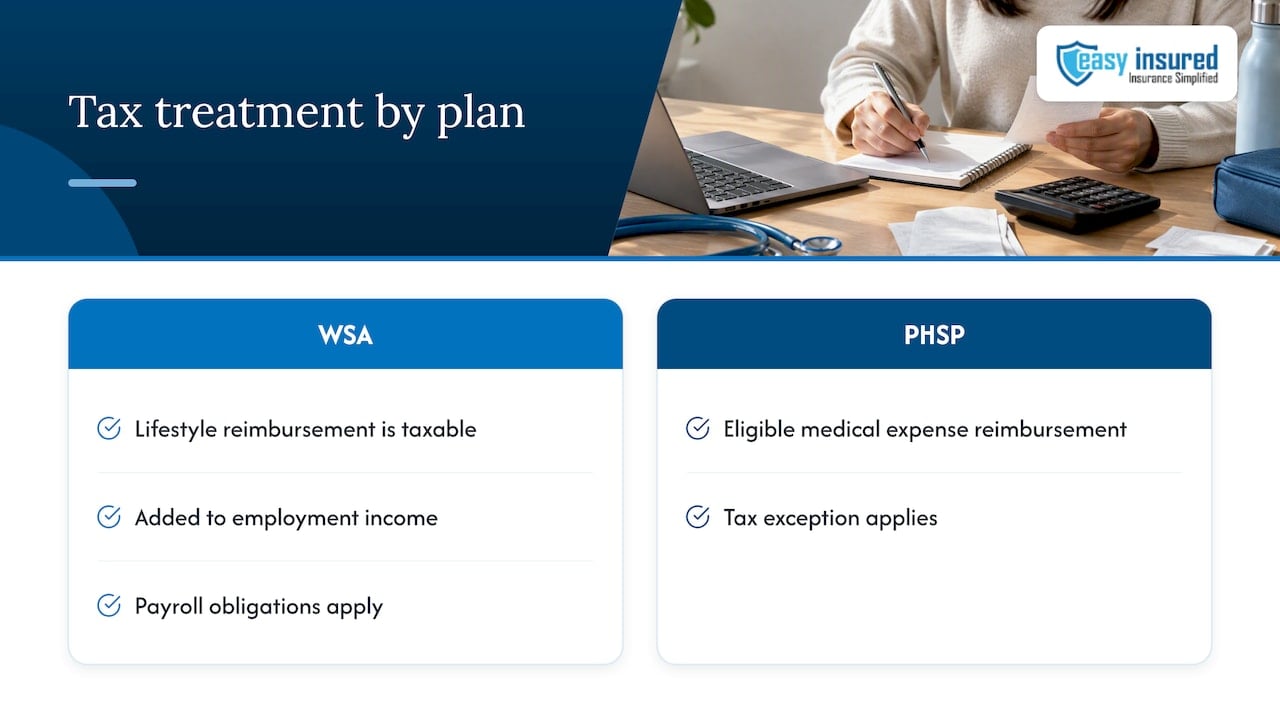
What this means in dollars
Suppose an employer gives each employee a $500 annual WSA. When an employee claims $500 for a gym membership, that $500 is treated like extra pay. The employee pays income tax on it at their marginal rate, and the employer has payroll obligations tied to it. The employee still comes out ahead compared with buying the membership entirely out of pocket if the employer funds it, but it is not the tax-free perk many people assume.
That is why a WSA is mainly an engagement and retention tool, not a tax-planning tool. Treat it as flexible compensation.
For the payroll side of this, our guide on taxable employee benefits and payroll steps in Canada walks through what to withhold and report.
WSA vs HSA: the difference that matters
People search for “HSA equivalent in Canada” and “wellness account” as if they were one product. They are two products with two different tax outcomes.
| Feature | Wellness spending account (WSA) | Health spending account (HSA / PHSP) |
|---|---|---|
| What it pays for | Lifestyle and wellness items chosen by the employer | Medical and dental expenses eligible for the Medical Expense Tax Credit |
| Tax to the employee | Taxable benefit | Generally tax-free (excluding Quebec) |
| Who sets the eligible list | The employer, through plan design | Set by the CRA’s medical expense rules |
| Typical examples | Gym, courses, financial planning, fitness equipment | Prescriptions, dental work, vision care, physiotherapy |
| Risk to watch | Under-reporting a taxable benefit | Losing PHSP status through poor design |
Many providers bundle both into one flex plan, with separate pots of money. Keeping them separate is not cosmetic. It is what protects the tax-free status of the HSA side. For a fuller look at the medical side, read whether a health spending account in Canada is worth setting up.
How an HSA loses its tax-free status
The CRA’s archived bulletin on flexible employee benefit programs is the reference point many advisors still use. The practical lesson is that an HSA must behave like insurance, with a reasonable element of risk, rather than like a cash account.
Three design habits cause trouble:
- Cash-outs. Letting employees withdraw unspent HSA money as cash.
- Reallocation to non-medical options. Letting employees move unused HSA credits into an RRSP or a lifestyle account. If credits can leave the medical pot, the whole HSA may lose its PHSP status, and benefits received from it may become taxable.
- Unclear administration. Plans run informally, with no clear rules on eligible claims and no documentation.
The flexibility employees like about a WSA is exactly what an HSA cannot have. That is why a flex plan needs careful drafting and a professional administrator. If you are mixing both account types, ask for the rules on credit transfers in writing before you sign.
Who can set up an HSA, and the sole proprietor warning
The CRA has been direct about this. In its notice, Buyer beware when it comes to Health Spending Accounts (updated 2023), the agency says it has seen businesses improperly claiming HSA-related deductions. Under that guidance:
- Incorporated businesses, including those where the owner is a shareholder-employee, can generally use an HSA.
- Sole proprietorships are eligible only if they employ at least one arm’s-length employee.
- Plans pitched to sole proprietors without arm’s-length employees as a tax-free way to write off personal medical costs are treated as tax schemes, and the costs are not deductible.
If you work for yourself and someone offers you a “tax-free health plan” with no employees involved, stop and get independent advice from your accountant before paying anything. The same caution applies to a WSA: for a business owner with no staff, a wellness account is simply a personal expense, not a deductible shortcut.
Reporting: T4 box 45 and what employers must do
Since the 2023 tax year, employers report whether dental coverage was available to an employee on the T4 or T4A, in box 45. The CRA’s Dental Care Measures Act update says this applies when coverage was offered to the employee, their spouse or their dependants on December 31 of the tax year.
Three practical points follow:
- You report access, not usage. Whether the employee actually claimed anything does not change the code.
- You do not report spending amounts in box 45. You report the availability of coverage at year-end.
- For 2023 and 2024 only, the CRA relaxed enforcement in certain cases where all reasonable efforts to comply had been made. That relief was limited to those two years, so do not assume it carries forward.
Whether a pure WSA triggers box 45 depends on whether it can pay dental expenses. If your plan can reimburse dental care, assume reporting applies and confirm with your payroll provider or accountant. The taxable value of the WSA reimbursements themselves is a separate payroll matter.
Provincial differences, including Quebec
The HSA’s tax-free treatment does not extend to Quebec in the same way. Employer-paid health premiums and benefits there are generally taxable at the provincial level, even where federal treatment is favourable. If you have employees in Quebec, check the provincial treatment of each account with an advisor who handles Quebec payroll. A national plan may need different tax outcomes for different employees.
Is a WSA worth offering?
A WSA makes sense when you want a flexible, low-admin perk that employees actually notice. It makes less sense if your goal is tax efficiency. Here is a quick decision frame.
A WSA fits when
- Your team values choice: fitness, therapy, courses, home office or childcare costs.
- You already have solid health and dental coverage and want a perk on top.
- You accept that the benefit is taxable and are comfortable explaining that to staff.
A WSA is the wrong tool when
- The real need is prescription, dental or vision coverage. An HSA or a group health plan serves that better.
- You are trying to get a deduction for personal costs as a one-person business.
- You have no budget for administration. Poorly tracked claims create payroll errors.
Setting one up, step by step
- Set the budget. Decide the annual amount per employee, and whether it is the same for everyone or tiered.
- Define the eligible categories. Write them down. Be specific about gym costs, apps, equipment and professional development, because disputes come from vague lists. Some health and fitness apps are commonly excluded by administrators, so confirm yours.
- Decide the rules on unused funds. Set whether credits expire at year-end or roll over. Do not allow unused WSA balances to be cashed out in ways that confuse the plan with your HSA.
- Keep it separate from the HSA. Use separate pots with separate rules.
- Plan payroll. Make sure reimbursements flow through payroll as taxable benefits.
- Confirm T4 reporting. Ask your administrator or accountant how box 45 applies to your design.
- Review annually. Rules and provider terms change, so recheck every year.
If you want to see how these costs fit inside a total benefits budget, our piece on what small Canadian employers actually pay for benefits breaks it down.
Our perspective
We see business owners reach for a wellness account because it sounds like a tax-friendly way to say thank you. Then they discover it is taxable, and the enthusiasm cools. We think that reaction is premature. A WSA can be a good perk when it is positioned honestly: a flexible allowance that employees value, not a tax strategy.
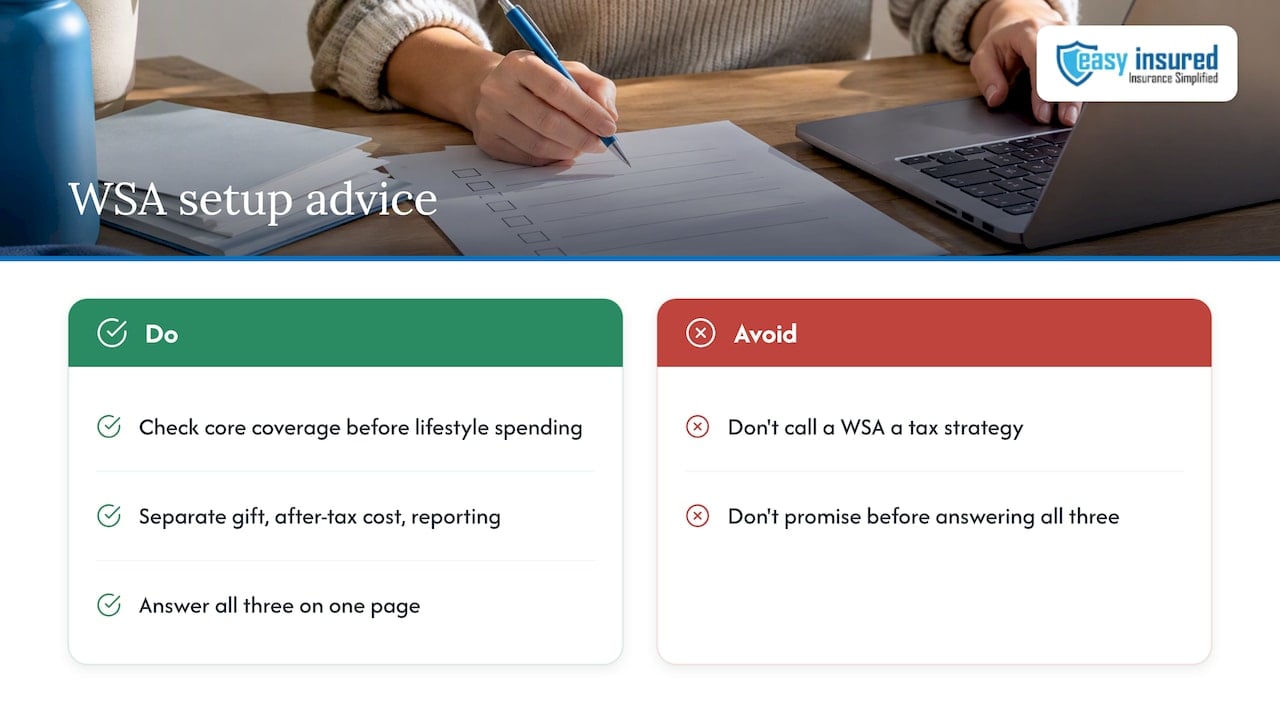
What we would put first is the protection layer. Before you fund lifestyle spending, check that your team has the basics: disability coverage if someone cannot work, critical illness coverage if they face a serious diagnosis, and group health and dental. Those are the benefits that change lives when something goes wrong, and they are also where plan design and the tax treatment matter most. A gym allowance is nice. Income replacement after a long illness is vital.
Our advice to owners is to separate three questions: what do we want to give our people, what does it cost after tax, and what must we report. If you can answer all three on one page, you are ready to launch. If you cannot, talk to an advisor and your accountant before you promise anything to staff.
— Frank
Talk to us about your benefits plan
If you are building or reviewing an employee benefits program, we can help you compare group coverage, health and dental options, and the protection products that sit beside a spending account. Start with our group insurance plans page, or read our business guide to working with a benefits broker first. We do not publish prices for these products, because coverage is quoted to your team’s size and needs.
FAQ
Is a wellness spending account a taxable benefit in Canada?
In most cases, yes. A WSA pays for expenses that are not eligible medical expenses, so the reimbursement is generally added to the employee’s taxable income. Only a health spending account that qualifies as a PHSP is generally tax-free, and not in Quebec.
What can I use my wellness account for?
It depends entirely on how your employer designed the plan. Common choices are gym memberships, fitness equipment, mental wellness, nutrition, courses and financial planning. Check your plan’s eligible expense list before buying, and ask whether apps or subscriptions count.
Is there an HSA equivalent in Canada?
Canada has the health spending account itself, which can qualify as a private health services plan under CRA rules. It reimburses eligible medical and dental expenses, while a WSA covers lifestyle items. The two serve different purposes and should be kept separate.
Can a sole proprietor set up a health spending account?
Only if the business employs at least one arm’s-length employee, according to the CRA. Plans sold to sole proprietors with no such employees as a tax-free way to deduct personal medical costs are treated as tax schemes. Speak with your accountant before buying any such plan.
Do employers have to report a wellness account on the T4?
Employers report access to dental coverage in box 45 as of December 31 of the tax year, and spending accounts that can pay dental claims fall within that. Reimbursements from a taxable WSA also have to be handled through payroll. Confirm the exact treatment of your plan with your payroll provider or accountant.
Sources
- Determine if a benefit is taxable, Canada.ca
- Medical expenses, including payments from a private health services plan, Canada.ca
- Archived: Flexible Employee Benefit Programs, Canada.ca
- Warning: Buyer beware when it comes to Health Spending Accounts, Canada.ca
- Dental Care Measures Act: T4 and T4A updates, Canada.ca