
Budget between roughly CAD 150 and CAD 275 per employee per month for a competitive group benefits plan, or annual costs falling in the low thousands per employee. Most employers spend an additional share of base payroll once benefits are added on top of wages. That figure only covers extended health, dental, and related coverage. Statutory costs like CPP, EI, and workers’ compensation sit on top as separate, mandatory employer expenses.
TL;DR:
- Benefits costs are influenced by group size, province, plan design, and claims history, with renewal increases often exceeding inflation due to rising drug and paramedical expenses.
- Statutory employer contributions, such as CPP and EI, add roughly 7% to 8% to total compensation costs, independent of benefits plan choices.
- Modifying plan features like deductibles, co-insurance, or adding health spending accounts can reduce costs by 5% to 15% without sacrificing core coverage.
- Using pooled or association plans is recommended for small groups under 10 employees to reduce renewal volatility and achieve better cost stability.
Table of Contents
- How Much Does Employee Benefits Cost in Canada?
- What’s Actually Inside a Benefits Package (and What Drives the Price)
- What Are the Statutory Payroll Costs on Top of Benefits?
- What Makes Your Group Benefits Quote Go Up or Down?
- How Do You Calculate Your Actual Benefits Cost Per Employee?
- How Can You Control Benefits Costs Without Cutting Coverage?
- Why Trust These Benchmarks?
- When Should You Start Getting Quotes?
- Get a Group Benefits Quote Built Around Your Actual Numbers
- Sources
How Much Does Employee Benefits Cost in Canada?
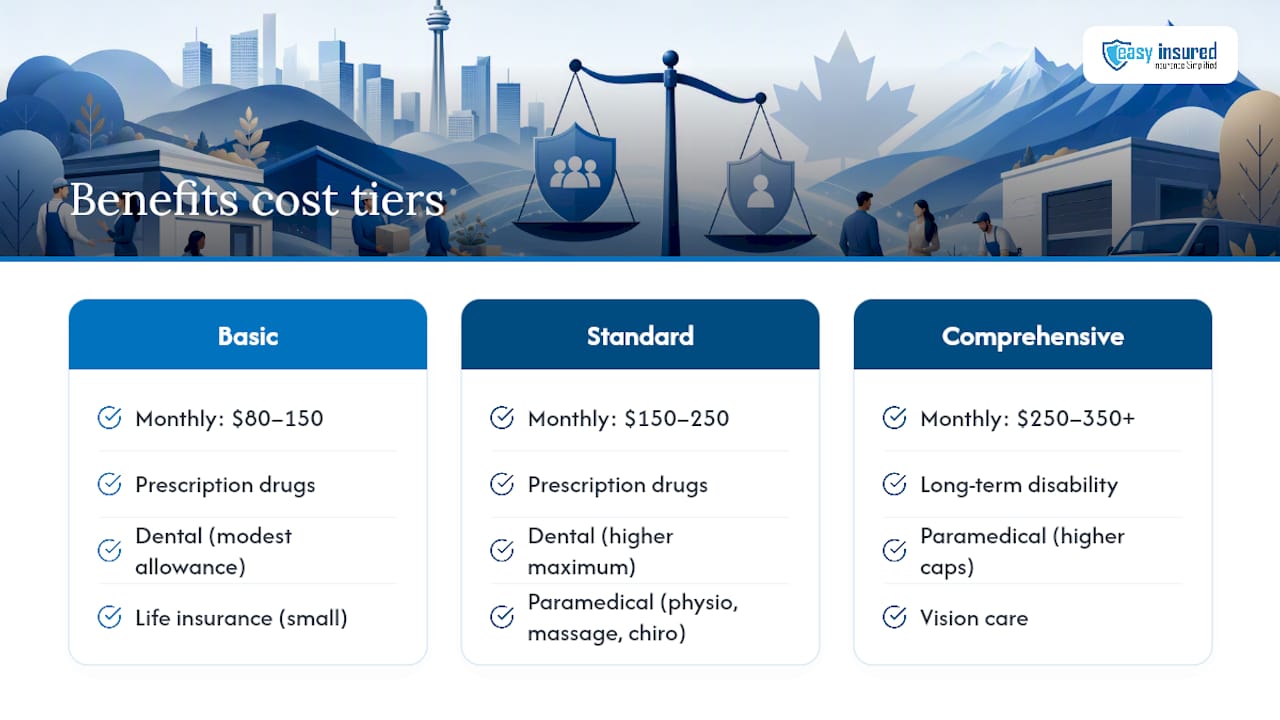
Ranges vary wildly depending on what you’re buying, but three tiers cover almost every small business scenario. A basic plan runs $80 to $150 per employee monthly and typically covers prescription drugs, a modest dental allowance, and a small life insurance benefit. A standard plan lands between $150 and $250, adding better dental maximums, paramedical coverage (physio, massage, chiropractic), and short-term disability. A comprehensive plan climbs to $250 to $350 or more, layering in long-term disability, higher paramedical caps, vision care, and sometimes a health spending account on top of the insured plan.
These ranges align with what brokers and HR platforms report across the small-business market, where comprehensive packages commonly land at $5,000 to $7,500 per employee annually. Cost-sharing data from benefits brokers shows fully employer-paid plans are more common for senior hires or industries fighting for talent.
A few variables push these numbers around more than owners expect. Group size matters more than most people assume: a five-person company often pays a higher per-head rate than a fifty-person company because the insurer has less claims data to spread risk across. Province matters too, since provincial health coverage, drug formularies, and regulatory requirements differ enough to shift premiums by several percentage points. Renewal trend is the other wildcard. Insurers have been pushing annual increases well above general inflation in recent years, driven largely by rising drug costs and higher paramedical utilization, so a plan that costs $200 per employee this year could realistically cost $220 to $230 at renewal even with zero claims changes.
What’s Actually Inside a Benefits Package (and What Drives the Price)
That’s not surprising once you see how a typical monthly premium breaks down for a mid-tier plan:
- Prescription drugs: roughly 35% to 40% of premium
- Dental care: roughly 20% to 25% of premium
- Paramedical services (physio, massage, psychology): roughly 10% to 15%
- Life and disability insurance: roughly 10% to 15%
- Vision, EAP, and other extras: the remainder
Dental coverage matters even more now that the federal government has rolled out its own dental care plan for lower and middle-income Canadians without existing coverage. That program targets people who lack employer dental benefits, so it doesn’t reduce what you pay for your group plan. If anything, it raises the bar: employees increasingly expect private dental coverage as table stakes, not a bonus.
Optional add-ons push costs higher but often deliver strong retention value. Health spending accounts (HSAs), lifestyle spending accounts, and employer RRSP matching aren’t part of the core insured premium, but they show up on the same budget line and matter just as much when employees compare offers.

What Are the Statutory Payroll Costs on Top of Benefits?
Insured benefits are voluntary. Statutory contributions are not, and they add real dollars to every employee’s total cost regardless of what plan you choose. For 2026, employers match employee contributions dollar for dollar on the Canada Pension Plan, and pay a 1.4 times multiplier on Employment Insurance premiums withheld from each paycheck, according to current payroll rate tables. Statistics Canada’s payroll data confirms these employer-side contributions are a fixed, unavoidable layer of total compensation cost that scales directly with wages, not with benefits plan design, based on its payroll and employer-cost reporting.
| Statutory Cost | Employer Rate (2026) | Notes |
|---|---|---|
| CPP/QPP | Matches employee contribution | Capped at the year’s maximum pensionable earnings |
| EI | 1.4x employee premium | Quebec employers pay a reduced EI rate offset by QPIP |
| Workers’ compensation | Varies by province and industry | Office work can cost a fraction of construction rates |
| Employer health tax | Varies by province | Ontario, Manitoba, and others apply payroll-based levies |
Quebec employers pay into the Quebec Parental Insurance Plan (QPIP) instead of the federal EI parental benefit, which changes the math slightly. Workers’ compensation premiums vary the most of any line item: industry classification alone can create a massive gap between what a software company and a construction firm pay per $100 of payroll.
What Makes Your Group Benefits Quote Go Up or Down?
Insurers price group plans on risk, and a few factors move your quote more than anything else.
- Team size and age profile: smaller, older groups pay more per head because there’s less pooling to absorb a bad claims year.
- Plan design choices: higher paramedical caps, lower deductibles, and unrestricted dispensing fees all raise premiums.
- Claims history: a group with several high-cost drug claims will see steeper renewal increases than a clean-claims group.
- Province: provincial healthcare differences and local regulation both shift baseline pricing.
- Industry risk class: this affects workers’ compensation far more than health premiums, but it still touches total employer burden.
Pro Tip: If your group has fewer than 10 employees, ask your broker about pooled or association plans before accepting a standalone quote. Pooling can smooth out the volatility that makes small-group renewals swing so sharply year to year.
How Do You Calculate Your Actual Benefits Cost Per Employee?
Two formulas cover most planning needs. Cost per enrolled employee equals total annual premium divided by the number of employees actually enrolled. Cost per eligible employee divides that same premium by everyone eligible for coverage, whether or not they’ve opted in. The second number matters more for budgeting because it reflects your real obligation as headcount grows.
Here’s a worked example for a business with 10 eligible employees averaging $75,000 in salary:
- Estimate benefits premium at $200/employee/month, or $2,400/year per person.
- Multiply by 10 employees: $24,000 total annual benefits spend.
- Add statutory costs: employer CPP match plus EI at 1.4x, which typically adds another 7% to 8% of gross payroll on top of wages.
- On $750,000 total payroll, that’s roughly $52,500 to $60,000 in statutory employer contributions alone, separate from the $24,000 in benefits premiums.
How Can You Control Benefits Costs Without Cutting Coverage?
Health spending accounts let you cap your annual liability precisely while still giving employees flexibility. Instead of an insured plan covering every paramedical claim, you fund a fixed HSA allowance, often averaging around $672 per employee per year for wellness-focused accounts, and employees spend it as needed. Explore whether a health spending account fits better than a fully insured paramedical benefit for your group size.
- Adjust deductibles, co-insurance percentages, and dispensing fee caps to shave 5% to 15% off premium without gutting core coverage.
- Layer in a wellness or claims-management program to catch small health issues before they become expensive claims.
- Work with a broker who can shop pooled or association plans, especially if your group is under 15 people.
- Offer voluntary, employee-paid upgrades (extra life insurance, higher dental maximums) so staff who want more coverage can buy it without raising your base cost.
Pro Tip: Review your plan design at every renewal, not just the premium. A $10 increase in your annual deductible per employee can offset a meaningful chunk of a rate hike without anyone noticing a coverage change.
Why Trust These Benchmarks?
These figures come from a synthesis of Statistics Canada payroll data, published broker benchmarks, and current 2026 statutory rate tables, not guesswork or a single vendor’s marketing numbers.
Group benefits pricing isn’t static. A broker who actively manages your renewal, negotiating with insurers, adjusting plan design, and flagging claims trends early, can hold your annual increase well below what an unmanaged plan would see at the same insurer.
Brokers earn their fee by modeling renewal risk before it hits your invoice. If you want a deeper look at what a broker actually does during that process, this guide to working with a benefits broker walks through the mechanics.
When Should You Start Getting Quotes?
Start gathering quotes 60 to 90 days before your target start date or renewal. Bring payroll data, employee ages and dependent status, your current plan summary if you have one, and two years of claims history. That paperwork lets a broker model realistic numbers instead of guessing, and it gives you time to compare more than one option before committing.
— Frank
Get a Group Benefits Quote Built Around Your Actual Numbers
Guessing at benefits costs from generic online ranges is how small businesses end up either overpaying for coverage nobody uses or underinsuring staff and losing them to a competitor with a better plan. Easy-insured works directly with Canadian small businesses to build group benefits packages sized to your actual payroll, team demographics, and province, not a one-size-fits-all template.
Our brokers shop pooled and association plans for smaller groups, model renewal risk before it becomes a surprise invoice, and layer in HSAs or voluntary upgrades where they make more sense than a fully insured benefit. If you’re comparing benefits costs for hiring or budgeting purposes, also check how payroll software can integrate statutory deductions alongside your benefits costs through resources like this payroll software comparison for Canadian small businesses. When you’re ready to see real numbers for your team, request a group insurance quote and get a plan built around your actual payroll instead of a national average.
This article is general information, not a substitute for advice from a qualified financial advisor. Consult a qualified financial professional about your own circumstances before acting on anything here.
Sources
- Statistics Canada payroll and employer-cost data (2025–2026)
- Government of Canada — dental care plan coverage
- Databooks payroll-cost tool (2026 rates)
- Atlas HXM — Employee benefits in Canada (2026)
- EBSource — benefits cost per employee in Canada