
Ontario small-business owners have access to three distinct benefit buckets: provincial tax relief through the Ontario small business deduction for Canadian-controlled private corporations, government advisory and grant programs through Small Business Enterprise Centres (SBECs) and the Ontario Job Grant, and private insurance and financial-planning products covering group health, disability, life, and critical illness. Here is what to prioritize and where to start:
- Contact your local SBEC first — mentoring often unlocks grant eligibility for programs like Starter Company Plus.
- Check Ontario Job Grant eligibility if you have staff to train; small employers with under 100 employees may qualify for up to $10,000 per trainee with reduced contribution requirements.
- Get a broker quote for group health and dental if you employ even one or two people.
- Review owner disability and life coverage — your income is the business’s most fragile asset.
- Confirm whether your corporation qualifies for the Ontario small business deduction and use those tax savings to fund premiums.
Pro Tip: Call your SBEC before applying online for any provincial grant. Many programs, including Starter Company Plus, require local mentoring as part of the approval process — skipping that step is the most common reason applications stall.
Table of Contents
- What employee benefits can small businesses in Ontario offer?
- What insurance does an Ontario business owner need for themselves?
- How are benefits paid for, and what is the tax treatment?
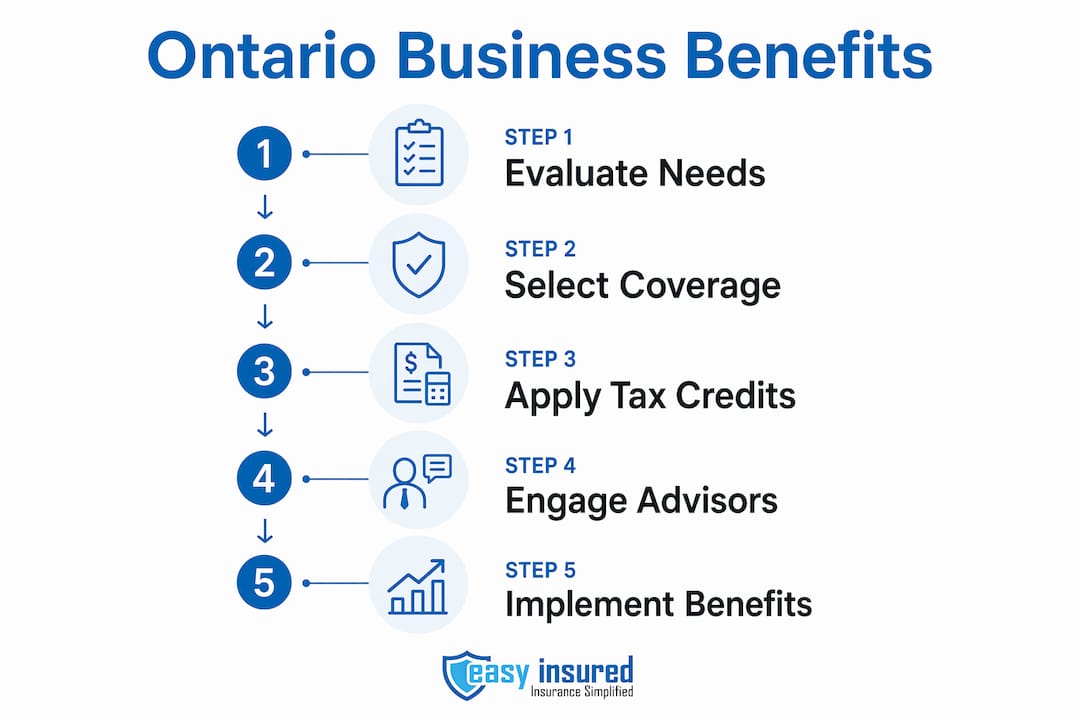
- How do you choose and implement benefits on a small-business budget?
- Who qualifies for Ontario government small business benefits?
- What has changed recently for Ontario small businesses?
- How small businesses are putting these benefits to work
- How to bring government supports and private benefits together
- Easy-insured helps Ontario owners build the full picture
- Key Takeaways
What employee benefits can small businesses in Ontario offer?
Small employers have three practical paths: a traditional small-group insurance plan, a health spending account (PHSP or HSA), or a voluntary benefits package. Each carries different tax and admin implications, so the right fit depends on your headcount and cash flow.
A small-group plan bundles health, dental, disability, and life coverage under one carrier. Most insurers will quote groups as small as two employees. Premiums are a deductible business expense, and employee benefits adopted early help attract and retain staff in competitive hiring markets.
A PHSP or HSA works differently: you set an annual dollar limit per employee, they submit receipts, and the corporation reimburses them tax-free. There is no insurer, no underwriting, and no minimum group size. For a solo owner or a micro-team, this is often the most cost-efficient starting point.
Critical illness and long-term disability coverage deserve a line item in any group plan. A single serious diagnosis can sideline a key employee for months; without disability coverage, that cost falls directly on the business.
What insurance does an Ontario business owner need for themselves?
Your employees can access group benefits, but as the owner, you often fall outside your own plan or carry inadequate personal coverage. The products that matter most:

Disability insurance is the one most owners underestimate. If you cannot work, the business may not survive. Owner disability coverage replaces a portion of your income and is structured differently from group disability — it follows you even if the business changes.
Term life is the affordable baseline for protecting a mortgage, a buy-sell agreement, or a family that depends on your income. Term life coverage locks in low premiums while your obligations are highest.
Whole or universal life adds a permanent component useful for estate planning and tax-sheltered growth. Critical illness pays a lump sum on diagnosis of a covered condition — cancer, heart attack, stroke — giving you cash to cover treatment costs or keep the business running. For owners thinking about succession, estate planning strategies that incorporate life insurance can reduce probate exposure and transfer wealth efficiently.
How are benefits paid for, and what is the tax treatment?
For incorporated owners, group insurance premiums paid by the corporation are generally a deductible business expense. Employee health and dental premiums are not a taxable benefit to employees when structured correctly. A PHSP reimbursement is tax-free to the employee and deductible to the corporation, making it one of the most tax-efficient tools available to small employers.
Ontario’s 2026 budget cut the small business tax rate from 3.2% to 2.2% for qualifying CCPCs, delivering up to $5,000 per year in provincial tax savings. Redirecting even part of that saving toward disability or group health premiums is a straightforward way to fund coverage without increasing your cash outlay.
Owner-paid disability premiums are generally not deductible, but the benefit received is then tax-free — a trade-off worth understanding before you structure the policy. Confirm the specifics with your accountant; the right structure depends on your corporate setup.
How do you choose and implement benefits on a small-business budget?
Start with a budget ceiling, not a wish list. Decide what percentage of payroll you can commit, then work backward to the plan design. A broker can model three or four options at that ceiling — group plan versus PHSP versus hybrid — so you are comparing real numbers, not brochure descriptions.
Admin complexity matters more than most owners expect. A traditional group plan requires enrollment, monthly billing reconciliation, and claims management. A PHSP is simpler but requires a third-party administrator. Ask any vendor how claims are submitted, how long reimbursements take, and what happens when an employee leaves. For sourcing and comparing group health plans, a broker who works with multiple carriers will give you a cleaner comparison than going directly to one insurer.
Timeline: allow four to six weeks from broker engagement to first coverage date for a standard group plan. A PHSP can often be set up in days.
Who qualifies for Ontario government small business benefits?
Starter Company Plus targets entrepreneurs starting, buying, or expanding a small business in Ontario. The grant is up to $5,000, and applicants must contribute at least 25% of the grant amount themselves. Applications flow through local SBECs, which also provide mandatory mentoring and workshops.
Ontario Job Grant is open to employers of any size, but small employers with under 100 employees get the most favorable terms: reduced contribution requirements and, in some cases, 100% funding for new hires who were previously unemployed. The training provider must have an Ontario physical presence for the duration of training — a detail that catches many applicants off guard.
Both programs require engagement with your local SBEC before or during the application. Applying online without that contact commonly reduces approval rates.
What has changed recently for Ontario small businesses?
The most significant recent shift is the 2026 Ontario budget tax cut: the small business corporate income tax rate dropped from 3.2% to 2.2%, part of a broader $1.1 billion reduction. For a qualifying CCPC, that translates to up to $5,000 in annual provincial tax relief — real money that can be redirected toward benefits or owner insurance premiums.
Ontario’s Small Business Strategy continues to emphasize digital adoption, talent development, and reducing regulatory friction. SBECs remain the primary local delivery point for advisory services and program access. For owners planning infrastructure alongside benefits, understanding business phone line options is a practical operational step as teams grow.
How small businesses are putting these benefits to work
A common pattern among Ontario micro-businesses: the owner starts with a PHSP to cover their own dental and vision costs tax-efficiently, then adds a small-group plan once they hire their second or third employee. The Ontario Job Grant funds training for those new hires, which frees payroll budget that would otherwise go to wage increases — and that freed budget funds the group plan premiums.
Incorporated owners often layer owner disability coverage on top of the group plan, since group disability typically covers only a fraction of an owner’s actual income. A business owner’s policy can complement personal coverage by addressing business-level liabilities alongside personal protections. The 2026 tax rate reduction makes the math on all of this slightly more favorable: lower corporate tax means more after-tax cash available to fund premiums inside the corporation.
How to bring government supports and private benefits together
The most effective approach treats SBECs, the Ontario Job Grant, and private insurance not as separate decisions but as one coordinated plan. An SBEC advisor can identify grant opportunities and business planning gaps; a broker handles insurance and financial-planning products; your accountant confirms the tax treatment. None of these conversations needs to happen in isolation.
Innovation Canada is a useful starting point for federal programs that layer on top of provincial supports. For estate and succession planning, coordinating life insurance with a will and a shareholder agreement protects both the business and your family — a step many owners defer until it is urgent.
Easy-insured helps Ontario owners build the full picture
Getting the right mix of coverage is straightforward when you have one advisor who understands both the insurance side and the financial-planning context. Easy-insured works with Ontario business owners at every stage: owner-only startups setting up their first disability and life coverage, micro-teams adding group insurance for the first time, and growing employers building full health, dental, and critical illness plans for their staff.
Easy-insured can coordinate directly with your accountant and SBEC advisor to align coverage decisions with your tax position and any grant applications in progress. When you book a consultation, bring a recent profit-and-loss statement or payroll summary — it cuts the conversation from an hour to twenty minutes. Start with a disability insurance review or explore health and dental options for your team. Easy-insured’s advisors are licensed, experienced with Canadian small-business structures, and focused on getting coverage in place without unnecessary complexity.
Key Takeaways
Ontario small-business owners who combine provincial tax relief, government advisory programs, and owner-focused insurance coverage get the most complete financial protection available to them.
| Point | Details |
|---|---|
| 2026 tax rate cut | Ontario reduced the small business corporate tax rate significantly, providing qualifying CCPCs with meaningful provincial tax relief. |
| Start with your SBEC | Local SBECs are the gateway for Starter Company Plus grants and Ontario Job Grant applications — engage them before applying online. |
| PHSP for micro-teams | A health spending account requires no insurer and no minimum group size, making it the most accessible first benefits step for small employers. |
| Owner disability is the priority | Group plans rarely cover an owner’s full income; a separate individual disability policy protects the income the business depends on. |
| Easy-insured for full coverage | Easy-insured helps Ontario owners set up disability, life, critical illness, and group benefits, and coordinates with accountants and SBEC advisors. |
This article is general information, not professional tax, legal, or financial advice. Confirm program eligibility and tax treatment with a qualified accountant or advisor for your specific situation.