
A broker for employee benefits is a licensed professional who acts as an intermediary between employers and insurance carriers to place, renew, and service group insurance plans. Canadian business owners and HR managers who skip this step often pay more and get less. The right benefits broker brings carrier market access, plan design expertise, and ongoing advocacy that most internal teams cannot replicate. This guide explains what a benefits broker does, how to evaluate one, and how to get the most value from the relationship.
What does a broker for employee benefits actually do?
An employee benefits broker does far more than collect quotes once a year. The core function is to represent your company’s interests when dealing with insurance carriers, not the other way around. That distinction matters because carriers have their own sales teams. A broker’s job is to push back on pricing, compare options across the market, and recommend the plan design that fits your workforce.
The full range of broker services includes:
- Quote gathering and carrier comparison: A broker approaches multiple carriers on your behalf and presents options side by side. This is the baseline function.
- Plan design and recommendation: Beyond pricing, a broker advises on benefit categories, coverage levels, and plan structures that match your employee demographics.
- Renewal negotiation: At each renewal, a broker reviews your claims experience, challenges carrier rate increases, and negotiates terms.
- Enrollment support: Brokers coordinate employee enrollment, prepare communication materials, and answer staff questions during onboarding.
- Year-round administration: Good brokers handle mid-year changes, billing issues, and claims escalations so your HR team does not have to.
- Compliance guidance: In Canada, group benefits must align with provincial insurance regulations. A broker keeps your plan compliant.
The industry term for this role is “group benefits advisor” in some Canadian contexts, but “employee benefits broker” and “benefits advisor” are both widely used and mean the same thing in practice.
Pro Tip: Ask any broker candidate to walk you through a specific renewal they negotiated in the past 12 months. The detail in their answer tells you more than any credential.

The distinction between a broker and a direct carrier representative is critical. A carrier rep sells one company’s products. A broker, in theory, shops the full market. That independence is the core of the value proposition, but only if the broker actually uses it.
How to evaluate and choose the right benefits broker
The single most important factor in choosing a benefits broker is carrier market access. A broker who only takes one or two carriers to market is likely not acting in your best interest. Market access breadth determines whether you get a genuinely competitive quote or a pre-selected recommendation.
Canadian group benefits are dominated by a handful of large carriers. Canadian brokers often focus on Sun Life, Manulife, and Canada Life, which can limit access to newer or more specialized plan designs. That concentration is not always wrong, but you should know about it before signing.
Key questions to ask during a broker interview:
- How many carriers did you approach for your last client in a similar industry and size?
- Do you receive override commissions or volume bonuses from any carrier?
- How do you communicate with clients outside of renewal season?
- Can you provide a written disclosure of all compensation you receive from carriers?
- What does your onboarding process look like for a new group plan?
Effective brokers disclose all compensation sources, including commissions and bonuses, in writing. If a broker resists this request, that is a clear signal to keep looking.
Transparency on compensation is not just an ethical standard. It is a practical tool for understanding whether a broker’s recommendations are driven by your needs or by carrier incentive structures. Many businesses overpay due to lack of expert broker advocacy, and opaque compensation is one of the main reasons.
Pro Tip: Ask specifically how many carriers were quoted for your last similar client. That single question, recommended by industry practitioners, is the clearest measure of a broker’s independence.
Brokers vs. consultants: what is the difference?
The terms “broker” and “consultant” are often used interchangeably, but they describe different roles with different compensation models and different scopes of work.
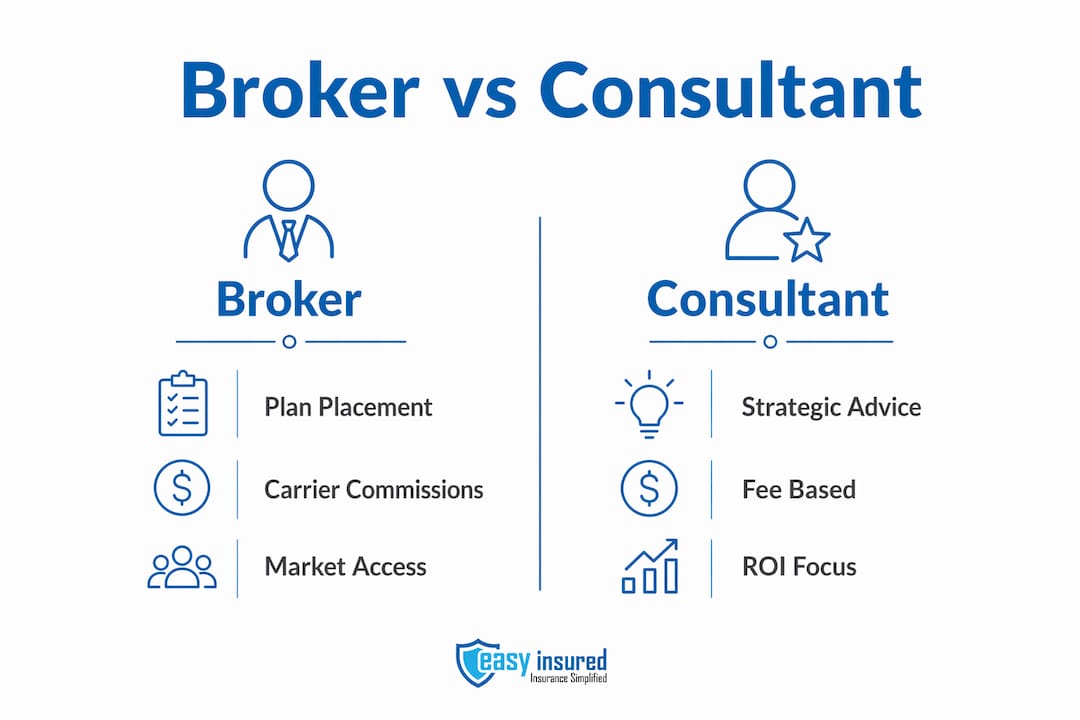
Brokers primarily place and renew plans, while consultants provide a strategic long-term roadmap and ROI measurement. A broker’s work is largely transactional. A consultant’s work is advisory and ongoing, often covering workforce analytics, total rewards strategy, and vendor performance measurement.
| Category | Benefits broker | Benefits consultant |
|---|---|---|
| Primary role | Plan placement and renewal | Strategic advisory and ROI analysis |
| Compensation model | Carrier commissions | Fee-for-service or retainer |
| Carrier independence | Varies by panel access | Typically broader, including niche providers |
| Best suited for | SMBs needing plan management | Mid-to-large employers with complex needs |
| Conflict of interest risk | Higher without disclosure | Lower due to fee-based structure |
Brokers typically earn commissions from insurance carriers, while consultants are usually fee-based. That compensation difference shapes behavior. A commission-based broker has a financial incentive tied to the premium you pay. A fee-based consultant earns the same regardless of which carrier you choose.
Consultants can access boutique or niche providers and recommend unique offerings not available through brokers with limited panels. For most small and mid-sized Canadian businesses, a well-qualified broker with broad market access is sufficient. Larger employers with 200 or more employees often benefit from adding a consultant layer.
Pro Tip: You do not have to choose one or the other. Some Canadian businesses use a broker for day-to-day plan management and bring in a consultant every three to five years for a full plan audit.
Best practices for managing your broker relationship
A benefits broker relationship that runs on autopilot costs you money. The most value comes from treating the broker as an active partner, not a once-a-year vendor.
- Set a communication schedule. Agree at the start of the relationship on how often you will meet outside of renewal. Quarterly check-ins are a reasonable baseline for most employers.
- Request proactive recommendations. The most critical work happens outside the annual renewal. Ask your broker to bring plan design ideas or cost-saving options every three to six months, not just when the renewal notice arrives.
- Review broker performance annually. Measure your broker against specific outcomes: how many carriers were quoted, what was the renewal rate increase versus the market average, and how quickly were service issues resolved.
- Run a market test periodically. Every three to four years, ask your broker to conduct a full market review. If they resist, that resistance tells you something important.
- Align the plan with your workforce. Share employee demographic data, turnover trends, and engagement survey results with your broker. A plan designed for a workforce with an average age of 35 looks very different from one designed for a workforce averaging 50.
- Demand written savings documentation. When a broker negotiates a rate reduction or plan improvement, ask for it in writing with a dollar figure attached. Businesses often overpay because they lack negotiated measurable savings from their broker.
The group insurance decisions you make today affect your ability to attract and retain employees for years. A broker who treats your account as a passive renewal is not delivering the value you are paying for through carrier commissions.
Key Takeaways
A broker for employee benefits delivers the most value when they combine broad carrier market access with transparent compensation and proactive advice outside of renewal season.
| Point | Details |
|---|---|
| Market access is the top priority | Choose a broker who quotes multiple carriers, not just one or two major insurers. |
| Demand compensation transparency | Require written disclosure of all commissions and bonuses before signing with any broker. |
| Proactive advice beats annual renewals | The best brokers bring cost-saving ideas every three to six months, not just at renewal. |
| Brokers and consultants serve different needs | Brokers manage plan placement; consultants provide strategic analysis and ROI measurement. |
| Measure broker performance with data | Track renewal rate outcomes, carriers quoted, and service response times every year. |
What I have learned working with Canadian benefits brokers
The biggest mistake I see Canadian business owners make is treating their benefits broker like a set-it-and-forget-it service. They sign the group plan, file the broker’s card, and only call when an employee has a claims problem. That approach guarantees you will overpay.
The brokers who actually deliver value are the ones who call you in july with a plan design idea, not just in october when the renewal package lands. That proactive behavior is the clearest signal of a broker who is working for you rather than for the carrier’s volume bonus.
The carrier concentration issue in Canada is real and underappreciated. When most brokers in your market are focused on the same three or four large insurers, the “competitive quote” you receive may not be as competitive as it looks. Asking how many carriers were actually approached is not an aggressive question. It is the most basic form of due diligence.
Compensation transparency is where I draw a hard line. Any broker who cannot hand you a written disclosure of every dollar they earn from your account within 24 hours of being asked is not a broker I would trust with my benefits spend. The health and dental decisions tied to that spend affect every employee on your team.
The broker-consultant distinction matters most when your headcount crosses 100 employees. Below that threshold, a well-qualified broker with genuine market access and a proactive communication style covers most of what you need. Above it, the ROI on adding a consultant layer becomes much easier to justify.
— Frank
How Easy-insured connects Canadian businesses with group benefits expertise
Canadian business owners and HR managers who want expert guidance on group insurance do not have to navigate the carrier market alone. Easy-insured works with Canadian businesses to match them with the right coverage across group benefits, disability, and critical illness protection.

Easy-insured’s team covers health and dental plans, disability coverage, critical illness, and term life options that integrate naturally into a complete employee benefits package. Whether you are building a plan from scratch or reviewing an existing one, Easy-insured provides the guidance to make an informed decision. Request a consultation to see what a properly structured group plan looks like for your workforce size and industry.
FAQ
What is an employee benefits broker?
An employee benefits broker is a licensed intermediary who helps employers select, place, and manage group insurance plans by comparing options across multiple insurance carriers.
How do I find an employee benefits broker in Canada?
Ask for referrals from your industry association, request written compensation disclosures upfront, and confirm how many carriers the broker quotes before committing.
How does a benefits broker get paid?
Most benefits brokers earn commissions paid directly by the insurance carrier, which means their cost is embedded in your premium rather than billed separately.
What is the difference between a benefits broker and a benefits consultant?
Brokers place and renew plans and earn carrier commissions, while consultants provide strategic advisory services on a fee-for-service basis with broader carrier independence.
How often should I meet with my employee benefits broker?
Quarterly meetings are the recommended baseline. Proactive recommendations every three to six months outside of renewal season are the mark of a high-performing broker relationship.