
An RESP saves for a student’s education after high school. An RDSP saves for the long-term financial security of a person who qualifies for the disability tax credit (DTC). Both are registered plans that get government money on top of your contributions. They have different rules, different limits and different goals. For a child with a disability, many families use both, and a special rule lets unused RESP growth move into the RDSP.
This guide compares the two side by side, explains who can open each one, and covers the situation many parents search for: what to do when one child could use either plan.
TL;DR
- An RESP funds post-secondary education. An RDSP is for a person approved for the DTC and is not tied to any specific expense.
- RESPs have a $50,000 lifetime contribution limit per beneficiary. RDSPs allow $200,000.
- Grant money is richer in the RDSP (up to $70,000 over a lifetime) than in the RESP ($7,200 in basic grants), but the RDSP is open only to DTC-eligible people under age 60.
- Neither plan gives a tax deduction for contributions. Growth is sheltered until withdrawal.
- A beneficiary can have both plans, and RESP growth can sometimes be rolled over to an RDSP without immediate tax.
Table of Contents
- What each plan is built to do
- Who can open one and who can be the beneficiary
- Contribution limits and government money
- Withdrawals and what they can pay for
- How each plan is taxed
- Can one person have both?
- Perspective: how we think about the choice
- Plan it with us
- FAQ
- Sources
What each plan is built to do
The Canada Revenue Agency describes the RESP as a plan to save for education after high school, including trade school, CEGEP, college and university. It describes the RDSP, on the same page, as a plan to help people approved for the DTC save for their future.
That difference in purpose drives everything else:
- The RESP has a natural end point. Money is meant to be paid out while the student is enrolled.
- The RDSP is a long-horizon plan. Payouts can be taken as lump sums or as regular payments, and the regular payments must begin in the year the beneficiary turns 60.
Think of the RESP as a tuition fund and the RDSP as a lifetime income and security fund.
Who can open one and who can be the beneficiary
RESP
Any adult can open an RESP, and the beneficiary can be a child or an adult. A parent, grandparent, aunt, uncle or family friend can all be the subscriber. There is no disability requirement.
If you are choosing between a plan for one child and a plan for several, our guide to family versus individual RESPs shows how the choice affects your ability to protect the $7,200 grant.
RDSP
The bar is higher. The RDSP beneficiary must be approved for the DTC, have a Social Insurance Number, be a Canadian resident when the plan is entered into, and be under age 60.
DTC approval is the gate. If you are not sure how it interacts with your other benefits, read our piece on how the DTC and disability tax rules affect your benefits.
Who holds the plan matters too. If an adult beneficiary has difficulty entering a contract, a legal representative must hold the plan. Where there is no legal representative, certain family members can act as the holder.
Contribution limits and government money
| RESP | RDSP | |
|---|---|---|
| Purpose | Post-secondary education | Long-term security for DTC-eligible people |
| Who can be the beneficiary | Child or adult, no disability needed | DTC-approved, under 60, Canadian resident |
| Annual contribution limit | None | None stated; lifetime cap applies |
| Lifetime contribution limit | $50,000 per beneficiary | $200,000 |
| Matching grant | CESG: 20% on the first $2,500 a year, up to $7,200 lifetime | CDSG: up to $3,500 a year, up to $70,000 lifetime |
| Income-tested bond | Canada Learning Bond | Canada Disability Savings Bond, up to $1,000 a year |
| Contributions deductible | No | No |
The figures behind the table come from the government’s own pages. RESPs have no annual contribution limit and a $50,000 lifetime limit per beneficiary, while the RDSP lifetime contribution limit is $200,000.
How the RESP grants work
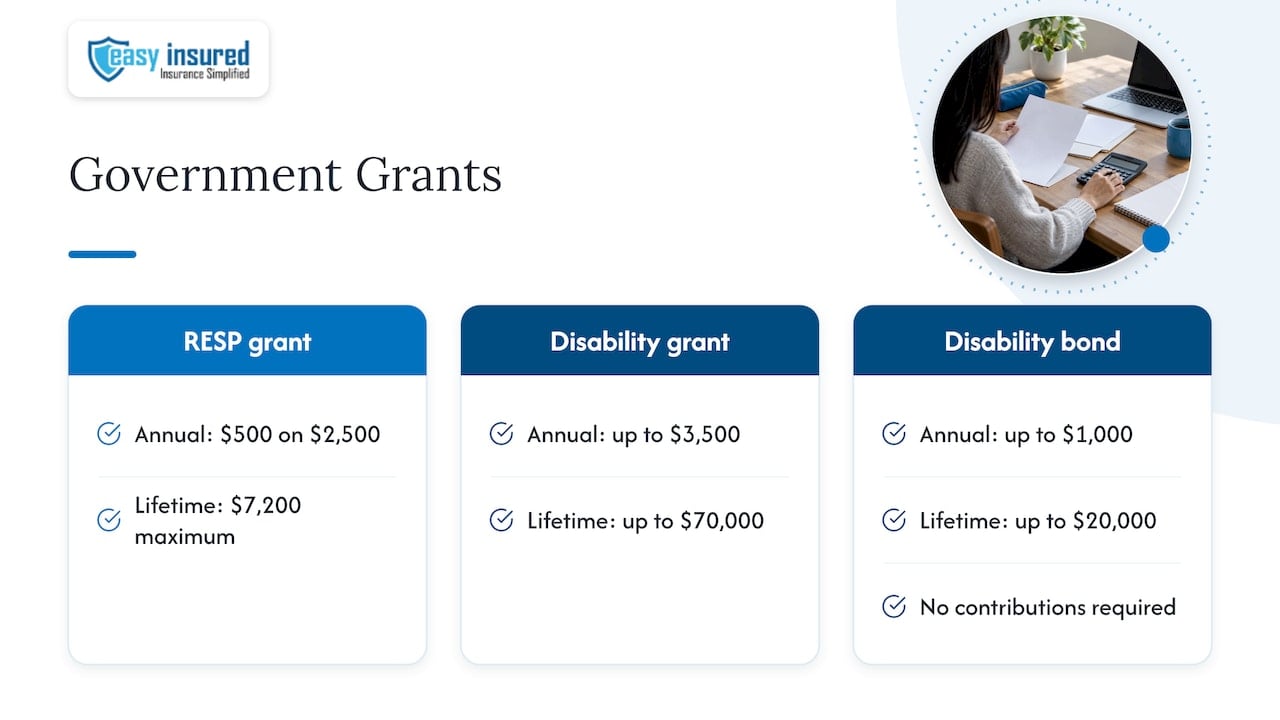
The Canada Education Savings Grant adds 20% on the first $2,500 of yearly contributions, which is up to $500 a year, with a lifetime maximum of $7,200 per beneficiary. The Canada Learning Bond is different: no contribution is needed to get it, though it is aimed at lower-income families.
How the RDSP grants work
The Canada Disability Savings Grant matches contributions up to $3,500 a year and $70,000 over a lifetime, depending on the beneficiary’s adjusted family net income. The matching rate is higher for lower incomes. The Canada Disability Savings Bond is paid to low- and modest-income individuals at up to $1,000 a year until $20,000 is reached, with no contributions required.
A useful way to compare: to collect the full RESP grant you contribute $2,500 a year and receive $500. The RDSP can return far more per contributed dollar for families with modest income, which is why it is often called one of the most generous savings incentives in the country.
The 10-year rule on RDSP grants
The RDSP has a feature the RESP does not. Grants and bonds paid in the last 10 years are subject to an assistance holdback amount. Taking money out early can mean repaying part of that government money. Plan the timing of withdrawals before you take them, not after.
Withdrawals and what they can pay for
RESP payouts
Payments can begin when the beneficiary enrolls in a qualifying post-secondary program. Money paid for education is taxed in the student’s hands, usually at a low rate because students tend to have little income. Early withdrawals have their own cap. See our guide to RESP withdrawal rules and the $8,000 first-term cap before you plan the first year of school.
RDSP payouts
RDSP payments are called disability assistance payments (DAPs). They can be lump sums or lifetime disability assistance payments, and the lifetime payments must start in the year the beneficiary turns 60. There is no requirement to spend the money on any particular expense.
A longer life for a non-family RESP
One bridge between the two plans: a non-family RESP may stay open up to 40 years if the beneficiary has a disability and qualifies for the DTC in the 31st year, provided the plan allows it. This is a niche rule, but it shows the government expects some students with disabilities to need more time.
How each plan is taxed
Both plans trade a tax deduction for tax-sheltered growth.
- RESP: contributions are not deductible, and investment earnings are not taxed until money is taken out to pay for education.
- RDSP: your contributions are not included in the beneficiary’s income when paid out, but grants, bonds, investment income and rollover proceeds are.
In practice, a large share of an RDSP payout is often taxable, since much of it can be grants and growth. A beneficiary with low income may pay little or no tax on it. If you also own private disability coverage, the tax treatment of those benefits is separate, and our article on three disability insurance scenarios explains when payouts become taxable.
Can one person have both?
Yes. An RESP and an RDSP are separate plans with separate limits, and neither blocks the other. A child with a disability who plans to attend college could have both: the RESP for tuition and the RDSP for everything after.
When does it make sense to prioritize one?
- Limited cash, DTC-approved beneficiary: the RDSP usually offers more government money per dollar, so many families fund it first. Run the numbers for your income before you decide.
- Beneficiary clearly heading to school: the RESP is worth funding enough to collect the annual $500 grant.
- Severe disability, post-secondary unlikely: the RDSP is the natural home for savings. An RESP may still be worth opening if a program is possible, because of the rollover rule below.
There is no fixed answer. The right split depends on family income, the beneficiary’s goals and how long the money must last.
Rolling an RESP into an RDSP
This is the link between the two plans. The CRA allows a rollover after 2013 from an RESP to an RDSP of accumulated income payments, which is the investment growth that would otherwise be taxed and penalized. Conditions include:
- The RESP must allow accumulated income payments, and the RESP subscriber and the RDSP holder must jointly elect the rollover. The beneficiary must be the same in both plans.
- The beneficiary must be DTC-eligible, a Canadian resident and not over 59 in the year of the contribution.
- One of the following must apply: the beneficiary cannot pursue post-secondary education because of a severe and prolonged mental impairment, or the RESP has existed for at least 35 years, or it has existed at least 10 years and each beneficiary is 21 or older and ineligible for educational assistance payments.
- The CESG and CLB in the RESP must be repaid and the RESP closed by the end of February of the following year.
- The rolled amount counts toward the $200,000 RDSP lifetime limit and is taxable when later paid out.
In short, you get to save the growth from tax and penalty, but the grants in the RESP go back to the government. Confirm the details with your plan provider, since both plans must cooperate on the election.
Perspective: how we think about the choice
When families ask us about RESP versus RDSP, the first thing we check is not the product but the person. Has the DTC been approved? What will this child likely need at 18, at 30 and at 60? The answer decides whether the plans compete or complement each other.
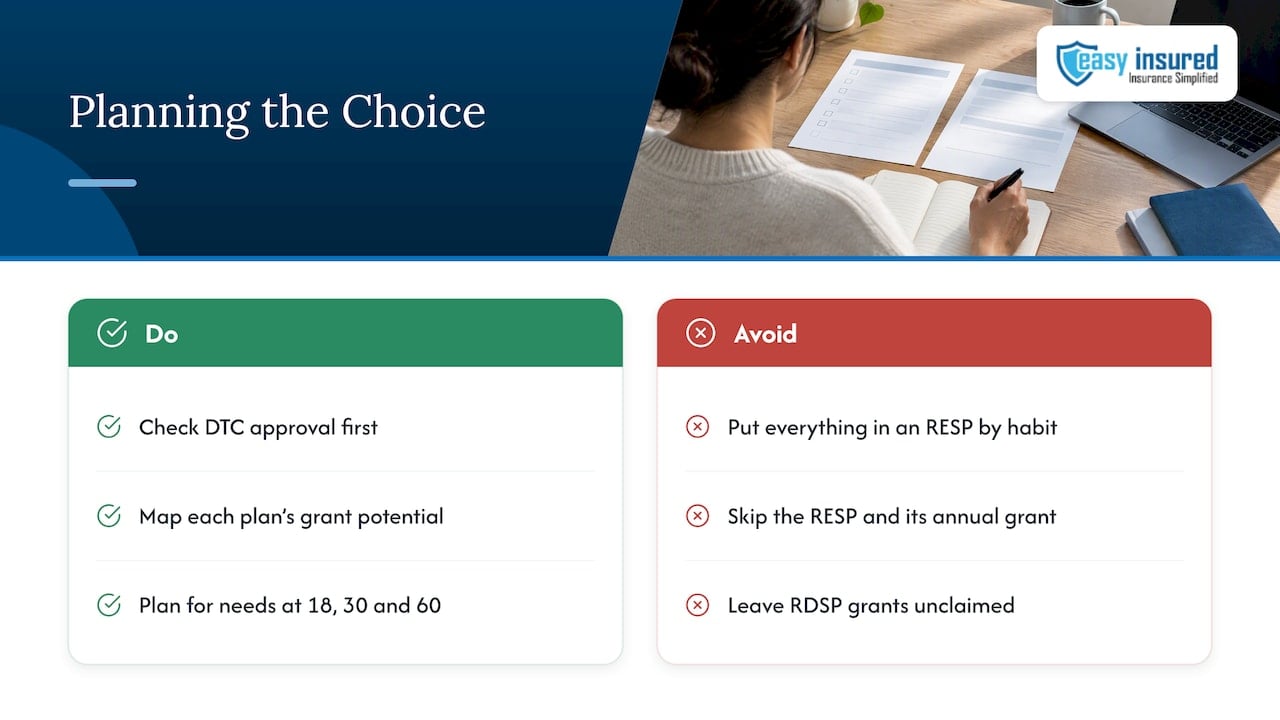
We see two mistakes. Some families put everything in an RESP out of habit and leave RDSP grants unclaimed because the paperwork seems heavy. Others open an RDSP and forget the RESP altogether, giving up the annual grant. The grants are the point of both plans, so we map out what each one can earn before talking about investments.
We also tie these plans to the rest of the picture: life insurance for the parents, a will and a trust structure that does not disturb disability benefits, and income planning for the years when parents are no longer there. Our advisors are certified financial planners, and the aim is a plan you can explain to the next person who has to manage it.
— Frank
Plan it with us
If you are weighing an RESP, an RDSP or both for someone in your family, our financial planning team can walk you through contribution timing, grants and how the plans fit with insurance and your estate plan. We can also review how disability insurance and your long-term savings work together.

For families who are also thinking about what happens to a beneficiary after the parents are gone, our estate planning services cover wills and trusts, and our checklist of six estate documents that avoid probate delays is a good place to start.
FAQ
Can I open an RDSP for my child without the DTC?
No. The beneficiary must be approved for the DTC before the plan can be opened and before grants can be paid. If your child has a diagnosis but has not been approved, the first step is the DTC application, which a medical practitioner must certify.
How much can I contribute to an RESP compared with an RDSP?
An RESP allows up to $50,000 per beneficiary over a lifetime, and an RDSP allows up to $200,000. Neither has a yearly contribution limit, but grants are tied to specific yearly amounts, so spreading contributions out usually earns more government money.
Do RESP and RDSP contributions reduce my taxes?
No. Contributions to either plan are not tax deductible. The benefit is tax-sheltered growth and government grants, with tax paid later, usually by the beneficiary.
What happens to an RESP if my child cannot go to school?
You can name another beneficiary, transfer the plan, take back your contributions, or in some cases roll the growth into an RDSP if the beneficiary qualifies. Grants not used for education generally must be returned, so ask your provider before closing the plan.
Can grandparents contribute to these plans?
Yes, for the RESP, since any adult can open one. For an RDSP, the holder controls the plan, but others can contribute with the holder’s written consent. Check the specific rules with the plan issuer.
Sources
- Saving for the future, Canada.ca
- Managing the Registered Education Savings Plan, taxes and more, Canada.ca
- Open a Registered Education Savings Plan, Canada.ca
- RDSP eligibility and contributions, Canada.ca
- Who can open an RDSP and apply for grants and bonds, Canada.ca
- Registered Disability Savings Plan guide RC4460, Canada.ca
- Registered Education Savings Plans guide RC4092, Canada.ca
- How much you could get in RDSP grants and bonds, Canada.ca