
Whether you can deduct disability insurance premiums in Canada comes down to one question: who pays them? If you buy an individual policy with your own after-tax dollars, you get no deduction, but your benefit checks arrive completely tax-free. If your employer or corporation pays and deducts the premiums, the math flips, and the Canada Revenue Agency generally treats the resulting benefits as taxable income. The exceptions involve shareholder status, group plan structure, and overhead expense policies, all covered below.
TL;DR:
- If your employer or corporation pays your disability insurance premiums, benefits are usually taxable, and claiming a deduction now can defer taxes but not eliminate them.
- Self-employed individuals who pay premiums with after-tax dollars receive non-taxable benefits, making personal policies more advantageous unless employed within a corporation.
- When corporations deduct premiums, the benefits paid out during a claim often become taxable income to the owner or shareholder, especially if premiums were previously deducted as a business expense.
- The CRA can recharacterize premiums and benefits based on actual tax reporting over the policy’s life, so inconsistent filings or changes can lead to unexpected tax liabilities.
- A professional review of your filing and payment history ensures the optimal policy structure, preventing surprises when filing a claim or applying for disability benefits.
Table of Contents
- Disability Insurance Tax Deduction Rules Every Canadian Should Know
- Common Ownership and Payment Scenarios in Canada
- How to Decide Between a Deduction and Tax-Free Benefits
- Reporting Rules and How They Interact With Federal Disability Programs
- Three Scenarios That Show the Real Money Impact
- Why the “Just Deduct It” Advice Gets This Wrong
- Get Your Disability Coverage Structured the Right Way
- Where to Verify These Rules Yourself
- Sources
- FAQ
Disability Insurance Tax Deduction Rules Every Canadian Should Know
The Canada Revenue Agency runs on a trade-off you can memorize in one line: deduct the premium now, pay tax on the benefit later. Skip the deduction, and the benefit comes to you tax-free when you need it most. That’s the whole architecture behind the disability insurance tax deduction question in Canada, and nearly every scenario you’ll run into is a variation on it.
A few factors decide which side of that line you land on:
- Who pays the premium — you personally, your employer, or your corporation
- Who benefits — you as an individual, or the business itself (as with an overhead expense policy)
- Policy type — personal income replacement versus a business overhead expense policy
- Plan structure — individual contract versus employer-sponsored group plan
Pro Tip: The CRA doesn’t just look at your policy documents. It looks at your tax filing history. If you’ve deducted premiums as a business expense in some years and not others, expect scrutiny at claim time.
CRA can and does recharacterize the tax treatment of a claim based on how premiums were actually reported over the life of the policy, not just how the paperwork was originally set up, a complex area covered in detail by Lottery Winnings Tax in Canada: What Winners Need to Know. That’s a detail insurance brokers see trip up incorporated owners more than almost anything else. A policy purchased with the intention of staying “personal” can quietly become a taxable arrangement if a bookkeeper starts running the premiums through the corporate books a few years in.

Common Ownership and Payment Scenarios in Canada
Match your situation to one of these, because the tax outcome genuinely differs by category.
- Individual or self-employed, personal policy. You pay premiums with after-tax dollars. Premiums are not deductible, and benefits paid out are tax-free. This is the cleanest scenario in the entire system.
- Employer-paid or group plan. The employer deducts the premium as a business expense. Benefits are generally taxable to the employee, unless the group plan is structured to meet the CRA’s specific criteria for non-taxable treatment, which is uncommon outside certain wage-loss replacement arrangements.
- Corporation pays for a shareholder or owner-employee. This is where it gets complicated. Subsection 15(1) of the Income Tax Act can treat the premium as a taxable shareholder benefit, and how you’re classified (employee versus shareholder) changes both the deductibility and the eventual benefit taxation.
- Overhead expense policies. These cover business costs, like rent and payroll, if the owner becomes disabled, not personal income. Premiums are generally deductible to the business, and the payout goes to the business, not the individual, so it’s taxed differently than personal income replacement.
Pro Tip: If your corporation has ever deducted disability premiums, even once, get a professional to check whether that changes how a future claim gets taxed before you rely on the payout amount in your budget.
Watch for red flags: premiums appearing inconsistently on corporate tax returns, missing T4 or T4A entries for taxable benefits, or a policy that was sold as “personal” but somehow ended up as a line item on the company’s books.
How to Decide Between a Deduction and Tax-Free Benefits
- Check who has actually paid the premiums, not who was supposed to. Pull your last three years of personal and corporate returns if you’re not sure.
- Run the numbers both ways. Compare the upfront tax saved by deducting premiums against the after-tax value you’d lose if a benefit claim gets taxed at your marginal rate for potentially years.
- Weigh the non-tax factors. Group plans offer portability and simpler payroll administration; personal policies offer control and portability if you leave a job.
- Get help before you decide, not after a claim starts. An accountant, tax lawyer, or a broker like Easy Insured can review your filing history and structure coverage accordingly.
Pro Tip: Bring your last two years of T4/T4A slips and corporate tax returns to any advisory conversation about disability coverage. Half the guesswork disappears once someone can see the actual filing history.
Reporting Rules and How They Interact With Federal Disability Programs
Taxable disability benefits typically show up on a T4 (employer-paid group plans) or T4A (some other arrangements), and they flow into your net income calculation on your return. That net income figure matters beyond your tax bill.
- Eligibility for the Canada Pension Plan disability benefit and related credits depends partly on income reported through these slips.
- The Canada Disability Benefit requires timely tax filing to confirm eligibility and keep payments uninterrupted.
- Applying for the CDB means having your SIN, legal status, and specific income lines ready. A late tax return can stall the whole process.
Miss a filing deadline, and it’s not just your refund at risk. It can delay a disability payment you’re actively depending on.
Three Scenarios That Show the Real Money Impact
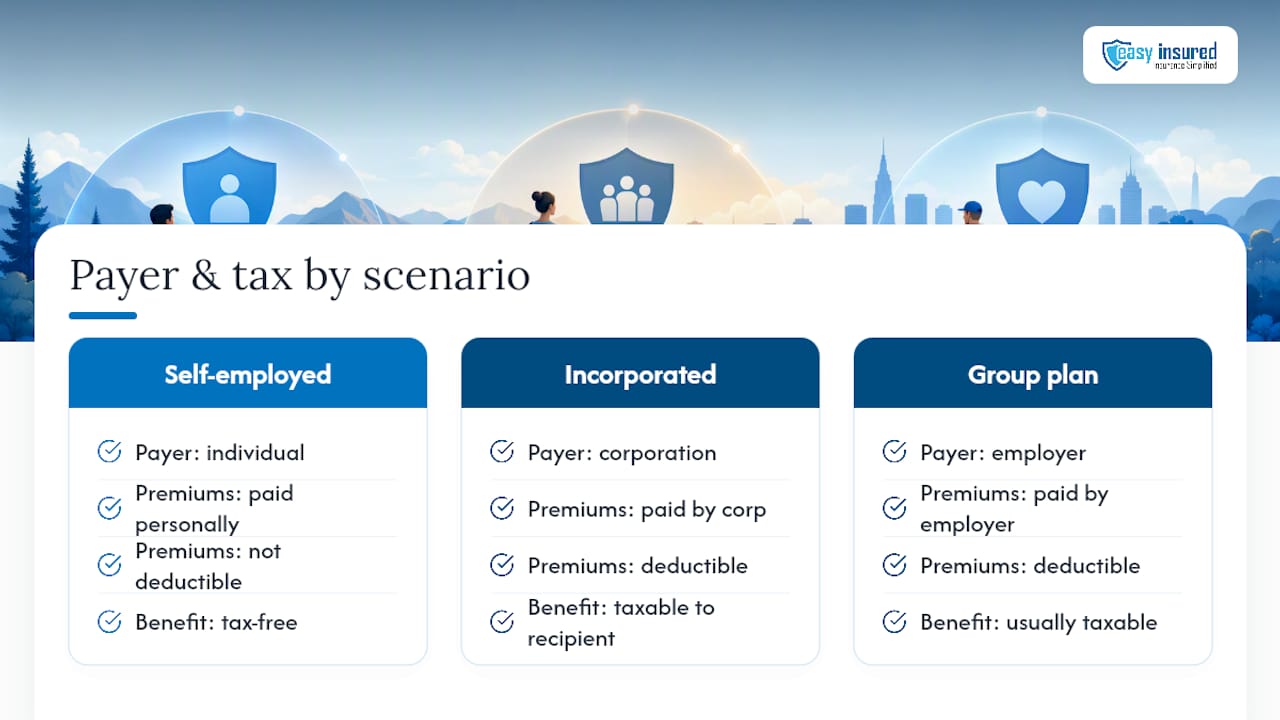
Self-employed, pays personally. A freelance designer buys an individual policy and pays premiums from her business account after tax. No deduction, but if she’s ever disabled, the monthly benefit arrives tax-free, fully available for rent and living costs.
Incorporated owner, corporation deducts premiums. A contractor’s corporation pays and deducts the premium as a business expense. He saves on corporate tax now, but under a disability claim, the benefit is generally taxable, and at his marginal rate that can erode a meaningful share of the monthly payout compared to the freelancer’s tax-free check.
Employee in a group plan. An office manager’s employer pays the group disability premium and deducts it. Her benefits are typically taxable unless the plan meets the CRA’s specific non-taxable structure. Most standard group plans don’t qualify, so she should plan around a reduced net payout if she ever needs to claim.
Why the “Just Deduct It” Advice Gets This Wrong
A common mistake seen is business owners chasing the deduction because it feels like free money in April. It rarely is. A dollar of premium deducted today is worth a lot less than a dollar of tax-free benefit received during an actual disability claim, especially for professionals in higher tax brackets who’d lose a meaningful chunk of a taxable payout right when they can least afford it. Easy-insured’s guides for self-employed Canadians consistently point incorporated owners toward personal, non-deducted premiums for exactly this reason. The right call depends on marginal tax rate, how the business is structured, and whether coverage runs through salary or dividends, which is precisely the kind of mixed situation where a tailored review beats generic advice.
— Frank
Get Your Disability Coverage Structured the Right Way
Getting the premium and benefit taxation right isn’t something to guess at with a generic online calculator. A professional review of your current filing history and how premiums have actually been reported can help recommend a policy structure built around your real tax exposure, not a one-size answer.

A consultation typically covers three things: a review of your existing coverage or proposed policy, a check of how premiums have historically been treated on your returns, and a recommendation on whether personal or corporate payment makes more sense for your situation. If you’re incorporated, self-employed, or running a mixed salary and dividend structure, that review can save you from an unpleasant surprise the day you actually file a claim. Visit the disability insurance page to request a quote, or explore term life and other coverage options if you’re building out a fuller financial plan alongside your disability protection.
Where to Verify These Rules Yourself
Confirm the details directly through the Financial Consumer Agency of Canada’s disability insurance page, the Canada Disability Benefit portal, and published CRA interpretation letters on self-employed policy premiums.
This article is general information, not a substitute for advice from a qualified financial advisor. Consult a qualified financial professional about your own circumstances before acting on anything here.
Sources
FAQ
Can You Deduct Disability Insurance Premiums in Canada?
Generally no, if you’re an individual paying for a personal policy with after-tax dollars. Employers and corporations can often deduct premiums as a business expense, but that typically makes the resulting benefits taxable to the employee or owner.
Are Disability Insurance Benefits Taxable in Canada?
It depends entirely on who paid the premiums. Personally paid premiums mean tax-free benefits; employer or corporate-deducted premiums usually mean taxable benefits.
Does an Overhead Expense Policy Get Taxed Differently?
Yes. Premiums for overhead expense policies are generally deductible to the business, and the payout covers business costs like rent and payroll rather than personal income, so it follows a different tax path than an income replacement policy.
How Does the Canada Disability Benefit Interact With My Tax Filing?
You need to file your tax return on time to confirm eligibility for the Canada Disability Benefit, and missed filings can delay or interrupt payments.
Should I Get Disability Coverage Reviewed if I’m Incorporated?
Yes, especially if you pay yourself through a mix of salary and dividends. Easy Insured can review your filing history and recommend whether personal or corporate premium payment fits your tax situation better.