
An in-trust-for (ITF) account is an informal trust where an adult invests on behalf of a minor, and the trustee controls the money until the child reaches the age of majority. The tax picture is the part families miss: the Canada Revenue Agency (CRA) can tax the contributor on the income, and reporting rules for some bare trusts change for years ending on or after December 31, 2026. We at Easy-insured explain how it all fits together.
TL;DR:
- An in trust label on a form does not establish a valid trust; keep signed intent, account documents, contribution records, and decisions showing funds served the child.
- Interest and dividends are usually attributed to a related adult contributor, while capital gains may be taxed to the child, depending on the facts.
- Certain bare trusts may need a T3 return and Schedule 15 for tax years ending on or after December 31, 2026; check filing duties early.
- Choose an RESP for education savings, or consider a formal trust when you need conditions on when or how a child receives larger gifts.
- Check provincial transfer rules and benefit eligibility before funding: the child’s assets may affect disability support, student aid, or other income based programs.
Table of Contents
- What an in trust account is and how it works in Canada
- How are ITF accounts taxed, and what changes in 2026?
- How to open and manage an ITF account step by step
- Recordkeeping and common mistakes to avoid
- When an ITF makes sense and when to get professional help
- Can an ITF affect a child’s government benefits?
- How ITF accounts fit into estate planning
- ITF accounts compared with other ways to save for a minor
- Choosing a trustee and understanding trustee duties
- Our view: the paperwork matters more than the label
- How we help with estate planning and trust documentation
- FAQ
- Sources
What an in trust account is and how it works in Canada
An ITF is an informal trust. There is usually no trust deed. The investment contract at your bank or brokerage is the main document, and it names you as trustee and your child or grandchild as beneficiary. Once a beneficiary is named, the beneficial interest is typically considered irrevocable, and a deposit is generally treated as a completed gift. You cannot take the money back for your own use later.
The trustee manages the investments for the child’s benefit. The beneficiary holds the beneficial interest. Check the rules in your province to find out when and how control transfers.
Two practical points matter before you start:
- Provider rules vary. Some institutions have stopped offering ITFs, and the forms and process differ from one provider to the next.
- Most investments qualify. Typical holdings include cash, GICs, stocks, bonds and other non-registered investments.
Parents often treat the account like personal savings, but a trustee’s authority is limited. That gap between expectation and legal reality is where most disputes begin, as a Canadian Bar Association article on in-trust account pitfalls points out.
How are ITF accounts taxed, and what changes in 2026?
Tax on an ITF is more complicated than the account’s simple setup suggests. Interest and dividends are typically attributed back to the contributor when that person is a related adult, such as a parent or grandparent. Capital gains, by contrast, may be taxed in the child’s hands, though exceptions exist.
The CRA does not accept the label “in trust” at face value. Its position is that the nature of an account is determined case by case, and that the three certainties must be present. Ticking a box on a form is not enough by itself to prove intent. If the CRA decides there is no valid trust, the contributor stays liable for tax on all the income and capital gains.
The CRA has confirmed that certain bare trusts may be required to file a T3 return, including Schedule 15, for taxation years ending on or after December 31, 2026. See the CRA’s update. That makes 2026 the year to tidy your paperwork, not the year after.
What to take from this:
- Income is often taxed to the contributor, so the child’s low tax bracket may not help on interest or dividends.
- Capital gains treatment is less predictable and depends on the facts.
- Weak documentation raises the chance that the CRA ignores the trust entirely.
- The CRA’s what has changed guidance covers when and how reportable bare trusts file, including beneficial ownership information.
If your ITF holds substantial assets, or you think you may meet a reporting trigger, speak with a tax professional before year end.
How to open and manage an ITF account step by step
Opening an ITF is quick. Managing it well takes discipline.
- Choose an institution that still offers ITF accounts. Call first and confirm, since not every bank or brokerage does.
- Complete the trustee and beneficiary details. Name yourself as trustee and the child as beneficiary on the account forms, and ask how the institution records the trust.
- Bring the right documents. Expect to show government ID, and some providers ask for proof of your relationship to the child. Have notes ready on where the money came from, and be prepared to supply the child’s Social Insurance Number where it applies. The Nova Scotia Securities Commission explainer covers SIN collection.
- Fund the account and log every contribution. Record the date, amount and source each time.
- Operate it as a trust. Keep the money separate from your own, avoid commingling, and make decisions only for the beneficiary’s benefit.
- Plan the handover. At the age of majority, check your province’s rule and ask your institution how it transfers the account to the beneficiary.
Pro Tip: Keep a simple one-page ledger and a signed note stating your intent to hold the funds for the child, then file both with your estate documents.
Recordkeeping and common mistakes to avoid
A trust needs three certainties: the intention to create it, identifiable beneficiaries, and identifiable property. Written evidence is how you prove the first one. In a 2003 technical interpretation, the CRA noted that whether an account is a trust is fact-specific, and that courts have sometimes treated transfers as gifts or as part of the transferor’s own assets.
The mistakes we see most often:
- Ticking an “in trust” box with no supporting documents.
- Mixing the child’s money with your own accounts.
- Withdrawing funds informally for personal use, which undermines the trust.
| What to keep | Why it matters |
|---|---|
| Account opening documents | Shows who is trustee and who is beneficiary |
| Contribution ledger | Proves the source and timing of each deposit |
| Record of trustee decisions | Shows funds were used for the child |
| Legal and CRA correspondence | Supports your position in a review |
Store these with your estate files so your executor can find them.
When an ITF makes sense and when to get professional help
Our view is straightforward. An ITF suits modest, simple gifts and small ongoing savings for a child. Once the sums are large, you want conditions on when the child receives the money, or tax planning is central to the decision, a formal trust is usually the better tool. Our article on inter vivos and testamentary trusts shows how the two formal options differ.
Check the CRA’s guidance on trust reporting for the 2025 taxation year, and get advice if reporting thresholds or tricky tax questions apply to you. We offer estate planning support.
Can an ITF affect a child’s government benefits?
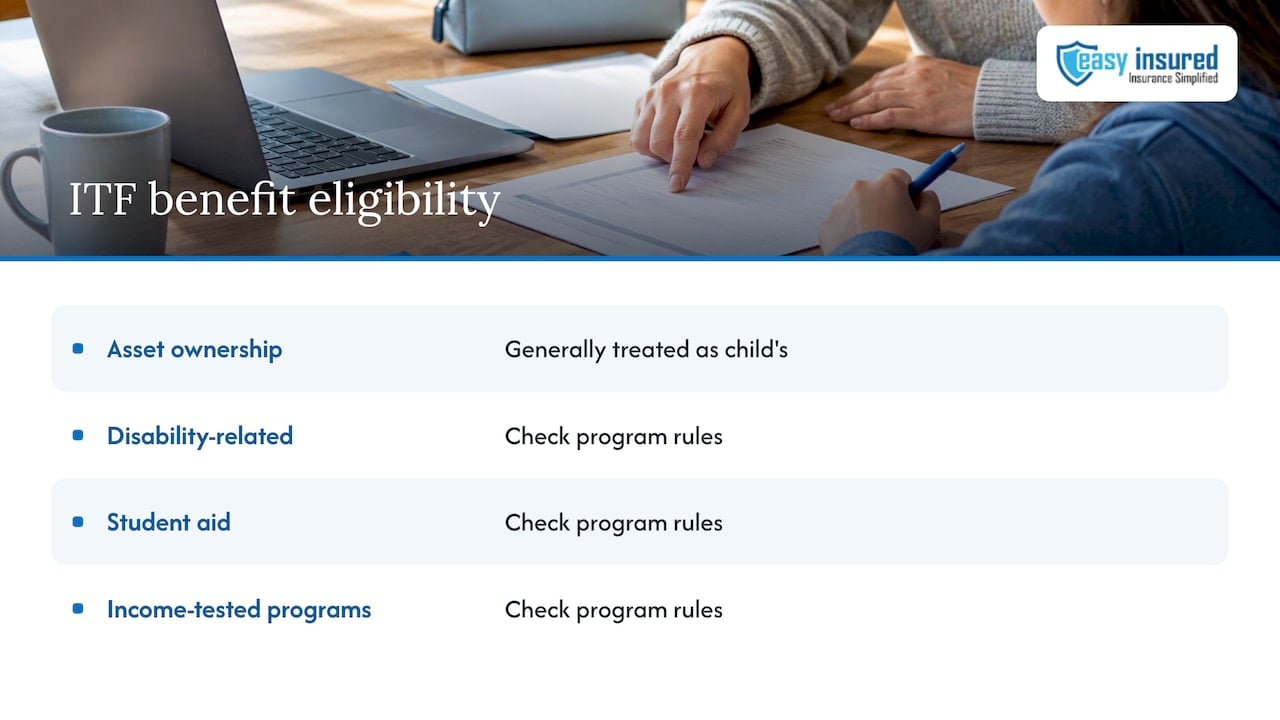
It can, and this is worth checking before you fund an account. Because the beneficiary holds the beneficial interest, the assets are generally treated as belonging to that child, not to you. For a young child, that rarely matters. Whether an ITF affects a beneficiary’s eligibility for support such as disability-related benefits, student aid or income-tested programs depends on the program’s rules. Confirm how the account is treated with the agency that runs the benefit before relying on an ITF.
If you are planning for a child who may need long-term support, a formal trust drafted for that purpose gives you more control over how and when money reaches the beneficiary. A professional can compare that route with an ITF for your family. Plan early: once money is deposited, the gift is typically irrevocable, so fixing a mistake later is hard.
How ITF accounts fit into estate planning
An ITF is not a will and does not replace one. Because a deposit is typically a completed gift, you may lose the flexibility to redirect the funds. Ask a qualified professional how an ITF could affect your estate plan.
For business owners and families, the real question is how the account sits beside the rest of the plan. A few points to weigh:
- Name a successor. An informal account may not say who steps in as trustee if you die or become incapacitated. Plan for that in your will or powers of attorney.
- Keep paperwork with your estate file. Your executor and tax advisor need the opening documents and ledger.
- Think about fairness. A gift to one grandchild can upset an otherwise balanced plan across your family.
- Coordinate with insurance. Life insurance can equalize an estate and fund gifts without drawing down investments. Our guide to a life insurance trust explains one approach.
A will versus trust review helps you decide which documents your family actually needs. If you own a business, add shares and succession to that conversation, since an ITF is rarely the right place for them.
ITF accounts compared with other ways to save for a minor
An ITF is one of several choices, and each trades flexibility for tax treatment.
| Option | Who controls it | Main tradeoff |
|---|---|---|
| ITF account | Trustee until age of majority | Interest and dividends often taxed to the contributor; gift is irrevocable |
| Registered Education Savings Plan (RESP) | Subscriber | The account’s terms and any available incentives depend on the plan and applicable rules |
| Formal trust | Trustees under a written deed | More setup and cost, but you can set conditions |
| Account in your own name | You | Full control, but no separation from your own assets |
An RESP can be a better fit when the goal is education. Our comparison of family and individual RESPs and our summary of RESP withdrawal rules show how that route works. A formal trust costs more to set up but lets you decide when and how the child receives money.
An ITF wins on simplicity and low cost. If you need conditions, grants or tax planning, look at the other options first.
Choosing a trustee and understanding trustee duties
Most parents and grandparents name themselves, and that is fine. What matters is that the trustee understands the role. The trustee must hold the money for the child, keep it apart from personal funds, and make decisions for the child’s benefit, not their own.
When choosing, consider:
- Reliability and record habits. The best trustee keeps a ledger without being reminded.
- Availability. If a grandparent is trustee, ask who takes over if they pass away or lose capacity.
- Relationship with the child and family. Disputes tend to start where expectations were never discussed.
- Willingness to follow the declared terms. Using the money like personal savings can lead to adverse tax consequences and disputes.
The strict rules lawyers follow for client money, such as keeping trust funds separate and fully recorded, are a useful model even though they do not apply to a family ITF. Treat the child’s money with the same care.
Our view: the paperwork matters more than the label
Most advice on ITF accounts stops at “open one and name the child.” That is where the real risk begins. The label does very little. What counts is whether your records show you intended a gift and then behaved like a trustee.
The conventional wisdom also oversells the tax benefit. Many families open an ITF hoping the child’s low bracket will shelter growth, then learn that interest and dividends can still land on the contributor’s return. Treat any tax saving as a bonus, not the reason to open the account.
Here is what we would do first. Decide whether the amount is small enough for an ITF. If it is, write a short statement of intent, keep a ledger, and never dip into the funds. If it is not, talk to a planner about a formal trust. And with reporting changes arriving for years ending on or after December 31, 2026, do not wait until the last minute to find out where you stand.
— Frank
How we help with estate planning and trust documentation
If an ITF raises more questions than it answers, we can help you sort out the right structure for your family. Our estate planning team can review what you have and what you may need, so you leave with a clear plan for the money you want to pass on.

Relevant services include:
- Estate planning
- Investment planning for gifts and long-term savings
- Life insurance used to fund or equalize an estate
- Tax planning that fits your family’s situation
Book a review, ask for an estate planning checklist, or ask whether a formal trust is a better fit than an ITF. You can also see all our services and reach out when you are ready.
This article is general information, not a substitute for advice from a qualified financial advisor. Consult a qualified financial professional about your own circumstances before acting on anything here.
FAQ
How do I open a trust account in Canada?
Contact a bank or brokerage that still offers in-trust accounts, then complete the forms naming yourself as trustee and the child as beneficiary. Bring ID and notes on where the money came from, and keep a record of every contribution.
Who pays tax on an in trust account?
Interest and dividends are usually taxed to the contributor when that person is a related adult. Capital gains may be taxed to the child, though exceptions apply, so confirm your situation with a tax professional.
What is a bare trust?
A bare trust is an arrangement where the trustee holds property for a beneficiary with no real discretion over it. The CRA has said certain bare trusts may need to file a T3 return for taxation years ending on or after December 31, 2026.
When does the child take control of an ITF account?
The beneficiary generally gains legal control at the age of majority, which varies by province. Check your province’s rule and ask your institution how it handles the transfer.
Sources
- Canada
- 8 June 2007 Roundtable, 2007-0233761C6 – 2007 STEP Conf-Q.1-In-trust Accounts | Tax Interpretations