
For most Canadians, a properly drafted will is the starting point. Add a trust when you need ongoing control over how money gets used, privacy from public probate records, or protection for business shares and complex assets. The Canada Revenue Agency’s rules on trusts and each province’s own statutes shape which option actually fits your situation, and Easy-insured works with families and business owners across Canada to sort out exactly that.
Here’s where to start today, regardless of which tool you eventually choose:
- Confirm your beneficiary designations on RRSPs, TFSAs, and life insurance policies.
- Name a guardian for minor children in your will, since a trust cannot do this.
- Identify one or two people you’d trust to act as executor or trustee.
- Gather your property titles, shareholder agreements, and policy documents before meeting an advisor.
Provincial rules on witnessing, electronic wills, and probate fees vary enough that the right answer in Ontario isn’t always the right answer in British Columbia or Quebec. That’s covered below, along with the tax trap that catches Canadians who assume a trust solves everything.
Key Takeaways
A will handles guardianship and catches assets left outside other arrangements, while a trust adds ongoing control, privacy, and incapacity protection once it’s properly funded.
| Point | Details |
|---|---|
| Start with a will | Every Canadian adult needs one to name an executor and guardians for minor children. |
| Fund the trust, not just create it | A trust only works once assets are legally retitled into its name. |
| Watch the 21-year rule | Trusts face deemed disposition on capital property every 21 years, so plan distributions ahead of that anniversary. |
| Check beneficiary forms yearly | Outdated designations on RRSPs, TFSAs, and life insurance can override your will’s instructions. |
| Know your province’s rules | Ontario witnessing requirements, BC’s electronic wills, and Quebec’s civil-law process each change how you execute your plan. |
Table of Contents
- Will vs. Trust in Canada: What a Will Actually Does
- Will vs. Trust in Canada: What a Trust Actually Does
- Comparing a Will and a Trust Across the Decisions That Matter
- When a Will Is Enough, and When You Need a Trust Too
- Why You Usually Need Both a Will and a Trust
- Provincial Rules That Change the Answer
- Misconceptions and Tax Traps Worth Knowing Before You Sign Anything
- Your Next Steps With Easy-insured
- The Most Overlooked Part of This Decision
- Frequently Asked Questions
- Sources
Will vs. Trust in Canada: What a Will Actually Does
A will takes effect only at death. Until then, you can change it, revoke it, or rewrite it entirely as many times as you like, as long as you’re mentally competent. That flexibility is the whole point of a will: it’s a living document until the moment it stops being one.
Two jobs belong exclusively to a will. First, naming an executor, the person legally responsible for paying debts, filing final tax returns, and distributing what’s left. Second, naming a guardian for minor children, something no trust can do. This alone is why estate lawyers tell nearly every parent to have a will, no matter how simple their finances look.
Not everything you own passes through your will. Life insurance proceeds, RRSPs, TFSAs, and jointly held property typically transfer directly to the named beneficiary or joint owner, bypassing your estate entirely. That’s efficient, but it also means an outdated beneficiary form can override what your will says. Update both, or one contradicts the other.
Most wills in Canada go through probate, the court process that validates the will and confirms the executor’s authority. Probate creates a public record. Anyone can request a copy of a probated will at the courthouse, which is one reason people uncomfortable with that exposure look at trusts instead. Our guide to probate in Canada walks through the timeline and what executors actually have to file.
Pro Tip: Review your beneficiary designations every time you have a major life event: marriage, divorce, a new child, or a new mortgage. It’s the single most common gap we see in otherwise solid estate plans.
Will vs. Trust in Canada: What a Trust Actually Does
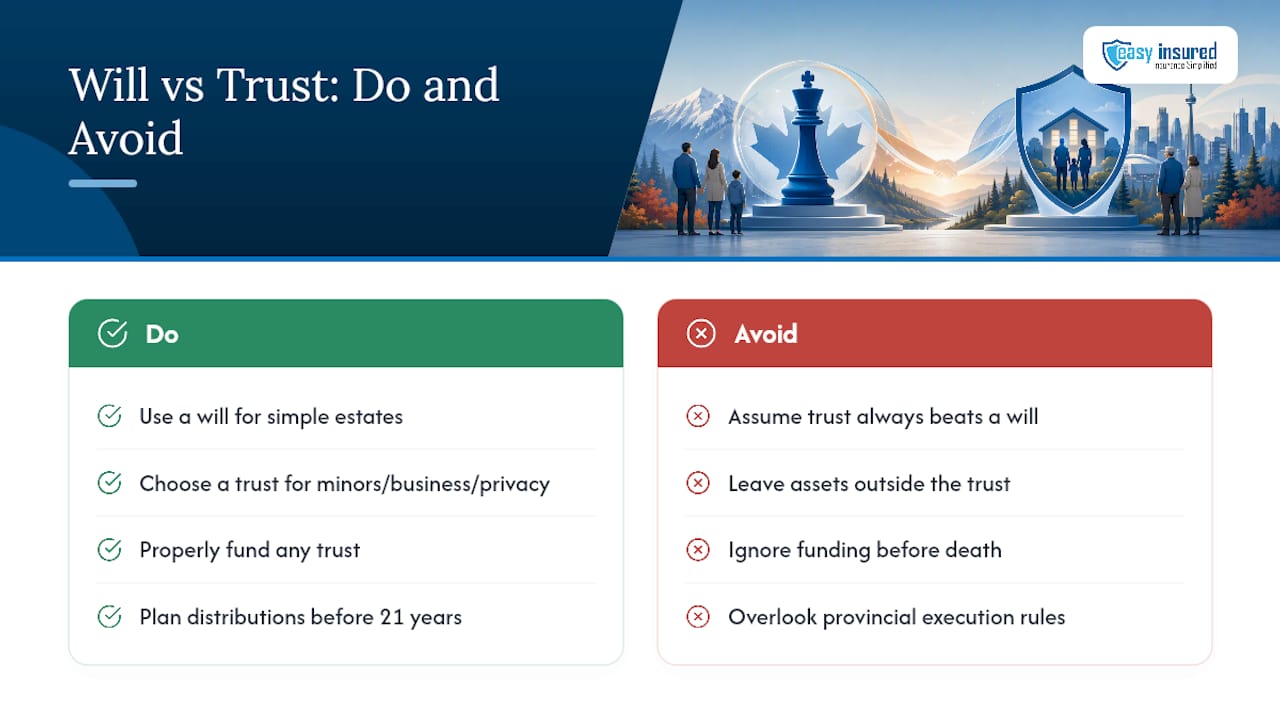
A trust involves three roles: the settlor (who creates it and contributes assets), the trustee (who manages those assets), and the beneficiary (who benefits from them). Unlike a will, a trust can start operating the moment it’s funded, which means transferring legal ownership of assets into the trust’s name. An unfunded trust is just a document sitting in a drawer.
Canada recognizes several trust structures, each built for a different job, as the Canada Revenue Agency outlines:
- Inter vivos trusts are created and funded during your lifetime, often for tax planning or asset protection.
- Testamentary trusts arise under your will and only come into existence at death.
- Family trusts hold assets for the benefit of multiple family members, common among business owners doing income splitting.
- Alter ego trusts let Canadians 65 and older transfer assets while retaining the income during their lifetime.
- Joint partner trusts work similarly but extend that same benefit to a spouse or partner.
The practical payoff of a properly funded trust is real: assets held in trust generally avoid probate because they’re no longer legally owned by you at death. Trusts also let you stagger distributions to beneficiaries instead of handing over a lump sum, build in incapacity planning if you become unable to manage your own affairs, and in some structures, add a layer of protection from creditors or a beneficiary’s future divorce. Practitioner analysis on wills versus trusts points out that business owners use this staged-distribution feature constantly when passing shares to adult children who aren’t ready to run the company yet.
Comparing a Will and a Trust Across the Decisions That Matter
Six factors decide which tool fits your situation, and none of them work the same way for a will as they do for a trust.
- Timing. A will sits dormant until death. A trust can go to work the day it’s funded, managing assets for a beneficiary who’s still a minor, incapacitated, or simply not ready for full control.
- Control. Wills generally hand out outright gifts once probate clears. Trusts let you set conditions: age milestones, staged payouts, or income-only access while capital stays protected.
- Probate and privacy. Assets that pass through a will typically go through probate and become part of the public court record. Assets properly transferred into a trust usually bypass that process entirely, keeping the details private.
- Tax and reporting. Trusts face their own tax rules under the Income Tax Act. The Canada Revenue Agency requires most trusts to file a T3 return annually, and every trust hits a deemed disposition of its capital property on the 21-year anniversary of its creation, which can trigger tax as if the assets had been sold, even though nothing changed hands.
- Cost. A basic will costs far less to draft than setting up and funding a trust. Trusts carry ongoing administrative work, including annual tax filings and trustee accounting, which adds real cost over time.
- Administrative burden. A will requires an executor to act once, at death. A trust requires a trustee to act continuously, sometimes for decades, which means trustee selection matters enormously.
The 21-year rule catches more Canadians off guard than any other trust provision. It’s not a one-time filing headache. It’s a recurring tax event that has to be managed proactively, and it’s the single biggest reason trusts require more than a “set it and forget it” mindset.
When a Will Is Enough, and When You Need a Trust Too
Most Canadians with straightforward finances, no minor children requiring long-term financial oversight, and no business interests to protect will do fine with a well-drafted will alone. The Angus Reid Institute has found that a large share of Canadians still don’t have one, which means the first and most urgent step for most readers isn’t choosing between a will and a trust. It’s simply having a will at all.
Run through this checklist before deciding whether to add a trust:
- Do you have minor children who’d inherit a large sum before they’re ready to manage it?
- Do you own business shares that need a succession plan beyond a simple bequest?
- Are you blending families, where you want to provide for a current spouse while preserving assets for children from a prior relationship?
- Do you hold property or investments in more than one province?
- Are privacy and avoiding a public probate record a priority for you?
A will alone usually suffices for simple estates with adult, financially capable beneficiaries. Add a testamentary trust, built into your will, when you want a business or investment portfolio managed for children over years rather than handed over at 18. An inter vivos trust makes sense for active income splitting or asset protection during your lifetime. An alter ego trust suits Canadians 65 and older who want to plan now for potential incapacity while keeping the income for themselves.
Pro Tip: Don’t set up a trust and then forget to fund it. An unfunded trust does nothing, and we’ve seen families discover this only after probate was already underway.
Why You Usually Need Both a Will and a Trust
A trust and a will aren’t competing tools. They’re complementary. A trust holds and manages whatever assets you’ve actually transferred into it. Your will catches everything else, appoints your executor, and names guardians for minor children, jobs no trust performs.
Funding matters more than the trust document itself. Retitling property, transferring investment accounts, and updating beneficiary designations are what actually move assets out of your estate and into the trust’s control. Skip that step and the trust is legally empty.
A testamentary trust works differently: it’s written into your will and only springs into existence at death, often to manage an inheritance for young children over a set number of years. An inter vivos trust, by contrast, operates while you’re alive.
Neither a will nor a trust handles incapacity while you’re still living. That’s the job of a power of attorney for property and a healthcare directive, both of which belong in every estate plan alongside your will and any trusts you set up.
Provincial Rules That Change the Answer
Estate law in Canada runs on a mix of federal tax rules and provincial statutes governing wills, trusts, and probate, and the details shift meaningfully depending on where you live.
Ontario requires two witnesses present at signing, and neither can be a beneficiary. Some Ontario business owners use dual wills, splitting assets that require probate from those that don’t, to reduce probate fees on shares and other assets that don’t need court validation.
British Columbia operates under the Wills, Estates and Succession Act, which now permits electronic wills under certain conditions, a notable departure from the paper-only tradition most provinces still follow.
Quebec runs on civil law rather than common law, which changes both terminology and process. Notarial wills, prepared and held by a notary, skip probate entirely, while trusts (called fiducies under Quebec’s Civil Code) follow different formal requirements than common-law trusts elsewhere in Canada.
Probate fees also vary by province, and in provinces with higher fees, funding a trust to move assets out of the estate can produce a meaningful cost saving. Federal statutes provide the baseline framework, but provincial legislation determines the actual mechanics where you live.
Misconceptions and Tax Traps Worth Knowing Before You Sign Anything
The biggest misconception: a trust doesn’t automatically eliminate taxes or probate. It only does that if it’s properly structured and properly funded, and registered accounts like RRSPs often can’t move into a trust without triggering tax consequences of their own.
The 21-year deemed disposition rule is the trap that catches people who set up a trust once and never revisit it. Every trust in Canada faces a deemed disposition of its capital property every 21 years, taxed as if the assets were sold at fair market value even though they weren’t. The standard planning response is distributing assets to beneficiaries before that anniversary hits, or rolling them out ahead of time to avoid tax at the trust’s often-higher marginal rate.
Other traps worth flagging:
- Revocable trusts stay flexible but offer weaker creditor and tax protection than irrevocable ones.
- Irrevocable trusts lock in protection but remove your ability to change course later.
- Choosing the wrong trustee, someone unwilling or unable to handle decades of accounting and T3 filings, creates more problems than the trust was meant to solve.
Your Next Steps With Easy-insured
Before meeting a lawyer or advisor, pull together your insurance policy details, property titles, shareholder agreements, and current beneficiary forms. Having them in one place cuts your first meeting in half.
- Ask an estate lawyer whether a testamentary trust makes sense given your family structure.
- Ask your insurance broker whether your current coverage provides enough liquidity to cover final taxes and probate costs without forcing an asset sale.
- Ask any trustee candidate honestly whether they’re willing to handle years of ongoing administration.
Life insurance and estate bonds are often the simplest way to fund tax bills and probate costs without liquidating a business or a home. Our estate bond guide breaks down how that works in practice.
Pro Tip: Schedule your beneficiary review and guardianship conversation this month, not “sometime this year.” Estate plans that stall usually stall at the first step.
If you’re weighing whether a trust makes sense for your family or business, Easy-insured’s estate planning services can help you map out funding, beneficiary designations, and the insurance-based liquidity that keeps a plan from falling apart when it matters most. A whole life policy is often the backbone of that liquidity, since its cash value and death benefit are built to cover exactly the kind of tax and probate costs a trust or estate can face.
The Most Overlooked Part of This Decision
The will versus trust question gets treated like a binary choice, and that’s the wrong frame. The research on this is pretty clear: most estate plans that fail don’t fail because someone picked the wrong tool. They fail because the tool they picked never got properly funded, or because beneficiary designations sat untouched for a decade after a divorce or remarriage.
Conventional advice fixates on which structure sounds more sophisticated. Trusts get marketed as the advanced option, wills as the basic one. That framing misses what actually protects a family: a will that reflects your current life, designations that match your will instead of contradicting it, and a trustee who actually understands what 21 years of filings involves.
If you take one thing from this, prioritize funding over formation. A trust document with no assets inside it protects nobody. A will that hasn’t been updated since your youngest was born isn’t protecting anyone either. Get the paperwork right, then get the follow through right, because that second part is where most plans quietly fall apart.
Frequently Asked Questions
Is a trust always better than a will in Canada?
No. A trust adds cost and ongoing administrative work that most simple estates don’t need. A will alone is often the right answer unless you have minor children needing long-term financial oversight, business shares to protect, or a strong preference for privacy over probate.
Does a trust avoid probate automatically?
Only if it’s properly funded. Assets have to be legally retitled into the trust’s name before death. Anything left outside the trust still passes through your will and potentially through probate.
What happens to a trust after 21 years in Canada?
The trust faces a deemed disposition of its capital property, taxed as though the assets were sold at fair market value. Trustees typically distribute assets to beneficiaries before the anniversary to manage this tax exposure.
Can a will and a trust work together?
Yes, and for most families with any complexity, they should. A testamentary trust is written directly into your will and takes effect at death, often to manage an inheritance for children over a set number of years.
Do provincial rules really change which one I need?
They change how you execute your plan more than which tool you need. Ontario’s witnessing requirements, British Columbia’s acceptance of electronic wills, and Quebec’s civil-law notarial process each carry different formalities that affect cost, privacy, and speed.
This article is general information, not a substitute for advice from a qualified financial advisor. Consult a qualified financial professional about your own circumstances before acting on anything here.
Sources
- Canada
- Will vs. Trust: Which One Actually Controls Your Assets In Canada? — The Advisors Table
- Angus Reid Institute — Canadians and wills