
Most beneficiaries receive life insurance proceeds within 7 to 14 days once an insurer has a complete claim, though 2 to 6 weeks is a more typical range once verification and administrative review are factored in. Cases involving investigations, estate routing, or missing paperwork can stretch to months. The first move is simple: notify the insurer and get a certified death certificate so the claim clock can start.
TL;DR:
- Ask the insurer for a written checklist, then submit a certified death certificate, signed claim form, beneficiary identification, and the original policy document if available.
- Claims filed during the policy’s first two years may face closer scrutiny; missing beneficiaries, estate administration, or medical investigations can extend payment for months.
- Naming a person rather than the estate generally avoids probate delays; when the estate is beneficiary, insurers often wait for probate before releasing proceeds.
- A lump sum is usually the quickest payment choice after approval, while annuities may delay the first disbursement during setup.
- The Canada Pension Plan death benefit typically takes 6 to 12 weeks after application, a separate timeline from private life insurance claims.
Table of Contents
- How life insurance payouts work: the claim process step by step
- Typical payout timelines: fast, average, and slow scenarios
- What slows or speeds payment: practical causes and fixes
- Payout options and how they affect timing
- Document checklist and how to organize your claim
- How we help with payouts and beneficiary setup
- What matters most in the first 30 days
- Get help with your claim or beneficiary setup
- FAQ
- Sources
How life insurance payouts work: the claim process step by step
Every payout follows roughly the same path, and most of the waiting happens in the gaps between these steps rather than in the steps themselves.
- Locate the policy. Check paperwork at home, ask the deceased’s employer about a group plan, or contact their financial advisor if one was involved.
- Notify the insurer and open a claim. Call the carrier directly, get a claim number, and note the name of the adjuster assigned to the file.
- Submit the required documents. This usually means a certified death certificate, a completed claim form, proof of beneficiary identity, and the original policy bond if it’s available.
- Wait through verification. The insurer confirms the policy was active, checks for any contestability issues, and may follow up with questions.
- Receive payment. Once approved, carriers typically notify the beneficiary and send funds by check or direct deposit.
The Financial Consumer Agency of Canada outlines this same sequence: locate the insurer, notify them, submit a certified death certificate and claim form along with identity and policy documents, answer any follow-up questions, then select or receive payment once the claim is approved.
Typical payout timelines: fast, average, and slow scenarios
Timing depends almost entirely on how complete the paperwork is when it lands on the adjuster’s desk.
- Fast track (7 to 14 days): happens when the insurer receives every required document at once and no investigation is triggered.
- Average case (2 to 6 weeks): standard for claims that need routine beneficiary verification and administrative processing.
- Slow cases (6 to 12+ weeks): occur when a policy is still within its contestability period, a beneficiary can’t be located, the estate must be administered, or a medical investigation is opened.
Some industry guidance notes that many insurers issue payment within about a week of receiving full documentation, according to the Life Insurance Council, while more complex claims naturally take longer. It’s worth noting that private life insurance timing is separate from government survivor benefits. The CPP death benefit, for example, typically takes about 6 to 12 weeks after a completed application, and beneficiaries sometimes mistake that timeline for how private insurers operate.
What slows or speeds payment: practical causes and fixes
Incomplete or incorrect paperwork is the single biggest cause of delay. Insurers commonly need:
- A certified copy of the death certificate (not a photocopy).
- A fully completed claim form signed by the beneficiary.
- Proof of identity and, occasionally, proof of relationship to the deceased.
- The original policy document, if it still exists.
Beyond paperwork, a few structural issues cause predictable slowdowns. When a policy names the estate as beneficiary rather than a person, proceeds often can’t move until probate is granted. Claims filed during a policy’s contestability window, generally the first two years, face closer scrutiny, and suicide clauses within that same window can trigger additional review. A minor named as beneficiary without a trustee in place may also see funds held by a provincial trustee office until a guardianship arrangement is sorted out.
Pro Tip: Call the insurer within the first week, ask for a written claim checklist, and keep a simple log of every call, document sent, and name of the person you spoke with.
Payout options and how they affect timing
Most policies offer more than one way to receive proceeds, and the choice affects how fast the first payment actually arrives.
- Lump sum: the default for most policies and typically the quickest option once a claim is approved.
- Periodic payments or an annuity: these require the insurer to set up a payment schedule, which can delay the first disbursement while the structure is arranged.
- Leaving funds on deposit with the insurer: an administrative alternative that keeps money with the carrier temporarily, often used when a beneficiary needs time to decide on next steps.
It’s worth asking the carrier directly how each option affects the expected date of the first payment, since the answer varies by insurer and by policy type.
Document checklist and how to organize your claim
A well-organized claim moves faster because the adjuster isn’t chasing paperwork.
- Get several certified copies of the death certificate from the funeral home or provincial vital statistics office; most insurers want an original, not a scan.
- Complete the insurer’s claim form and gather the original policy bond, beneficiary ID, and any proof of relationship requested.
- If proceeds go to the estate, prepare the will, letters probate, and executor identification, since these documents govern how funds are released.
- Keep a running file with the claim number, adjuster’s name, and copies of everything submitted, and follow up weekly if you haven’t heard back.
Pro Tip: Naming a specific person as beneficiary, rather than the estate, is one of the simplest ways to avoid probate delays entirely, as explained in our guide to naming a beneficiary.
How we help with payouts and beneficiary setup
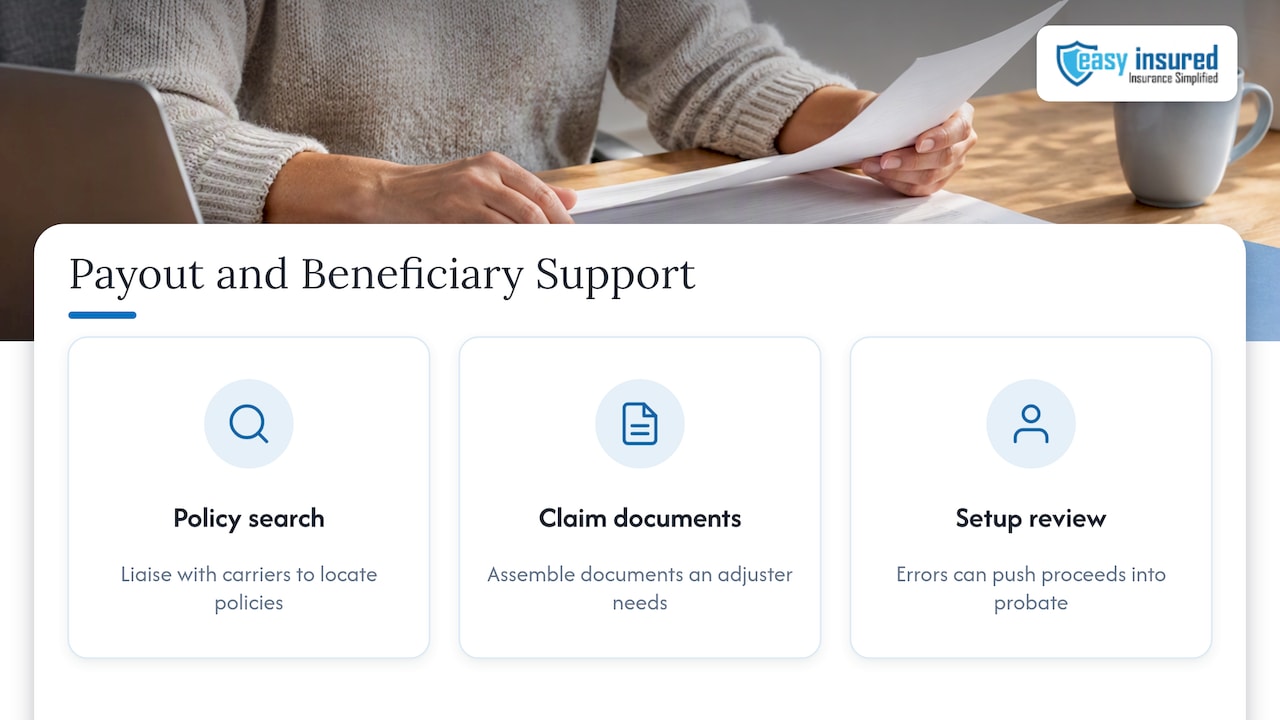
We provide assistance with term, whole, and final-expense policies, including helping families organize beneficiary details before a claim needs to be filed. When a policy can’t be located, we liaise directly with carriers to track it down and assemble the documents an adjuster needs. We also review beneficiary designations and policy ownership, which is often where delays start, since mistakes here are a common cause of beneficiary designation errors that push proceeds into probate unnecessarily.
What matters most in the first 30 days
The paperwork matters less than the order you do it in. Certified death certificates and an open claim file come first, before anything else. Confirm exactly who is named as beneficiary, because that single detail determines whether money moves in days or gets tied up in an estate. Daily follow-up calls in week one feel excessive until you see how much faster they move a file.
— Frank
Get help with your claim or beneficiary setup
If you’re a beneficiary trying to track down a policy or sort out next steps, assistance is available to work through the claim directly with the carrier and check whether beneficiary and ownership setup is slowing things down. We offer term life, whole life, and final expense coverage, and our advisors can review an existing policy even if we didn’t originally sell it.

- Request a quick review of your beneficiary designations and policy ownership.
- Get a quote on coverage for your own family while you handle a current claim.
- Reach out through our services page for direct advisor support.
If a mortgage is tied to the policy, the Mortgage Life Insurance Needs Calculator can help estimate how much coverage is needed to clear the balance.
This article is general information, not a substitute for advice from a qualified financial advisor. Consult a qualified financial professional about your own circumstances before acting on anything here.
FAQ
How long does it take to pull money from a life insurance policy?
Most insurers pay out within 7 to 14 days once they have a complete claim, though 2 to 6 weeks is common when standard verification is required. Delays stretching into months usually involve contestability reviews, estate administration, or missing paperwork, as outlined by the Financial Consumer Agency of Canada.
What deaths does life insurance not cover?
Coverage exclusions vary by policy, but suicide within the contestability period (typically the first two years) is a common exclusion addressed directly in policy language. Fraud or material misrepresentation on the original application can also void a claim, since insurers review this during the contestability window described in industry policy standards.
How does naming a beneficiary affect payout speed?
Naming a specific person as beneficiary generally lets proceeds bypass the estate and probate entirely, which speeds up payment. Naming the estate instead means funds often can’t be released until probate is granted, a process explained further in our guide on policy ownership.
What should I do first after a policyholder’s death?
Contact the insurer to open a claim and request several certified copies of the death certificate right away. Submitting the completed claim form along with these documents as early as possible is what starts the insurer’s processing clock, per Canada.ca guidance.
What are the benefits of life insurance for seniors?
Final expense and whole life policies for seniors typically provide a tax-free lump sum that covers funeral costs and other final expenses without going through probate when a person is named as beneficiary. Coverage amounts and eligibility vary by insurer and health status, so reviewing options with an advisor is the practical next step.