
Term life insurance in Canada typically costs a few dozen dollars a month for a healthy young adult with modest coverage, rising significantly for older applicants or larger policies, with age as the single biggest factor behind that spread. Smoking status is the second-biggest driver, often doubling or tripling a premium at the same age and coverage level. Because underwriting varies by insurer, the only way to know your real number is to get personalized quotes and check how ownership and tax rules apply to your situation.
TL;DR:
- Premium costs increase sharply with age, especially for older applicants and larger coverage amounts, making early purchase more cost-effective.
- Smokers pay two to three times more than nonsmokers across all ages due to higher mortality risk, so quitting nicotine before applying can significantly lower premiums.
- Underwriting includes health, lifestyle, occupation, and activity factors, which can lead to rating adjustments or exclusions after medical verification.
- Final premiums depend on medical records and tests, not just initial quotes, which are only preliminary estimates subject to underwriting review.
- Ownership structure and tax considerations, such as corporate or personal ownership and provincial levies, can alter the true cost and benefit of a policy.
Table of Contents
- Real-world monthly costs by age, coverage, and smoker status
- What actually moves your price: the factors insurers weigh
- How your quote turns into a final offer
- How ownership and taxes change your real cost
- Practical ways to bring your premium down
- What happens when your term policy expires
- Why this guide exists and how to use it
- Getting a quote that accounts for your full picture
- Where these figures and rules come from
- Sources
- FAQ
Real-world monthly costs by age, coverage, and smoker status
The dollar figures below are illustrative examples built around common Canadian underwriting patterns, not quotes from any specific insurer. They’re meant to help you ballpark your own cost before you apply.
For a healthy nonsmoker buying a 20-year term policy, monthly premiums tend to fall into these rough bands:
Typical monthly premiums for a healthy nonsmoker buying 20-year term policies vary by age and coverage amount, generally rising with age and coverage level. For example, younger adults pay lower premiums for modest coverage while premiums rise significantly for older adults and larger coverage amounts.
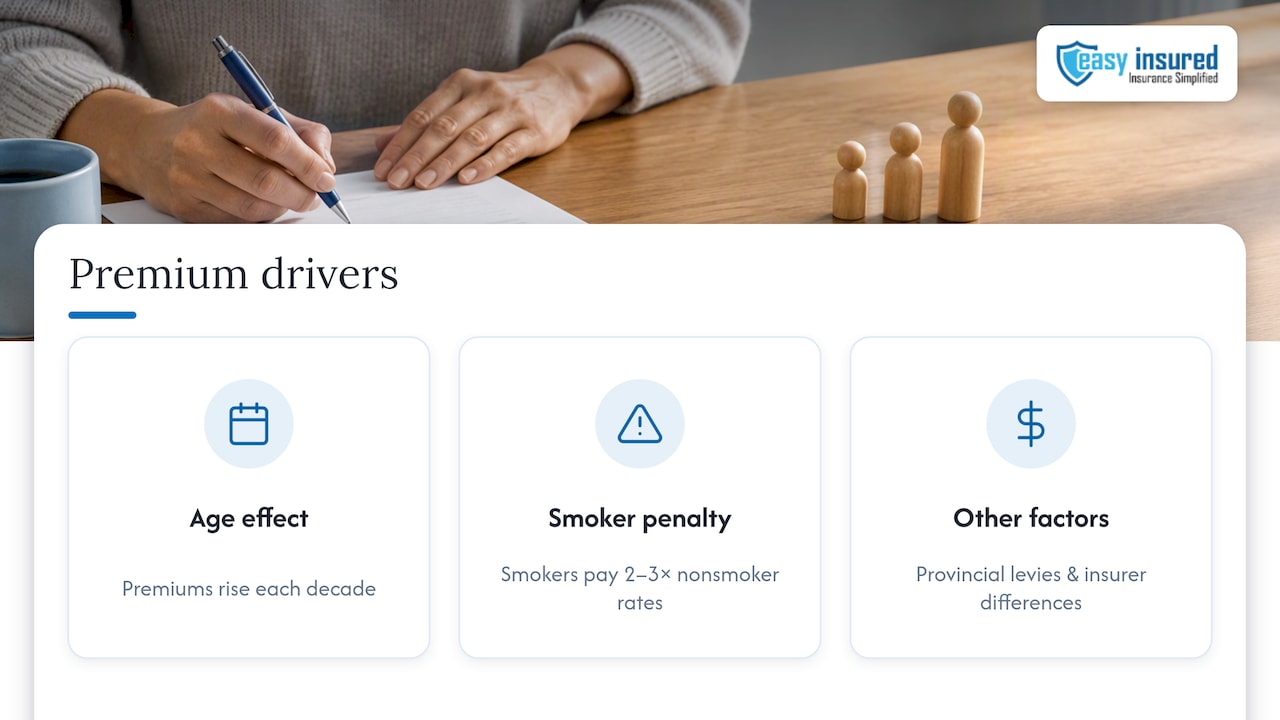
Smokers pay considerably more at every age and coverage level, sometimes two to three times the nonsmoker rate, because insurers classify nicotine use as one of the strongest predictors of early mortality. Smokers typically pay significantly more than nonsmokers for the same coverage, often doubling or tripling the premium at the same age due to higher mortality risk.
The variation in premium costs arises from factors such as health and lifestyle underwriting classifications, applicable provincial levies that add a small percentage, and insurers’ individual risk appetites which affect pricing differences among companies.
Premiums generally rise noticeably with each decade of age, according to CLHIA’s consumer guidance, which is why buying term coverage earlier in life, even before you strictly need it, tends to lock in a lower rate for the life of the policy.
What actually moves your price: the factors insurers weigh
Insurers build your premium from a set of specific inputs, and understanding which ones you can influence helps you shop smarter.
- Age and term length interact directly: choosing a 30-year term instead of a 20-year term at the same age raises your premium because the insurer is guaranteeing that rate over a longer window of rising mortality risk.
- Coverage amount doesn’t scale in a straight line: doubling your coverage from $250,000 to $500,000 often costs less than double the premium, since insurers spread fixed administrative costs across the larger policy.
- Medical underwriting looks for red flags: conditions like uncontrolled diabetes, a history of heart disease, or elevated blood pressure can push you into a higher-rated class or trigger specific exclusions on the policy.
- Nicotine and vaping use carry their own classification: most insurers require 12 months of confirmed abstinence before considering you for nonsmoker rates, and some ask for nicotine testing rather than just a declaration.
- Occupation and hobbies matter: commercial pilots, professional drivers, and people who regularly scuba dive, skydive, or race motor vehicles often face rated premiums or specific activity exclusions.
- Provincial levies apply on top of base premiums in payroll and group insurance contexts, which is one reason employer-sponsored coverage can carry a different effective cost than an individually underwritten policy.
Pro Tip: If you’ve recently quit smoking or vaping, ask your broker about applying right at the 12-month mark rather than waiting years longer, since that’s typically when nonsmoker rates become available.
How your quote turns into a final offer
The number you see on an online quoting tool is an estimate based on the information you type in, not a binding price. The real premium comes after underwriting, when the insurer verifies what you’ve told them and checks it against medical and third-party records.
According to CLHIA’s guide to life insurance, insurers can and do revise preliminary estimates once they review your medical history and any required test results, so the quote you started with is a starting point rather than a promise.
Here’s what typically happens between application and policy issuance:
- You submit a detailed application covering your health history, family history, occupation, and lifestyle.
- The insurer may order a paramedical exam, blood and urine tests, or request records from your doctor through an Attending Physician Statement.
- The insurer cross-references your application against databases like the MIB to catch inconsistencies with prior applications.
- Underwriters assign you to a rate class, which may match your initial quote, add a rating for a specific health issue, or apply an exclusion for a particular activity.
- You receive a formal offer, and this is the point to compare the actual policy wording, not just the monthly number, against what you originally expected.
When an offer arrives with a rating or exclusion, ask the insurer exactly what triggered it and whether it’s negotiable with additional medical evidence. A second opinion from another insurer sometimes produces a materially better outcome for the same coverage.
How ownership and taxes change your real cost
Who owns the policy, and whether it’s paid personally or through a business, changes both your tax exposure and your net cost. This is where a lot of Canadians leave money on the table.
If your employer pays for group life insurance on your behalf, the CRA treats that premium as a taxable benefit that must be calculated and reported, and provincial levies get factored into that calculation as well. That means the “free” coverage through work has a real tax cost that shows up on your paycheck or T4.
For business owners, corporate ownership introduces its own set of rules. Net proceeds received by a private corporation can increase the capital dividend account, which can let shareholders receive proceeds tax-free, but the adjusted cost basis and required elections make this a detail worth confirming with an advisor before you apply. Our tax check guide for Canadian life insurance owners walks through common pitfalls, and business owners specifically should review our corporate-owned life insurance guide before choosing a structure.
On the GST/HST side, the CRA’s bulletin on insurance product taxation outlines which components of insurance products and administration fees are subject to GST/HST, since not every charge tied to your policy is taxed the same way.
- Ask whether your policy will be personally owned or corporately owned, and how that choice affects proceeds and premiums.
- Ask your payroll department how any employer-paid premium is being reported as a taxable benefit.
- Ask a tax advisor whether your specific province’s levy is baked into the quoted premium or added separately.
One useful fact to confirm before applying: CRA’s payroll bulletin explains exactly how employer-paid group premiums translate into a taxable benefit on your pay stub, including provincial levy examples.
Practical ways to bring your premium down
You have more control over your price than you might think, especially if you act before you apply rather than after.
- Match your term length and coverage amount to your actual obligations: a 15-year term that ends when your mortgage does typically costs less than a 30-year term you don’t need.
- Address controllable health metrics like weight, blood pressure, and cholesterol months before applying, since insurers use recent test results, not lifetime history, to classify most applicants.
- If you’ve quit nicotine, wait until you hit your insurer’s abstinence threshold (commonly 12 months) before applying for nonsmoker rates rather than applying early and getting rated as a smoker.
- Compare a broker’s multi-insurer shopping against a single direct purchase, since brokers can sometimes find a better-priced class for your specific health profile.
- Be completely accurate on your application: an omission discovered later, even an honest mistake, can lead to a rating adjustment or a denied claim.
Pro Tip: If you’re buying coverage specifically to protect a mortgage, a decreasing term policy that shrinks alongside your balance often costs less than a flat-coverage term policy for the same starting protection. If your mortgage terms are still in flux, a conversation with a mortgage advisor like CK the Mortgage Guy can help you time your insurance purchase around your actual loan schedule.
What happens when your term policy expires
Term policies are built to end, and what happens next depends entirely on the contract you signed years earlier.
- Most policies offer guaranteed renewal, but the new premium is recalculated at your current age, often producing a sharp jump since you’re now underwritten by age band rather than your original health class.
- Many term policies include conversion rights, letting you switch to a permanent policy without new medical underwriting, which can be valuable if your health has declined since you first applied.
- CLHIA’s consumer guide notes that a 20-year term policy provides death coverage only for that term; at expiry it may lapse, renew at a much higher rate, or convert, but it never builds guaranteed cash value simply because the term elapsed.
- If you’re within a few years of your term’s end, it’s worth shopping a new policy and comparing that cost against your guaranteed renewal rate before deciding, since converting to permanent coverage isn’t always the cheaper path.
- Read your specific policy’s renewal and conversion clauses now, not at expiry, since the deadlines and options vary by insurer and by product.
Why this guide exists and how to use it
Frank covers insurance and financial planning topics for Canadian families and business owners, with a focus on the cost and tax mechanics that most quoting tools skip over. Easy-insured works across life, disability, critical illness, and estate planning, which shapes the tax-aware angle in this guide. Treat the ranges here as a starting point: your real premium depends on underwriting, and your real tax outcome depends on ownership structure, so pair this guide with a personalized quote and, if you’re a business owner, a conversation with a tax advisor before you sign anything.
— Frank
Getting a quote that accounts for your full picture
Comparing monthly premiums is only half the job. The harder part is making sure your policy is owned the right way, sized to your actual obligations, and coordinated with whatever else you’re building financially, whether that’s an estate plan, a corporate structure, or retirement savings.

We work with Canadian families and business owners on term and whole life coverage, plus estate and tax planning to help shape what a policy actually accomplishes. If you’re a business owner weighing corporate versus personal ownership, our estate planning services can walk through the capital dividend account implications alongside your insurance choice, and business owners managing cash flow through a corporation may also find it useful to loop in a payments partner like CARDZ3N when structuring premium payments. Start with a personalized quote on our term life page to see where your actual numbers land.
Where these figures and rules come from
Cost ranges and tax rules here draw on CLHIA’s consumer guidance, CRA’s payroll bulletin on premiums, and OSFI’s disclosure guidance for participating policies.
This article is general information, not a substitute for advice from a qualified financial advisor. Consult a qualified financial professional about your own circumstances before acting on anything here.
Sources
- CLHIA – Guide to Life Insurance
- Canada
- Participating account management and disclosure to participating policyholders and adjustable policyholders – Guideline (2023)
FAQ
What is the average monthly cost of life insurance in Canada?
There’s no single flat number since cost depends heavily on your age, coverage amount, and smoker status. A healthy nonsmoker in their 30s buying a moderate term policy often pays somewhere in the range described earlier in this guide, while older applicants or smokers pay considerably more for identical coverage.
How much does a $1,000,000 life insurance policy cost per month?
For a healthy adult nonsmoker, 20-year term coverage for a moderate to large amount often costs a few dozen dollars a month, with premiums rising significantly for older applicants and smokers. Older applicants, smokers, or those with health conditions should expect meaningfully higher premiums for the same coverage amount.
How much is a $500,000 life insurance policy for a 60-year-old man?
Premiums climb sharply in older age because mortality risk rises quickly, so a healthy person in their 60s can expect significantly higher monthly premiums than someone in their 50s, depending on health and the insurer’s rate tables. Getting a personalized quote is the only way to know your exact number at this age, since underwriting classes vary widely.
What happens after a 20-year whole life insurance policy?
Whole life insurance is a permanent policy, so it doesn’t expire the way term coverage does. Depending on how the policy was structured, it typically continues building cash value and death benefit coverage as long as premiums are paid, and participating policies may pay dividends, though OSFI guidance stresses that dividends are illustrated, not guaranteed, so it’s worth reviewing your specific contract’s guaranteed values.