
Low-cost, do-it-yourself index investors usually come out ahead with ETFs, while investors who want automatic contributions and ongoing advice often do better with mutual funds. The gap narrows inside a TFSA or RRSP, where registered status removes most tax differences between the two. Fees, trading habits, and how much hands-on guidance you want matter more than the label on the fund. A checklist near the end of this guide walks through exactly how to decide.
TL;DR:
- ETFs generally have lower management fees than mutual funds, and their cost advantage has grown since 2013 despite declining fees for mutual funds.
- Mutual funds typically support automatic contributions and advice, making them suitable for hands-off investors, while ETFs are better for cost-conscious, self-directed investors.
- Tax efficiency favors ETFs held in taxable accounts due to fewer capital gains distributions, but both fund types are taxed similarly outside registered accounts.
- Trading mechanics differ: ETFs trade intraday at market prices with bid-ask spreads, while mutual funds settle once daily at end-of-day NAV, affecting urgency and trading costs.
- The decision should be based on individual account type, investment habits, cost sensitivity, and whether ongoing advice or automation is needed.
Table of Contents
- What Are ETFs and Mutual Funds, Exactly?
- Where ETFs and Mutual Funds Overlap
- Costs, Trading, Tax, and Minimums: The Real Differences
- Which One Fits Your Investing Profile
- A Checklist for Choosing Between the Two
- What the Regulatory Evidence Actually Shows
- How I’d Apply This to a Real Client
- Where to Get Personalized Help With This Decision
- FAQ
- Sources
What Are ETFs and Mutual Funds, Exactly?
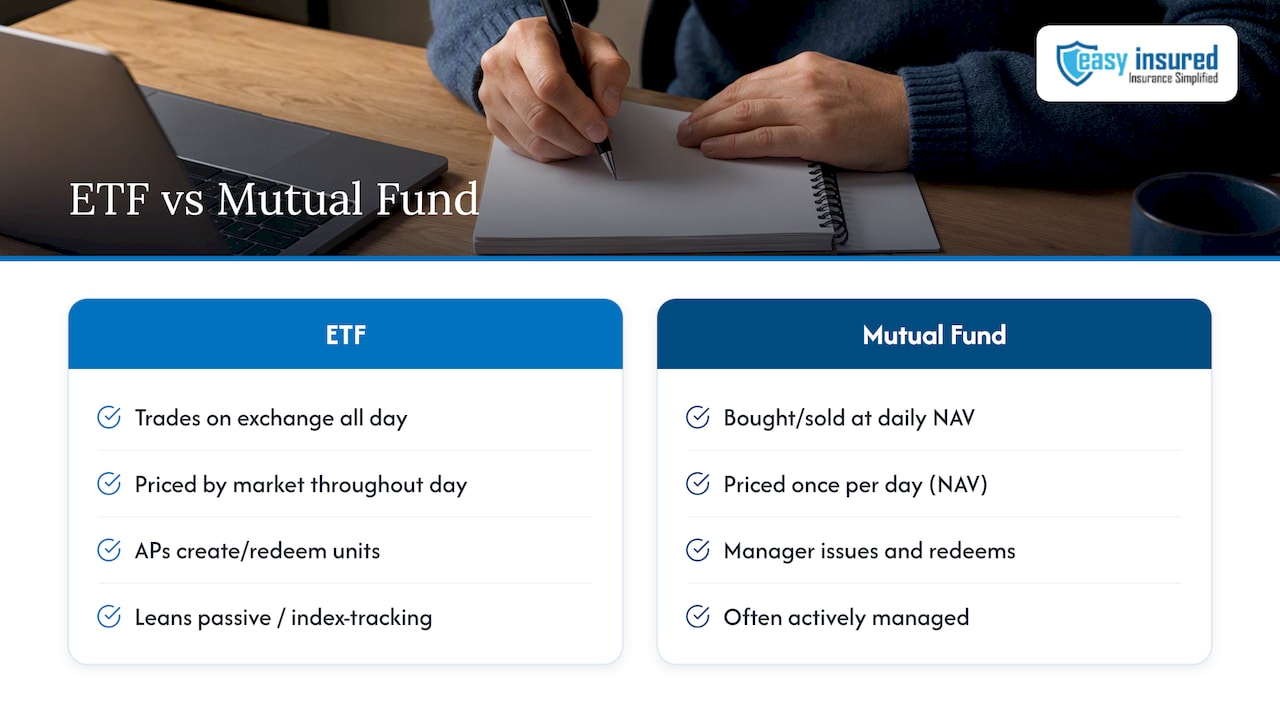
A mutual fund pools money from many investors into one portfolio, run by a manager and sold in series or classes with different fee structures. It prices once a day: every purchase or sale settles at that day’s net asset value (NAV), calculated after markets close. Mutual funds are typically structured as trusts or, less often, as corporations, and both structures can hold stocks, bonds, or a mix of both.
An ETF, or exchange-traded fund, holds a basket of securities too, but its units trade on a stock exchange all day long, just like a share of a company. Behind the scenes, large institutional players called authorized participants create and redeem blocks of ETF units directly with the fund, which keeps the market price close to the value of the underlying holdings. Both ETFs and mutual funds can be actively managed or built to track an index, but ETFs lean heavily toward passive, index-tracking strategies, while active management is far more common among mutual funds.
Where ETFs and Mutual Funds Overlap
Before getting into what separates them, it helps to see how much ground they share.
- Both pool your money with other investors to buy a diversified basket of securities in one transaction.
- Both are regulated investment funds that you can hold inside a TFSA, RRSP, RESP, or other registered account.
- Both come in nearly every strategy you could want: broad equity, bonds, balanced portfolios, sector-specific bets, and target-date funds that shift risk as you age.
The real differences show up in cost, trading mechanics, and tax treatment, which is where the decision usually gets made.
Costs, Trading, Tax, and Minimums: The Real Differences
Fees are usually the biggest gap. Mutual funds often carry a management expense ratio (MER) that bundles in trailer fees paid to the advisor’s dealer, plus potential sales charges on purchase or redemption. ETFs typically charge a lower, more transparent MER with no trailer fee built in, though you’ll pay a brokerage commission on each trade unless your platform waives it.
ETFs started from a lower average MER than mutual funds, and that gap persisted through 2020. Research from the Canadian Securities Administrators found the asset-weighted average MER for the ETF sample studied fell by 8 basis points, a 21% drop, between 2013 and 2020, even as mutual fund fees also declined over the same period.
Trading mechanics differ just as much:
- ETFs trade intraday at live market prices, so you can buy or sell the moment you decide, but you’re exposed to bid-ask spreads and commissions on each trade.
- Mutual funds settle once a day at end-of-day NAV, which removes intraday price risk but means you don’t know your exact fill price when you place the order.
- Mutual funds often support automatic monthly purchases directly through the fund company with no broker involved, while ETFs are more broker-centric, though commission-free trading and fractional shares have closed much of that gap.
Tax treatment depends heavily on account type. According to CRA guidance, distributions from mutual funds held outside a registered account are taxable and reported on a T3 or T5 slip, while funds held inside a TFSA or RRSP are generally sheltered from that tax. In a taxable account, ETFs can be more tax-efficient because their in-kind creation and redemption process tends to trigger fewer capital gains distributions than a mutual fund’s cash-based redemptions. Trailer fees embedded in many mutual funds also create an incentive structure worth understanding, since research from the Canadian Securities Administrators found that these fee arrangements can be linked to weaker future risk-adjusted performance in some fund categories.
Which One Fits Your Investing Profile
The right answer depends less on which fund is “better” and more on how you invest. A few common profiles make the choice clearer.
- The low-cost, buy-and-hold index investor generally does best with ETFs, since lower MERs and broad index exposure compound in your favor over decades.
- The hands-off saver who wants automatic contributions and ongoing advice often fits mutual funds better, especially advisor-sold series that bundle guidance into the fee.
- The taxable-account investor worried about year-end capital gains distributions tends to lean toward ETFs for their typically lower distribution activity, though the account type still matters more than the fund type.
- The investor chasing niche active management or a specific sector bet should weigh manager track record, fees, and liquidity before assuming either structure wins by default.
A segregated fund, sold through insurance contracts rather than a brokerage, adds another layer worth comparing if estate protection or creditor guarantees matter to you, a topic covered in our comparison of segregated funds and mutual funds.
A Checklist for Choosing Between the Two
Run through these points before committing to either vehicle.
- Add up the total cost: MER, any trailer fee, and brokerage commissions, not just the headline MER.
- Confirm which account you’ll hold it in and whether that account shelters distributions from tax.
- Check minimums and whether automatic, scheduled purchases are available without extra fees.
- Think about how quickly you might need to sell and whether intraday pricing actually matters to you.
- Look at the fund’s track record, size, and trading volume before assuming it will be easy to exit.
- Ask directly whether trailer fees or other distribution incentives are built into the recommendation.
Pro Tip: Ask any advisor or platform point-blank how they’re paid on the product they’re recommending; a straight answer tells you a lot about whether the recommendation fits your goals or their compensation.
Red flags worth walking away from include opaque fee disclosures, unusually high trailing commissions relative to similar funds, and high portfolio turnover with no clear explanation for it.
What the Regulatory Evidence Actually Shows
The MER gap between ETFs and mutual funds isn’t anecdotal. CSA-reviewed data on client relationship model amendments found that both fund types saw average fees fall between 2013 and 2020, with ETF market share growing partly because of that cost advantage and the rise of actively managed and strategic-beta ETFs. On the tax side, mutual fund distributions outside registered accounts still land on a T3 or T5 slip, which is a detail many investors only discover at filing time. These are the kinds of fee and tax mechanics we work through with clients at Easy-insured when investment choices intersect with broader financial planning and retirement goals.
How I’d Apply This to a Real Client
Picture two households: a self-directed saver maxing out a TFSA with index ETFs, and a family that wants someone to manage contributions and explain the plan annually. The first client’s checklist points to low-fee ETFs. The second often lands on an advice-driven mutual fund series, even at a higher cost, because the service has real value to them. Either way, matching the vehicle to your habits matters more than chasing the theoretically cheaper option.
— Frank
Where to Get Personalized Help With This Decision
Choosing between an ETF and a mutual fund gets easier once someone looks at your actual accounts, goals, and timeline instead of general rules of thumb. We bring fee comparisons, account-type guidance, and tax considerations into one conversation, then build a plan around registered accounts like your TFSA, RRSP, or RESP alongside the rest of your financial picture. If you’re also weighing how an RRSP or TFSA allocation fits into a bigger purchase, our partner at Dreamhouse Mortgage breaks down TFSA versus FHSA tradeoffs for buyers in Alberta.
Our Investment Planning and Retirement Planning services connect fund selection to the rest of your estate and tax strategy, including how your investments are structured alongside estate planning decisions like beneficiary designations. If you’d like a second set of eyes on your current mix of ETFs and mutual funds, reach out for a financial planning conversation and we’ll walk through what actually fits your situation.
This article is general information, not a substitute for advice from a qualified financial advisor. Consult a qualified financial professional about your own circumstances before acting on anything here.

FAQ
Which is better for investing, ETFs or mutual funds?
Neither wins outright. ETFs tend to suit cost-conscious, self-directed investors, while mutual funds often fit people who want automatic contributions and built-in advice, and the right choice shifts once you factor in your account type and fees.
What are 3 ETFs I can buy and hold forever?
We can’t recommend specific tickers, since the right holding depends on your goals, time horizon, and account type. A broad domestic equity ETF, a broad international equity ETF, and a bond ETF are the common building blocks many long-term portfolios start from, but a financial planning conversation can help match specific funds to your situation.
What is a mutual fund?
A mutual fund is a pooled investment that collects money from many investors to buy a diversified basket of stocks, bonds, or other securities, managed by a professional manager. It prices once a day at NAV after markets close, unlike an ETF, which trades throughout the day.
Is an ETF tax free?
An ETF isn’t automatically tax free. Distributions and capital gains from an ETF held in a non-registered account are taxable, following the same CRA reporting rules that apply to mutual funds, while ETFs held in a TFSA or RRSP are generally sheltered from that tax.
Sources
- CSA publishes research on impact of client relationship model amendments on industry and investor behaviour
- Canada
- A Dissection of Mutual Fund Fees, Flows and Performance — Canadian Securities Administrators