
Mutual funds are the lower-cost default for most Canadian investors. Segregated funds cost more but add something mutual funds legally cannot: guaranteed minimum returns at maturity or death, creditor protection when a preferred beneficiary is named, and a probate bypass that can save your estate time and money. The right choice comes down to three questions.
- Do you need a guarantee on your principal or income?
- Is creditor protection or probate bypass a real concern in your situation?
- Can you hold the contract long enough for the guarantees to actually apply?
If all three answers are no, a mutual fund almost always wins on cost. If even one is yes, a segregated fund deserves a serious look.
Key Takeaways
Segregated funds justify their higher fees only when guarantees, creditor protection, or probate bypass address a real need in your specific situation; for most registered-account investors, lower-cost mutual funds produce better long-term outcomes.
| Point | Details |
|---|---|
| Guarantees are conditional | Segregated fund guarantees (75%–100%) apply only at contract maturity or death; early redemption pays market value only. |
| Fees compound against you | Segregated fund MERs can range from about 1.8% to over 3.1% annually, while comparable index mutual funds can be well under 0.5% in some cases. The gap grows significantly over 10+ years. |
| Creditor and estate benefits are real but situational | Probate bypass and creditor protection matter most for non-registered assets owned by business owners or self-employed professionals. |
| Registered accounts reduce the advantage | Inside a TFSA or RRSP, beneficiary and creditor protections often already exist, making segregated fund premiums harder to justify. |
| Easy-insured can help you decide | Easy-insured’s financial planning and estate planning services help Canadian investors model whether segregated fund guarantees are worth the cost in their situation. |
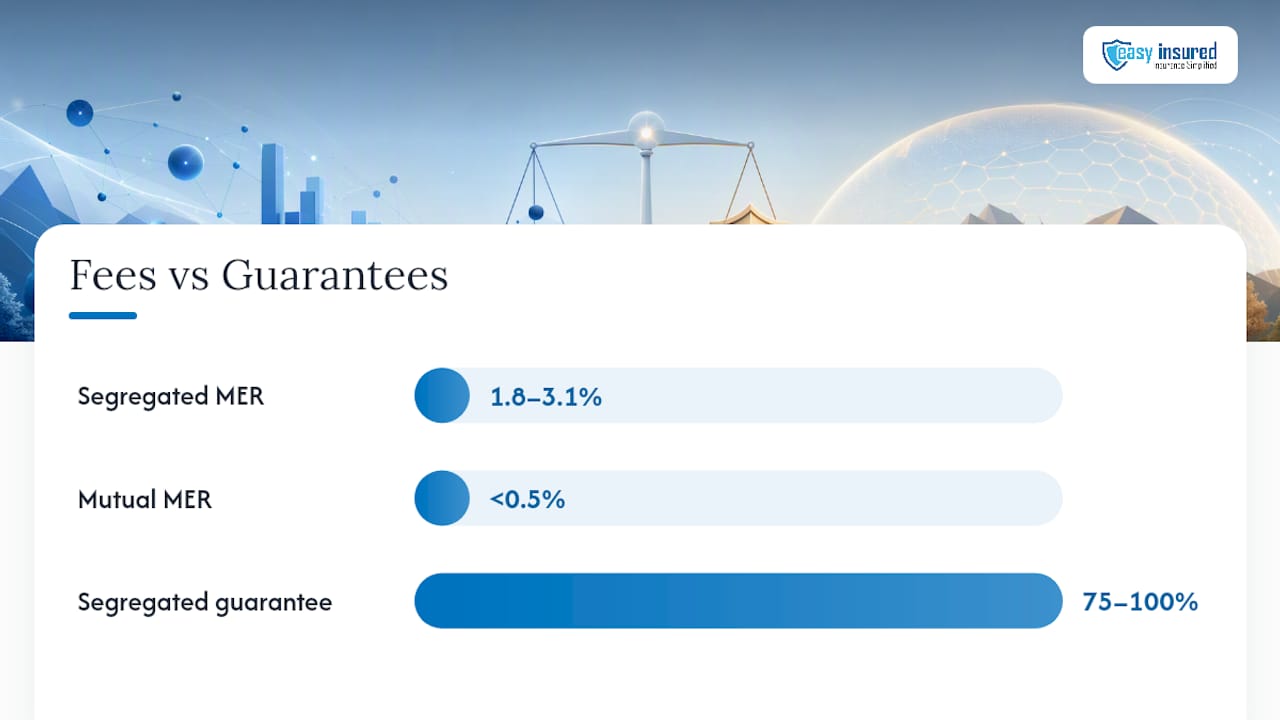
Table of Contents
- What are segregated funds and mutual funds?
- Why mutual funds work well for most investors
- What segregated funds add that mutual funds cannot
- How segregated fund guarantees actually work, and where they fall short
- How fees compare: MERs, insurance charges, and the real cost over time
- Practical downsides and risks of segregated funds
- Holding segregated funds inside a TFSA, RRSP, or RRIF
- How to decide between segregated funds and mutual funds
- When segregated funds tend to make sense, and when they usually don’t
- The real question most investors never ask
- Easy-insured helps you choose the right product for your situation
- Useful sources and further reading
What are segregated funds and mutual funds?
Mutual funds are pooled investment vehicles regulated under Canadian securities law. When you invest, you buy units in a fund managed by a portfolio manager. Your returns come from the underlying securities — stocks, bonds, or a mix. You own securities, not an insurance product, and there is no guarantee on what you get back. The Autorité des marchés financiers (AMF) notes that mutual funds are sold by fund companies and distributed through registered dealers.
Segregated funds are insurance contracts issued by Canadian life insurance companies and regulated under provincial insurance legislation. Structurally, they work like mutual funds: your money goes into a pooled investment fund. But legally, you hold an insurance contract, not a securities product. That distinction is what makes guarantees possible.
Key structural differences at a glance:
- Mutual funds: issued by fund companies, regulated under securities law, no guarantees, no beneficiary designation
- Segregated funds: issued by life insurers, regulated under insurance law, include maturity and death benefit guarantees (typically 75%–100% of deposits), allow named beneficiaries
Typical segregated fund contracts run for a term generally measured in multiple years to maturity. The guarantee percentage you receive depends on the contract you choose and the insurer’s product lineup.
Why mutual funds work well for most investors
For cost-conscious investors with long time horizons and no pressing estate or creditor concerns, mutual funds have real advantages.
Lower fees. Management expense ratios (MERs) on actively managed Canadian mutual funds typically run lower than comparable segregated fund series, and index mutual funds or ETF-based funds can be well under 1% annually. That gap compounds significantly over decades.
Liquidity. Most mutual funds let you redeem at net asset value any business day, with no surrender schedules or deferred sales charges on newer no-load series. Segregated funds often carry early redemption penalties, especially in the first several years of the contract.
Broad availability. Mutual funds are available in registered accounts (TFSA, RRSP, RRIF, RESP) and non-registered accounts through virtually every bank, credit union, and investment dealer in Canada. The product shelf is enormous, from actively managed balanced funds to passive index trackers.
Tax clarity in registered accounts. Inside a TFSA or RRSP, growth is sheltered regardless of product type. The tax advantage of an insurance contract adds little incremental value when the account itself already provides tax deferral or exemption.
Pro Tip: If your primary goal is long-term wealth accumulation inside a TFSA or RRSP and you have no creditor exposure, a low-cost index mutual fund or ETF will almost always outperform a comparable segregated fund over 20 years, purely because of the fee difference.
What segregated funds add that mutual funds cannot
The insurance structure of a segregated fund unlocks four benefits that no mutual fund can replicate.
Maturity and death benefit guarantees. At contract maturity (typically 10 years) or on the policyholder’s death, the insurer guarantees you receive at least a specified percentage of your deposits, commonly 75% or 100%, regardless of how the underlying fund performed. Some contracts offer a guaranteed minimum withdrawal benefit (GMWB) or guaranteed income benefit, providing a floor on retirement income even if markets fall.
Probate bypass. Because a segregated fund is an insurance contract with a named beneficiary, the death benefit passes directly to that beneficiary outside the estate. No probate fees, no delays, no public disclosure. In provinces like Ontario and British Columbia, where probate fees can reach 1.5% of estate value, this can represent meaningful savings on large non-registered balances.
Creditor protection. When a spouse, child, parent, or grandchild is named as beneficiary (a “preferred beneficiary” under insurance law), the contract value may be protected from creditors in the event of bankruptcy or a lawsuit. For self-employed professionals, incorporated business owners, or anyone with significant personal liability exposure, this is a planning tool mutual funds simply cannot offer.
Regulatory backstop through Assuris. If a Canadian life insurer becomes insolvent, Assuris protects policyholders up to specified limits. Coverage rules differ between the saving phase and the payout phase, and between product types such as guaranteed withdrawal balances and guaranteed income benefits.
Segregated funds are among the few retail investment products in Canada that combine market participation with contractual guarantees and estate-planning features — a combination that can justify higher fees for the right investor.
How segregated fund guarantees actually work, and where they fall short
The guarantee is real, but it is conditional. Understanding those conditions is what separates investors who benefit from those who pay extra for nothing.
Maturity guarantee. At the end of the contract term (commonly 10 years), the insurer pays you the greater of the market value of the fund or the guaranteed percentage of your deposits. If you put in $100,000 and the fund dropped to $70,000 over 10 years, a 75% maturity guarantee means you receive $75,000. A 100% guarantee means you get your full $100,000 back.
Death benefit guarantee. If you die while the contract is in force, your named beneficiary receives the greater of the current market value or the guaranteed percentage of deposits, regardless of when death occurs relative to the maturity date.
Resets. Many contracts allow you to “reset” the guaranteed amount to the current market value when markets are up, locking in gains as the new guarantee floor. Resets typically restart the maturity clock, so use them carefully.
The critical limit: early redemption. According to AMF guidance, guarantees apply at contract maturity or on death. If you cash out early, you receive the current market value, not the guaranteed amount. You will have paid higher fees for years and walked away with no guarantee protection. This is the single most common mistake investors make with segregated funds.
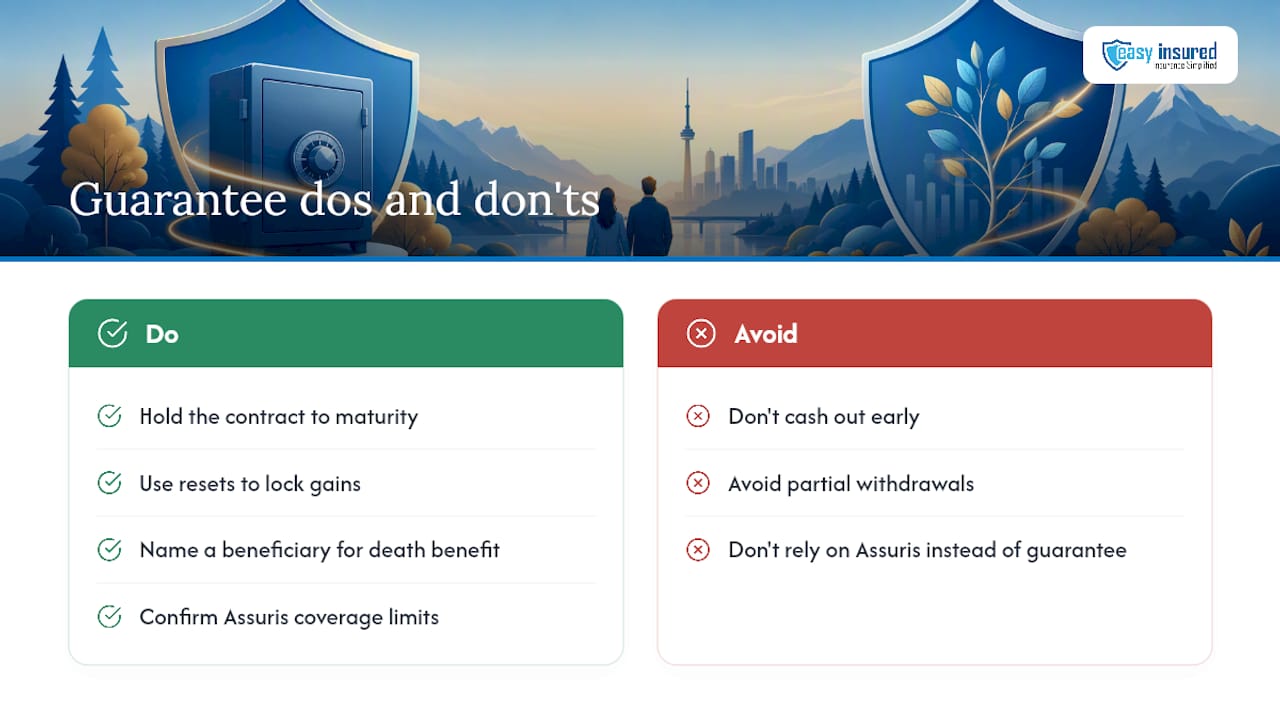
Partial withdrawals also reduce the guaranteed amount proportionally, so taking money out mid-contract erodes the floor you paid to build.
Assuris protection limits. Assuris is the industry-funded protection agency for Canadian life insurance policyholders. It covers the guaranteed amounts on segregated funds up to defined dollar limits, which differ by product type and phase (saving vs. payout). Assuris protection is a backstop against insurer insolvency, not a substitute for the contract’s own guarantee. Confirm the specific coverage limits for your product type directly with Assuris or your advisor.
Assuris protection and the contract guarantee are two separate layers. The contract guarantee protects you from market loss at maturity; Assuris protects the guarantee itself if the insurer fails.
How fees compare: MERs, insurance charges, and the real cost over time
Fees are where segregated funds take their biggest hit in any honest comparison. According to Investopedia, segregated fund MERs can range from roughly 1.8% to over 3.1% annually, while comparable index mutual funds can sit well under 0.5% in some cases. The gap exists because, as Sun Life Global Investments explains, the cost of the embedded guarantee must be funded through the fee structure.
| Fee Component | Typical Mutual Fund | Typical Segregated Fund |
|---|---|---|
| Management fees tend to be lower for mutual funds and higher for segregated funds due to embedded guarantees. | ||
| Guarantee/insurance charge | None | Embedded in MER |
| Sales charge (front-end) | 0%–5% (varies by series) | 0%–5% (varies) |
| Surrender/deferred sales charge | Rare on newer series | Common in early years |
| Beneficiary designation | Not available | Included |
Example: fee drag over 10 years. Suppose you invest $100,000 and the underlying fund earns 6% annually before fees.
- Mutual fund at 1.0% MER: Net return approximately 5.0% annually. After 10 years: roughly $162,889.
- Segregated fund at 2.5% MER: Net return approximately 3.5% annually. After 10 years: roughly $141,060.
That is a difference of about $21,800 on a $100,000 investment, before any guarantee value is factored in. If the market never drops below the guarantee floor, you paid for protection you never used.
Fee red flags to watch for:
- Surrender schedules that lock you in for multiple years with early withdrawal penalties
- Guarantee fees disclosed separately from the MER, making the true all-in cost hard to see
- Layered advisor commissions on top of already-high MERs
- Reset features that restart the maturity clock without clearly disclosing the cost
Practical downsides and risks of segregated funds
The guarantee is only as useful as your ability and willingness to hold the contract to maturity. Several real-world factors work against that.
Fee drag on long-term returns. For investors who never trigger the guarantee (markets rise over their holding period), the extra 1%–2% in annual fees represents a permanent cost with no offsetting benefit. Over 20 or 30 years, that compounds into a substantial gap.
Complexity and opacity. Segregated fund contracts can run dozens of pages. Reset provisions, partial withdrawal rules, guarantee reduction formulas, and surrender schedules interact in ways that are genuinely difficult to track. Many investors do not fully understand what they own.
Redundant protections in registered accounts. Inside a TFSA or RRSP, the probate bypass and creditor protection features of a segregated fund often add little value. Registered accounts already pass to named beneficiaries outside the estate in most provinces, and RRSP/RRIF assets have their own creditor protections under federal bankruptcy law for named beneficiaries.
Pro Tip: Avoid segregated funds if your investment horizon is under 10 years, your assets are entirely inside registered accounts, or you have no creditor exposure and a straightforward estate. In those situations, the guarantee premium is almost certainly not worth paying.
Holding segregated funds inside a TFSA, RRSP, or RRIF
Segregated funds can be held inside registered accounts, including TFSAs, RRSPs, and RRIFs. The investment mechanics work the same way. But the insurance-specific benefits change significantly depending on the account type.
Where the benefits overlap or disappear inside registered accounts:
- TFSA and RRSP accounts already allow named successor holders or beneficiaries, bypassing probate in most provinces without needing an insurance contract
- RRSP and RRIF assets paid to a named beneficiary (spouse, financially dependent child) are already protected from creditors under federal bankruptcy legislation in many cases
- The maturity guarantee still applies inside a registered account, but the tax treatment of the payout follows registered account rules, not insurance contract rules
Where segregated funds inside registered accounts still add value:
- The maturity or death benefit guarantee provides a floor on the account value that a standard mutual fund cannot match, which may matter for retirees drawing down a RRIF in volatile markets.
- A GMWB inside an RRIF can provide a guaranteed income stream that supplements CPP and OAS, reducing longevity risk.
- For provinces where registered account beneficiary rules are less straightforward (or for non-spouse beneficiaries), the insurance contract structure can still simplify estate administration.
The bottom line: inside a TFSA or RRSP used purely for accumulation, the extra cost of a segregated fund is hard to justify. Inside a RRIF in drawdown, the income guarantee features can be genuinely useful.
How to decide between segregated funds and mutual funds
Work through this checklist before your next advisor meeting.
- What is your time horizon? Segregated fund guarantees require holding to maturity (typically 10+ years). If you may need the money sooner, the guarantee is not accessible.
- Do you have creditor exposure? Self-employed professionals, business owners, or anyone with personal liability risk should ask whether a named preferred beneficiary would protect this asset.
- What are your estate planning goals? If avoiding probate and passing assets directly to beneficiaries matters, a segregated fund in a non-registered account has a clear advantage. If assets are already in registered accounts with named beneficiaries, the benefit is largely duplicated.
- What is your fee tolerance? Can the guarantee justify an extra 1%–2% annually? Run the numbers for your specific situation.
- What account type will hold the investment? Registered accounts reduce the marginal value of most segregated fund features.
Questions to ask your advisor before signing:
- What is the exact guarantee percentage and maturity date on this contract?
- What happens to my guarantee if I make a partial withdrawal?
- What is the full surrender schedule and when do penalties expire?
- What does Assuris cover for this specific product type and phase?
- What is the all-in MER, including any separate guarantee charges?
Red flags that suggest overselling:
- Guarantees are emphasized without discussing the maturity condition
- Fees are not disclosed in writing before you sign
- The advisor cannot explain the surrender schedule clearly
- The product is being recommended for a short-term goal or entirely inside registered accounts
When segregated funds tend to make sense, and when they usually don’t
The evidence points to a fairly clear set of use cases where the extra cost is justified, and a larger set where it is not.
Segregated funds tend to make sense for:
- Business owners and self-employed professionals with non-registered assets and real creditor exposure, where naming a preferred beneficiary provides protection a mutual fund cannot
- Retirees drawing down non-registered assets who want a guaranteed income floor (GMWB) and a probate bypass on remaining balances
- Investors with large non-registered estates in high-probate provinces, where the bypass saves meaningful fees and delays
- Anyone who genuinely cannot tolerate the risk of receiving less than their deposit at a defined future date, and who will hold the contract to maturity
Mutual funds are usually the better choice for:
- Long-horizon accumulation inside a TFSA or RRSP, where fees compound against you and registered-account rules already handle beneficiary designations
- Cost-sensitive investors who are comfortable with standard estate planning tools (wills, joint ownership, registered account beneficiaries)
- Investors with time horizons under 10 years, where the maturity guarantee is not accessible
- Anyone building a diversified portfolio primarily through index funds or ETFs, where MER minimization is the dominant driver of long-term outcomes
As Athena Financial notes, the planning advantages of segregated funds for non-registered assets owned by people with creditor risk can sometimes offset higher fees. The key word is “sometimes.” A licensed CFP or insurance advisor can model your specific numbers before you commit.
Pro Tip: Ask your advisor to show you the break-even scenario: at what market return does the segregated fund’s guarantee actually pay off relative to the mutual fund’s lower fees? If the break-even requires a severe and sustained market decline, the guarantee may be less valuable than it appears.
The real question most investors never ask
Most articles on seg funds vs mutual funds frame the decision as “guarantees vs. fees.” That framing is correct but incomplete. The question that actually matters is: will you hold the contract long enough for the guarantee to apply?
The guarantee is not a safety net you can grab at any time. It is a contractual promise that activates at a specific future date or on death. Investors who buy a segregated fund with a 10-year maturity, then cash out in year six because they need the money or because markets recovered, paid three or four extra percentage points annually for a guarantee they never received. The insurer kept the fee. The investor kept the market risk.
This is not a theoretical concern. Surrender schedules exist precisely because insurers know early redemption is common. The fee structure is designed to be profitable even when guarantees are never triggered.
The investors who genuinely benefit from segregated funds are those who have a specific, non-negotiable reason to hold to maturity: a retirement income floor they cannot outlive, a non-registered estate they want to pass cleanly to a beneficiary, or a creditor threat that makes the insurance structure worth paying for. For everyone else, the math almost always favors the mutual fund.
That said, dismissing segregated funds entirely is also a mistake. For a business owner with $500,000 in non-registered savings and real liability exposure, the creditor protection alone can be worth more than the fee premium. The product is not bad. It is just frequently sold to people who do not need what it actually provides.
Easy-insured helps you choose the right product for your situation
Choosing between a segregated fund and a mutual fund is not a product decision. It is a planning decision, and it depends on your estate, your creditor exposure, your time horizon, and your tax situation. Easy-insured works with Canadian families and business owners to map exactly those factors before recommending any product.

Easy-insured’s advisors can walk you through the full picture: how guaranteed life insurance features compare with segregated fund guarantees, how estate planning strategies interact with beneficiary designations, and whether the fee premium on a segregated fund is justified by your specific non-registered assets and creditor profile. If you are a business owner evaluating creditor protection, or a retiree weighing a GMWB against other income options, that conversation is worth having before you sign anything.
Book a no-obligation consultation through Easy-insured’s investments page to get a clear, numbers-based answer for your situation.
This article is general information only, not personal financial or legal advice. Confirm current rules and product details with a licensed CFP or insurance advisor before making any investment decision.
Useful sources and further reading
These are the primary sources used in this article. Each is authoritative for its specific role.
- Segregated funds | AMF
- Guarantees on Segregated Funds | Assuris
- How Do Segregated Funds Differ From Mutual Funds? | Investopedia
- What are segregated funds? Definition and how they work | Wealthsimple
- Segregated funds cost more than mutual funds. Why? | Sun Life Global Investments
- Mutual Funds vs Segregated Funds: Key Differences Explained | Athena Financial INC