
Fully underwritten life insurance is a policy where the insurer reviews your health, history and finances in detail before it agrees to cover you and sets your price. You answer a full questionnaire, you usually complete a medical exam or provide records, and an underwriter decides your risk class. In exchange for that effort, you typically get the widest choice of coverage amounts and the most accurate premium for your health. This guide explains each step, the timeline, the possible outcomes and when a faster, lighter option makes more sense.
TL;DR
- Full underwriting means the insurer verifies your health and background before issuing a policy, instead of accepting your word alone.
- Expect a detailed questionnaire, often a paramedical exam, and sometimes a doctor’s report. Plan on several weeks, longer if records are slow.
- Honest, complete answers are essential. Omissions can lead to a cancelled policy or a denied claim.
- Simplified-issue and guaranteed-issue policies are quicker, but they usually cap coverage or cost more for the amount you get.
- If you are healthy and want larger coverage, full underwriting is often the better fit. Ask a broker to compare insurers before you apply.
Table of Contents
- What fully underwritten life insurance means
- What the insurer asks for
- The process from application to decision
- How long full underwriting takes
- Possible outcomes of underwriting
- How underwriting affects what you pay
- Fully underwritten vs simplified issue vs guaranteed issue
- Who should choose full underwriting
- Our perspective
- How to prepare for your application
- Talk to us about the right underwriting route
- FAQ
- Sources
What fully underwritten life insurance means
Underwriting is how a life insurer decides whether to offer you coverage and at what price. According to the Financial Consumer Agency of Canada, insurers assess eligibility using information such as your age, sex, medical history, credit history and the amount of coverage you ask for.
“Fully underwritten” is the traditional, most thorough version of that process. The insurer does not rely only on a few yes-or-no questions. It asks about specific conditions, checks the answers against evidence, and prices the policy for the risk it finds.
That matters because life insurance is a promise that may be called on decades from now. The insurer needs to know what it is promising to cover, and you need to know the promise will hold when your family files a claim.
What the insurer asks for
In Canada, applicants must prove their health status as part of a life insurance application. The FCAC notes that insurers verify this with evidence of insurability, such as medical questionnaires or exams.
In practice, a fully underwritten file can include several pieces.
The application and health questionnaire
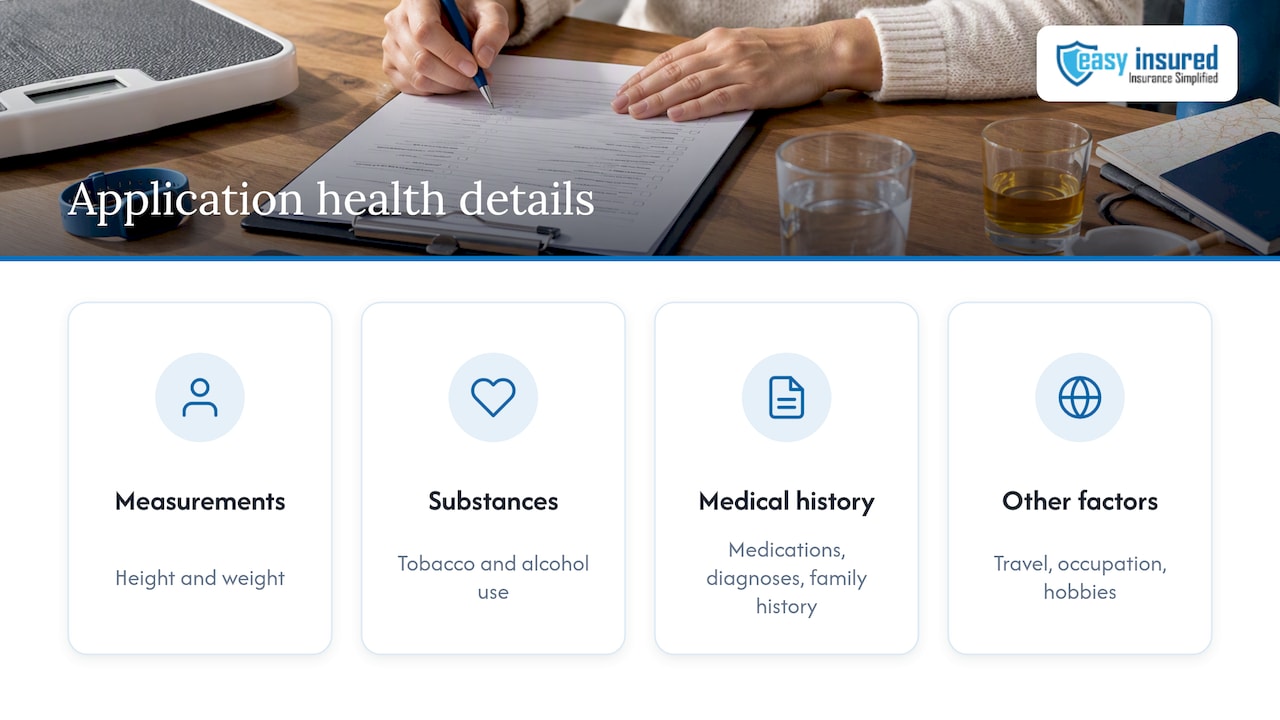
This covers your height and weight, tobacco and alcohol use, current medications, past diagnoses, family medical history, and often travel, occupation and hobbies such as aviation or scuba diving. Expect more detailed questions than on a simplified application, including questions about specific conditions.
The paramedical exam
Many insurers send a nurse or technician to your home or workplace. The exam commonly includes measurements of height, weight and blood pressure, and blood and urine samples. Whether it is required depends on your age, the amount of coverage and your answers. Our guide Do You Need a Medical Exam for Life Insurance? goes through when one is triggered and how to prepare.
Medical records and the attending physician’s statement
If your answers point to a condition, the insurer may ask your doctor for an attending physician’s statement, often called an APS. This is the step most likely to slow a file, because it depends on a busy clinic.
Financial and other checks
For larger amounts, the insurer wants to confirm that the coverage matches a real need, such as income replacement, a mortgage or a business obligation. As noted above, credit history can also be part of the assessment.
The process from application to decision
- Needs analysis. You and your advisor decide how much coverage you need and for how long, then choose a type of policy.
- Application. You complete the questionnaire. Take your time and check dates, diagnoses and medications.
- Medical evidence. The insurer arranges the exam and, if needed, requests records from your doctors.
- Underwriter review. The underwriter weighs everything and may ask follow-up questions or request more records.
- Offer. The insurer issues an offer at a specific risk class, or declines to offer coverage.
- Acceptance and delivery. You review the policy, pay the first premium and the coverage starts according to the policy terms.
Be careful with the third step. The FCAC warns that incomplete or dishonest information can lead the insurer to cancel the policy or deny future claims, and can also make it harder to get insurance from other companies. A condition you consider minor should still go on the form if the question asks about it.
How long full underwriting takes
There is no single answer, because the timeline depends on your file. A healthy applicant with a clean questionnaire and a quick exam can be decided much faster than someone whose file needs doctors’ reports.
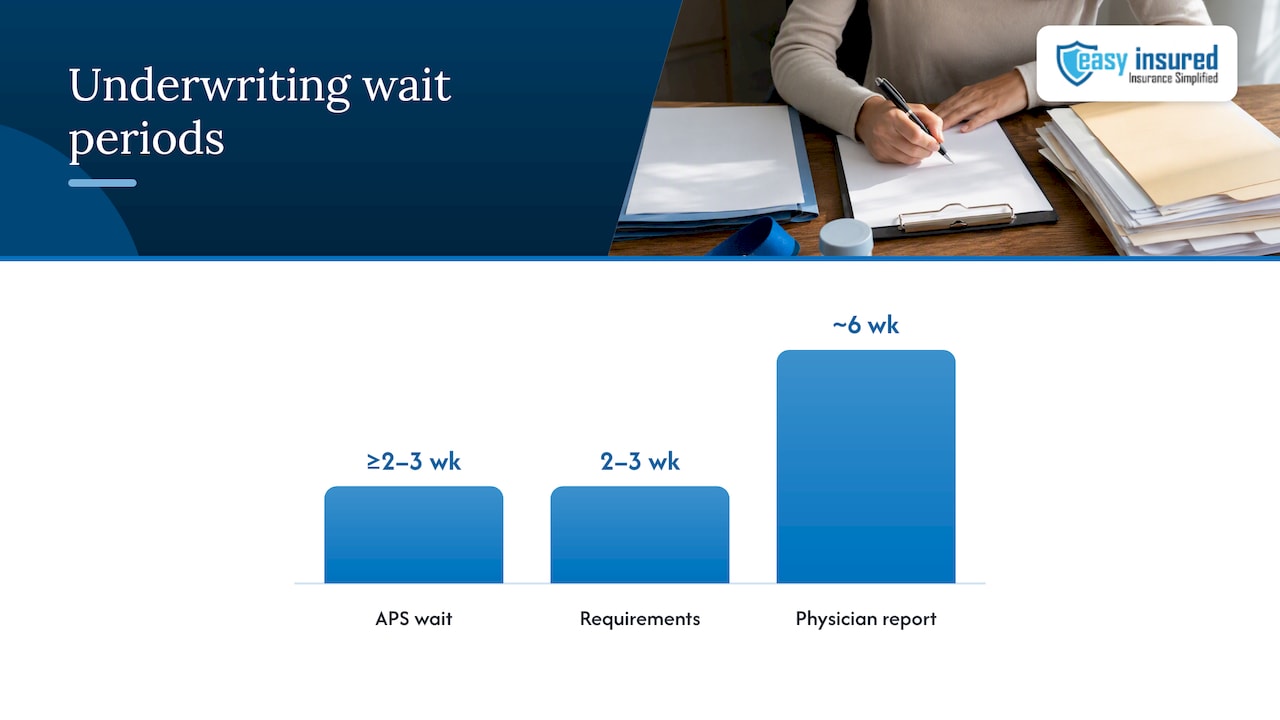
The records step is the usual bottleneck. The British Columbia Medical Journal reported in 2018 that underwriters can usually expect to wait at least 2 to 3 weeks for an APS, and that even a motivated applicant who finishes requirements in 2 to 3 weeks may then wait about six more weeks for the physician’s report. A 2023 article in the same journal says an outstanding statement can delay the insurer’s decision for several more weeks. Once it arrives, the underwriter may need clarification from the original physician or another source, which adds more time.
What you can do to keep things moving:
- Book the exam quickly, and follow the instructions on fasting and hydration.
- Tell your advisor early about any conditions, so records can be requested in parallel.
- Give your doctor’s name and clinic details accurately.
- Answer follow-up questions from the insurer the same day if you can.
Possible outcomes of underwriting
After review, the insurer’s decision generally falls into one of a few groups. Insurers use different class names, so ask your advisor how a particular company labels them.
| Outcome | What it means for you |
|---|---|
| Preferred or best class | The insurer sees lower-than-average risk. This usually brings the lowest premium. |
| Standard class | Average risk for your age. Premiums follow the insurer’s standard rates. |
| Rated or substandard | Coverage is offered at a higher premium, often expressed as a percentage above standard, because of a health or lifestyle factor. |
| Postponed | The insurer will not offer coverage now, but may reconsider after a set time or once a condition stabilizes. |
| Declined | The insurer will not issue the policy. |
A rated offer is not a failure. For many people with a managed condition, it is the route to coverage that would not exist otherwise. If you are declined by one insurer, another may assess the same condition differently, which is a major reason people use a broker who works with several companies. A decline or rating will usually need to be disclosed on future applications that ask about it, so mention it to your advisor before applying elsewhere.
How underwriting affects what you pay
Your premium reflects the risk class the underwriter assigns, along with your age, the amount of coverage, the policy type and the term. Two people of the same age asking for the same amount of term cover can receive very different quotes because one is a non-smoker with normal blood pressure and the other is not.
This is also why published price ranges are only a starting point. We do not quote premiums on this page, because a number without your health profile would mislead you. For a figure that applies to you, you need an application, and for a policy such as whole life, the cost also depends on the structure of the plan.
Full underwriting often gives healthy people the best price because the insurer does not need to build in a margin for unknowns. When the insurer knows more, it has less reason to charge for uncertainty.
Fully underwritten vs simplified issue vs guaranteed issue
Not every applicant needs, or wants, the full process. Here is how the main types compare.
| Feature | Fully underwritten | Simplified issue | Guaranteed issue |
|---|---|---|---|
| Health questions | Detailed, with specific conditions | Short questionnaire | None |
| Medical tests | Often required, depending on age and amount | None | None |
| Speed | Weeks, sometimes longer | Often within an hour or a day | Immediate acceptance |
| Coverage amounts | Highest range | Moderate | Usually low |
| Cost for the coverage | Most accurate to your health | Often higher than full underwriting for healthy people | Highest |
The Autorité des marchés financiers describes simplified issue as using a medical questionnaire with no medical tests, usually issued within an hour or a day. It describes guaranteed issue as having no medical questions and automatic acceptance, but typically low coverage amounts and higher cost than other types.
Two of our guides cover these alternatives in detail: No Medical Life Insurance: Fast Coverage Options Explained and Simplified Issue vs Guaranteed Issue in Canada. If you have a serious health history and need coverage regardless, see our page on guaranteed life insurance.
What about accelerated underwriting?
Some insurers now offer accelerated underwriting, which sits inside the traditional process. Munich Re, a reinsurer, describes it as waiving certain traditional requirements, such as fluid samples or vitals, for applicants who meet favourable risk criteria, giving a faster and less invasive experience. Eligibility depends on the insurer, your age, the amount and your answers, so ask whether you qualify before booking an exam.
Who should choose full underwriting
Full underwriting is usually worth the effort when:
- You are in good health and want the best price available for your profile.
- You need a large amount of coverage, for example to replace income, cover a mortgage or fund a business buy-sell agreement.
- You want permanent coverage, such as whole life or universal life, as part of an estate plan.
- You are a business owner who needs coverage for key person protection or shareholder agreements.
A lighter option may fit better when:
- You need coverage in place quickly, for example before a closing date.
- You are older and want a modest amount to cover final expenses. Our final expense insurance page explains this.
- You have health conditions that make a standard offer unlikely.
A useful middle path: some people take a smaller quick policy for immediate protection and then apply for a fully underwritten policy for the larger amount. Ask your advisor whether that works with your timeline.
Our perspective
We see the same pattern with families and business owners. People choose the fastest product because the form is short, then discover the coverage amount or the price does not fit their real need. Full underwriting feels slower, but when you are healthy, it is often the most honest way to buy: you tell the insurer the truth, the insurer prices that truth, and the policy is built to pay.
Our approach is to start with the need, not the product. We look at income, debts, dependants, business obligations and your estate plan, then recommend the type of underwriting that serves that picture. We combine online access with advice from a certified financial planner, and we keep the onboarding jargon-free, so you know what each question means and why it is asked.
One thing we ask every client: tell us everything before the insurer asks. A condition we know about on day one can be handled with the right insurer. A condition discovered at claim time cannot be fixed.
— Frank
How to prepare for your application
- List your medications and diagnoses. Include dates, doctors’ names and clinics.
- Gather family history. Note parents’ and siblings’ major illnesses and ages.
- Know your coverage target. Work out the amount and term before the application, not during it.
- Plan for the exam. Schedule it at a time you can follow the fasting instructions and avoid heavy exercise or alcohol beforehand, as the examiner advises.
- Do not cancel existing coverage until the new policy is in force and you have reviewed it.
- Ask about beneficiaries and ownership. For larger policies, the structure matters, including whether a trust fits. Our guide on life insurance trusts explains one use.
Talk to us about the right underwriting route
We help business owners and families in Canada compare life insurance options, including term, whole and universal life, and match them to a financial or estate plan. If you want to see what a fully underwritten application would involve for your situation, start from our life insurance page or review our financial planning services. We will tell you plainly when a faster product is the better choice for you.
FAQ
Is fully underwritten life insurance better than no-medical insurance?
Not always, but for healthy people it is often better value. It typically allows higher coverage amounts and prices the policy to your actual health. No-medical policies win on speed and convenience, and they can be the only route for some people with health conditions.
Do I always need a medical exam?
No. Whether you need one depends on your age, the amount of coverage and your answers. Some insurers waive parts of the exam under accelerated underwriting if you meet their criteria, so ask before you book.
What happens if I leave something out of my application?
The consequences can be serious. The Financial Consumer Agency of Canada says that incomplete or dishonest information can lead to a cancelled policy or denied claims. If you are unsure whether something is relevant, ask your advisor and disclose it.
Can I be declined for life insurance?
Yes. An insurer can decline an application or postpone it, and it can also offer coverage at a higher rate. Another insurer may assess the same condition differently, so a decline from one company does not necessarily end your options. Speak to a broker before reapplying.
Sources
- Getting an insurance policy, Financial Consumer Agency of Canada
- Simplified issue life insurance, Autorité des marchés financiers
- The importance of expediency in writing the APS, British Columbia Medical Journal
- A delay in the attending physician’s statement can delay your insurance application, British Columbia Medical Journal
- Accelerated underwriting in Canada, Munich Re