
The right time to buy an annuity in Canada is when your guaranteed income (CPP, OAS, any pension) falls short of your essential spending and you want to close that gap for life. For most people that is somewhere between retirement and the year their RRSP must convert, and it is rarely all at once. The Financial Consumer Agency of Canada (FCAC) says the best time to buy depends on your financial needs and sources of income, not on a magic birthday.
This guide walks through the factors that move the decision: your age, interest rates, the type of annuity, the tax treatment of the money you use and how much of your savings you commit.
TL;DR
- Buy an annuity when you have a clear income gap: essential expenses that your pensions, CPP and OAS do not cover.
- Rates matter. When interest rates are high at purchase, payments are higher than when rates are low, and that payment is locked in.
- Waiting can raise income: older buyers generally receive more, and a deferred annuity pays more than an immediate one because you receive fewer payments.
- Registered money (RRSP, RRIF) and non-registered money are taxed differently, so decide the source of funds before you decide the date.
- Most people do better splitting the purchase over several years than committing everything in one day.
Table of Contents
- What an annuity does, in plain words
- The first test: do you have an income gap?
- How age affects the timing
- Interest rates: the factor you cannot control
- Immediate or deferred?
- RRSP, RRIF and tax rules that set your deadline
- Choosing the type before the date
- How much of your savings to put in
- Protection if the insurer fails
- Our perspective
- Work through the decision with us
- A quick timing checklist
- FAQ
- Sources
What an annuity does, in plain words
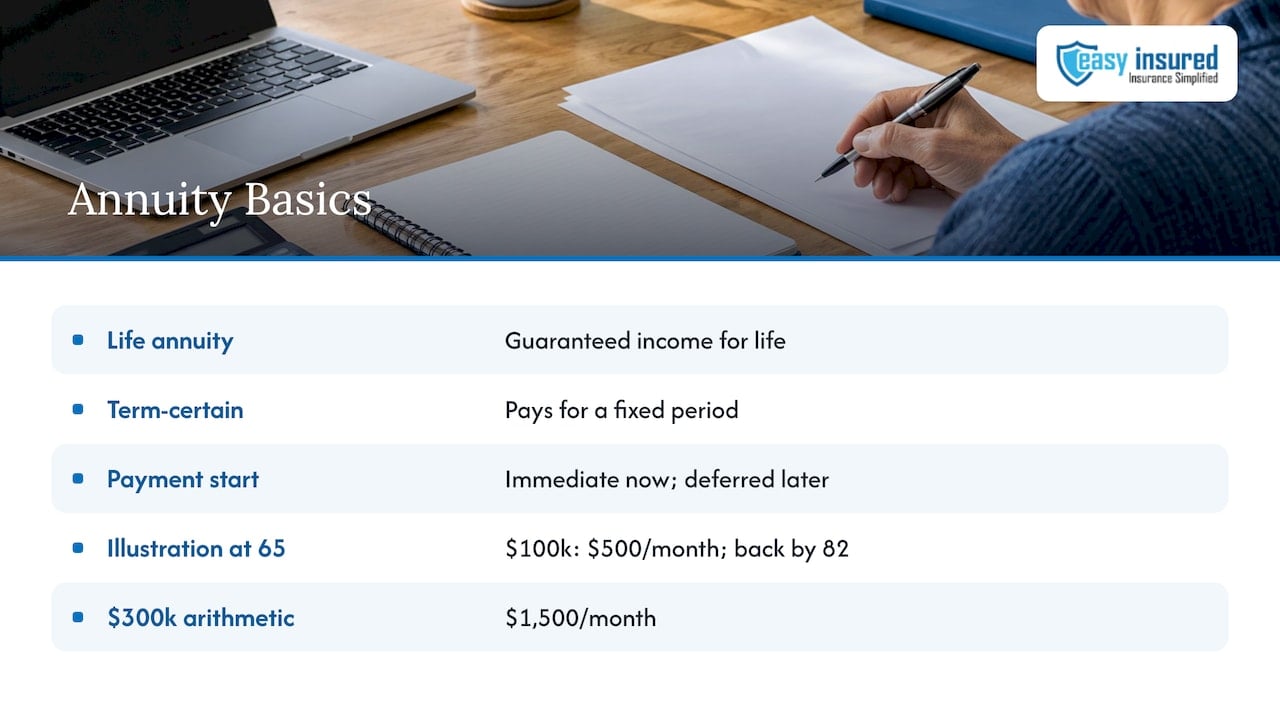
An annuity is a contract: you hand an insurer a lump sum and it pays you a regular income, either for life or for a fixed number of years. The FCAC explains that a life annuity provides guaranteed income for life, while a term-certain annuity pays for a fixed period. You can start payments right away (immediate) or later (deferred).
Its job is not to beat the stock market. Its job is to turn savings into a paycheque you cannot outlive. That is why timing is about your life, not about market predictions.
The FCAC gives a simple illustration. If you buy a life annuity for $100,000 at age 65 and receive $500 a month, you get your $100,000 back by age 82, and if you live past that, the payments keep coming for as long as you live. Scaled up as pure arithmetic, the same ratio on $300,000 would be $1,500 a month. Real quotes depend on your age, sex, health and the rates on the day, so treat that as an illustration of how the math works, not a quote.
The first test: do you have an income gap?
Start with a plain budget, not a calendar.
- List the expenses you cannot skip: housing, food, utilities, insurance, taxes, health costs.
- List the income that arrives no matter what: CPP, OAS, any defined benefit pension.
- Subtract. The shortfall is your gap.
If the gap is zero, an annuity may not be needed. The FCAC is direct on this point: an annuity is not always the best option because your regular income and savings may already cover your expenses, and it suggests speaking with a financial professional about whether you will have enough.
If the gap is real, an annuity is one way to fill it with income that does not depend on markets or on your own discipline. A common structure is to cover the essentials with guaranteed income and keep investments for flexible, longer-horizon spending.
How age affects the timing
Age works in two ways at once.
Older buyers get higher payments. Get Smarter About Money lists age among the factors that set your income and notes that older buyers generally receive higher payments. The insurer expects to pay for fewer years, so each payment can be larger.
Waiting also costs you something. Every year you delay, you are funding that year’s spending from other savings, and you carry market risk on the money you have not yet annuitized. Waiting is a trade, not a free upgrade.
Buying in your 50s or early 60s
This is where a term-certain annuity often earns its place, for example to bridge the years between retiring and starting CPP or a pension. Our guide to term certain annuities in Canada shows how to line payments up with a pension start date. A column in The Carillon notes that a term-certain annuity can be set from 3 to 40 years and may offer a cashable option, which the author says is available only with this type.
Buying in your mid-60s to early 70s
This is the most common window for a life annuity. You are retired or close to it, your income gap is known, and the payment per dollar is higher than at 55. It is also when registered account rules begin to shape your choices, covered below.
Buying later
Payments per dollar keep rising with age, but the window to benefit from decades of guaranteed income shrinks, and health changes can limit choices. If you are considering waiting, do it for a reason you can name (a pension starting, an inheritance expected, a deliberate deferred purchase), not because the decision feels uncomfortable.
Interest rates: the factor you cannot control
Annuity payments are priced from bond yields, so the rate environment on the day you buy is baked into your income. Get Smarter About Money puts it simply: if rates are high when you buy, your payments will be higher than if rates were low, because the institution expects to earn more by investing your money.
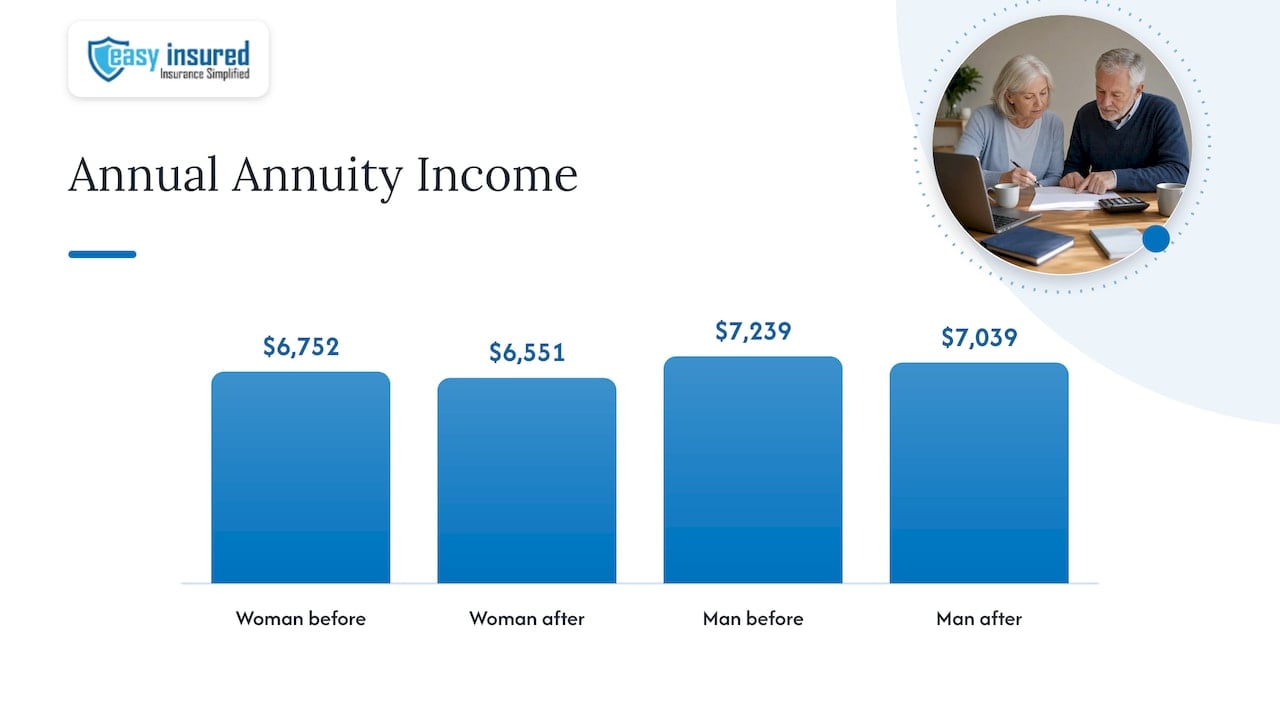
The Globe and Mail showed how fast this can move. In one month in late 2023, annual income from a $100,000 annuity with a 10-year guarantee for a 65-year-old woman fell from $6,752 to $6,551, almost 3 per cent, while for a 65-year-old man it fell from $7,239 to $7,039. The same article notes that payouts are set using short-term rates, long-term bond yields, the buyer’s age and the insurer’s experience with how long its annuity clients live.
Should you try to time rates?
Nobody reliably predicts rates, and that includes economists. A practical approach:
- If you have an income gap now, do not postpone a needed purchase hoping for a better rate.
- If you have flexibility, split the purchase into two or three tranches over a few years, so no single day’s rate sets your whole income.
- Remember the payment is fixed once you buy. That is the point of an annuity, and also the reason to size it to the gap rather than to all of your savings.
If inflation worries you, read our guide to annuity inflation protection options before you decide on the structure.
Immediate or deferred?
An immediate annuity starts paying right away. A deferred annuity starts later, on a date you choose. The FCAC explains that deferred life annuities provide higher regular payments than immediate ones because you receive fewer payments over your life, and that if you want more money later you may consider waiting to buy a deferred annuity.
| Situation | Often suits |
|---|---|
| You need income now to cover essentials | Immediate annuity |
| You want more income later and can fund the years between | Deferred annuity |
| You want to cover a bridge to a pension or CPP start | Term-certain annuity |
| You want income for as long as you live | Life annuity |
A deferred purchase can be a way to buy longevity protection in your 60s for income that begins in your 80s, while using other savings in between. The tax detail matters here: The Carillon column notes that in a deferred annuity, interest earned during the accumulation phase is taxable, so it is best funded with registered investments.
RRSP, RRIF and tax rules that set your deadline
For many Canadians the decision date is driven by the registered account, not by the annuity.
Registered money
Your RRSP has to be wound up by the end of the year you turn 71, and one of the options is to buy an annuity. Our guide on RRIF withdrawals and the age 71 tax timing explains how that deadline shapes your choices, and RRIF vs LIRA covers how the accounts differ if part of your savings came from a workplace pension.
Two rules are worth knowing before you buy with registered funds. Get Smarter About Money states that term-certain annuities bought with RRSP or RRIF money must extend to age 90, and that if you die before the end of the term, payments continue to your estate. That rule affects how long a bridge annuity can be if the money is registered.
Also keep in mind that cashing out an RRSP before converting triggers withholding tax. See RRSP withholding tax in Canada before you move money by withdrawal instead of a direct transfer.
Non-registered money
The FCAC says that taxes will be different depending on whether you buy with registered or non-registered savings, and that you must report annuity income when you file. With non-registered money, Get Smarter About Money explains that in the early years the CRA treats most of what you receive as interest and fully taxable, while later most of it is return of your own principal, so the tax goes down over time.
The practical upshot: the best purchase date is often the one that lets you use the right account, in the right year, with a clear view of your total taxable income. We cover the paperwork side in annuity taxation in Canada, and the interaction with government benefits in retirement income planning to avoid OAS clawback.
Choosing the type before the date
The date matters less if the structure is wrong. Questions to settle first:
- Life or term-certain? Life income protects against outliving your money. Term-certain fits a defined period.
- A guarantee period or refund feature? These protect your family if you die early but lower the payment. See cash refund annuities and what they cost.
- Single or joint life? If a spouse relies on the income, joint life keeps it going after the first death.
- Fixed or variable payments? Compare in life annuity vs variable payment annuity.
The FCAC lists what sets your payment: your sex, age and health when you buy, the amount invested, the type of annuity, whether you have a beneficiary or estate continuation option, how long you want payments, the interest rate when you buy and the provider. Each option you add is a trade between a bigger payment and more protection for your family.
How much of your savings to put in
This is where most buyers go wrong. An annuity is irreversible in most forms, so size it to the job.
- Work out the income gap, as above.
- Estimate how much capital it takes to produce that gap at current quotes for your age.
- Keep an emergency reserve, money for large one-off costs and growth investments for the rest.
A common approach is to annuitize only the essential-expense gap and keep the remainder flexible. People with large estates or strong pensions may need very little. People with little guaranteed income and a long family history of longevity may reasonably put more in.
Protection if the insurer fails
Safety of the contract matters when you are committing a lump sum for decades. Assuris, the industry’s guarantee fund, states that if your life and health insurer fails, it guarantees you will keep up to $5,000 a month or 90% of your promised monthly income, whichever is higher, for payout annuities. Ask your advisor how that applies to your contract.
Our perspective
We see the same pattern with families and business owners: the people who are happiest with an annuity bought it for a specific reason, not because a rate looked good that month.
The question we start with is the income gap. We map CPP, OAS, pensions and business sale proceeds against the spending that has to be paid, and only then look at whether guaranteed income fits. For a business owner, that often means the sale or wind-down year is the real decision point. For families, it is usually the year a mortgage ends or a spouse retires.
Our approach is designed around planning first and product second: a certified financial planner looks at your registered and non-registered accounts, the tax effect of each, and whether to buy once or in stages. Pairing that with estate planning means the beneficiary and guarantee choices on the annuity match the rest of your plan.
Frank
Work through the decision with us
An annuity is one piece of a retirement income plan, and the timing is easier to judge when someone has your whole picture. Our team helps Canadian families and business owners connect retirement income, tax and estate decisions. See our retirement and investment planning services, or look at how estate planning fits with your beneficiary choices.

If the income you want to protect is your paycheque before retirement, our disability insurance page covers that side, so your retirement savings stay intact.
A quick timing checklist
- You know your essential monthly spending and your guaranteed income.
- You have decided which account the money comes from, and what the tax effect is.
- You have chosen life or term-certain, and single or joint.
- You have decided how much to annuitize and how much to keep flexible.
- You have considered splitting the purchase over more than one year.
- You have checked quotes from more than one insurer on the same day for the same terms.
FAQ
Is it a good idea to buy an annuity in retirement?
It can be, if you have an income gap for essential expenses and want it covered for life. The FCAC notes an annuity is not always the best option when your regular income and savings already cover your expenses, so work out the gap first and speak to a financial professional.
What is the best age to buy an annuity in Canada?
There is no single best age. Older buyers generally get higher payments, but you also fund the waiting years from other savings. Many people buy between retirement and the RRSP conversion deadline, or in stages across those years. Your needs and income sources should decide.
Should I wait for interest rates to rise?
Rates do change payouts: higher rates at purchase mean higher payments. But rates are hard to predict, and a needed income should not wait on a guess. Splitting your purchase into a few tranches spreads the rate risk.
How much does a $300,000 annuity pay per month?
It depends on your age, sex, health, the guarantee and the rates that day. As a ratio, the FCAC example of $500 a month for $100,000 at 65 would imply $1,500 a month on $300,000, but only a current quote gives the real figure.
Sources
- Annuities, Financial Consumer Agency of Canada
- How annuities work, Get Smarter About Money
- If you ever had thoughts of buying an annuity, now is the time, The Globe and Mail
- Ask the Money Lady: Annuities good for retirement portfolio, The Carillon
- Payout Annuity, Assuris