
The Canada Education Savings Grant (CESG) is free money from the federal government that tops up your contributions to a child’s Registered Education Savings Plan (RESP). The basic grant is 20% of what you put in, up to $500 per child per year, and a child can receive up to $7,200 over a lifetime. You get it by opening an RESP, giving your provider a signed grant application, and contributing.
Below you will find the exact rules, a worked example, the catch-up option, the age 16 and 17 conditions, the steps to apply, and a short comparison with the TFSA and FHSA, since families often weigh all three.
TL;DR
- The basic CESG pays 20% on the first $2,500 you contribute each year, which is a maximum of $500 per child per year.
- Lower and middle income families can earn an additional CESG of 10% or 20% on the first $500 contributed, so the yearly maximum is $600, $550 or $500 depending on family income.
- The lifetime maximum is $7,200 per child, and unused grant room carries forward, so you can catch up to a $1,000 grant in a single year.
- The child must live in Canada, have a Social Insurance Number, be named in an RESP and be 17 or younger.
- You apply through your RESP provider with the ESDC grant form, and the government deposits the grant straight into the plan.
Table of Contents
- What the CESG is and who qualifies
- How much the CESG pays: annual and lifetime limits
- A worked example
- Catching up on missed years
- Special rules at ages 16 and 17
- How to apply for the CESG
- What happens when it is time to withdraw
- TFSA vs FHSA vs RESP: which job does each account do?
- Common mistakes that cost families grant money
- Our perspective
- Put the grant to work with a plan
- FAQ
- Sources
What the CESG is and who qualifies
The CESG is an incentive paid by Employment and Social Development Canada (ESDC) to encourage parents, family and friends to save for a child’s post-secondary education. According to the CRA’s CESG page, the grant is calculated from the amount contributed to a registered education savings plan for the child.
To be eligible for a grant, the beneficiary must:
- be a resident of Canada at the time the contribution is made,
- have a Social Insurance Number,
- be named as a beneficiary in an RESP, and
- be 17 years old or younger.
The grant is available until the calendar year in which the child turns 17, as the CRA’s RESP guide (RC4092) explains. Notice what is not on the list: your income does not decide whether the child gets the basic grant. Family income only matters for the additional amount, covered below.
The grant is paid on contributions, not on the plan’s investment growth. No contribution, no CESG.
How much the CESG pays: annual and lifetime limits
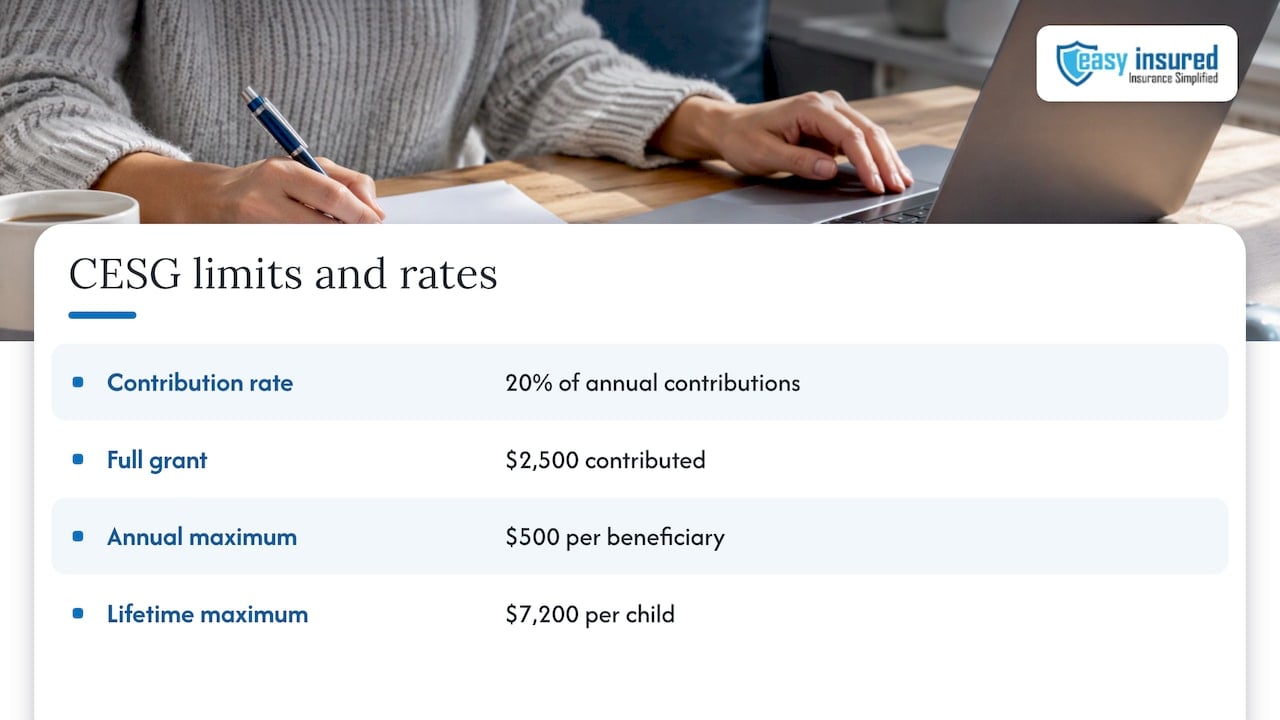
The basic CESG is 20% of annual personal contributions, up to $500 per beneficiary per year. To earn the full $500, you contribute $2,500 in the year. The lifetime limit is $7,200 per child, according to the CRA’s CESG page.
The additional CESG for lower and middle incomes
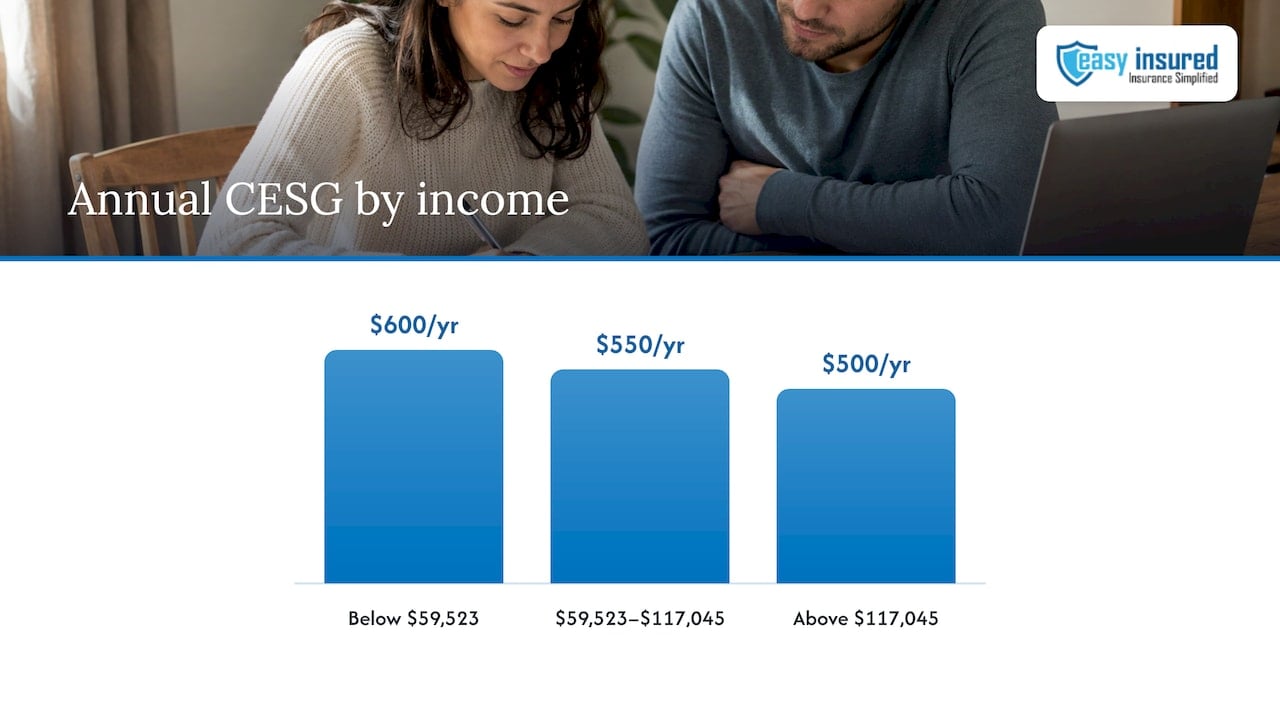
On top of the basic grant, the additional CESG adds 10% or 20% on the first $500 of annual contributions, depending on adjusted family net income. For 2026, per the CRA’s RC4092 publication, the additional grant is 20% for families with adjusted family net income below $59,523 and 10% for families between $59,523 and $117,045. These income thresholds are indexed, so check the current figures each year.
Here is what that means in yearly terms, with the basic grant included:
| Adjusted family net income (2026) | Basic CESG on $2,500 | Additional CESG on first $500 | Maximum CESG per year |
|---|---|---|---|
| Below $59,523 | $500 | $100 (20%) | $600 |
| $59,523 to $117,045 | $500 | $50 (10%) | $550 |
| Above $117,045 | $500 | None | $500 |
The yearly maximums come from the CRA’s CESG page. In every case the lifetime maximum, additional amount included, stays at $7,200.
The additional CESG is assessed using the primary caregiver’s income, or their spouse’s, and it can be paid only if the RESP has one beneficiary or, when there are several, all of them are siblings.
A worked example
Suppose you open an RESP when your daughter is born and contribute $2,500 every year, which works out to about $208 a month.
- Each year the government adds $500.
- After 14 years you have contributed $35,000 and received $7,000 in grants.
- In year 15 you contribute another $1,000 and receive the final $200, reaching the $7,200 cap.
Total contributions are $36,000, well under the $50,000 lifetime limit per beneficiary. The $7,200 is a 20% return on those contributions before a single dollar of investment growth, and it grows tax-sheltered inside the plan.
A family with lower income, using the additional grant, reaches the cap sooner. At $600 a year, the $7,200 limit arrives after 12 years of contributing $2,500.
Catching up on missed years
Every child under 18 who is a Canadian resident accumulates $500 of unused CESG room each year from 2007 onward, and $400 for 1998 to 2006. Unused room carries forward and can be used when you make contributions in later years, according to the CRA.
The catch-up rules, per ESDC’s page on how much money can be added to an RESP:
- If there is unused grant from previous years, you can contribute more than $2,500 in a year and receive 20% of your contributions, on up to $5,000.
- The most a child can receive in one calendar year is $1,000 in CESG, even when catching up.
- You can only catch up one year of grant at a time.
So if you started late or skipped a year, contributing $5,000 in a single year brings in $1,000. Once the backlog is cleared, you return to $2,500 a year.
One caution for families who like to front-load: the grant is capped annually, so putting in a lump sum much larger than $5,000 does not earn more grant that year. It adds to the $50,000 lifetime contribution limit, and going over that limit triggers a 1% monthly tax on the excess, as ESDC explains. If you are weighing a lump sum against steady contributions, a planner can help you map the year-by-year amounts.
Special rules at ages 16 and 17
The CESG does not simply continue through the teenage years. Beneficiaries aged 16 or 17 can receive the grant only if at least one of these is true, per the CRA’s CESG page:
- At least $2,000 was contributed to the RESP, and not withdrawn, before the end of the calendar year the child turned 15.
- A minimum of $100 in annual contributions was made in at least four of the years before the end of the calendar year the child turned 15.
This is why starting early matters even with small amounts. A modest $100 a year in four early years keeps the door open for later grant room that you might want to use during high school.
How to apply for the CESG
There is no separate government portal for most families. Your RESP provider handles the paperwork.
- Get the child’s SIN. The child needs a Social Insurance Number to receive the grant.
- Open an RESP. Choose individual or family plan. A family plan allows several beneficiaries, who must be related to the subscriber. If you are deciding, see our guide on family vs individual RESPs and protecting the $7,200 CESG.
- Complete the grant application. The ESDC form (SDE0093) is completed, signed and dated by the RESP subscriber or subscribers and handed to the provider. It also uses the primary caregiver’s or spouse’s SIN to assess the additional CESG and the Canada Learning Bond.
- Contribute. The beneficiary must be a resident of Canada when each contribution is made for the grant to be paid.
- Let the grant arrive. ESDC deposits the CESG directly into the child’s RESP based on your contributions.
Keep in mind that you can contribute for up to 31 years after opening an RESP and use the money for up to 35 years, according to ESDC, so the plan has plenty of runway. The grant only flows while the child is eligible, though.
What happens when it is time to withdraw
When the student starts post-secondary studies, the money comes out as Educational Assistance Payments (EAPs), which include the grant and investment growth. EAPs are reported on the student’s tax return, not the subscriber’s, and students often owe little or no tax. Your original contributions can come out separately without being taxed. Withdrawal timing and the early-term limit are worth understanding before the first semester, so read our guide on RESP withdrawal rules and the $8,000 first-term cap.
If the child does not pursue post-secondary education, the plan can stay open for years, and there are options to explore before closing it. Take advice before closing, since the grant portion generally must go back to the government if it is not used for education.
TFSA vs FHSA vs RESP: which job does each account do?
Many parents searching for the CESG are also comparing registered accounts. They solve different problems, and the RESP is the only one of the three that attracts the CESG. The comparison below draws on the CRA’s Saving for the future page.
| TFSA | FHSA | RESP | |
|---|---|---|---|
| Purpose | Flexible tax-free savings | First home purchase | Post-secondary education |
| Contributions deductible | No | Yes | No |
| Withdrawals | Generally tax-free | Tax-free if qualifying | Growth and grants taxed in the student’s hands |
| Limits | $7,000 for 2026 | $8,000 a year, $40,000 lifetime | $50,000 lifetime per beneficiary |
| Government grant | None | None | CESG, plus CLB for eligible families |
The TFSA’s $7,000 dollar limit for 2026 comes from the CRA’s TFSA room page. You must be 18 or older with a valid SIN to open one.
How to prioritize
- Saving for a child’s education: the RESP comes first, at least up to the amount that earns the grant. A 20% match is hard for any other account to beat.
- Saving for your own first home: the FHSA gives you a deduction going in and tax-free qualifying withdrawals coming out.
- Everything else, including emergency money: the TFSA is flexible, and withdrawn amounts return to your room the following January 1. See our pieces on the TFSA contribution limit and your room and TFSA withdrawal rules.
If the beneficiary has a disability, an RESP is not the only plan to consider. Our comparison of RESP vs RDSP shows how they differ.
Common mistakes that cost families grant money
- Contributing less than $2,500 without a plan to catch up. The room carries forward, but only one year of catch-up can be claimed at a time, up to $1,000 of grant a year.
- Skipping the early years. Because of the age 16 and 17 rules, early contributions protect your later eligibility.
- Over-contributing. Going past the $50,000 lifetime limit for a beneficiary across all RESPs means a 1% monthly tax on your share of the excess.
- Mixing beneficiaries who are not siblings. The additional CESG is only paid when the plan has one beneficiary or when all beneficiaries are siblings.
- Forgetting residency. The child must live in Canada when each contribution is made.
Our perspective
Most families we meet treat the RESP as a stand-alone chore. We see it as one piece of a household plan. The grant is generous, but it competes for the same dollars as your mortgage, your emergency fund and your own retirement.
The question we ask first is not “how do we maximize the grant?” but “what happens to this plan if income stops?” If a parent becomes disabled or critically ill, contributions stop, and so does the 20% match. That is why we look at RESP contributions alongside disability and critical illness coverage, and life insurance, so the education plan survives a bad year.
Our approach is to combine online access to policies with advice from a certified financial planner, so you can set up the RESP, set a contribution schedule you can sustain, and review it as your income changes. We aim to keep the process jargon-free and simple to start.
Frank
Put the grant to work with a plan
An RESP works best when the contribution amount fits your wider budget and protection. At Easy Insured, our planners help Canadian families and business owners line up education savings, retirement savings and insurance so one setback does not undo years of contributions. Explore our financial planning and investment services to see how we can help.

If you want to protect your ability to keep contributing, our disability insurance and critical illness insurance pages explain how that cover works.
FAQ
What is the annual contribution limit for the RESP grant?
The grant is earned on up to $2,500 of contributions a year, which produces the $500 basic CESG. If you have unused grant room from earlier years, you can contribute up to $5,000 in a year and receive up to $1,000. There is no annual limit on RESP contributions themselves, but there is a $50,000 lifetime limit per beneficiary.
Is there a lifetime limit on the CESG?
Yes. The maximum is $7,200 per eligible child, additional CESG included, regardless of family income. Once a child reaches that amount, no more grant is paid on that child’s plan.
Can I get the CESG if my child is 16 or 17?
Possibly. The child must meet one of two contribution tests before the end of the year they turned 15: at least $2,000 contributed and not withdrawn, or at least $100 contributed in each of four separate years. Without that history, no grant is paid for those ages.
Do I need to apply every year?
No. You complete the grant application once through your RESP provider, then the grant is deposited automatically after each eligible contribution. Contact your provider if your family circumstances change, such as a new primary caregiver, since that affects the additional CESG.
Does the CESG depend on my income?
The basic grant does not. The additional CESG does: for 2026 it is 20% on the first $500 for adjusted family net income below $59,523 and 10% up to $117,045.
Sources
- Canada Education Savings Grant (CESG), Canada.ca
- Registered Education Savings Plans (RESPs), RC4092, Canada.ca
- How much money can be added to Registered Education Savings Plans, Canada.ca
- Managing the Registered Education Savings Plan, Canada.ca
- ESDC grant application form SDE0093
- Saving for the future, Canada.ca
- Calculate your TFSA contribution room, Canada.ca