
A cash refund annuity is a life annuity with a safety net. It pays you income for life, and if you die before those payments add up to what you paid in, your beneficiary receives the difference as one lump sum. The price of that promise is a lower monthly payment than the same annuity without the refund. This guide explains how the refund is calculated, what drives your quote, how the income is taxed, and when the feature is worth paying for.
TL;DR
- A cash refund annuity pays income for life and returns the unpaid balance of your purchase amount to your beneficiary in one payment if you die early.
- The refund feature lowers your monthly income compared with a plain life annuity, because the insurer takes on more risk.
- Once payments start, a payout annuity in Canada generally cannot be cashed out, so only use money you will not need back.
- Tax depends on the source of funds: registered money is fully taxable as income, while non-registered annuities follow different rules.
- Get quotes from several providers for the same set-up, because income for the same annuity type can differ.
Table of Contents
- What a cash refund annuity is
- How the refund works, with an example
- Cash refund vs guarantee period
- What affects your monthly income
- Can you cash out a cash refund annuity?
- How cash refund annuity income is taxed
- When a cash refund makes sense
- Our perspective
- Plan your annuity with a certified planner
- Before you sign: a checklist
- FAQ
- Sources
What a cash refund annuity is
You give an insurance company a lump sum, called the purchase amount or single premium. In return it pays you a regular income, usually monthly, for as long as you live. Adding a cash refund guarantee means the insurer also promises that the total paid out to you and your beneficiary will never be less than the amount you put in. Investopedia describes these as typically offered as a rider on life annuities, guaranteeing a return of the premium minus the payments already received.
A plain life annuity has no such promise. If you die early, the insurer keeps the remainder, and that pooled money is what lets it pay higher income to people who live a long time. One Canadian adviser newsletter puts the downside bluntly: if the annuitant dies shortly after the annuity starts, there is no refund of the amounts invested once the transfer is made. The cash refund option exists for people who dislike that outcome.
How the refund works, with an example
The arithmetic is simple. Using round numbers purely for illustration (not a quote):
| Step | Example |
|---|---|
| Purchase amount | $100,000 |
| Income payments received before death | $38,000 |
| Shortfall paid to beneficiary | $62,000 |
Sun Life’s payout annuity guide says that if the payments received are less than the original single premium, the beneficiary receives the difference as a single payment. If you live long enough that payments exceed the purchase amount, there is no refund at all. Payments simply continue for life, and the guarantee has done its job by never being needed.
Two points often confuse buyers:
- The refund is not extra money. It is your own purchase amount coming back to your family in a different order. It does not include interest.
- Death benefits vary by contract. According to the same guide, what is paid depends on whether income has started, the source of the premium and the guaranteed period you chose. Read the contract wording before you sign.
Cash refund vs guarantee period
The refund is one of several ways to protect against dying early. The usual alternatives are:
- Guarantee period (for example 10 or 15 years): payments continue to your beneficiary until the end of the period if you die within it. Unlike a cash refund, the payments may keep arriving as income rather than as a lump sum, and the guarantee ends when the period does.
- Joint and survivor: income continues for a spouse after your death, often at the same or a reduced level.
- No guarantee (single life): the highest income, with nothing left after death.
A Canadian glossary on cash refund annuities lists lower monthly payments, irrevocability and inflation risk as the drawbacks, which matches how insurers price these products. The more you ask the insurer to guarantee, the less it can pay each month. A cash refund and a long guarantee period do much the same job, so the right choice often comes down to whether your beneficiary would rather have a lump sum or a continuing stream, and which one the insurer prices better for your age.
If you want to match payments to a specific end date instead, see our guide to term certain annuities. For a wider look at payout structures, read life annuity vs variable payment annuity.
What affects your monthly income
People search for how much a $100,000 annuity pays each month, and there is no honest single answer. The Financial Consumer Agency of Canada says providers set payments using the type of annuity, the term, your age, your gender, operating costs and expected investment returns. Adding a cash refund changes the type, which is why it moves the number.
In practice, these are the levers:
- Your age at purchase. Older buyers get higher payments because the insurer expects to pay for fewer years.
- Gender. Providers use it in pricing, as the FCAC notes.
- Interest rates on the day you buy. Annuity income is tied to what the insurer can earn on bonds, so the same $100,000 buys different income in different years.
- The guarantee you add. A cash refund or a long guarantee period lowers payments. Joint survivor options lower them too.
- Indexing. Income that rises with inflation starts lower than level income. We cover this in annuity inflation protection in Canada.
- The provider. The FCAC recommends comparing similar annuity products from several providers, since they may offer different income for the same type.
When you request quotes, ask for the same purchase amount, start date and options from each company, and ask for a version with and without the refund. The gap between the two figures is the real cost of the guarantee, stated in dollars per month. Divide that gap into your purchase amount to see how long it takes to pay for itself, then decide if that trade feels right.
Can you cash out a cash refund annuity?
No, in general. Sun Life’s guide states that payout annuities in Canada cannot be surrendered and have no cash surrender value once income payments begin. Exceptions exist only for certain types of non-prescribed term-certain annuities, and those depend on company approval and may involve a market value adjustment.
The cash refund does not change this. It is a promise paid at death, not a withdrawal right. Before you buy, be sure about three things:
- You keep enough liquid savings for emergencies, home repairs and care costs.
- You are not putting in money you may need for a business, a mortgage or a family loan.
- You understand that the lump sum is locked in as a stream of income for life.
This lack of access is the main reason many retirees split their savings. They keep a flexible account for spending and one-off needs, and use an annuity for a baseline of guaranteed income. Research on sustainable withdrawal rates shows why people weigh drawing down their own portfolio against buying income they cannot outlive, and the answer rarely has to be all or nothing.
How cash refund annuity income is taxed
Tax depends on where the money came from, not on the refund feature itself.
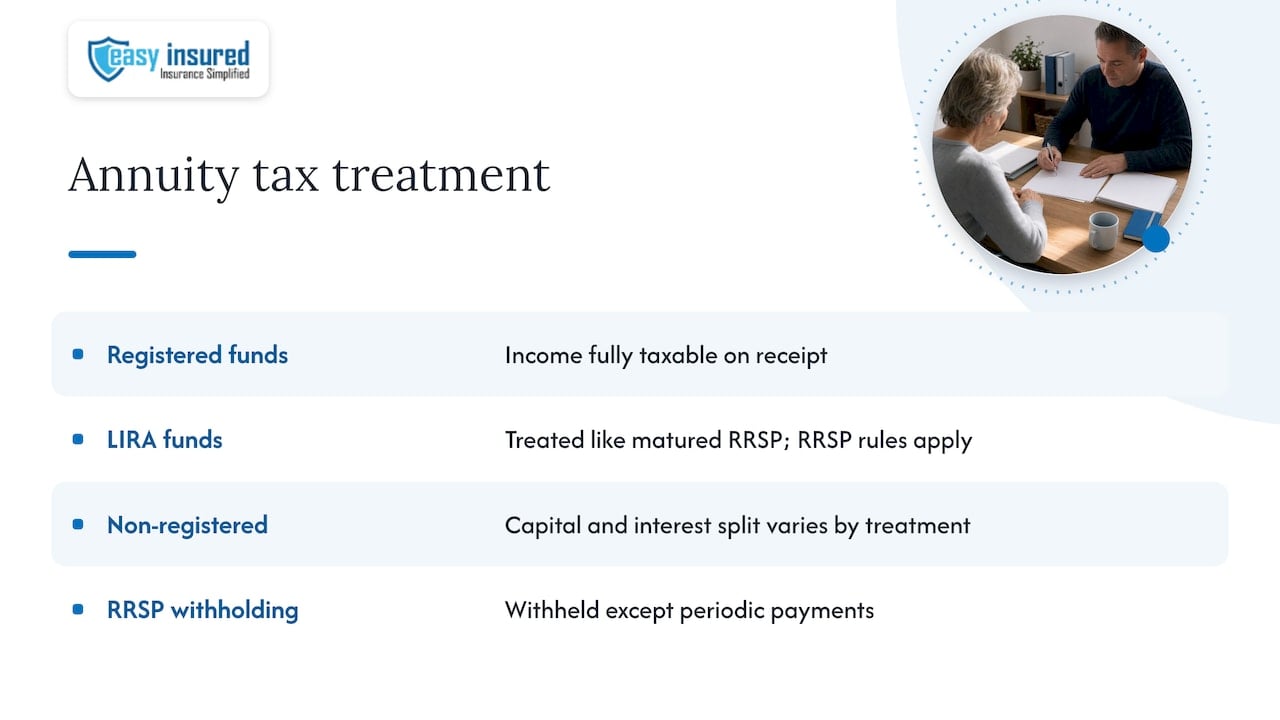
Registered money (RRSP, RRIF, LIRA). Sun Life’s guide explains that registered annuity income is fully taxable in the year you receive it. The source of the premium matters too. If the annuity is bought with LIRA or locked-in RSP funds, it is treated like a matured RRSP and RRSP tax rules apply.
Non-registered money. Income can be taxed under prescribed, non-prescribed or level treatment. In broad terms, part of each payment is a return of your own capital and part is interest, and the way that split is spread over the years depends on which treatment applies. This is a real planning decision, so have an adviser or accountant model it with your numbers.
Withholding. The Canada Revenue Agency states that tax must be withheld from RRSP payments during the original annuitant’s lifetime, except periodic annuity payments and certain specified exemptions. That is one reason buying an annuity with RRSP funds can be cleaner than taking a lump-sum withdrawal first. Our article on RRSP withholding tax walks through the difference.
For the paperwork to collect before you commit, see annuity taxation in Canada. If your annuity income will push you toward other thresholds, retirement income planning and pension splitting for couples are the next reads.
One caution on the death payment: the tax outcome for your beneficiary and estate depends on whether the funds were registered and on who is named. Check this with a licensed adviser or accountant before you buy, because a registered annuity and a non-registered one can produce quite different results for an estate.
When a cash refund makes sense
The feature fits best in a few situations:
- You are buying with a large share of your savings and want your family to recover whatever the insurer has not yet paid you.
- You are in your 60s or early 70s and worried about early death, and a plain life annuity feels like a gamble you do not want to take.
- You have a spouse or children who rely on an inheritance and no other life insurance to replace it.
- You want a simpler promise than a guarantee period, with one clear lump sum rather than income continuing to someone else.
It makes less sense when:
- Your priority is maximum monthly income and you have other assets to leave behind.
- You are in poor health and want the best possible protection, in which case a different structure may serve you better.
- You already hold permanent insurance meant for your heirs, such as whole life.
That last point deserves attention. Some families use a single life annuity for higher income and pair it with life insurance to replace the capital. The annuity gives more monthly income, while the insurance pays the family a tax-efficient death benefit. The combined cost can beat a cash refund annuity, depending on your age and health, but it needs underwriting and is not available to everyone. Ask for both scenarios side by side.
Our perspective
We see the cash refund option misunderstood in both directions. Some people treat it as a free guarantee, and it is not: you pay for it in lower income every month. Others dismiss it as a gimmick, when for the right household it is a sensible way to turn a large lump sum into income while keeping the family’s stake intact.
The question we ask first is not which annuity is best. It is how much of your income needs to be guaranteed, and what you want to happen to the rest. Annuities work well for the floor under your spending, such as housing, food and insurance. Money you want to stay flexible, invest or leave behind belongs elsewhere. We would rather you buy a smaller annuity that you understand than a larger one you cannot reverse.
We also suggest comparing the cost of the refund against other tools. Sometimes a guarantee period, a joint survivor option or separate life insurance protects your family better for less. Quotes make that visible. A careful plan looks at your RRIF timing, your pension, government benefits and your estate together, not the annuity in isolation.
— Frank
Plan your annuity with a certified planner
Buying an annuity is a one-way decision, so it is worth testing it against your whole retirement picture first. Our team can help you compare payout options, model the tax on registered and non-registered funds, and line the income up with your estate wishes. Start with our retirement and estate planning services, or look at how estate planning can work alongside your annuity.

If your RRSP is approaching conversion, our guides to RRIF withdrawal rules and RRIF vs LIRA explain the choices that sit beside an annuity.
Before you sign: a checklist
- Confirm the source of funds (registered, locked-in or non-registered) and the tax treatment that follows.
- Request quotes with and without the cash refund from several providers, on identical terms.
- Decide who the beneficiary is, and whether you want a lump sum or continuing income for them.
- Check what happens if your spouse or beneficiary dies before you.
- Ask whether indexing is available and what it does to starting income.
- Keep enough accessible savings, because you will not be able to cash the annuity out.
- Review the plan with a certified financial planner or accountant, then read the contract wording once more.
FAQ
How much will a $100,000 cash refund annuity pay monthly?
There is no fixed figure. The amount depends on your age, gender, the term, interest rates when you buy and the provider, according to the Financial Consumer Agency of Canada. Adding the refund lowers the monthly amount compared with a plain life annuity. Ask several providers for quotes on the same terms.
Can you cash out an annuity in Canada?
Generally not once payments begin. Payout annuities usually have no surrender value, and the exceptions are limited to certain non-prescribed term-certain annuities, subject to company approval and possible market value adjustments. The cash refund pays your beneficiary at death, not you.
Is annuity income taxable in Canada?
Yes. Income from an annuity bought with registered funds is fully taxable in the year you receive it. Non-registered annuities follow prescribed, non-prescribed or level treatment, which splits each payment between capital and interest differently. An accountant can model this for your situation.
What happens if I die before I have received my purchase amount?
With a cash refund, your beneficiary receives the difference between the purchase amount and the payments you received, as a single payment. If payments already exceed the purchase amount, no refund is due. Contract terms vary by premium source and guarantee, so confirm them in writing.
Sources
- Types of Cash Refund Annuities and How They Function, Investopedia
- Payout Annuity Advisor Guide, Sun Life Global Investments
- Annuities, Financial Consumer Agency of Canada
- T4RSP Statement of RRSP income, Canada Revenue Agency
- Cash Refund Annuity definition, Accountor glossary
- Sustainable withdrawal rates for retirees