
Term life insurance is the right primary choice for most people because it pays out for death from nearly any cause, subject to standard policy exclusions. Accidental death (AD&D) insurance only pays when death results from a covered accident, which makes it a narrow, supplemental layer rather than a replacement for term coverage.
TL;DR:
- A fatal crash may trigger both policies, while cancer, heart attacks, and deaths related to illness qualify for term life but not AD&D.
- For severe injuries, a typical AD&D schedule pays about 50% for one lost limb and up to 100% for multiple severe losses, though exact amounts vary by policy.
- AD&D usually costs less and often requires little health screening, but term premiums stay fixed only through the chosen term; renewal rates usually rise sharply.
- Adding an AD&D rider to term coverage can trigger both benefits after a covered accidental death; check existing employer coverage before buying separate protection.
- Before buying, review exclusions: illness and natural causes are generally excluded, and a claim may require death within 90 to 180 days after an accident.
Table of Contents
- Comparing coverage: term life vs accidental death (AD&D)
- Cost, underwriting and eligibility: why AD&D is cheaper
- Riders and combination strategies: how double payouts work
- Decision checklist: which to buy first and what to ask
- How we weigh term life and AD&D riders with clients
- Get a term life quote with optional AD&D riders
- FAQ
- Sources
Comparing coverage: term life vs accidental death (AD&D)
Term life insurance pays a level death benefit if you die during a set period, often lasting multiple years, regardless of whether the cause is illness, an accident, or most other circumstances outside a handful of exclusions. AD&D insurance works differently: it pays only when death happens because of a qualifying accident, and it also pays partial benefits for serious injuries like the loss of a limb or eyesight.
Picture a few scenarios. A fatal car crash is typically covered by both term life and AD&D. A heart attack or cancer diagnosis is covered by term life but not by AD&D, since it is not an accident. A workplace fall that causes death is usually an AD&D trigger. Drowning often qualifies, while death from a drug overdose or most illness-related complications generally does not, according to MoneyGeek’s comparison of AD&D and life insurance.
Dismemberment benefits pay a percentage of the policy’s face value rather than the full amount. A common structure pays around 50% for the loss of one limb and up to 100% for multiple severe losses, though exact percentages vary by insurer and policy, per MoneyGeek.
AD&D policies carry exclusions that term life does not share:
- Death from illness or natural causes is almost always excluded from AD&D, even though it is covered under term life.
- Suicide is typically excluded from both policy types during an early contestability period, often the first one to two years.
- High-risk activities, such as certain extreme sports or flying as a non-commercial pilot, can be excluded or restricted under AD&D contracts.
Cost, underwriting and eligibility: why AD&D is cheaper
AD&D premiums tend to run lower than term life premiums for a comparable face amount, mainly because the payout trigger is so much narrower. Term life has to price in every cause of death across the policy term, while AD&D only has to price in accidents, according to MoneyGeek’s analysis.
AD&D premiums are typically lower than term life premiums because the restricted payout conditions reduce the insurer’s risk exposure, per MoneyGeek.
Underwriting differs too:
- Term life often requires a medical exam or detailed health questionnaire, especially for larger face amounts.
- AD&D frequently uses simplified issue or guaranteed issue underwriting, with little or no health screening.
- Term life premiums lock in for the full term, while renewal after the term ends usually comes at a sharply higher rate based on your age at renewal.
- AD&D is widely available through employer group benefits, as a rider attached to a life policy, or as a standalone retail product.
Riders and combination strategies: how double payouts work
Adding an AD&D rider to a term policy is one of the more cost-efficient ways to boost accidental coverage without buying a second policy. The rider increases your payout specifically when death results from a covered accident, usually for a modest premium increase relative to the added benefit, as outlined in Easy Insured’s guide to life insurance riders.
A few ways people commonly structure this coverage:
- Buy term life sized for income replacement, then add an AD&D rider for extra protection against accidents.
- Buy a standalone AD&D policy alongside an existing term policy, so an accidental death triggers both payouts.
- Rely on employer group AD&D for a baseline, then layer individual term life on top for income replacement.
In an illustrative example, someone with a term policy and a separate AD&D rider could see both benefits pay out if death results from a qualifying accident, a structure often called double indemnity, since both the life and the accident benefit respond to the same event.
Pro Tip: If your occupation involves frequent travel, manual labor, or driving, an AD&D rider is usually worth the small added premium.
Decision checklist: which to buy first and what to ask
Term life should come first for anyone supporting dependents, carrying a mortgage, or replacing household income. AD&D belongs on top of that foundation, not instead of it, particularly for people in higher-risk occupations or those who travel internationally often.
Before choosing a policy, run through a short checklist:
- Count your dependents and outstanding debts, including a mortgage, to size your term life need.
- Check whether your employer already provides group AD&D, and note what happens to that coverage if you leave the job.
- Weigh your occupation risk and travel habits against the cost of an AD&D rider or standalone policy.
- Review your budget to confirm term life premiums fit comfortably before adding extras.
When comparing quotes or talking with an advisor, ask what specifically triggers a payout, what exclusions apply, how the dismemberment schedule is structured, and what documentation a claim requires. Claim windows for AD&D commonly require the death to occur within 90 to 180 days of the accident, so timing matters.
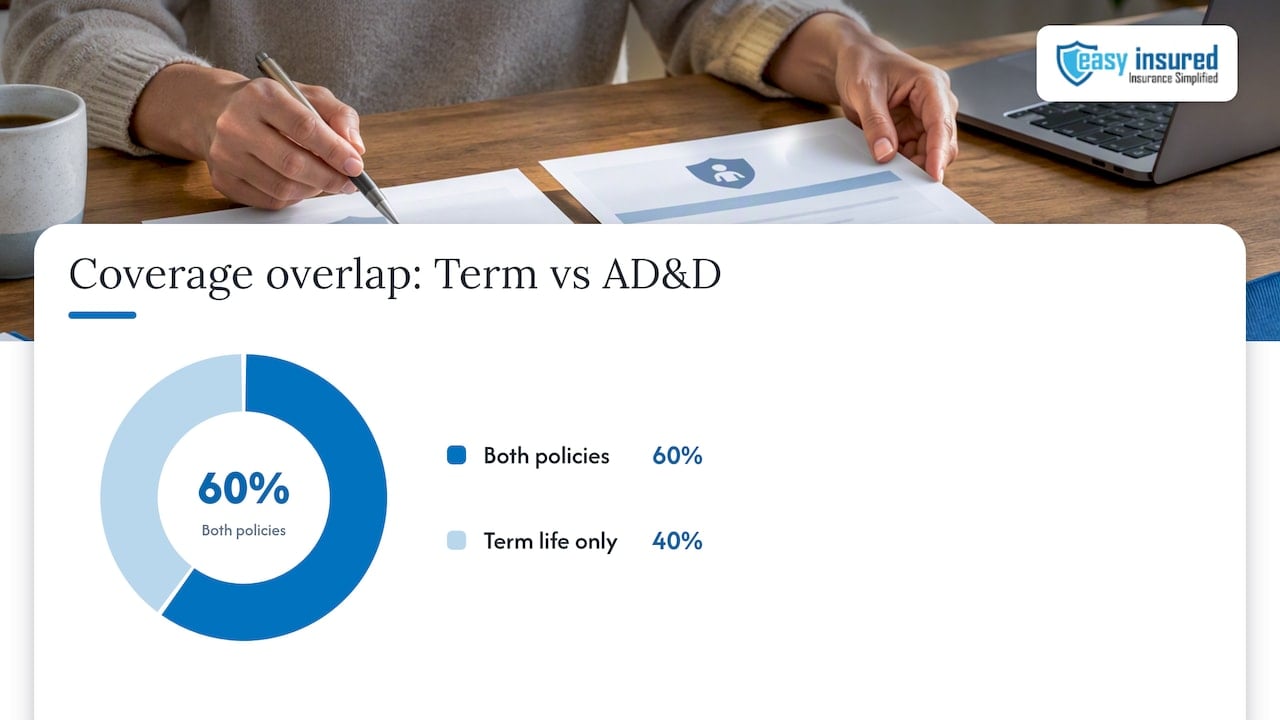
If you hold both AD&D and term life, a qualifying accidental death can trigger both benefits, a structure known as double indemnity.
How we weigh term life and AD&D riders with clients
We work across term, whole and final expense life insurance, along with disability, critical illness and estate planning, which means we see how term life and AD&D riders interact in real financial plans rather than in isolation. Our term life resources and riders guide walk through how term coverage and accidental death riders fit together for income replacement and accident protection.
When estate or beneficiary tax questions come up alongside a death benefit, a resource like Tledgers’ guide to capital dividend accounts can help business owners understand how proceeds interact with corporate tax treatment.
We help you size term coverage first, then decide whether an AD&D rider or standalone policy makes sense for your occupation and travel habits.
— Frank
Get a term life quote with optional AD&D riders
Term life insurance remains the fastest way to put meaningful income protection in place for the people who depend on you, and we make it straightforward to compare options and add accidental death protection where it fits.

Our term life page walks through term lengths and coverage amounts, and our riders guide breaks down how an AD&D rider changes your payout and premium. If your income replacement needs are already covered, our final expense options can round out a plan for funeral and end-of-life costs.
Request a quote through our services page and we will help you compare rider costs, confirm what your employer’s group AD&D already covers, and build a policy that matches your budget and risk profile.
This article is general information, not a substitute for advice from a qualified financial advisor. Consult a qualified financial professional about your own circumstances before acting on anything here.

FAQ
What is the difference between term life and accidental death insurance?
Term life pays a death benefit for nearly any cause of death during the policy term, while AD&D pays only when death results from a covered accident. Term life is built for income replacement, while AD&D is a narrower, supplemental benefit.
Does term insurance cover accidental death?
Yes, standard term life insurance covers death from accidents just as it covers illness and most other causes, subject to standard exclusions like suicide within an early contestability period. You do not need a separate AD&D policy for a term policy to pay out after an accidental death.
At what age should I cancel term life insurance?
There is no universal age to cancel term life. The right time depends on whether your dependents still rely on your income, whether your mortgage or other debts are paid off, and whether your term has reached its end date and renewal pricing no longer makes sense for your needs.
What is not considered an accidental death?
Death from illness, natural causes, or complications of a pre-existing medical condition is generally not considered accidental and would not trigger an AD&D payout, even though it would still be covered under a standard term life policy. Suicide is also typically excluded from both AD&D and term life during an early contestability period.