
An elimination period is the waiting period between the start of a disability and the day your benefits actually begin, and it commonly runs anywhere from 30 to 365 days, with 90 days a frequent standard in individual policies. Choosing its length is really a trade: a shorter wait means faster income but higher premiums, while a longer wait lowers your monthly cost and shifts more of the early financial burden onto you.
TL;DR:
- Shorter elimination periods, such as 30 days, significantly raise monthly premiums compared to longer ones like 90 or 180 days.
- The counting of disability days toward the elimination period requires continuous, total disability without gaps, with some plans allowing intermittent days to add up.
- Filing claims immediately after disability begins helps build the documentation needed for faster benefits, regardless of your chosen waiting period.
- Employer and group plans may set elimination periods based on administrative or leave exhaustion timelines, which can extend beyond the standard number of days.
- Building a cash-flow buffer that covers expenses for the length of the elimination period reduces financial stress until benefits start arriving.
Table of Contents
- What an elimination period is and how it works in a policy
- Common elimination period lengths and how they affect premiums
- How days are counted toward your elimination period
- Why filing early still matters even with a waiting period
- Group and employer plan rules that change the timeline
- Building a cash-flow bridge to cover the elimination period
- Frank’s take on choosing the right elimination period
- When a longer elimination period makes sense
- How we help you plan around the wait
- FAQ
- Sources
What an elimination period is and how it works in a policy
An elimination period, sometimes called a waiting period or deferred period, is the stretch of time you must be continuously disabled before your insurer starts paying benefits. It works much like a deductible, except instead of money, you’re absorbing time. Insurers use this structure to avoid paying out for short-term illnesses or injuries that resolve on their own, which keeps premiums lower for everyone holding a policy.
During this stretch, most contracts expect you to meet the policy’s definition of total disability every single day, not just at the start. That distinction matters because a partial recovery or a few days back at work can complicate your claim later.
What insurers typically require during the elimination period:
- Continuous total disability as defined in your contract, not intermittent symptoms.
- Ongoing medical treatment or documentation showing the condition persists.
- No gap in the qualifying period caused by a return to work, unless a recurrence clause applies.
Common elimination period lengths and how they affect premiums
Most individual long-term disability policies offer elimination periods of 30, 60, 90, 180, or 365 days, and 90 days is a frequent middle ground between cost and how quickly money arrives. There’s a direct inverse relationship at play: a shorter elimination period raises your monthly premium, while a longer one lowers it, because the insurer is taking on more of the early-stage risk.
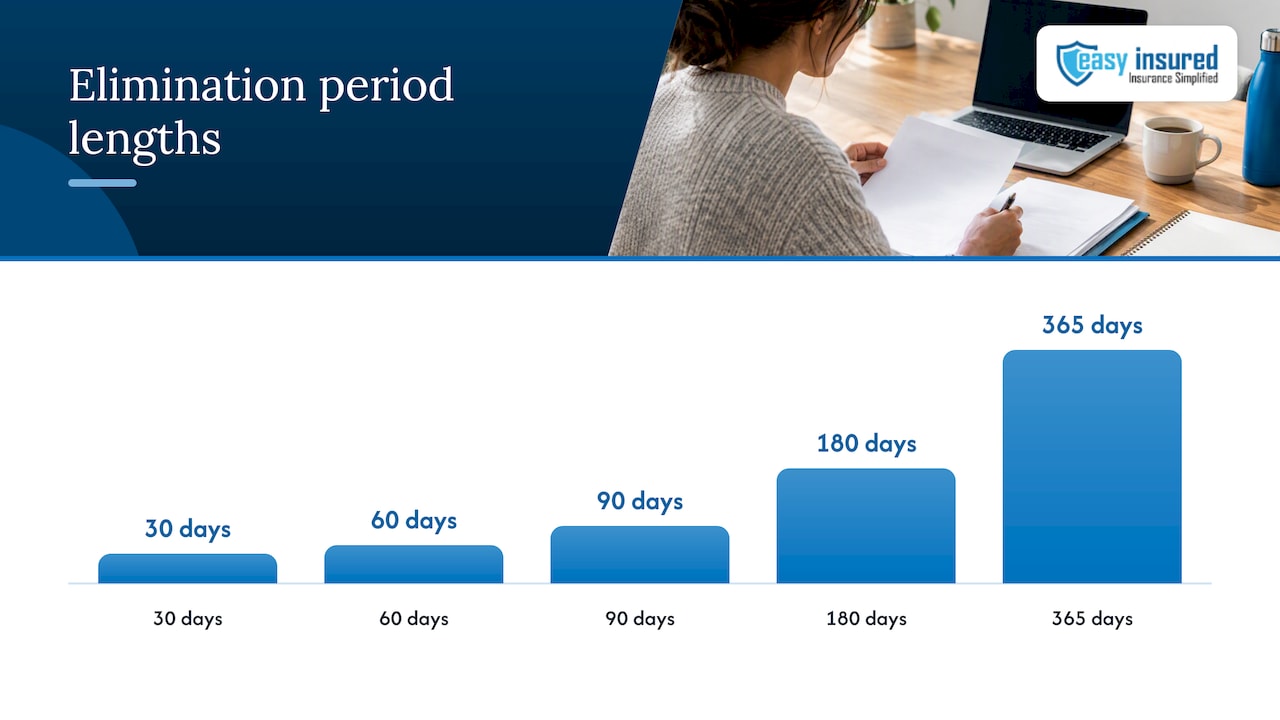
A policy with a 30-day elimination period typically costs more each month than an identical policy with a 90-day elimination period, since the insurer starts paying sooner and absorbs more claims that would otherwise resolve before benefits kick in.
A few heuristics help narrow the choice:
- If you have three to six months of living expenses saved, a longer elimination period can meaningfully cut your premium.
- If you carry employer-paid sick leave, align your private elimination period to start after that coverage ends.
- If your household runs on a single income with little cushion, a shorter elimination period is worth the added premium.
How days are counted toward your elimination period
The clock usually starts on the first full day you’re considered totally disabled, though some contracts use the date of the triggering incident instead. That small wording difference changes your actual benefit start date, so it’s worth confirming with your plan booklet or policy document.
How the counting typically works:
- Most individual policies require consecutive days of disability, meaning any interruption can reset the count.
- Some group plans instead use an accumulation method, letting intermittent disability days add up toward the total.
- A recurrence provision may let a related disability that returns within a set window skip a second elimination period.
- A partial return to work during the elimination period can pause or reset the clock, depending on contract wording.
Insurers tend to enforce continuity strictly: a single day that fails the policy’s disability test can interrupt the entire qualifying period.
Why filing early still matters even with a waiting period
A common misunderstanding is that you should wait to file until the elimination period ends. In reality, you should file as soon as the disability begins, since the elimination period governs when benefits become payable, not when you’re allowed to submit a claim. Filing promptly builds the documentation trail your insurer will need.
Documents worth gathering early:
- Medical statements from your treating physician, updated regularly.
- Employer records confirming your last day worked and any sick leave used.
- Claim forms consistent with the CLHIA’s harmonized disability medical form, a format Canadian insurers are adopting to reduce paperwork delays.
Even once the elimination period ends, insurers still need time to review medical documentation before the first payment arrives, so plan for that lag separately from the waiting period itself.
Pro Tip: Keep a dated copy of every document you submit. If a claim stalls, that record shows exactly when your insurer received each piece of evidence.
Group and employer plan rules that change the timeline
Employer and federal group plans often tie the elimination period to administrative milestones rather than a flat number of days. One structure makes benefits payable after 13 weeks of disability or once paid sick leave is exhausted, whichever comes later. That means your actual wait could stretch well past a standard 90-day mark if your sick leave bank runs longer.
What to check in your plan member booklet:
- Whether your elimination period is based on calendar days, business days, or exhaustion of leave.
- Whether approved rehabilitation programs let you earn income without losing benefit eligibility, often up to 24 months from the end of the elimination period.
- How earnings from a rehab program are offset against your benefit, which usually only applies once total income exceeds your pre-disability earnings.
Building a cash-flow bridge to cover the elimination period
Before your benefits start, you need a plan for covering expenses during the gap. Here’s a straightforward way to size it up:
- Calculate your required bridge fund: multiply monthly essential spending by the number of months in your elimination period, then subtract any paid sick leave you’ll receive during that stretch.
- Compare funding sources: an emergency savings account is the most flexible option, a short-term disability policy can cover part of the gap, and a short-term loan or line of credit fills shortfalls but adds interest cost.
- Avoid tapping long-term investments like retirement accounts unless other options are exhausted, since early withdrawals can trigger taxes or lost growth.
If you’re comparing short-term and long-term disability coverage, line up the elimination periods so one policy’s benefit starts exactly when the other’s ends, with no overlap or gap.
Pro Tip: Request quotes at two or three elimination period lengths with the same benefit amount held constant. The premium difference tells you exactly what you’re paying for speed.
Frank’s take on choosing the right elimination period
I’ve found most people default to whatever elimination period their advisor suggests without running the numbers themselves. Checking your employer’s own plan wording, your actual monthly expenses, and a couple of comparative quotes takes less than an hour and often changes the answer. Our checklist: confirm how your plan defines total disability, calculate your cash-flow bridge, request quotes at multiple elimination periods, and keep every document you submit when filing.
When a longer elimination period makes sense
A longer elimination period tends to fit households with several months of savings, two incomes, or a business with cash reserves to lean on, since the lower premium outweighs the longer wait. A shorter elimination period fits better when there’s no emergency fund, a single income supports the household, or fixed costs like a mortgage leave little room for a gap in pay. Either way, run actual quotes before committing to a default.
— Frank
How we help you plan around the wait
We work with disability policies regularly and can help illustrate how different elimination periods may affect your premium using actual quotes. For business owners and self-employed Canadians without employer sick leave to lean on, we help map out a disability insurance for self-employed Canadians strategy that accounts for the full gap before benefits start.

We can provide:
- Comparisons of elimination period options at similar benefit levels.
- Assistance coordinating coverage between employer group plans and private policies.
- Cash-flow planning to help manage expenses during elimination periods.
If you’re ready to see what your options look like, request a quote on our disability insurance page and we’ll walk through the numbers with you directly.
This article is general information, not a substitute for advice from a qualified financial advisor. Consult a qualified financial professional about your own circumstances before acting on anything here.
FAQ
What does elimination period mean in disability insurance?
An elimination period is the waiting period between the start of a disability and the date your benefit payments begin. Lengths commonly range from 30 to 365 days, with 90 days a frequent choice in individual policies.
What happens after 2 years on disability?
What happens depends entirely on your specific policy and whether it defines disability as “own occupation” or “any occupation” after the initial period, since many contracts tighten that definition over time. Check your own-occupation versus any-occupation wording directly, since it determines whether benefits continue.
What is the longest you can be on long-term disability?
Long-term disability benefit duration varies by contract and can extend to a specified age, such as retirement age, rather than a fixed number of years. The exact maximum duration is set in your individual policy or plan document, so it’s worth confirming directly with your insurer or plan booklet.
What is the maximum elimination period allowed for a long-term care policy?
Long-term care policies are a distinct product from long-term disability insurance, with their own separate rules and typical elimination period ranges. If you’re researching long-term care specifically, check that policy’s own documentation rather than assuming disability insurance terms apply.
Sources
- Elimination period definition (Investopedia)
- CLHIA news release on harmonized disability medical forms