
For most incorporated Canadian business owners over 40 with stable T4 salary, an Individual Pension Plan (IPP) delivers more tax-sheltered retirement savings than an RRSP.
RRSPs still win in two common situations:
- You’re under 35 to 40, where RRSP flexibility and lower cost outweigh the modest funding gap.
- Your corporation has irregular cash flow, since an IPP carries mandatory funding obligations even in lean years.
Key Takeaways
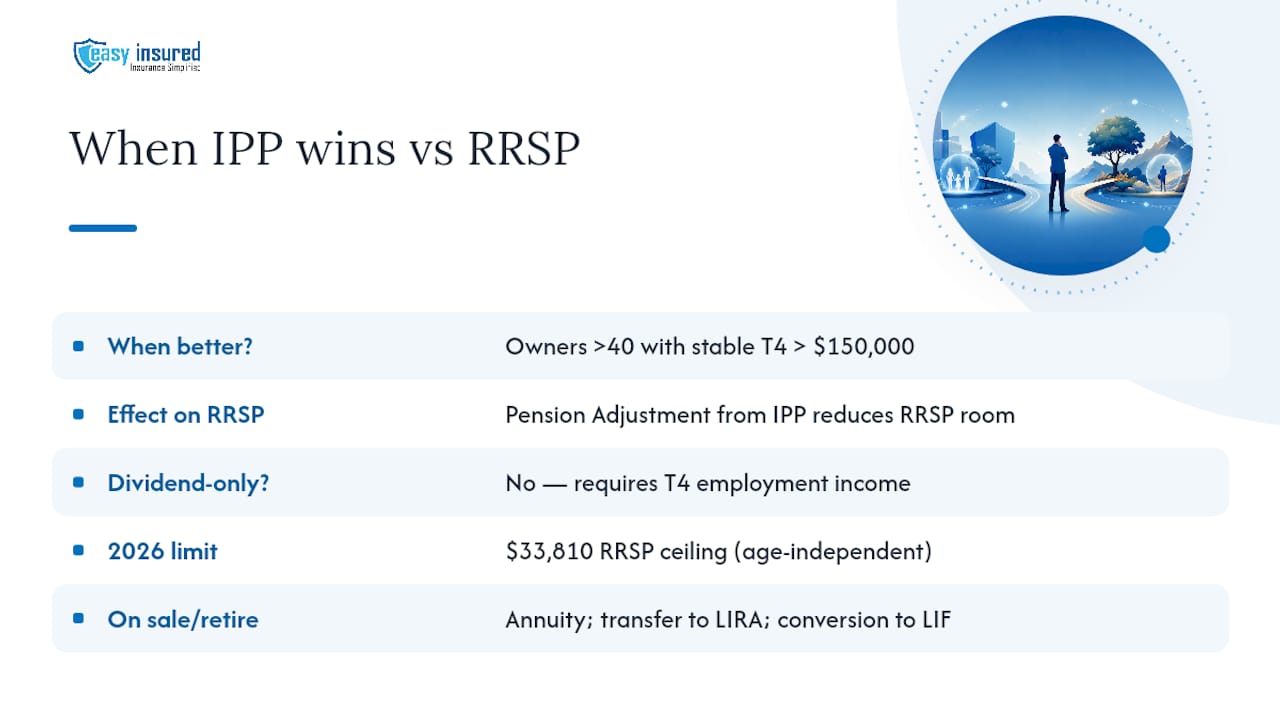
An IPP typically outperforms an RRSP for incorporated owners over 40 with stable T4 salary, because actuarial funding scales with age while RRSP room stays fixed.
| Point | Details |
|---|---|
| Age drives the verdict | IPPs pull ahead of RRSPs mainly after age 40, when actuarial contributions outpace the fixed $33,810 RRSP ceiling. |
| T4 salary is mandatory | Dividend-only compensation doesn’t qualify for IPP contributions; you need pensionable T4 earnings. |
| PA reduces RRSP room | Every IPP contribution triggers a Pension Adjustment that cuts your RRSP room dollar for dollar. |
| Costs are real and ongoing | Setup runs $3,000 to $6,000, with annual administration between $1,500 and $4,000. |
| Easy-insured coordinates the process | Easy-insured assesses IPP fit and coordinates with your actuary, pension counsel, and estate plan. |
Table of Contents
- Individual Pension Plan vs RRSP: The Core Difference
- What Is an Individual Pension Plan (IPP)?
- What Is an RRSP? A Quick Refresher for Incorporated Owners
- Side-by-Side: IPP vs RRSP Across the Decisions That Matter
- How Actuaries Calculate IPP Contributions and Pension Adjustments
- Advantages of an IPP Over an RRSP
- Downsides, Costs, and Obligations of an IPP
- Who Should Consider an IPP: A Practical Checklist
- What Happens to an IPP at Retirement or Death
- Setting Up an IPP: Steps, Timeline, and Costs
- Worked Examples: Two Incorporated Owners Compared
- When I Recommend an IPP
- How Easy-insured Helps You Evaluate an IPP
- Frequently Asked Questions
- Sources
Individual Pension Plan vs RRSP: The Core Difference
An IPP is a registered defined-benefit pension plan built for one person, sponsored and funded by your corporation. An RRSP is a personal defined-contribution account you fund yourself, with no employer obligation attached. That distinction, employer-funded versus self-funded, drives almost every other difference between the two vehicles, from who bears investment risk to how much room you actually get.
The comparison matters most for owners drawing T4 salary rather than dividends only, because IPP eligibility depends on pensionable earnings, not corporate profit. Dividend-only compensation, common among many incorporated professionals, doesn’t qualify you for an IPP at all.
What Is an Individual Pension Plan (IPP)?
An IPP is a registered defined-benefit plan sponsored by a corporation for a single member, typically the owner or a small group of senior employees. It’s not a product you buy off a shelf. It’s a formal pension structure, filed with regulators and backed by actuarial math.
To qualify, you generally need:
- T4 employment income (a “connected employee,” often defined as owning 10% or more of company shares) rather than dividend-only compensation.
- An actuary to calculate your required annual contribution and file periodic valuations.
- Registration under the Income Tax Act’s pension rules and CRA’s technical requirements, including provincial pension standards where applicable.
Statistic Callout: For a business owner earning a $200,000 T4 salary at age 60, an actuary might calculate an eligible IPP contribution in the range of $95,000 for that year, according to industry analysis of actuarial funding at that income and age. That dwarfs anything an RRSP can offer at the same income level.
What Is an RRSP? A Quick Refresher for Incorporated Owners
An RRSP is a defined-contribution account where you, not your corporation, control the investments and bear the risk. CRA rules let contributions reduce taxable income, growth compounds tax-deferred while funds stay in the plan, and withdrawals get taxed as income when you take them out.
- The 2026 RRSP contribution ceiling sits at $33,810, regardless of how old you are or how many years you’ve been contributing.
- Unlike an IPP, an RRSP lets you tap funds early through the Home Buyers’ Plan or Lifelong Learning Plan, with no employer or actuary involved.
That flat ceiling is precisely where the RRSP starts losing ground to an IPP as you age. Contribution room doesn’t grow with proximity to retirement the way IPP funding does.
Side-by-Side: IPP vs RRSP Across the Decisions That Matter
The differences aren’t abstract once you line them up against actual planning decisions.
| Dimension | Individual Pension Plan (IPP) | RRSP |
|---|---|---|
| Best for | Owners 40+ with stable T4 salary | Owners under 40 or with variable income |
| Contribution method | Actuarial: age, salary, years of service | Fixed 18% of earned income, capped at $33,810 (2026) |
| Tax/deduction timing | Corporate deduction, funded by the company | Personal deduction, funded by the individual |
| Investment/funding risk | Corporation must top up shortfalls | Individual bears all investment risk |
| Past-service funding | Yes, can buy back years back to 1991 | Not applicable |
| Creditor protection | Generally strong, varies by province | Generally strong, varies by province |
| Setup and ongoing cost | Actuary, legal, and administration fees | Minimal to none |
| Portability at exit | Annuity, LIRA/LIF transfer, commuted value | Convert to RRIF or annuity anytime |
| Effect on RRSP room | Reduces RRSP room via Pension Adjustment | Builds RRSP room directly |
A few practical takeaways jump out of that table:
- An IPP suits someone 45 and up with predictable T4 income who plans to stay incorporated for years.
- An RRSP suits someone prioritizing liquidity, simplicity, or the Home Buyers’ Plan.
- The corporate funding obligation behind an IPP is a real commitment, not a nice-to-have perk.
How Actuaries Calculate IPP Contributions and Pension Adjustments
Older members need bigger annual deposits because there’s less time left to fund the same promised benefit. That’s the entire mechanism behind why a 60-year-old can shelter roughly $95,000 in a single year while the 2026 RRSP ceiling caps everyone at $33,810, no matter their age.
Every IPP contribution generates a Pension Adjustment (PA), a figure reported on your T4 slip that reduces your RRSP room dollar for dollar. If you’ve been contributing to an IPP for years, don’t expect to also max out an RRSP; the PA effectively transfers your tax-sheltering capacity from one vehicle to the other. Setting up an IPP retroactively can also trigger a Past Service Pension Adjustment (PSPA), which claws back RRSP room for prior years covered by the buyback.
- PA reduces current-year RRSP room.
- PSPA reduces RRSP room for past years included in a service buyback.
- Both are calculated and reported by the plan administrator, not estimated by you.
Pro Tip: Maximize your RRSP contribution in the calendar year you establish your IPP, before the Pension Adjustment or PSPA eats into that room. Once the IPP is running, your RRSP contribution room from that source effectively goes dormant.
Advantages of an IPP Over an RRSP
The appeal compounds with age. Industry practitioner analysis shows the contribution gap between IPP and RRSP widens meaningfully after 40, and for owners in their 50s and 60s, IPP funding can run double or more what an RRSP would allow at the same income.
- Age-weighted contributions mean the older you are, the bigger the annual tax shelter.
- Past-service funding lets you buy back years of employment back to 1991, often creating a large, immediately deductible lump-sum contribution the year you set up the plan.
- Contributions are a corporate tax deduction, reducing taxable business income while building a personal retirement asset.
- Creditor protection is generally strong for registered pension assets, though the exact scope varies by province.
For an owner planning an exit or sale in the next decade, past-service funding alone can justify the plan.
Downsides, Costs, and Obligations of an IPP
None of this comes free, and the obligations are binding, not optional.
- Setup costs typically run from actuarial fees, legal drafting, and registration, often landing in the thousands of dollars before the plan even accepts its first contribution.
- Ongoing administration requires periodic actuarial valuations and annual filings, an expense that continues for the life of the plan.
- Your corporation is legally obligated to fund shortfalls if plan investments underperform, an obligation an RRSP never imposes on anyone.
- You lose flexible RRSP room permanently through the Pension Adjustment, and IPP funds are locked in, so there’s no Home Buyers’ Plan or Lifelong Learning Plan equivalent.
- Winding up an IPP, especially on short notice, involves more legal and actuarial complexity than closing an RRSP ever would.
Who Should Consider an IPP: A Practical Checklist
Run your situation against these markers before calling an actuary:
- Age 40 or older, with the advantage growing sharper past 45.
- Stable T4 salary, ideally $150,000 or more, sustained for several years.
- Multiple years of pensionable service you could buy back.
- Corporation with reliable, predictable cash flow to meet mandatory funding.
- Low tolerance for creditor exposure, where locked-in pension assets offer protection RRSPs may not match as cleanly.
- Retirement or sale horizon of five to fifteen years, long enough to benefit from compounding but not so long that liquidity needs dominate.
If you’re 40-plus, earning stable T4 salary above roughly $150,000, and planning to stay incorporated, an IPP deserves a real feasibility study.
Pro Tip: If you currently pay yourself mostly in dividends, shifting part of your compensation to T4 salary is often the prerequisite step, since pensionable earnings, not corporate profit, are what qualify you for IPP contributions in the first place.
What Happens to an IPP at Retirement or Death
At retirement, you generally choose between a lifetime pension income stream, a transfer of the commuted value to a Locked-In Retirement Account (LIRA), or conversion to a Life Income Fund (LIF) for structured withdrawals. Timing and transfer limits depend on provincial pension standards, which also govern creditor protection and portability rules at wind-up.
- IPP pension income is fully taxable when received, same as RRIF withdrawals, and it layers on top of CPP/QPP and OAS in retirement.
- Excess funds beyond what commuted-value rules allow to transfer tax-free may trigger immediate taxation.
- Surviving spouses typically inherit the pension benefit or commuted value; provincial rules govern exactly how, and creditor protection generally continues to apply to those locked-in assets.
Setting Up an IPP: Steps, Timeline, and Costs
- Engage an actuary to run a feasibility study and calculate projected contributions and past-service value.
- Finalize plan design, choosing the benefit formula and confirming eligible past service.
- Retain pension counsel to draft the plan text and trust documents.
- Pass a board resolution and register the plan with CRA and your provincial pension regulator.
- Establish the trustee account and fund the first contribution, including any past-service buyback.
Expect the process to take a few weeks to a few months from engagement to registration. Setup costs typically fall between $3,000 and $6,000, with ongoing annual administration running $1,500 to $4,000. Buying back past service often requires transferring existing RRSP funds into the plan under PSPA rules, so coordinating your RRSP contribution timing with the setup year matters.
Worked Examples: Two Incorporated Owners Compared
- Age 45, $150,000 T4 salary, 15 years of service. RRSP room caps out at $27,000 (18% of income, under the $33,810 ceiling). An actuary might calculate an IPP contribution meaningfully above that, plus a past-service buyback option that could generate a substantial first-year corporate deduction, funded partly by transferring existing RRSP assets under PSPA rules.
- Age 60, $200,000 T4 salary, 20 years of service. RRSP room is capped at the flat $33,810 ceiling regardless of age. The same owner’s IPP contribution could land around $95,000 for that year alone, before factoring in any remaining past-service opportunity.
These figures are illustrative only. Actual numbers depend on your specific actuarial assumptions, and you should confirm exact contribution amounts with a qualified actuary and accountant before acting.
When I Recommend an IPP
I recommend an IPP almost exclusively to owners past their mid-40s with dependable T4 income, because that’s where the actuarial math genuinely overtakes the RRSP. Younger owners, or anyone with lumpy corporate cash flow, usually do better sticking with an RRSP’s simplicity until the numbers shift in the IPP’s favor.

How Easy-insured Helps You Evaluate an IPP
Deciding between an IPP and an RRSP isn’t a decision to make from a spreadsheet alone. Easy-insured works alongside your accountant to assess whether an IPP fits your age, salary structure, and corporate cash flow, then coordinates directly with the actuary and pension counsel who handle plan design and registration.

Beyond the pension mechanics, Easy-insured looks at how an IPP interacts with your broader financial planning and estate strategy, including how life insurance can offset the corporate funding obligation an IPP creates or support a smoother estate transition for your family. We can put together a plain-language cost and benefit summary before you commit a dollar to actuarial fees. If you’re 40 or older, incorporated, and drawing steady T4 salary, book a consultation with Easy-insured to find out whether an IPP actually pencils out for your situation.
Frequently Asked Questions
Is an individual pension plan better than an RRSP for every incorporated owner?
No. An IPP typically wins for owners over 40 with stable T4 salary above roughly $150,000. Younger owners or those with irregular income usually do better with an RRSP’s flexibility and lower cost.
How does an IPP affect my RRSP contribution room?
Every IPP contribution generates a Pension Adjustment that reduces your RRSP room dollar for dollar, and setting up past-service funding can trigger a Past Service Pension Adjustment that reduces room retroactively.
Can I contribute to an IPP if I only pay myself dividends?
No. IPP eligibility requires T4 employment income as a connected employee. Dividend-only compensation doesn’t create pensionable earnings.
What is the 2026 RRSP contribution limit?
The 2026 RRSP dollar ceiling is $33,810, applying equally regardless of your age, unlike IPP contributions which increase with age under actuarial rules.
What happens to my IPP if I sell my business or retire early?
You can typically choose an annuity income stream, a transfer to a LIRA, or conversion to a LIF, with the exact commuted value and timing governed by provincial pension standards.
This article is general information, not a substitute for advice from a qualified financial advisor. Consult a qualified financial professional about your own circumstances before acting on anything here.