
Eligible first-time Canadian buyers can withdraw up to $60,000 from their RRSPs under the Home Buyers’ Plan (HBP) — and that withdrawal is completely tax-free, provided you repay it on schedule over 15 years. If you and your spouse or common-law partner each qualify, you can pull the maximum combined amount allowed from your respective RRSPs for the same purchase.
Your immediate next steps:
- Check the CRA first-time buyer definition — you must not have owned a home you lived in at any point during the current calendar year or the previous four calendar years (and neither can your spouse or common-law partner).
- Confirm you have no outstanding HBP balance from a prior participation — an unpaid balance from a previous HBP use can disqualify you.
- Prepare Form T1036 (Home Buyers’ Plan Request to Withdraw Funds from an RRSP) — one form per withdrawal, per RRSP account.
- Contact your RRSP issuer to confirm their processing timeline and any internal requirements before you submit the form.
Pro Tip: Before moving any money into your RRSP specifically to boost your HBP withdrawal, check the 89-day rule. Contributions made within 89 days of your withdrawal date may not be deductible — meaning you get the RRSP room but lose the tax break for that contribution. Also confirm your spouse or common-law partner’s ownership history before assuming you both qualify.
Key Takeaways
The RRSP Home Buyers’ Plan gives eligible first-time Canadian buyers tax-free access to up to $60,000 in RRSP savings, with a 15-year repayment schedule that keeps the withdrawal off your taxable income as long as you stay current.
| Point | Details |
|---|---|
| Withdrawal limit | $60,000 per person; couples where both qualify can access $120,000 combined. |
| Repayment schedule | 15 years; annual minimum is total withdrawal divided by 15 (e.g., $2,000/year on a $30,000 withdrawal). |
| Missed repayments | Any missed annual repayment is added to your taxable income for that year — no grace period. |
| FHSA coordination | You can use both FHSA and HBP withdrawals for the same qualifying home; exhaust FHSA first when possible. |
| Easy-insured planning | Easy-insured advisors help coordinate HBP repayment, FHSA strategy, and mortgage protection in one plan. |
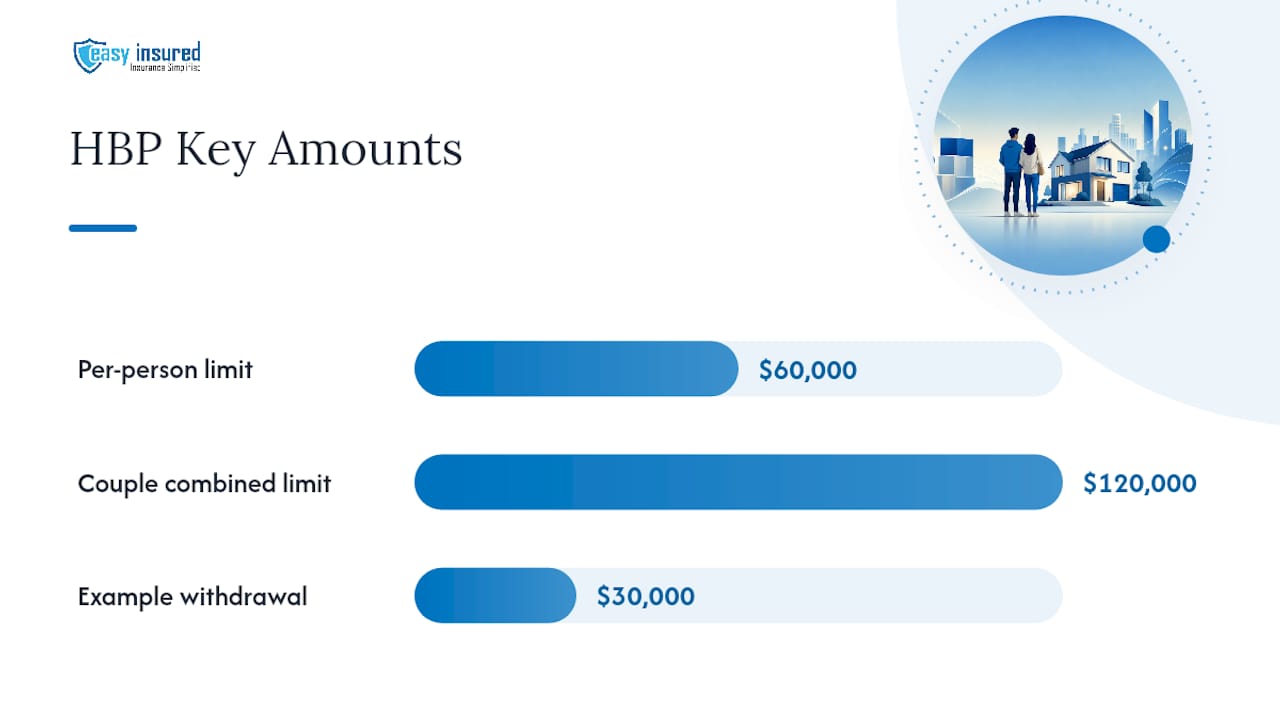
Table of Contents
- How does the RRSP Home Buyers’ Plan actually work?
- Who qualifies for the HBP?
- How to withdraw RRSP funds under the HBP, step by step
- How does the HBP interact with the First Home Savings Account?
- Benefits and trade-offs of using the HBP for a down payment
- Common HBP mistakes and how to fix them
- What CRA forms do you need for the HBP?
- Sources
How does the RRSP Home Buyers’ Plan actually work?
The HBP is a federal program that lets you borrow from your own RRSP, interest-free, to fund a home purchase. The Canada Revenue Agency (CRA) treats the withdrawal as a loan to yourself rather than taxable income — as long as you repay it within the required schedule. Miss repayments, and the CRA adds the missed portion to your taxable income for that year.
Withdrawal mechanics and limits
Each eligible person can withdraw up to $60,000 from their RRSP under the HBP. You can make multiple withdrawals across different RRSP accounts in the same calendar year, and you can also make withdrawals in January of the following year and still count them toward the same home purchase — provided the written agreement to buy or build was in place before October 1 of the prior year.
The funds must come from your own RRSP, not a spousal RRSP you contributed to (though your spouse can withdraw from their own RRSP under their own HBP participation). Locked-in RRSPs and group RRSPs may have restrictions — confirm with your issuer.
Key limit: $60,000 per person. A couple where both partners qualify can access $120,000 combined. Amounts withdrawn above the individual limit must be reported as income for that year.
Repayment schedule and tax consequences
Repayment begins the second calendar year after the year you make your first HBP withdrawal. You have 15 years to repay the full amount. Each year, the CRA expects you to contribute at least 1/15th of the total amount you withdrew.
Worked example — $30,000 withdrawal:
| Detail | Amount |
|---|---|
| Total HBP withdrawal | $30,000 |
| Repayment period | 15 years |
| Annual minimum repayment | $4,000 ($60,000 ÷ 15) |
| Missed repayment consequence | $4,000 added to taxable income that year |
If you withdrew $60,000, your annual minimum is $4,000. Miss a year and $4,000 gets added to your income — taxed at your marginal rate. That is not a small number for most buyers.
You report HBP repayments and outstanding balances on Schedule 7 (RRSP, PRPP, and SPP Unused Contributions, Transfers, and HBP or LLP Activities) when you file your annual tax return.
Timeline from application to funds:
Most RRSP issuers process a completed T1036 within 5–10 business days, though timelines vary. Build at least two to three weeks of buffer between submitting your form and your closing date.
Who qualifies for the HBP?
The CRA’s eligibility definition is more specific than most buyers expect, and the spousal rule catches people off guard regularly.
The first-time home buyer test
You qualify as a first-time home buyer if neither you nor your spouse or common-law partner owned a home that either of you lived in as a principal place of residence at any time during the current calendar year or the four preceding calendar years. The lookback window is five years total.
CRA’s exact rule: “You are considered a first-time home buyer if, in the preceding four calendar years, you did not occupy a home that you or your current spouse or common-law partner owned.” This means your partner’s ownership history counts against you — even if you personally never owned property.
That last point trips up a lot of buyers. If your partner owned a home and lived in it three years ago, neither of you qualifies under the standard HBP rules right now.
The disabled person exception
If you or a related person with a disability is buying a home that is more accessible or better suited to their needs, the first-time buyer test may be waived. This exception applies even if you currently own a home. The CRA defines the qualifying conditions on its HBP definitions page.
What counts as a qualifying home
The property must be located in Canada and intended as your principal place of residence within one year of buying or building it. Condos, detached homes, semi-detached homes, townhouses, mobile homes, and certain shares in a co-operative housing corporation all qualify. Rental properties do not.
Other eligibility constraints
- You must have a written agreement to buy or build a qualifying home before you make the withdrawal.
- You cannot have an outstanding HBP balance from a prior participation unless it has been fully repaid.
- You must be a Canadian resident at the time of the withdrawal.
Pro Tip: If you previously used the HBP and fully repaid it, you may be eligible to participate again — but only if you meet the first-time buyer test again. Check your CRA My Account for your current HBP balance before assuming you are clear.
How to withdraw RRSP funds under the HBP, step by step
Getting the withdrawal right matters. A procedural error — wrong form, wrong timing, wrong account — can turn a tax-free withdrawal into taxable income. Here is the exact sequence.
Step-by-step withdrawal process
- Verify your eligibility. Confirm you meet the first-time buyer test, have a written agreement to buy or build, and have no outstanding HBP balance.
- Check the 89-day rule. Any RRSP contributions made within 89 days before your planned withdrawal date may not be deductible. If you recently contributed, confirm the contribution date before proceeding — you can still withdraw the funds, but you may lose the deduction on that contribution.
- Complete Area 1 of Form T1036. Fill in your personal information, the amount you want to withdraw, and certify that you meet the HBP conditions. You sign this section.
- Submit the form to your RRSP issuer. Each RRSP account you withdraw from requires its own T1036. If you have three RRSP accounts and want to pull from all three, you need three separate forms.
- Issuer completes Area 2. Your RRSP issuer fills in Area 2, confirms the withdrawal details, and releases the funds. They will also issue a T4RSP slip showing the HBP withdrawal — this slip confirms the amount is not taxable income.
- Receive funds. Processing typically takes 5–10 business days per issuer, though some institutions are faster. Wire transfers or direct deposits are common.
- Report on Schedule 7. When you file your tax return for the year of withdrawal, report the HBP amount on Schedule 7. No tax is owed on the withdrawal itself if all conditions are met.
Documents your issuer will typically need
- Completed and signed Form T1036 (Area 1)
- Government-issued photo ID
- A copy of your signed purchase agreement or building contract (some issuers require this; others do not — ask in advance)
Timing rules for multiple withdrawals
You can make more than one HBP withdrawal, from the same or different RRSP accounts, as long as your total does not exceed $60,000. All withdrawals must occur in the same calendar year, with one exception: withdrawals made in January of the following year can still count toward the same home purchase if your written agreement was signed before October 1 of the prior year.
Pro Tip: Read the RRSP contribution deadline guide before making last-minute contributions. The 89-day window is calculated from the date of each contribution, not the date you open the account — so a contribution made in early January could still fall inside the window if your withdrawal happens in late March.
How does the HBP interact with the First Home Savings Account?
The First Home Savings Account (FHSA) is a registered account introduced specifically for first-time home buyers. You can use both an FHSA withdrawal and an HBP withdrawal for the same qualifying home purchase, provided the conditions for each program are independently satisfied.
That combination is one of the most powerful planning tools available to Canadian first-time buyers right now.
Tax treatment compared
- FHSA: Contributions are tax-deductible (like an RRSP). Qualifying withdrawals for a first home are completely tax-free and do not need to be repaid. The account has an annual contribution limit of $8,000 and a lifetime limit of $40,000.
- HBP: Withdrawals are tax-free only if repaid over 15 years. Fail to repay and the missed amount becomes taxable income. There is no contribution limit specific to the HBP — it draws on your existing RRSP balance.
The FHSA is the cleaner option from a repayment standpoint. But most buyers do not have $40,000 sitting in an FHSA, especially if the account was opened recently. The HBP fills the gap by tapping a larger, longer-established RRSP balance.
Sequencing and coordination tips
- Exhaust your FHSA first when possible. Since FHSA withdrawals require no repayment, they preserve your retirement savings more effectively than HBP withdrawals.
- Watch the 89-day rule on RRSP contributions if you are also contributing to an RRSP in the same period. FHSA contributions do not trigger the 89-day rule for HBP purposes.
- Mortgage approval: Some lenders factor HBP repayment obligations into your debt service ratios. FHSA withdrawals carry no such obligation. If you are close to a stress test threshold, the order in which you draw from each account can affect your approval.
Pro Tip: The combined FHSA-plus-HBP strategy can put a substantial down payment together, but the tax and retirement math is genuinely complex. A financial planning consultation before you withdraw from either account can save you from a repayment schedule that strains your budget for 15 years.
Benefits and trade-offs of using the HBP for a down payment
The HBP is genuinely useful. It is also genuinely misunderstood. Here is an honest look at both sides.
Advantages
- Tax-free access to savings. You access funds that would otherwise be locked in a tax-deferred account, with no immediate tax hit.
- Larger down payment. A bigger down payment can push you above the 20% threshold, eliminating the need for CMHC mortgage default insurance — which can add tens of thousands of dollars to the total cost of your mortgage.
- Interest-free loan. There is no interest charged on the HBP withdrawal. The only “cost” is the opportunity cost of lost RRSP growth while the funds are out.
- Works alongside the FHSA. As discussed above, you can stack both programs for the same purchase.
Important trade-offs
- Lost compound growth. Every dollar out of your RRSP stops compounding. Over 15 years, a $60,000 withdrawal at a 6% average annual return represents a meaningful reduction in your retirement balance — the exact amount depends on your investment mix and return assumptions, but the direction is always negative.
- Repayment discipline required. You owe $4,000 per year (on a $60,000 withdrawal) back into your RRSP for 15 years. That is a real cash flow obligation, on top of your mortgage payments, property taxes, and maintenance costs.
- Mortgage underwriting impact. Some lenders treat HBP repayment obligations similarly to other debt obligations when calculating your gross debt service (GDS) and total debt service (TDS) ratios. Ask your mortgage broker how your lender handles this.
- No flexibility on missed repayments. The CRA does not offer payment plans or extensions for missed HBP repayments. Miss a year and that amount is simply added to your income.
Pro Tip: Before withdrawing the maximum $60,000, model what $4,000 per year in RRSP repayments looks like alongside your projected mortgage payment. Many buyers find the first two to three years post-purchase are the tightest financially — a smaller HBP withdrawal with a lower annual repayment can be the smarter call.
Common HBP mistakes and how to fix them
The CRA flags several recurring errors that turn tax-free withdrawals into taxable income. Most are avoidable with a quick check before you submit anything.
The most common mistakes
- Misreading the first-time buyer test. Buyers assume the test applies only to them personally. It applies to your spouse or common-law partner too. If your partner owned and lived in a home at any point in the past five years, neither of you qualifies under the standard rules.
- Withdrawing with an outstanding HBP balance. If you used the HBP before and still have an unpaid balance, a new withdrawal is not permitted until the balance is cleared. The CRA will treat the new withdrawal as taxable income.
- Violating the 89-day rule. Contributing to an RRSP and withdrawing under the HBP within 89 days means the contribution may not be deductible. You still get the withdrawal, but you lose the tax deduction — which defeats the purpose of the last-minute contribution.
- Making false statements on Form T1036. The form requires you to certify eligibility. Certifying incorrectly — even accidentally — can result in the withdrawal being treated as taxable income and potential CRA penalties.
- Missing annual repayments. Missed repayments are added to your taxable income for that year. This is not a penalty per se, but the tax hit can be significant depending on your marginal rate.
How to fix problems
If you discover ineligibility after withdrawal: Contact the CRA immediately. In some cases, you may be able to cancel the withdrawal using Form RC471 (Home Buyers’ Plan Cancellation) and return the funds to your RRSP, avoiding the income inclusion. Timing and eligibility rules apply — this is not always available, and the window is narrow.
If you miss a repayment: You cannot retroactively fix a missed repayment year. The missed amount is included in your income for that year. Going forward, you continue making annual repayments on the remaining balance. The 15-year clock does not reset.
For immediate help: Contact your RRSP issuer first for account-specific questions. For eligibility and tax questions, the CRA’s individual tax enquiries line handles HBP questions directly. CRA My Account also shows your current HBP balance and repayment history.
What CRA forms do you need for the HBP?
Every HBP transaction runs through a specific CRA form. Here is what each one does and where to get it.
- Form T1036 — Home Buyers’ Plan Request to Withdraw Funds from an RRSP: The core withdrawal form. You complete Area 1 and sign it; your RRSP issuer completes Area 2 before releasing funds. One form per withdrawal per RRSP account.
- Schedule 7 — RRSP, PRPP, and SPP Unused Contributions, Transfers, and HBP or LLP Activities: Filed with your annual T1 return. Reports your HBP withdrawal amount, tracks repayments made during the year, and carries forward your outstanding balance.
- Form RC471 — Home Buyers’ Plan Cancellation: Used to cancel an HBP withdrawal and return funds to your RRSP when eligible. Specific timing and eligibility conditions apply — not available in all situations.
- Form RC98 — Home Buyers’ Plan Transfer on Death: Handles HBP balance treatment on the death of the plan holder. Relevant for estate planning purposes.
All four forms are available as fillable PDFs on Canada.ca. Download directly from the CRA forms page to ensure you have the current version — third-party copies may be outdated.
| Form | Purpose | Who completes it |
|---|---|---|
| T1036 | Withdrawal request | You (Area 1) + RRSP issuer (Area 2) |
| Schedule 7 | Annual tax reporting of HBP activity | You (filed with T1 return) |
| RC471 | Cancellation of HBP withdrawal | You (submitted to CRA) |
| RC98 | Transfer on death of plan holder | Estate/plan administrator |
Processing time for T1036 varies by issuer — typically 5–10 business days. Submit well before your closing date. For Schedule 7, it is filed with your regular tax return by the April 30 deadline (or June 15 if self-employed, though any balance owing is still due April 30).
A practical perspective on when the HBP makes sense
The HBP is a good tool for buyers who have meaningful RRSP savings, a stable income to support 15 years of repayments, and a down payment gap that the HBP can close. It is less useful for buyers with small RRSP balances, those close to retirement, or anyone whose cash flow will be stretched thin by both a mortgage and annual repayments.
The FHSA-plus-HBP combination is genuinely worth exploring for buyers who opened an FHSA early and have built up both accounts. But the sequencing matters, and the retirement trade-offs are real. Pulling $60,000 from an RRSP at age 30 versus age 40 has very different long-term consequences — the compounding math is not forgiving.
Easy-insured’s financial planning advisors work through exactly these trade-offs with clients: how much to withdraw, whether to prioritize FHSA or RRSP, and how to structure repayments without derailing retirement goals. The HBP is not a decision to make based on a CRA form alone.
Protect your home purchase with the right coverage
Buying your first home is one of the largest financial commitments you will make. The HBP helps you get there — but once you own the home, protecting it matters just as much as funding the down payment.

Easy-insured works with Canadian homeowners and first-time buyers to build coverage that fits the full picture: term life insurance to protect your mortgage if something happens to you, disability coverage to keep repayments on track if you cannot work, and financial planning to coordinate your HBP repayment schedule with your retirement goals. These are not separate conversations — they belong together.
If you want a clear view of how your HBP withdrawal fits into your broader financial plan, an Easy-insured advisor can map it out with you. Get in touch for a no-obligation consultation at Easy-insured.
Sources
The rules and forms referenced throughout this guide come directly from CRA. Check these pages for the most current information, as limits and procedures can change:
- The Home Buyers’ Plan (HBP)
- How to make withdrawals from your RRSPs under the Home Buyers’ Plan
- Definitions — Home Buyers’ Plan
CRA updates these pages periodically. Verify current limits and form versions directly on Canada.ca before submitting any withdrawal request.
This article provides general information about the RRSP Home Buyers’ Plan and is not a substitute for personalized tax or financial advice. Confirm current rules with the CRA or a qualified financial advisor before making any withdrawal.