
A donor-advised fund (DAF) is an account held inside an existing charity, usually a public foundation. A private foundation is a separate registered charity that you create and run yourself. The DAF is faster, cheaper and more private. The private foundation gives you full control, but it costs more and brings heavier legal duties. Which one fits depends on how much you plan to give, how much control you want and how much administration you will accept.
TL;DR
- A DAF is quick to open and low in cost, and you advise on grants. The charity that holds the fund makes the final decision.
- A private foundation gives you control over investments, grants and timing. It needs legal setup, annual filings and ongoing administration.
- Both can issue official donation receipts, so the donor tax credit works in the same way for gifts to either.
- A DAF’s details stay private. A private foundation’s financials, directors and grants are public on the CRA website.
- Many advisers see private foundations as suited to very large, long-term giving. Smaller or less hands-on goals usually fit a DAF.
Table of Contents
- The core difference: who owns the money
- DAF vs private foundation at a glance
- What each costs to set up and run
- Who controls grants and investments
- Tax credits and donation receipts
- Annual obligations after you give
- Privacy and family continuity
- Which fits your situation
- Where giving fits in your wider plan
- Our perspective
- Plan your giving with Easy Insured
- FAQ
- Sources
The core difference: who owns the money
In Canada, a DAF is a fund established by a charity, usually a foundation. According to a Canadian charity law analysis, donations to it are irrevocable, the funds belong to the charity, and the donor provides non-binding advice. Once you give, the gift is no longer yours. The charity’s board must control how the resources are managed and used.
A private foundation works differently. You (or your family, or your corporation) create a registered charity and fund it. The CRA explains that a charity is typically designated a private foundation if 50% or more of its directors or trustees do not deal at arm’s length with each other. The same is true if more than 50% of its funding comes from a person or group that controls it. So the foundation is yours to steer, within the rules for charities.
A public foundation, which usually hosts DAFs, is the opposite. Per the CRA’s description of charity designations, it is controlled by a board where more than half of the members deal with one another at arm’s length. It generally receives funding from several arm’s-length donors. That independent board is why the donor’s role in a DAF is advisory.
DAF vs private foundation at a glance
| Feature | Donor-advised fund | Private foundation |
|---|---|---|
| Legal status | Fund held inside a public foundation or other charity | Separate registered charity (corporation or trust) |
| Setup time | Days, sometimes as little as 24 hours | Often 6 to 12 months |
| Setup cost | Often none at community foundations | Legal costs commonly $5,000 to $15,000 |
| Ongoing cost | Administrative fee on assets | Accounting, legal, filings, administration |
| Grant decisions | Donor advises, charity decides | Your board decides |
| Investment choices | Within the host charity’s options | Set by your directors |
| Privacy | Individual DAF details not disclosed | Financials and grants public |
| Donation receipt | Yes | Yes |
The figures behind the table come from the sections below.
What each costs to set up and run
Cost is where the two options part most clearly.
Setting up a DAF
The Toronto Foundation says that opening a DAF with them takes less than a week at no cost. JCF Montreal says that opening a DAF at a public foundation can take as little as 24 hours with minimal start-up costs. Minimums vary by host. The Calgary Foundation’s July 2026 comparison lists a $10,000 minimum contribution for DAFs at community foundations. It lists a range of $10,000 to $250,000 for DAFs at financial institutions.
Ongoing fees are an annual percentage of assets. JCF Montreal reports average DAF administrative fees of 0.2% a year, with no fees on cash balances. Charity Law Group, in its guide to DAFs, says management fees typically run from 0.5% to 2% of assets annually. Fee schedules differ by provider, so read the host’s current schedule before you commit.
Setting up a private foundation
A private foundation needs incorporation or a trust, bylaws, and an application for charitable status from the CRA. Toronto Foundation states that this can take 6 to 12 months, with legal costs starting at $7,000. It also notes a recommended minimum fund balance of $5 million. The Calgary Foundation puts legal and registration costs at $5,000 to $10,000. It describes current expert opinion on seed capital as $3 million to $5 million. Charity Law Group says that comprehensive legal help to incorporate and register typically costs $5,900 to $15,000.
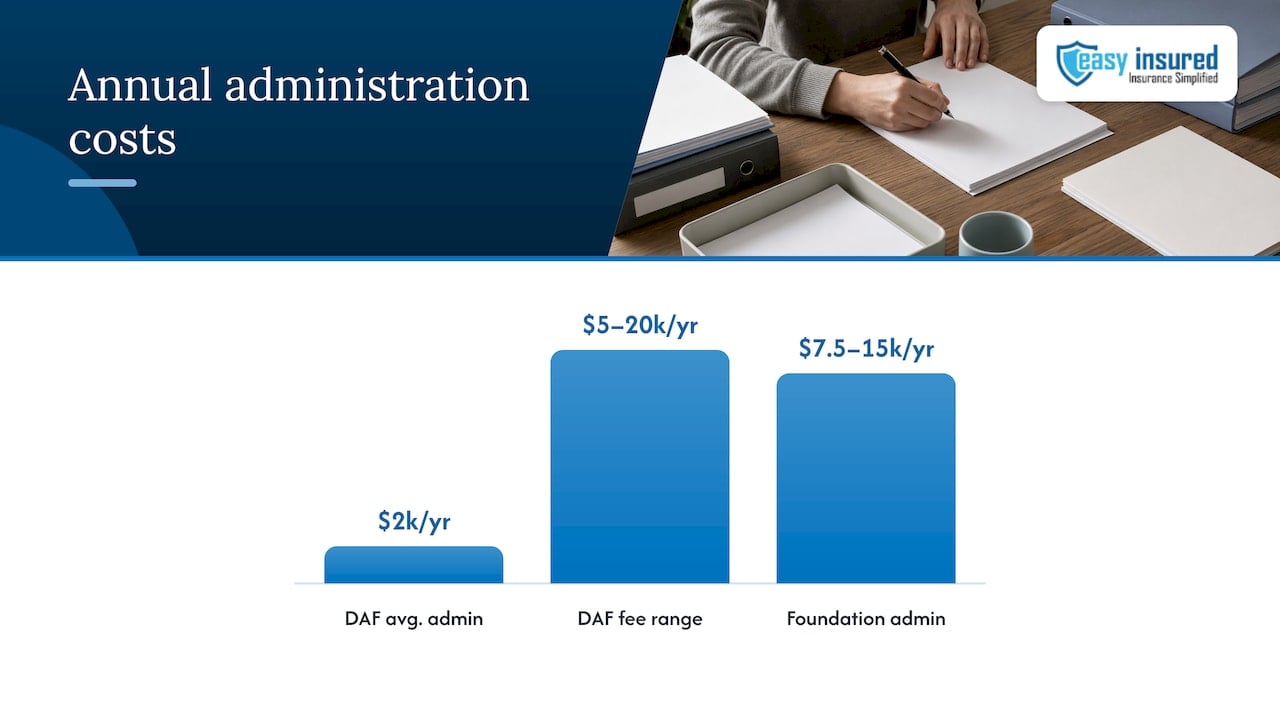
Running costs continue every year. Charity Law Group says legal fees, accounting and administration for a private foundation can easily exceed $10,000 a year. The Calgary Foundation says administrative fees for private foundations typically run from 0.75% to 1.5% of assets, before investment management fees. You also pay for accounting, the annual T3010 filing and portfolio management.
A simple cost example
Take a $1 million gift. At the 0.2% average fee JCF Montreal cites, a DAF’s administration costs about $2,000 a year. At Charity Law Group’s 0.5% to 2% range, the cost would run from $5,000 to $20,000 a year. A private foundation of the same size would face the Calgary Foundation’s 0.75% to 1.5%, which is $7,500 to $15,000 a year. Add investment fees, and the legal setup cost on top. These are illustrations built from the published ranges, not quotes. The point is that at smaller sizes, the fixed costs of a private foundation weigh heavily against the giving it supports. That is why the Toronto Foundation and Calgary Foundation both point to seed capital in the millions.
Who controls grants and investments
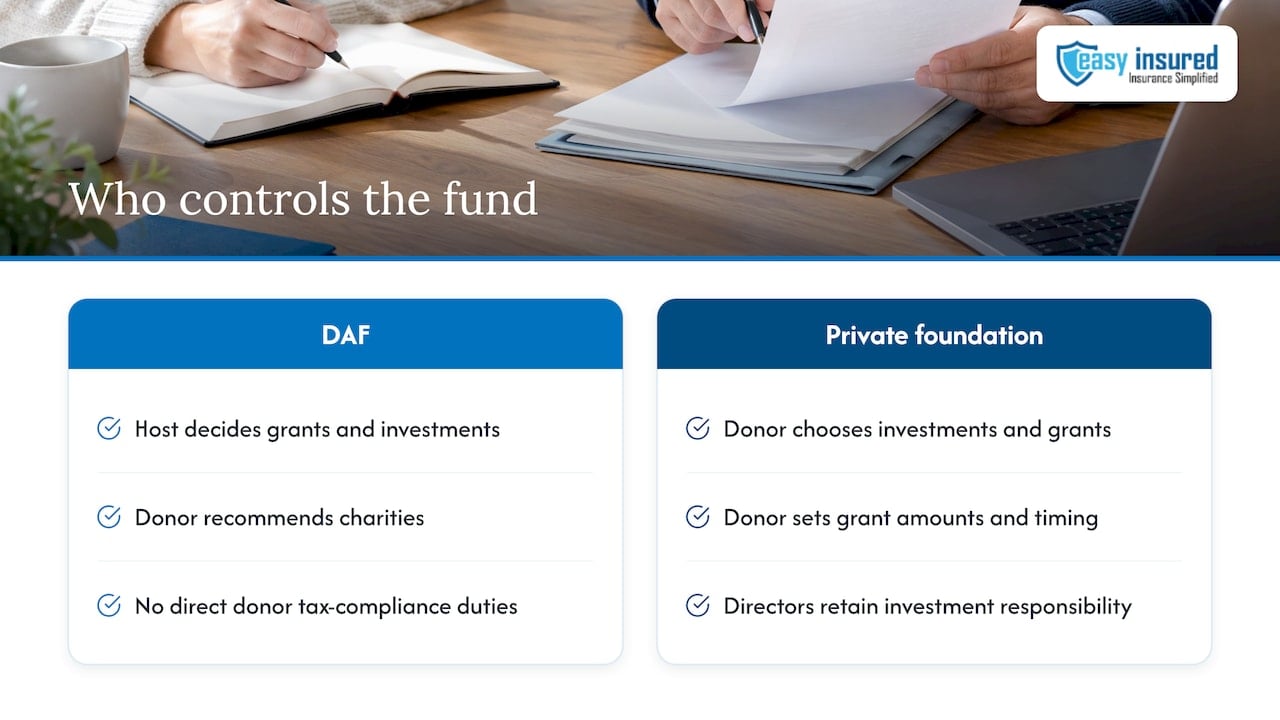
With a DAF, you recommend. The host charity decides. The Carters paper on DAFs, a primer from a Canadian charity law firm, says all administrative, operational and governance matters rest with the holding charity, because the fund is its property alone. A planning newsletter from Leith Wheeler adds that the foundation administers, invests and maintains the fund. You have no direct tax-compliance obligations and may advise on which charities to support, but the foundation has ultimate control over distributions.
With a private foundation, Philanthropic Foundations Canada explains that the donor keeps control of decisions. That covers how assets are invested, which charities are supported, and the amounts and timing of grants. Control comes with responsibility. In its governance guide, PFC notes that directors or trustees remain responsible for investments even when they delegate to an investment committee, consultant or outside manager.
In practice, the question is whether you want to choose the investments and the grants yourself, or whether you would prefer a trusted host to handle everything while you shape the giving.
Tax credits and donation receipts
Both structures are registered charities, so both can issue official receipts. The CRA states that all registered charities, whatever their designation, can issue official donation receipts for income tax purposes.
The credit works the same way for both. According to the CRA’s guide to gifts and income tax, a donor may claim federal and provincial or territorial non-refundable tax credits for a gift to a qualified donee if they receive an official receipt. Claims are generally limited to 75% of net income, with exceptions and carry-forward rules.
This is why a DAF suits a high-income year. You receive the receipt when you contribute to the fund, then decide over time which causes to support. Tax rules for specific assets, such as shares or private company holdings, deserve a conversation with your accountant before you give.
Annual obligations after you give
Disbursement quota
Both public and private foundations must meet a disbursement quota. The CRA’s calculation page says that if the average value of property not used directly in charitable activities or administration exceeds $25,000, the quota is 3.5% of the average value up to $1 million. It is 5% on the amount above $1 million. Charity Law Group notes these rates apply to taxation years beginning on or after January 1, 2023.
Veritas Charity Services’ DAF market report shows the Canadian DAF market, excluding community foundations, reached $6.2 billion in 2023. Its payout ratio was 9.7%, more than double the required minimum of 5% it cites. The same report notes that this was a decline from 10.7% in 2022 and that it is more than double the payout ratio of private foundations. It also puts the community foundation payout ratio at 5.4% of average assets.
Filing and records
A private foundation carries the paperwork itself. The CRA says a registered charity must file a T3010 every year within six months of its fiscal year-end, keep complete books and records, meet its disbursement quota, and make sure its official receipts are complete and accurate. With a DAF, the host charity carries these duties.
Investment rules that apply to private foundations
Private foundations also face rules that matter if the donor owns a company:
- Business activity. The CRA’s policy commentary says paragraph 149.1(4)(a) of the Income Tax Act prohibits private foundations from any business activity. Managing your own investment portfolio generally is not one, though the extent of the activity is weighed against the size of holdings.
- Excess corporate holdings. Under the CRA’s regime for private foundations, a foundation holding more than 2% of a share class, while the foundation and relevant persons together hold more than 20%, may face divestment obligations. Holdings are reported on Form T2081 with the T3010.
- Non-qualified investments. The CRA’s tax liability page explains that debts or shares from related persons or controlled corporations can trigger a tax under section 189 of the Income Tax Act, if the foundation does not receive interest or dividends at prescribed rates.
These rules matter most to business owners hoping to fund a foundation with private company shares. Get tailored legal and tax advice before you transfer them.
Privacy and family continuity
Despite the name, a private foundation is not private. JCF Montreal says private foundations are open to public scrutiny. Most T3010 information, including financials, director or trustee details and all grants made, is public on the CRA website. The Toronto Foundation says DAF donor and financial information is not disclosed and grants can be made anonymously. JCF Montreal adds that individual DAFs at public foundations report in aggregate.
For families, the structures carry on the giving differently. A private foundation can keep your children as directors, so they learn to govern a charity and set grant policy together. A DAF can involve family too. The CAGP’s guide for donors says a DAF may suit donors who want to involve family in philanthropic planning. It also lists those planning a philanthropic legacy through their estate. A DAF can name successor advisors, subject to the host’s policies. Ask the host how succession works before you give.
Which fits your situation
A DAF tends to fit when:
- You want to simplify your giving into one receipt and one account.
- You have a high-income year or a liquidity event, such as selling a business or property, and want the credit now.
- You want to give a significant amount now and choose the causes later.
- You value privacy.
- Your giving is in the range where a hosted fund’s fees are lower than running a separate charity.
A private foundation tends to fit when:
- You plan to give at a scale where legal and administration costs are a small share of the assets.
- You want to choose every investment and every grant yourself.
- You want a long-term family governance structure with directors who are family members.
- You are comfortable with public reporting.
The Calgary Foundation notes that among Canada’s 11,000 active foundations, more than 6,000 are private. So the private foundation is well established. It is simply a different tool for a different scale of giving.
Some donors use both. They keep a private foundation for core family causes and a DAF for flexible or anonymous gifts. That depends on the size of your assets and your advisers.
Where giving fits in your wider plan
Charitable giving is one piece of how you pass wealth on. A gift in your will, or a gift of a policy or securities, interacts with probate, taxes on death and what your family receives. Our guide on probate fees by province shows what your estate could face. Our overview of estate planning strategies to reduce estate taxes covers where giving can sit alongside those moves. If you are building documents, the estate planning checklist lists the essentials.
Our perspective
Most people who ask us about a DAF or a private foundation are really asking a bigger question: how do I give well without leaving my family short?
We start with the family and the business. What income do you need in retirement? What does your spouse need if you die early? What does a business owner need if a partner is disabled? Once those needs are covered, giving becomes a choice rather than a worry. Life insurance, disability and critical illness cover, and a proper estate plan are what make a larger gift something you can afford.
A certified financial planner can then place charitable giving inside the plan. That means timing a receipt against a high-income year, checking how a gift in the will interacts with probate, and deciding whether a hosted fund or a stand-alone foundation matches the size of your giving. We see the structure as the last step, not the first.
For many families we meet, a simple, well-documented plan does more good than a complicated structure. Whichever route you pick, bring your lawyer and accountant in early.
Frank
Plan your giving with Easy Insured
Charitable goals work best when the rest of your plan is solid. Our team helps Canadian families and business owners with estate planning and financial planning. We also cover the protection that keeps your plan on track, including life insurance and disability insurance. You can see everything we offer on our services page.
Bring your questions about gifts, your will and your business to a conversation with a certified financial planner.
FAQ
Can I get a tax receipt right away with a DAF?
Yes. A DAF sits inside a registered charity, and registered charities can issue official donation receipts. You receive the receipt when you contribute to the fund, not when grants go out. Claims are generally limited to 75% of net income, with carry-forward rules, so confirm the limits with your accountant.
Is a private foundation worth it for a smaller gift?
Usually not. Published guidance from Canadian community foundations points to legal setup costs in the thousands of dollars and recommended seed capital of $3 million to $5 million or more. Annual accounting, filing and administration add to that. Smaller amounts generally fit a DAF, where the host handles the administration.
Can I change my mind and take money back from a DAF?
No. Donations to a DAF are irrevocable and the funds belong to the charity. You advise on grants, but the host’s board decides. A private foundation is also a charity, so assets given to it must be used for charitable purposes, even though you control the decisions.
Does a private foundation keep my giving confidential?
No. A private foundation files a T3010 every year, and much of it is public on the CRA website. That includes financial details, directors or trustees and grants made. A DAF reports in aggregate, so individual donors and grants are not disclosed.
Can a business owner fund a private foundation with company shares?
Possibly, but special rules apply. The CRA’s excess corporate holdings regime and its rules on non-qualified investments can affect foundations that hold shares of related corporations. Speak with a charity lawyer and your accountant before you transfer any shares.
Sources
- CRA: About becoming a registered charity
- CRA: Types of registered charities (designations)
- CRA: Gifts and Income Tax
- CRA: Disbursement quota calculation
- CRA: Excess corporate holdings regime for private foundations
- CRA: Non-qualified investment tax liability
- CRA: Private foundations and investment portfolios
- Toronto Foundation: DAFs versus private foundations
- Calgary Foundation: Comparing your options
- JCF Montreal: Private foundations vs. donor-advised funds
- Charity Law Group: How to start a foundation in Canada
- Charity Law Group: Donor advised funds
- Veritas Charity Services: Advised fund market report
- Philanthropic Foundations Canada: Starting a foundation
- Philanthropic Foundations Canada: Good governance
- Canadian Foundations Perspectives: Donor-advised fund assumptions
- Carters: Primer on donor advised funds
- Leith Wheeler: Four ways of charitable giving
- CAGP: Donor-advised funds resource for donors