
Segregated funds can protect your savings from creditors in Canada, but not automatically. The protection comes from insurance law, not from the fund itself. It generally depends on the beneficiary you name, the province you live in, and the timing and purpose of your purchase. If you run a business or work in a profession with personal liability, it is worth understanding before you decide where your savings sit.
This guide explains why a segregated fund is treated differently from a mutual fund, who can qualify, what can undo the protection, and how to set up your contract so it does the job you want.
TL;DR
- A segregated fund is an insurance contract, so provincial insurance law can put it out of reach of creditors. A mutual fund is not an insurance contract and has no such feature.
- The protection usually turns on your beneficiary. Naming a spouse, child, grandchild or parent (the “protected” class in some provinces) is the typical route. Naming your estate generally removes it.
- Rules differ by province, and bankruptcy law adds its own tests, so confirm your situation with a licensed advisor before relying on it.
- Protection is not guaranteed, and it is not the same thing as Assuris or CIPF coverage, which address insurer or dealer failure.
Table of Contents
- Why segregated funds are treated differently
- Who can qualify for protection
- Why the beneficiary choice matters so much
- What happens in a bankruptcy or creditor claim
- What can put the protection at risk
- Creditor protection is not the same as Assuris or CIPF
- Who tends to look at this strategy
- How to set it up well
- A note on contract features
- Talk to us about your plan
- FAQ
- Sources
Why segregated funds are treated differently
A segregated fund is issued by a life insurance company. Legally it is an insurance contract that holds investments, which is why it can come with features a mutual fund cannot offer: maturity and death benefit guarantees, the ability to name a beneficiary directly, and potential creditor protection.
The Canada Revenue Agency has said as much in a 2022 technical interpretation. It stated that a segregated fund is, for relevant Income Tax Act purposes, a life insurance policy, and that creditor protection in common-law provinces may arise under provincial Insurance Acts when the beneficiary relationship falls within a prescribed class. In the same interpretation, the CRA noted that whether a shareholder benefit arises from a beneficiary arrangement is a question of fact decided case by case, which is a good reminder that structure and facts both matter.
That is the key idea. Creditor protection is a feature of the contract and the law around it. It does not come from the investments inside.
Who can qualify for protection
Provincial insurance legislation sets the rules, so the answer depends on where you live. Ontario is a useful example because many business owners are there.
Under section 196 of Ontario’s Insurance Act, insurance money is protected from the insured’s creditors once it becomes payable when a beneficiary has been designated. While a designation in favour of a spouse, child, grandchild or parent is in effect, the insured’s rights and interests in the contract are exempt from execution or seizure. The version of the statute linked here is an older consolidation, so check the current text on the Ontario e-Laws site or with your advisor before acting.
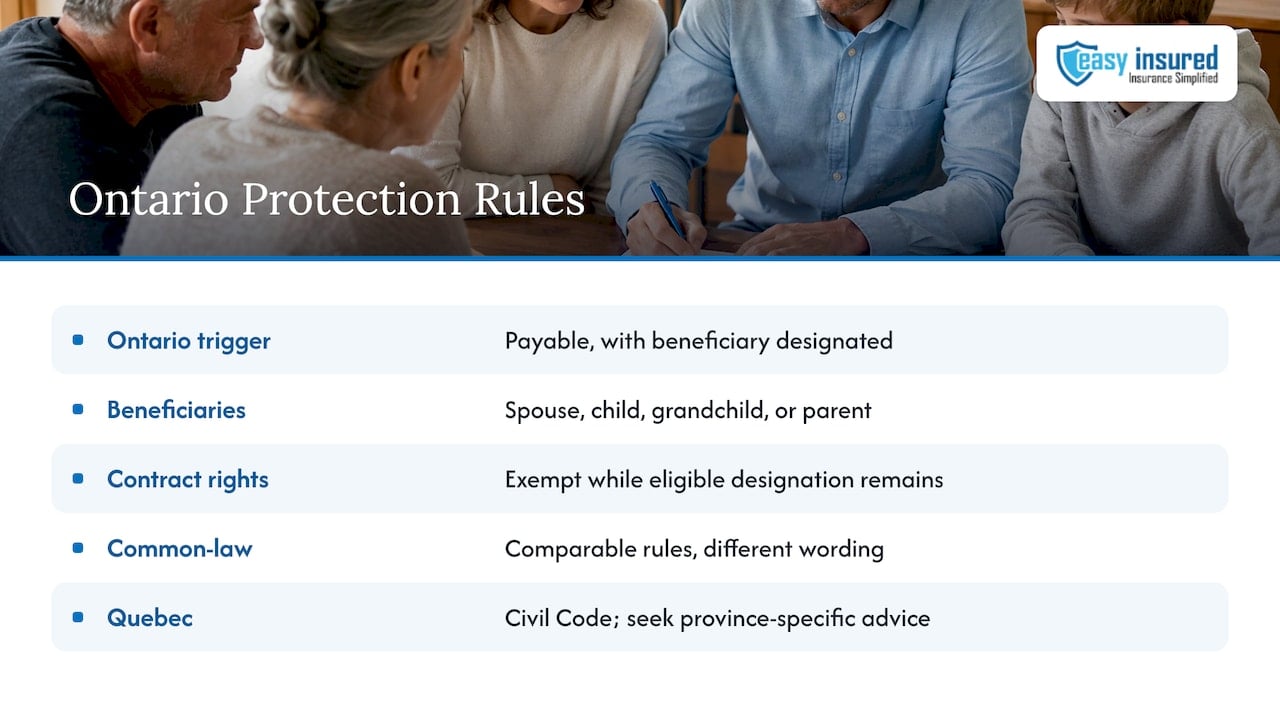
Other common-law provinces have comparable provisions with their own wording. Quebec works differently, under its Civil Code, so a Quebec resident should get province-specific advice before assuming anything carries over from the Ontario example.
Typical beneficiary categories
| Beneficiary designation | General effect on creditor protection | What to confirm |
|---|---|---|
| Spouse, child, grandchild or parent (in a province that protects this class) | This is the usual route to potential protection | The exact wording of your province’s Insurance Act |
| Another individual, such as a sibling or friend | Often outside the protected class | Whether your province extends protection to other beneficiaries |
| Your estate | Proceeds generally become estate property open to estate creditors | Whether this is really your intent |
| Irrevocable beneficiary | Changes who controls the contract, with its own legal effects | Ask a licensed advisor before using it |
Treat the table as a map of questions, not as legal advice. Your province, your family and your business structure all change the answer.
Why the beneficiary choice matters so much
The beneficiary does two jobs. It decides who receives the money, and it often decides whether the contract qualifies for protection.
A direct beneficiary designation also keeps the money out of the estate. An Ontario law firm’s explanation notes that naming the estate can remove the main estate-planning advantage: proceeds generally become estate property exposed to estate creditors, while a valid direct designation normally bypasses the estate. This is the same reason segregated funds come up so often in probate planning. If you want more on that side, our guide on how to avoid probate in Canada walks through the main tools, and our probate fees by province comparison shows what is at stake in your province.
A few practical habits follow from this:
- Name a beneficiary directly. Do not leave the field blank, and do not default to the estate unless you have a reason.
- Match the designation to the protected class in your province when creditor protection is a goal.
- Review after life events. Marriage, divorce, a new child or a death in the family can leave an old designation out of step with your plan.
- Keep your will consistent. A will that says one thing while your contract says another is a common source of disputes. Our estate planning checklist covers the documents that should agree with each other.
The same discipline applies to registered accounts. If you hold a TFSA, see how a successor holder or named beneficiary is set up, because the choices interact.
What happens in a bankruptcy or creditor claim
Bankruptcy law sits on top of provincial insurance law, which is why this area needs care.
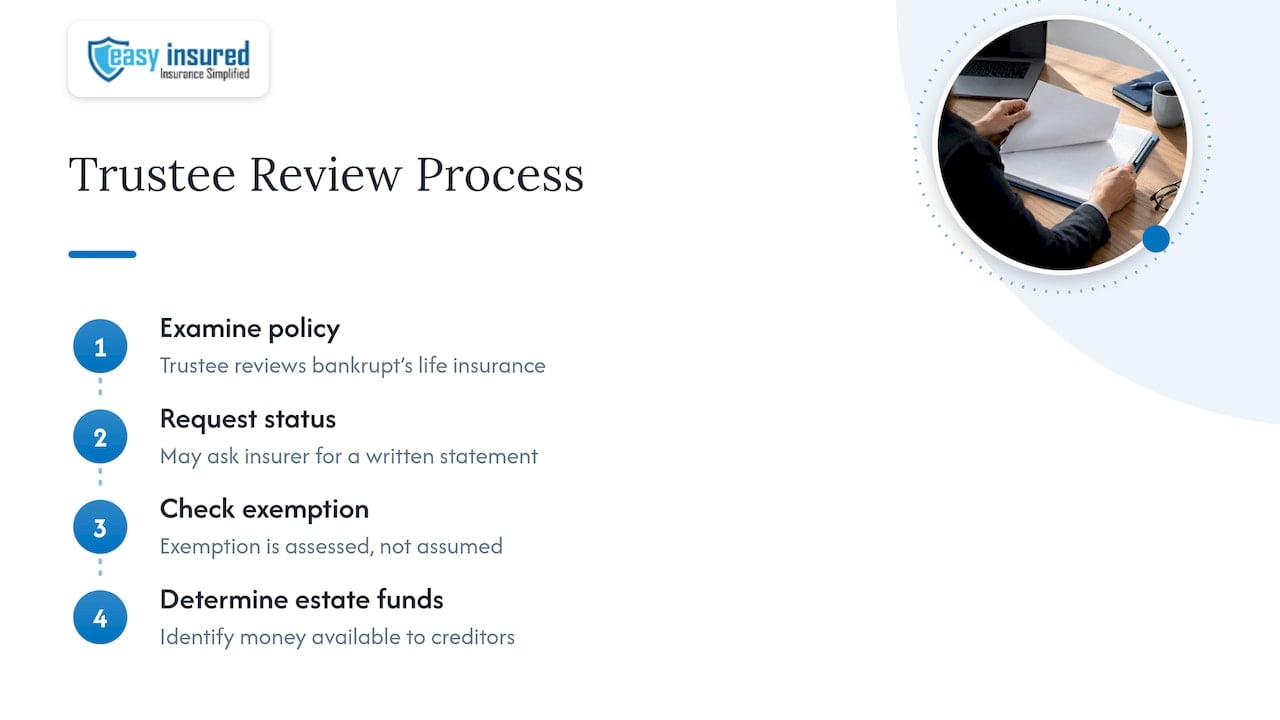
When someone goes bankrupt, the trustee has a duty to look at life insurance. Under the Office of the Superintendent of Bankruptcy’s Directive 25R, a trustee must examine a bankrupt’s life insurance policy, which may include asking the insurer for a written status statement, so that any money available to creditors is paid into the estate. In other words, the trustee will check whether your contract is really exempt. It will not simply be assumed.
The Supreme Court of Canada looked at how federal and provincial rules fit together in Royal Bank of Canada v. North American Life Assurance Co. (1996). The court confirmed that even if a beneficiary designation is voidable under the Bankruptcy and Insolvency Act’s settlement rules, the asset may stay exempt from execution if it qualifies as an insurance annuity under provincial law. The case concerned a Saskatchewan RRIF, where the exemption under provincial law survived even though the designation was void against the trustee. It shows that provincial exemptions can carry real weight in a bankruptcy.
The lesson is not that every contract is safe. It is that the rules are layered, and a well-built contract set up early has the best chance of standing up.
What can put the protection at risk
In practice, a few patterns are worth avoiding. They are general risk factors that advisors and lawyers discuss, not a complete list, so ask about your own circumstances.
- Timing. Moving assets into a contract when you already face a claim or expect one can invite a challenge. Protection is best arranged as part of ordinary planning, well before any trouble.
- Naming the estate or an unprotected beneficiary. As covered above, this can remove the shield.
- Contracts that do not fit the rules. Not every product with an investment component qualifies in every province. The contract has to be a genuine insurance contract meeting your province’s definitions.
- Business guarantees. If you personally guaranteed a business loan, the lender is a creditor with a direct claim on you. Ask how a particular guarantee interacts with your plan.
- Outdated designations. A beneficiary change that was never filed, or a family change that was never reflected, can undo the intended result.
None of this is a reason to avoid the strategy. It is the reason to set it up with care and keep it current.
Creditor protection is not the same as Assuris or CIPF
Readers often mix these up, so it helps to separate them.
- Creditor protection is about your own creditors: people or institutions you owe money to. It is a feature of insurance law and your beneficiary choice.
- Assuris is the industry-funded protection for policyholders if a life insurer fails.
- CIPF is protection for customers of certain investment dealers and mutual fund dealers if the dealer fails. It sits outside the insurance contract world.
They answer different questions. Asking whether a seg fund is protected from creditors is not the same as asking whether your money is safe if the company holding it collapses. For the details and limits of insurer-failure protection, read the current information published by Assuris directly.
Who tends to look at this strategy
The feature draws the most interest from people whose personal assets could be exposed to business or professional risk:
- Business owners who carry debt, personal guarantees or contractual liability.
- Self-employed professionals whose work involves personal exposure. If this is you, consider also how your income is protected, for example through disability insurance for self-employed Canadians.
- Families who want savings to pass directly to loved ones without delay. Our guide for executors on probate explains what the estate route involves.
- Anyone building a legacy plan, who may also want to review strategies to reduce estate taxes and what heirs and estates owe.
How to set it up well
- List your exposures. Business debts, personal guarantees, professional liability and lawsuits you could face.
- Identify your province’s rules. The protected beneficiary class and the wording differ by province.
- Choose a contract and beneficiary together. Decide who you want to receive the money, then check whether that person fits a protected class.
- Name the beneficiary directly in the contract. Confirm in writing that the designation is on file.
- Align the rest of your plan. Your will, corporate structure and other registered accounts should point the same direction.
- Review yearly and after any life change.
If you also invest through a corporation, ask how holding structure and ownership affect the result. This is the type of detail a licensed advisor should confirm for your exact facts.
A note on contract features
Segregated funds are sold under rules that change over time. For example, FSRA banned the issuance of new segregated fund contracts with a deferred sales charge option in Ontario, effective June 1, 2023. When you review a contract, ask your advisor how the fees are structured, what guarantees apply, and how the contract fits your goals.
Our perspective
We meet business owners who have built something real and who hold nearly everything personally: the house, the savings, the guarantee on the credit line. They rarely ask us about creditor protection first. They ask about returns. We think the better first question is what the money is for and who it should reach.
A segregated fund is one of the few tools that lets one contract serve several goals: growth, a direct path to your family, and, depending on your province and beneficiary, potential protection from creditors. We like it because it is practical. It works quietly in the background of an ordinary plan.
What we care most about is the setup. The right beneficiary, a contract that fits your province, and a plan that your will, your business and your family all agree with. A certified financial planner can walk through that with you in plain language, without the jargon, and we would rather spend an hour on structure now than watch a good plan miss its target later.
Frank
Talk to us about your plan
We help Canadian business owners and families put insurance, investments and estate planning together in one plan. That includes financial planning and investment options built around your goals, with advice from a certified financial planner.

If you want to see how a beneficiary choice, a contract and your business structure fit together, contact us through our services page and we will start with your situation, not a sales pitch.
FAQ
Are segregated funds protected from creditors in Canada?
They can be, but not in every case. Because a segregated fund is an insurance contract, provincial insurance law may exempt it from seizure when the beneficiary falls within a protected class. Your province, your beneficiary and the timing of your purchase all matter.
Does naming my estate as beneficiary affect protection?
Yes. Proceeds paid to the estate generally become estate property, which can be reached by estate creditors. A direct designation to an eligible beneficiary normally bypasses the estate and is the usual route to potential protection.
Do the rules differ by province?
They do. Ontario’s Insurance Act, for instance, protects designated spouse, child, grandchild or parent beneficiaries. Other provinces word their rules differently, and Quebec works under its Civil Code, so get advice specific to where you live.
Does creditor protection still apply if I go bankrupt?
Potentially, but a trustee will examine your life insurance contracts to see what is available to creditors. The Supreme Court of Canada has confirmed that a provincial exemption can remain even when a designation is challenged under federal bankruptcy rules. A licensed insolvency or legal professional should review your specific facts.
Is creditor protection the same as Assuris coverage?
No. Creditor protection concerns people you owe money to. Assuris addresses what happens if a life insurer fails. They solve different problems.
Sources
- CRA technical interpretation, CALU Roundtable Q. 6, 3 May 2022
- Insurance Act, R.S.O. 1990, c. I.8, Ontario e-Laws
- Can creditors reach segregated fund proceeds paid to a beneficiary in Ontario
- Directive No. 25R, Office of the Superintendent of Bankruptcy
- Royal Bank of Canada v. North American Life Assurance Co., 1996 CanLII 219 (SCC)
- FSRA compliance report on cessation of the deferred sales charge, June 2024