
A flexible benefits plan lets each employee choose the type and level of coverage from a menu, instead of everyone receiving the same package. In most Canadian flex plans the employer sets a budget, usually as credits or a dollar allowance, and the employee spends it on the coverage that fits their life. The design is simple to describe. The tax rules, enrolment rules and cost control behind it are where employers get tripped up, so this guide covers both.
TL;DR
- A flex plan gives employees a credit or allowance and a menu of health, dental, life, disability and spending-account options. A traditional plan gives everyone the same coverage.
- Each benefit in a flex plan is taxed under its own rules. Leftover credits paid as cash are taxable, and some benefits are safer paid by payroll deduction.
- Elections generally have to be made, and funded, before the plan year starts and are usually irrevocable during it.
- Spending accounts can expire: one published flex guide sets two years for Health Spending Accounts and one year for Wellness accounts.
- Flex suits mixed workforces. A traditional plan suits groups that value uniform, predictable coverage.
Table of Contents
- What a flexible benefits plan is
- What a Canadian flex plan can include
- How credits, deductions and leftovers work
- How flex plans are taxed in Canada
- Design rules employers need to get right
- Flex vs traditional group benefits
- Choosing well as an employee
- Our perspective
- Where Easy Insured fits
- FAQ
- Sources
What a flexible benefits plan is
The Canada Revenue Agency’s bulletin on flexible employee benefit programs (IT-529) describes a flex program as one where employees select the type and level of coverage from a range of options. One common structure has the employer allocate credits, and the employee uses those credits to pick benefits.
The idea is practical. A 26-year-old renter, a 45-year-old with three children and a 58-year-old planning retirement do not need the same plan. A single uniform package overpays for coverage some people will never use and underserves others.
Flex plans in Canada tend to fall into a few shapes:
- Credit-based plans. The employer gives each employee credits. Each benefit option has a credit price, and the employee builds a package up to the total.
- Modular plans. The employer bundles benefits into a few packages, such as basic, standard and enhanced, and employees pick one.
- Core-plus-options plans. Everyone gets a core level of coverage, and employees add upgrades or extra benefits.
- Allowance or spending-account plans. Each employee gets an annual or monthly amount to spend on eligible health or wellness expenses, usually on top of a base group plan.
Many employers mix these. The common thread is that the employee, not the plan sponsor, decides how the money is split.
What a Canadian flex plan can include
A flex menu usually follows the categories of a standard group plan, with more levels in each. A published enrolment guide for one Canadian flex plan, for example, groups its choices into health, dental, out-of-country emergency, basic and optional life insurance and more categories, and each is selectable at different levels. Typical menu items include:
- Extended health (prescription drugs, paramedical practitioners, vision)
- Dental, often at basic, basic-plus-major and orthodontic levels
- Out-of-province or out-of-country emergency medical
- Basic and optional life insurance, and accidental death and dismemberment (AD&D)
- Short-term and long-term disability
- Critical illness coverage
- Health Spending Accounts (HSAs) and Wellness Spending Accounts
- Employer-matched retirement contributions, in some plans
Not every plan offers all of these. The carrier, the plan size and the plan’s tax design all limit the menu. If you are weighing how a wellness account fits into the mix, our guide to wellness spending accounts in Canada covers the tax rules and setup.
How credits, deductions and leftovers work
The BC Public Service flex plan is a good public example of the mechanics. Its 2026 flexible benefit guide explains that flex credits are allocated to employees to pay for their coverage. If an employee’s choices cost more than their credits, the balance comes off through monthly payroll deductions. If credits are left over, they are paid out as taxable cash or allocated to a Health Spending Account.
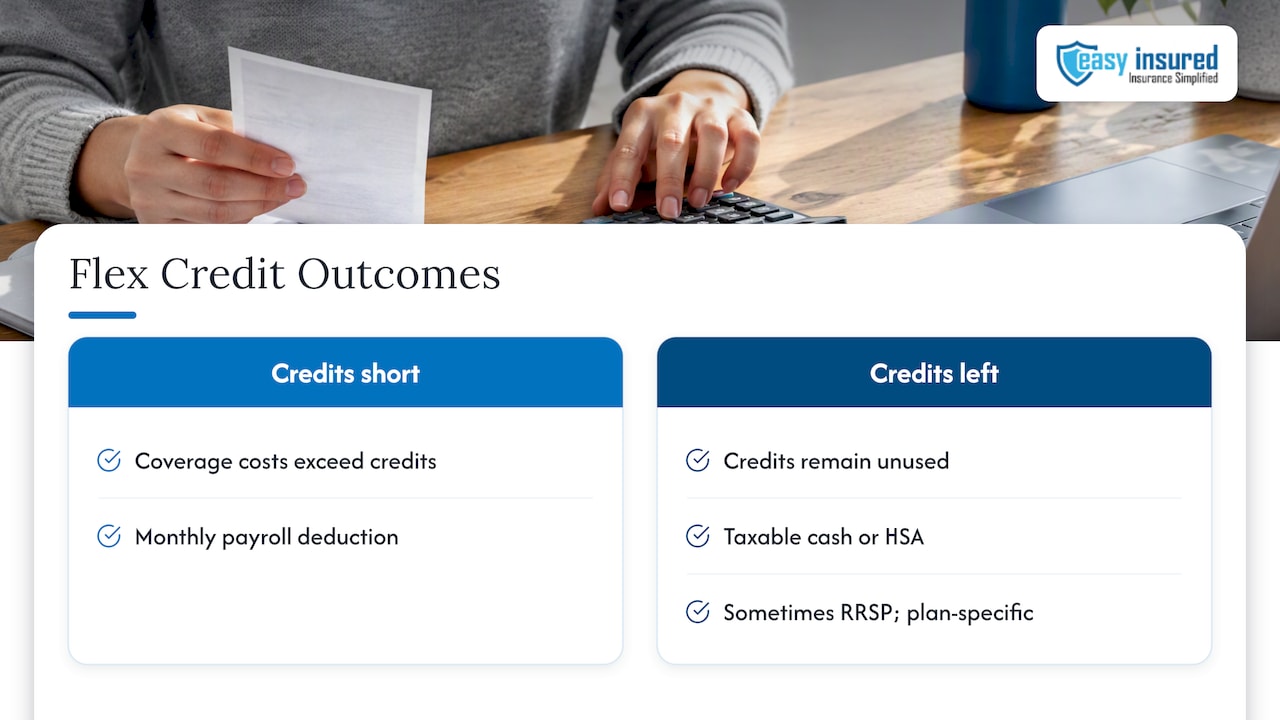
The same guide shows that how credits are used decides the tax treatment. Some benefits, such as life insurance and AD&D, are often paid through payroll deduction rather than credits, to avoid creating a taxable benefit out of the credits.
A private-sector example of the same logic: the SLB Canada flex guide says unused credits can sometimes be deposited into an RRSP, subject to CRA contribution limits. That option is plan-specific, so it is a design choice rather than a rule of flex plans in general.
A simple worked example
Suppose an employer gives each employee a flex allowance and a menu with three levels of dental and two levels of extended health. The numbers below are illustrative only, not client pricing.
| Employee | Choices | Outcome |
|---|---|---|
| Single, healthy | Basic extended health, basic dental, no optional life | Credits left over, taken as taxable cash or moved to a spending account |
| Parent of three | Enhanced extended health, dental with orthodontics | Credits used up, balance paid by payroll deduction |
| Near retirement | Enhanced extended health, optional life | Life premium paid by payroll deduction, credits cover the rest |
The point of the example: same employer budget per person, three different packages, and three different tax and payroll outcomes. Payroll has to handle all of them correctly, which is why setup matters. Our guide to payroll steps for taxable benefits walks through the common mistakes.
How flex plans are taxed in Canada
There is no single tax rule for “a flex plan”. The CRA’s position is that each benefit component is taxed under its own rules: depending on the benefit and how it is paid for, it may be taxable or non-taxable. The same bulletin says a flex plan must be designed to meet specific conditions, or adverse tax consequences can apply to all the benefits in it.
Three practical consequences:
- Health and dental can stay tax-free. The CRA says employer contributions to a private health services plan, such as a medical or dental plan, are not a taxable benefit when the plan meets all the conditions to qualify as one.
- Cash is taxable. Credits paid out in cash are income to the employee. That is why many plans route leftovers to a spending account or a retirement account instead.
- Life and AD&D need care. Employer-paid group term life is generally a taxable benefit, which is why plans often use payroll deductions for it. Our article on life insurance tax checks explains the details.
Because the CRA bulletin is old and some details have been updated over the years, confirm the current treatment of each benefit with your advisor and the CRA’s current payroll pages before launch.
Design rules employers need to get right
The CRA’s bulletin expects employees to choose their benefits, and the funding to be set, before the plan year begins and, generally, irrevocably. That is the foundation of the tax design. A plan where employees can switch freely mid-year looks different to the CRA.
Other design points to settle before enrolment:
- Qualifying events. Define what lets an employee change elections mid-year: marriage, birth, loss of a spouse’s coverage. Write it into the plan.
- Evidence of insurability. Changing life or disability choices often means a medical questionnaire. CUPE notes that changing flex choices often requires a medical review to show evidence of insurability, so employees should know this before they trade coverage down and try to trade it back up later.
- Expiry of spending accounts. One published Canadian flex guide states that HSAs expire after two years and Wellness accounts after one year. Your carrier or administrator sets the exact rule for your plan, so communicate it clearly.
- Default coverage. Decide what happens to employees who make no election. A sensible default package protects people who miss the window.
- Eligible-expense lists. Spending accounts need a clear list of what qualifies, so claims are not a guessing game.
- Cost to the employer. Premiums are only part of the picture. Our guide to what small Canadian employers actually pay separates premiums from payroll taxes.
Flex vs traditional group benefits
In a traditional plan, everyone in the group gets the same coverage at the same level. In a flex plan, coverage varies by person. Both are legitimate designs, and unions and employers have debated them for decades. CUPE, for instance, argues that traditional group plans cover all members for all benefits while flex plans shift choices and costs onto individuals, and that employees often pay for upgraded coverage through payroll deductions. That is a useful reminder: with flex you must explain the trade-offs clearly so employees choose well.
| Factor | Traditional plan | Flex plan |
|---|---|---|
| Coverage | Same for everyone | Chosen by each employee |
| Employer budget | Set by plan design | Set as credits or allowance |
| Administration | Simpler | More enrolment, payroll and communication work |
| Fit for diverse workforce | Weaker | Stronger |
| Fit for uniform groups | Strong | Often unnecessary |
| Tax design | Standard group rules | Must meet flex-specific conditions |
When each approach fits
Flex tends to suit:
- Teams with a wide age range or varied family situations
- Employers who want to control benefit costs with a fixed allowance
- Businesses competing for talent where choice is a selling point
A traditional plan tends to suit:
- Small teams with similar needs
- Employers who want minimal administration
- Groups where a negotiated, uniform package is the goal
Families reading this as employees can use the same logic. If your employer offers flex, build your package around your household’s real usage: prescriptions, dental work, vision, plus the life and disability cover your family would need if your income stopped. If you are self-employed, a flex-style approach is also how many owners shape their own coverage, which is where our guide to disability insurance for self-employed Canadians comes in.
Choosing well as an employee
A flex menu rewards a little preparation. Before enrolment closes:
- Add up last year’s real health, dental and vision spending for your household.
- Check whether your spouse has coverage, and whether the two plans can coordinate.
- Decide your life and disability levels based on what your family would need to replace if your income stopped. Remember that disability benefits rarely replace the full percentage on the label once taxes and plan terms are counted.
- Check which items are paid with credits and which by payroll deduction.
- Note the spending-account expiry dates and put a reminder in your calendar.
- Check whether your plan includes access to an employee assistance program, often included at no extra cost.
Our perspective
We see the same pattern with business owners: they want a benefits plan their people actually value, but they do not want an administrative burden or a surprise at tax time. Flex plans can deliver the first and create the second if they are set up carelessly.
Our view is that the plan design should come first and the product second. Decide the budget, the coverage floor everyone needs (usually life, disability and a base health and dental level), and the options on top. Then check each element against its tax treatment before a single employee enrols.
For families, we think the best flex choices protect income first. Dental and vision are predictable and can be budgeted. A long disability or a critical illness cannot, and that is where the right coverage matters most. Because we work as a brokerage across insurance and financial planning, we can look at the group plan and the household plan together, so an employee’s flex choices fit their personal coverage rather than duplicating it.
Frank
Where Easy Insured fits
If you are an employer designing or reviewing a group plan, we can help you structure coverage and explain the options to your team. See our group insurance plans and our broker guide for Canadian employee benefits to see how we work. If you are an employee or family looking to fill gaps your workplace plan leaves, we also arrange disability and critical illness coverage, along with financial and estate planning.
To talk through your own situation, start at Easy Insured.
FAQ
What is the difference between a flex plan and a traditional benefits plan?
A traditional plan gives every covered person the same benefits. A flex plan gives each employee a credit or allowance and a menu, so people choose their own coverage. Flex needs more enrolment and payroll work, and its tax design has to meet specific conditions.
Are flex benefits taxable in Canada?
It depends on the benefit. The CRA taxes each component of a flex plan under its own rules, so some are non-taxable and some are taxable. Credits paid out as cash are taxable, and life insurance is often paid by payroll deduction for that reason. Confirm the treatment with your advisor before launch.
Can employees change their flex choices during the year?
Generally not freely. Elections are normally made before the plan year and are usually irrevocable, though plans commonly allow changes after qualifying life events such as marriage or the birth of a child. Changing life or disability cover can also require evidence of insurability.
What happens to unused flex credits?
That depends on the plan. Public examples show leftover credits paid as taxable cash, moved into a Health Spending Account, or in some plans deposited into an RRSP within CRA limits. Spending accounts can also expire, so check your plan’s rules.
Is a flex plan right for a small business?
It can be, particularly if your team has varied needs. If your team is small and similar, a traditional plan may be simpler to run. A broker can compare both designs against your budget and headcount.
Sources
- CRA: Flexible Employee Benefit Programs (IT-529)
- SLB Canada 2026 Flex Guide
- CUPE: Flexible benefits
- CRA: Premiums and contributions to insurance plans