
An employee assistance program (EAP) in Canada is an employer-funded, confidential support service. It gives employees, and usually their immediate family, short-term counselling and referrals for personal, family, work and financial problems, at no cost to the user. Some employers call it an employee and family assistance program (EFAP). It is not a substitute for long-term treatment, but it is often the fastest first step. For employers, it is one of the more affordable pieces of a group benefits plan to understand and set up well.
This guide covers what an EAP includes, how sessions work, where confidentiality stops, who can use it, and what a business owner should check before adding one.
TL;DR
- An EAP is a free, voluntary and confidential service paid for by the employer, usually delivered by an outside provider.
- It typically covers short-term counselling, crisis support and referrals. Health Canada’s own program offers 1 to 8 hours of support per issue, though this varies by organization.
- Confidentiality has legal limits, such as a risk of serious harm or suspected child abuse.
- For ongoing care, an EAP works alongside extended health coverage, not instead of it.
- Employers should judge a program on competence, confidentiality, choice of professionals and continuity of care.
Table of Contents
- What an EAP is and where it came from
- What an EAP typically covers
- How many sessions you get
- Confidentiality and its limits
- Who can use an EAP and how to access it
- EAP, health spending accounts and insured health benefits: how they differ
- What employers should check before adding an EAP
- Where an EAP fits beside disability and critical illness cover
- Our perspective
- Put the pieces together with Easy Insured
- Is using an EAP a good idea?
- FAQ
- Sources
What an EAP is and where it came from
An EAP is a workplace program that helps people deal with problems that can affect their work, health or home life. CCOHS, Canada’s national occupational health and safety centre, explains that these programs grew out of industrial alcoholism programs in the 1940s. They have since widened to cover a much broader set of concerns. CCOHS also notes that they are sometimes called employee and family assistance programs, and that they are open to employees and immediate family members.
The program is usually paid for by the employer. Delivery is another matter: CCOHS says EAPs are often run by external organizations, though occasionally a department inside the company provides them. In practice, most small and mid-sized Canadian employers buy access to an outside provider, often as part of a group benefits package.
The federal government offers a useful public example. Health Canada’s EAP is free, voluntary and confidential for federal employees and their family members. It offers short-term mental health support for concerns that affect personal or professional well-being. Private-sector programs differ in detail, but the basic idea is the same.
What an EAP typically covers
The range of issues is wider than most people expect. According to CCOHS, EAP services can address:
- Personal and relationship difficulties
- Job stress
- Childcare and eldercare
- Substance use
- Work-family balance
- Financial or legal issues
- Family violence
Providers may also offer crisis counselling, and they refer people to other professionals or agencies when the issue needs more than a short program can deliver.
For federal organizations, a floor exists. The Treasury Board’s Directive on Employee Assistance Programs, effective April 1, 2020, requires access for all employees and their dependants. At a minimum, services must include assessment, short-term confidential counselling, referrals to resources, follow-up, and education activities. Private employers are not bound by this directive, but it is a reasonable checklist when you compare providers.
Who delivers the counselling
Qualifications matter. Health Canada reports that its EAP network includes nearly 1,000 mental health professionals. All of them hold at least a Master’s degree in psychology, counselling or social work, and have a minimum of five years’ experience. That is the federal program’s standard, not a promise from every provider. If you are an employer choosing a program, ask any provider for its own credential requirements in writing.
How many sessions you get
Session limits are the most common source of confusion. Health Canada says its EAP typically offers 1 to 8 hours of support per issue, though this may vary by organization. The limit extends to up to 12 hours for situations involving intimate partner violence.
Private plans set their own caps, and the cap is often described per issue rather than per year. When you read your plan documents, look for three things:
- How many sessions or hours are included for each issue
- Whether a new issue resets the count
- Whether family members draw from the same allowance or have their own
The Canadian Professional Networking Body (CPNB) published guidelines in 2018 noting that most individual counselling and therapy needs can be met in 8 to 12 sessions or less. The same CPNB guidelines recommend that employers consider flexibility to extend sessions, and consider health insurance coverage for continuity of care. In other words, a short cap is workable for many people, but a program with no path to further care leaves some people stranded.
Confidentiality and its limits
Confidentiality is the main reason people trust an EAP, and employees are right to ask how it works. In general, your employer does not see who used the service or what was discussed. Programs usually report only anonymous, aggregated usage to the employer.
The limits are set by law. The Treasury Board directive requires procedures for handling personal information. It also states that confidentiality cannot be promised in these situations:
- A court subpoena
- Suspected child abuse or neglect
- Risk of serious bodily harm or death
- Other legally required disclosures
A good counsellor explains these limits at the first session, before you share anything sensitive. If yours does not, ask.
Who can use an EAP and how to access it
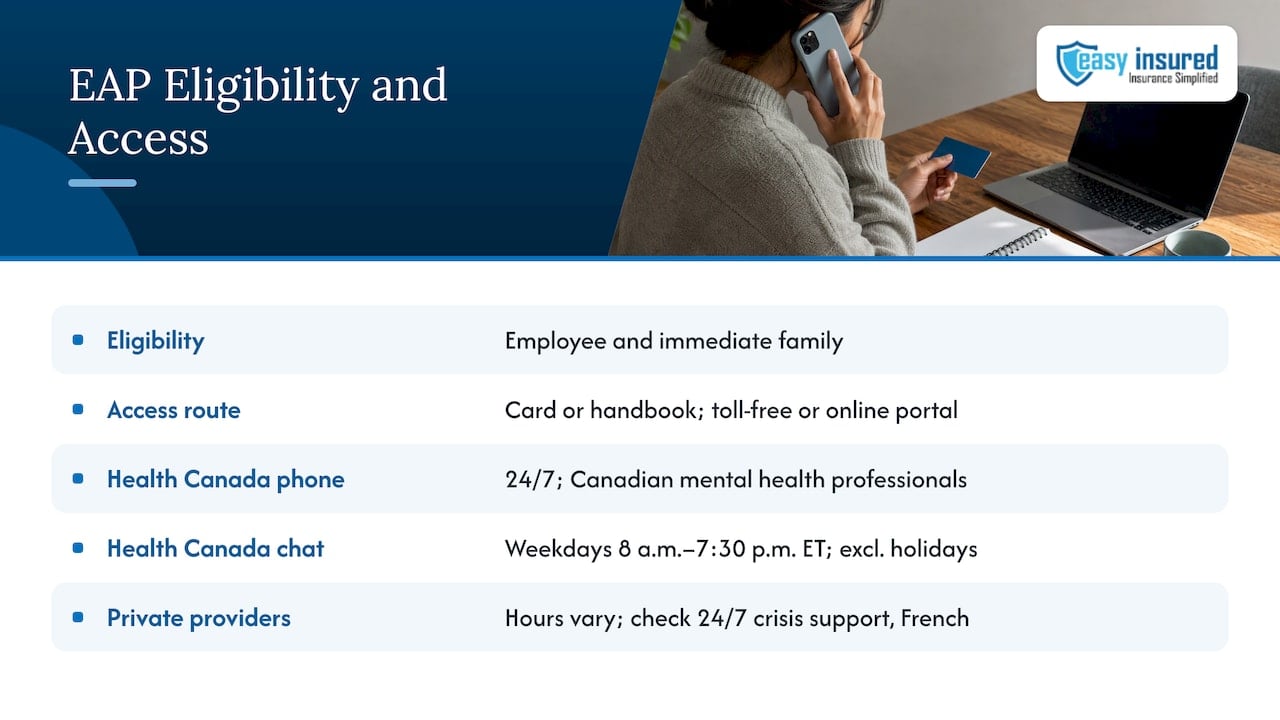
Eligibility is set by the employer’s plan. Under most plans, the employee and immediate family members can use it. CCOHS describes programs as open to both, and the federal directive covers dependants.
Access usually works through a toll-free number or an online portal, printed on your benefits card or in your employee handbook. Health Canada’s program serves employees and family members in over 90 federal organizations. Its phone service runs 24/7, with calls answered by mental health professionals in Canada, in English and French. Eligible users can also chat on weekdays from 8 a.m. to 7:30 p.m. Eastern, except statutory holidays. Private providers set their own hours, so check whether crisis support is available around the clock and whether service is offered in French.
If you are not sure your employer has a program, ask HR or your benefits administrator. If you work for a small business with a group plan, the program may be bundled into the plan without anyone mentioning it.
EAP, health spending accounts and insured health benefits: how they differ
These tools solve different problems, and mixing them up leads to gaps.
| Tool | What it does | Typical limit |
|---|---|---|
| EAP / EFAP | Short-term counselling, crisis support, referrals, work-life services | Capped sessions per issue |
| Extended health insurance | Reimburses covered services such as psychological care, per plan terms | Annual maximums and plan rules |
| Health spending account | Employer-funded account the employee uses for eligible medical expenses | Set by the employer’s dollar allocation |
| Wellness spending account | Flexible account for wellness expenses, taxable or not depending on setup | Set by the employer’s dollar allocation |
The CPNB guidelines describe the handoff. An EFAP provides counselling or screening and may refer people who need ongoing treatment. Health insurance plans may then cover further psychological services, which supports continuity of care. If your plan has an EAP but weak extended health coverage, employees who need more than a few sessions may face out-of-pocket costs. Extended health insurance coverage is what carries someone from the EAP’s first sessions into longer-term counselling.
If you are weighing spending accounts as a flexible complement, our guides on whether a health spending account is worth setting up and wellness spending accounts, including tax rules and setup walk through the mechanics.
What employers should check before adding an EAP
If you own a business, an EAP is easier to add than most benefits, and employees tend to value it. Still, the quality varies. Use these criteria.
Competence, confidentiality, choice and continuity
The CPNB guidelines say an EFAP is effective when it is founded on four things: competence, confidentiality, choice of professionals, and continuity of care. Turn those into questions for any provider:
- Competence: What degrees, licences and years of experience do counsellors need?
- Confidentiality: How is personal information handled, and what does the employer receive in reports?
- Choice: Can employees choose their counsellor, and pick in-person, phone or video?
- Continuity: What happens after the session cap, and does the plan’s health coverage pick up where the EAP stops?
Support, promotion and evaluation
CCOHS advises that an EAP is more likely to succeed when it is supported by top management, workers and unions. It also needs formal or informal referral procedures, plus regular promotion and evaluation. A program nobody knows about does not help anyone. Mention it at onboarding, in payroll communications and in managers’ training, and review usage numbers at least yearly.
Rules for federal organizations
If you are a federal organization, the Treasury Board directive adds duties. You must consult employee representatives on education and promotion, offer services in both official languages, protect personal information and monitor service quality. It also says leave to consult an EAP must be handled according to relevant collective agreements or the employee’s terms of employment. Provincially regulated and private employers should check their own employment standards and any collective agreement.
Cost and how it fits your benefits budget
EAP pricing is usually quoted per employee per month, or folded into a group insurance package. We do not publish a price for it, and quotes depend on your headcount and provider. What is worth planning for is how it sits beside the rest of your benefits spend. Our guide on what small Canadian employers actually pay for benefits covers the cost side. If you are deciding who should arrange the plan, read our business guide to using a broker for employee benefits. Also remember that some employer-paid benefits are taxable, so check the payroll treatment of anything you add. Our payroll steps for taxable benefits explain where the traps are.
Where an EAP fits beside disability and critical illness cover
An EAP helps someone cope early. It does not replace income if a person cannot work. Long-term disability pays a portion of income during a prolonged absence, and critical illness insurance pays a lump sum on a covered diagnosis. They answer different questions. If you are building out a plan, our guides on why disability benefits are not what you keep and exactly when disability and critical illness pay lay out the differences. Owners with no employer plan at all should look at disability insurance for self-employed Canadians, because they have no EAP to fall back on.
Our perspective
We talk to business owners every week who treat an EAP as a box to tick. They add it to the group plan, and nobody tells the staff. The result is a benefit that costs something and helps no one.
Our view is that an EAP works best as one layer in a plan that is designed on purpose. The first layer is early support: counselling, crisis lines, referrals. The second is extended health coverage, so an employee who needs more than a few sessions is not left alone. The third is income protection, such as disability cover, for the cases where someone cannot work. When those layers are chosen together by a broker who looks at your whole team, the plan costs less to explain and works better when someone needs it.
We also think owners should be included. Business owners are often the people with the least support, the most stress and no one to call. A well-built plan and a certified financial planner who understands your situation can turn that around.
Frank
Put the pieces together with Easy Insured
If you run a business in Canada and want employees to have real support, we can help you look at group benefits as a whole, including how counselling support, extended health and income protection fit together.

See our group insurance plans or our business insurance solutions. If you are an owner thinking about your own protection, our disability insurance and critical illness insurance pages explain the options. Ask what any group plan includes before you buy.
Is using an EAP a good idea?
For most people, yes, when the issue is something a short, confidential conversation could help with. CCOHS says an EAP can help people understand or overcome difficulties affecting work, and refer them to other professionals or agencies for more or extended care. That makes it a low-barrier first step: no referral, no claim form and usually no wait compared with many other routes.
It is a good fit for work stress, a difficult relationship, grief, caring for an ageing parent, money worries or a legal question. In an emergency, or when you are having thoughts of harming yourself, contact emergency services or a crisis line right away rather than waiting for an appointment. Use the program’s own 24/7 line if it has one.
If you need longer-term therapy, use the EAP to get started, then ask the counsellor about referrals. Check your extended health plan for psychological coverage, since the EAP’s cap may run out before the work is done.
FAQ
What is the difference between an EAP and an EFAP?
They are essentially the same kind of program. EFAP stands for employee and family assistance program, and the “family” part highlights that immediate family members can usually use the service too. Check your plan for exactly who counts as eligible.
Is an EAP free for employees?
Usually, yes. The employer funds the program, and the employee does not pay for covered sessions. Health Canada describes its own program as free, voluntary and confidential. Private plans set their own terms, so confirm session limits and who is covered.
Does my employer know if I use the EAP?
Generally not in a way that identifies you. Providers protect personal information, and legal exceptions apply, such as a court subpoena, suspected child abuse or neglect, or a risk of serious bodily harm or death. Ask your counsellor to explain the limits at the start.
How many EAP sessions can I have?
It depends on the plan. Health Canada’s program typically offers 1 to 8 hours of support per issue and up to 12 hours in cases of intimate partner violence. Private programs set their own caps, so check your benefits booklet or call the provider.
Can a small business offer an EAP?
Yes. Many small employers get access through a group benefits plan, and an outside provider delivers the service. A broker can compare options and explain what is bundled. Start with our group insurance plans page.
Sources
- CCOHS: Employee Assistance Programs (EAP)
- Health Canada: Employee Assistance Program
- Treasury Board of Canada Secretariat: Directive on Employee Assistance Programs
- Canadian Professional Networking Body: EFAP Guidelines, 2018