
Canadian RESP withdrawals fall into three categories: PSE payments (your own contributions, tax-free), EAPs (grants and investment growth, taxed to the student), and AIPs (leftover growth withdrawn if school doesn’t happen, taxed heavily to the subscriber). The first 13 weeks of enrollment cap EAPs at $8,000 for full-time students and $4,000 for part-time students. Most students pay little or no tax on their EAPs because their income is low.
TL;DR:
- EAP withdrawals are taxable to the student, but timing withdrawals during low-income years can minimize tax impact.
- The first 13 weeks of enrollment cap EAPs at $8,000 for full-time students and $4,000 for part-time students, with higher amounts possible if receipts justify additional costs.
- Excess contributions exceeding the lifetime limit attract a 1% monthly tax until withdrawn, requiring careful tracking across multiple family RESPs.
- Non-educational withdrawals trigger heavy taxes on accumulated income, with options to roll into RRSPs or transfer to other family members to reduce penalties.
- Provincial grants have their own rules, often requiring separate repayment if funds are used outside qualified education expenses.
Table of Contents
- What are the different types of RESP withdrawals?
- How are RESP withdrawals taxed and reported?
- What are the RESP withdrawal limits and timing rules?
- What documents do you need to request an RESP withdrawal?
- When do you have to repay CESG or CLB grants?
- What happens if the beneficiary doesn’t go to post-secondary school?
- Does an RESP withdrawal affect student financial aid?
- What happens if you withdraw RESP funds for non-education reasons?
- How do RESP rules interact with provincial education savings programs?
- A financial planner’s take on timing RESP withdrawals
- How Easy-insured helps you coordinate RESP withdrawals with your bigger financial picture
- Sources
What are the different types of RESP withdrawals?
Every RESP withdrawal falls into one of three buckets, and knowing which one applies changes everything about the tax bill.
Post-Secondary Education (PSE) payments come out of the money you contributed as the subscriber. These withdrawals are not taxable, since you already used after-tax dollars to fund them. There is no annual cap on PSE amounts, and no T4A is issued because the CRA doesn’t consider this income.
Educational Assistance Payments (EAPs) draw from the government grants (like the Canada Education Savings Grant) and the investment earnings the account has generated. These are paid directly to the beneficiary, the student, and they’re taxable in the student’s hands, reported on a T4A slip issued in their name.
Accumulated Income Payments (AIPs) come into play when a beneficiary doesn’t pursue post-secondary education at all. These pull from the earnings left in the plan after grants are returned to the government, and they carry a much heavier tax hit for the subscriber.
- PSE: your contributions, tax-free, no limit, no T4A
- EAP: grants plus growth, taxed to the student, capped in the first 13 weeks
- AIP: leftover growth, taxed to the subscriber, only allowed under specific conditions
Every RESP promoter (the bank, credit union, or scholarship plan dealer holding your account) uses slightly different terminology and paperwork for these three categories, so don’t assume one provider’s process matches another’s exactly.
How are RESP withdrawals taxed and reported?
PSE withdrawals never touch a tax return. You contributed with after-tax income, so pulling that money back out generates no T4A and no reportable income for anyone.
EAPs work differently. The promoter reports the full amount on a T4A under the beneficiary’s Social Insurance Number, and the student includes it as income on their own return. Because most students juggle school with limited part-time work, their overall taxable income often stays low enough that the EAP creates little or no actual tax owing, especially once tuition and education amounts get factored in.
There’s no flat EAP tax rate. It rides entirely on the student’s marginal bracket that year, which is why timing matters.
- Time larger EAP withdrawals for years when the student has low or no outside income
- Pair EAP income with tuition tax credits to offset the taxable amount
- Avoid dumping a huge EAP in a year the student also earns a full-time salary from a co-op placement
Statistic Callout: Basic CESG contributions match 20% of your annual RESP deposits, building toward a lifetime maximum of $7,200 per child. That grant money flows out as part of the EAP, not the PSE, which is exactly why EAPs carry the tax exposure that contributions don’t.
What are the RESP withdrawal limits and timing rules?
The biggest trap families fall into is the first-13-weeks rule. During the first 13 consecutive weeks of enrollment, EAP withdrawals cap at $8,000 for full-time students and $4,000 per 13-week period for part-time students. After that initial window closes, the promoter can release larger amounts without the same cap.
- $8,000 maximum EAP in the first 13 weeks of full-time study
- $4,000 maximum EAP per 13-week block for part-time study
- Promoters can approve higher first-13-week amounts if the student supplies receipts justifying the extra cost
A gap of 12 months or more between periods of enrollment resets the clock, meaning the $8,000 cap applies again as if the student were starting fresh. Payments can also continue for up to six months after a program ends, covering costs that trail the actual school term.
Beneficiaries aged 16 or 17 face an extra hurdle for CESG eligibility: the RESP must have either at least $2,000 in contributions made before the year they turn 16, or minimum annual contributions of $100 in at least four earlier years. Miss both conditions, and no further CESG gets added, though existing grant money already in the account stays put.
What documents do you need to request an RESP withdrawal?
Before you call your promoter, gather the paperwork that proves the money is going toward real education costs.
- Proof of enrolment. Most promoters want an official confirmation letter or form from the school showing program name, start date, and full-time or part-time status.
- Program details. Confirm the length of the program and the specific term dates, since these determine which 13-week window you’re in.
- Receipts, if requested. Some promoters ask for tuition or expense receipts, especially for withdrawal amounts above the standard caps.
- Beneficiary identification. The student’s SIN and basic ID are usually required since EAPs get reported under their name.
- Withdrawal request form. Paper or online, depending on the promoter, this specifies the amount, the type of payment (PSE or EAP), and where the money should land.
Pro Tip: Contact your RESP promoter a few weeks before the semester starts, not the day tuition is due. Processing times vary widely, and confirming the exact proof-of-enrollment format your provider needs avoids a payment delay right when the student needs cash for residence deposits or textbooks.
When do you have to repay CESG or CLB grants?
Government grants aren’t unconditional gifts sitting in the account forever. If the beneficiary never enrolls in a qualifying program, or the RESP gets terminated without an eligible transfer, the CESG and Canada Learning Bond must go back to the government rather than out to the family.
Excess contributions create a separate, more immediate problem. If total contributions for a beneficiary across all RESPs exceed the lifetime limit, the excess amount is taxed at 1% per month until it’s withdrawn. That tax is owed within 90 days of the calendar year end.
- Confirm your remaining CESG room with your promoter before adding a lump sum
- Withdraw any excess contribution as soon as it’s identified to stop the 1% monthly charge from compounding
- Coordinate contributions across every RESP the child has, since multiple family members opening separate plans is the most common way families accidentally overshoot the limit
- Contact CRA or your promoter directly if you’re unsure whether a past contribution pushed the account over
What happens if the beneficiary doesn’t go to post-secondary school?
You have more flexibility here than most families realize, and the least-taxed option usually isn’t the obvious one.
- Transfer to another RESP. Moving funds to a sibling’s plan avoids tax entirely, provided the receiving plan is registered with CRA before the transfer happens.
- RDSP rollover. If the beneficiary qualifies for the Disability Tax Credit, accumulated income can roll into their Registered Disability Savings Plan without immediate tax, subject to RDSP contribution room.
- AIP withdrawal. The subscriber can take the accumulated income directly, but it’s taxed at their marginal rate plus a 20% additional tax, unless rolled into an RRSP where room permits.
- Refund of contributions. Your original contributions come back tax-free, though any CESG or CLB attached must return to the government.
Does an RESP withdrawal affect student financial aid?
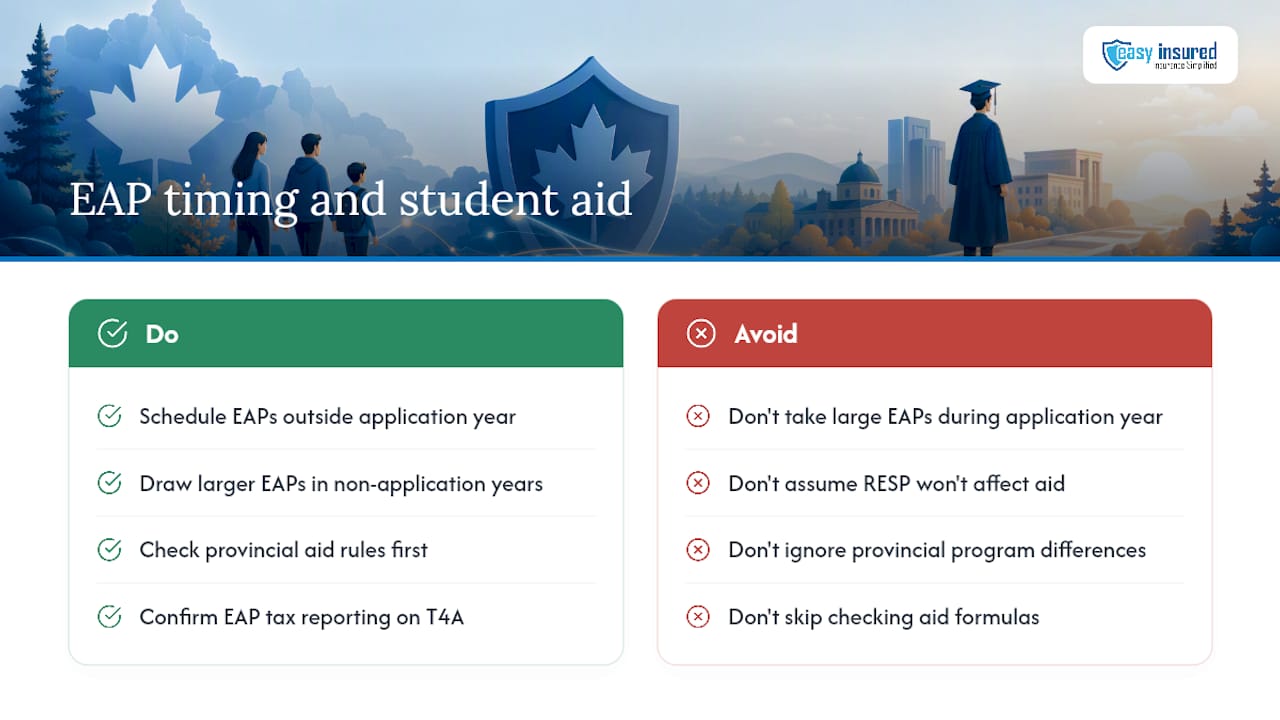
This is where a lot of families get caught off guard. Provincial and federal student aid programs assess need based partly on the student’s reported income, and since EAPs are taxable income reported on a T4A, a large EAP withdrawal in the wrong year can inflate the income figure used in a financial aid application.
The timing matters more than the total amount. A student who receives a large EAP the same year they apply for a student loan could see their assessed income jump, potentially reducing the grant or loan amount they qualify for. Because aid applications typically look at the prior tax year’s income, withdrawing EAPs strategically, perhaps drawing more heavily in a year when the student isn’t also applying for aid, can help avoid an unintended clawback effect on need-based assistance.
RESP assets held by the subscriber (usually a parent) generally get treated differently from the student’s own assets or income for aid purposes, since the RESP itself isn’t counted as the student’s resource until it’s paid out as an EAP. That distinction is worth understanding before assuming a healthy RESP balance will automatically show up against the student on a financial aid form. Every province runs its own aid formula, so a family in Ontario applying through OSAP faces different income thresholds than a family in British Columbia, and checking the specific provincial program’s treatment of RESP-derived income before a big withdrawal year is worth the ten minutes it takes.
What happens if you withdraw RESP funds for non-education reasons?
Pulling RESP money for something other than education, tuition paid outside a qualifying program, or general household expenses, triggers the AIP rules rather than the EAP or PSE rules, even if you didn’t intend it that way.
The consequences stack up quickly. Any grant money (CESG, CLB, or provincial equivalents) attached to that withdrawal must be repaid to the government immediately, regardless of whether you’ve already spent it. The remaining accumulated income becomes taxable to the subscriber at their marginal rate, plus an additional 20% tax on top, since the government designed that penalty specifically to discourage RESPs from functioning as a tax shelter unrelated to education.
There are remedies that soften the blow. If you have RRSP contribution room, up to $50,000 of accumulated income can be rolled into an RRSP instead of taken as a taxable AIP, deferring the tax entirely until retirement withdrawal. The RESP also needs to have existed for at least 10 years and every named beneficiary must be at least 21 and not currently pursuing eligible education, so this isn’t a same-year fix if you open a plan and change your mind quickly.
Before assuming a non-education withdrawal is your only option, check whether a sibling, cousin, or other eligible family member could become a beneficiary instead. A family RESP structure often makes a same-family transfer possible even after one child’s education plans fall through, which sidesteps the AIP tax hit completely.
How do RESP rules interact with provincial education savings programs?
Several provinces layer their own incentives on top of the federal RESP structure, and withdrawal rules for that provincial money don’t always mirror the federal EAP framework exactly.
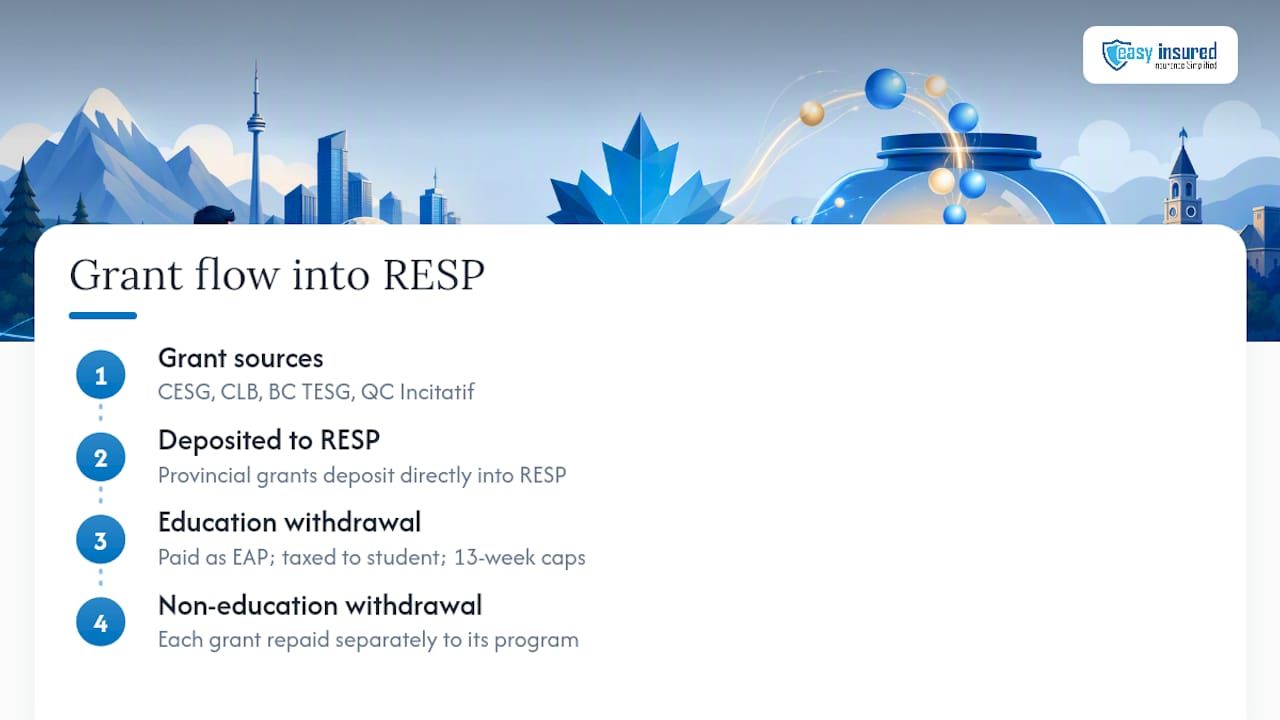
British Columbia’s Training and Education Savings Grant and Quebec’s Incitatif québécois à l’épargne-études both deposit money directly into an RESP, and both get withdrawn as part of the EAP, not separately. That means the tax treatment matches ordinary EAP rules, taxed to the student, subject to the same first-13-weeks caps that apply to federal CESG money.
Where it gets more complicated is repayment. If a beneficiary doesn’t use the funds for education, provincial grant money typically has to go back to that specific province’s program, separately from the federal CESG or CLB repayment. A promoter processing a non-education withdrawal needs to calculate and return each grant source individually rather than treating all the “grant” money as one pool.
Quebec residents should also know that the provincial grant has its own annual and lifetime maximums that run independently of the federal CESG limit, so a family maximizing federal grant room isn’t automatically maximizing the provincial one too. Confirming with your promoter exactly which provincial programs are attached to your specific RESP, since not every financial institution offers every provincial grant, avoids a surprise when it comes time to reconcile what needs to be repaid.
A financial planner’s take on timing RESP withdrawals
The mistake I see most often isn’t misunderstanding the tax rules. It’s treating RESP withdrawals as a one-time event instead of a multi-year plan. Prioritize EAPs in years the student has little other income, confirm your specific promoter’s proof-of-enrollment format before the term starts, and don’t wait until a grant-repayment notice to check your excess-contribution math. Where it gets genuinely complicated, family-plan transfers, an approaching AIP, or an RDSP rollover, that’s when a second set of eyes from a planner pays for itself.
— Frank
How Easy-insured helps you coordinate RESP withdrawals with your bigger financial picture
Timing an EAP against a student’s low income year is straightforward math. Deciding how that decision fits your mortgage payoff, your retirement contributions, and your estate plan is a different conversation entirely, and that’s where a coordinated financial plan earns its keep over a spreadsheet.

Easy-insured works with Canadian families on exactly that kind of coordination: sequencing RESP withdrawals alongside RRSP and TFSA contributions, flagging when an AIP or RDSP rollover changes your tax picture for the year, and folding education funding into a broader estate plan so grandparents’ contributions and beneficiary designations stay aligned. This isn’t a required step before you withdraw a dollar from your RESP. It’s an option for families who want the withdrawal decision checked against everything else going on financially. If that sounds useful, start with a conversation through Easy-insured’s financial planning services and get a plan that accounts for the RESP alongside your other accounts.
This article is general information, not a substitute for advice from a qualified financial advisor. Consult a qualified financial professional about your own circumstances before acting on anything here.